

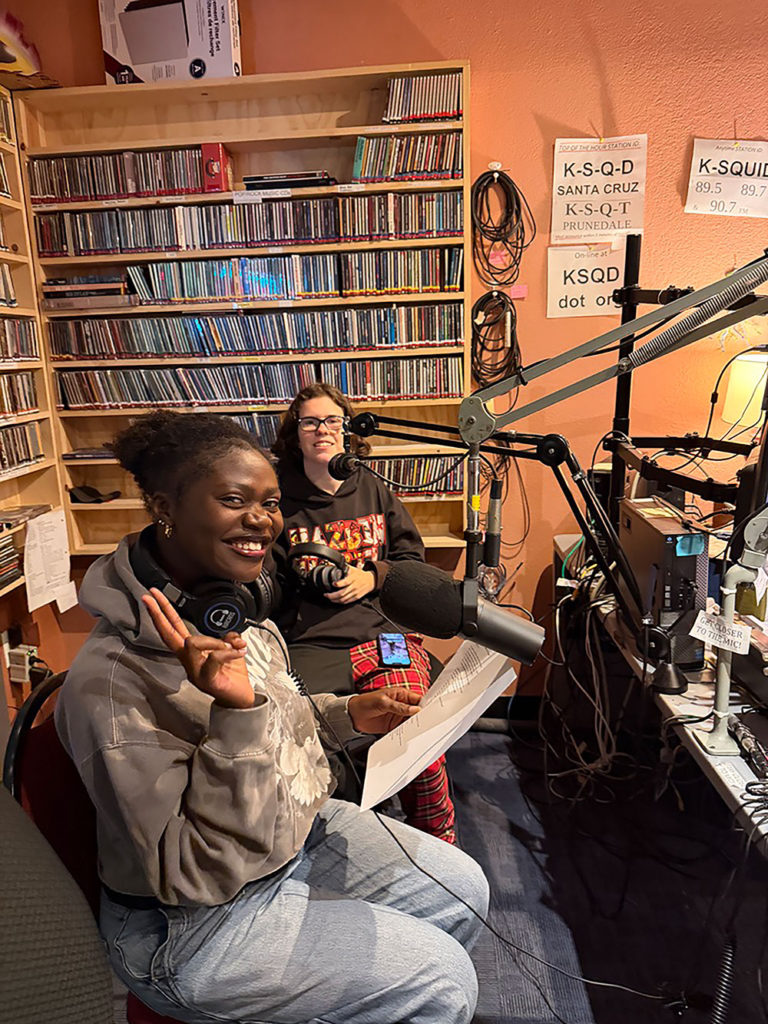
I have enjoyed a funny routine these past two months. Every Friday, I wrap up teaching at my job in Silicon Valley, where rows of gleaming Teslas line the parking lot. I head toward the mountains, watching the traffic thin and the trees multiply. Finally, I pull into San Lorenzo Valley High School just in time to catch the last hour of the school week.
There, a hand-painted sign advertises the student-run farm stand, and mud-splattered trucks abound. Students mill about a track nestled in redwoods. It’s a vibe shift worthy of a poem; and it just so happens, I go there to teach poetry.
This fall, I have been a fellow with Rising Voices, a countywide poetry program created by Santa Cruz County Poet Laureate Nancy Miller Gomez in collaboration with the Santa Cruz County Office of Education to bring creative writing workshops into classrooms that rarely receive them.
“I really wanted to work with the youth in the county,” Gomez says, “specifically targeting under-served youth who could really benefit from the healing value of poetry.”
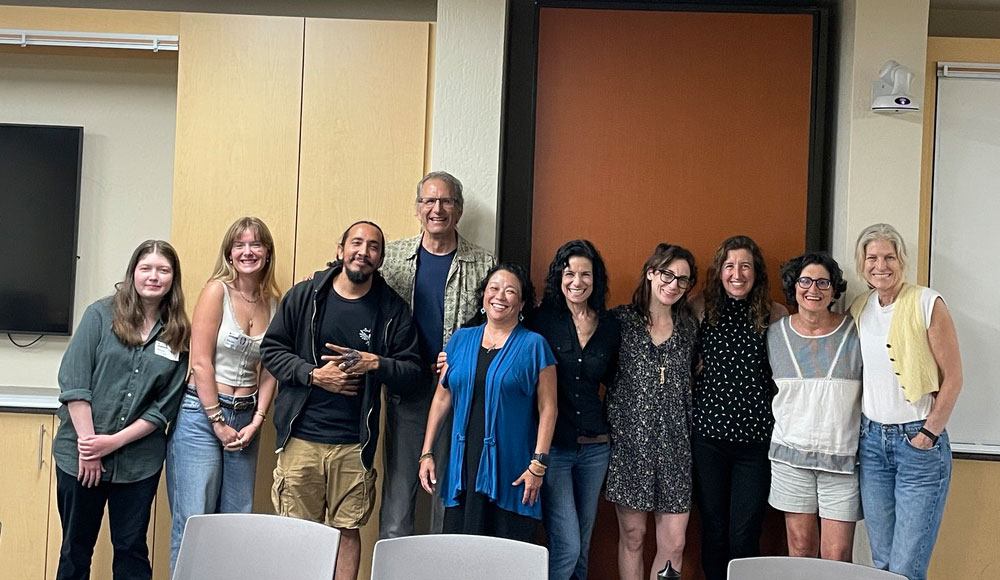
Over eight weeks, a team of teaching poets that Gomez recruited fanned out across school sites—from comprehensive high schools to alternative education programs and the juvenile hall—working with more than 300 students.
At SLVH, I spent Friday afternoons with veteran teacher and poet Jennifer Ruby’s freshman English class. Meanwhile, fellow writer Heather Duffy, who has worked extensively in county jails with the Santa Cruz Poetry Project, taught in the Alternative Education Program at Seabright High School.
Farnaz Fatemi, the former Santa Cruz County Poet Laureate, came aboard, teaching at Aptos High and Harbor High.
Local poets Bob Gomez (former Poet Laureate of Watsonville), Jen Siraganian (former Poet Laureate of Los Gatos), Joseph Jason Santiago LaCour and Lisa Ortiz have also spent their fall as Rising Voices fellows. The UCSC Humanities EXCEL Program also contributed, providing interns Naomi Garrett and Grace Menagh.
We scattered across the county with pocket-sized notebooks, sample poems and prompts designed to coax teenagers toward the page. Our methods and classes varied a great deal, but we shared the same goal: to give young people in Santa Cruz the tools and permission to consider themselves poets.
“At its core, education is about uplifting and amplifying student voice,” says Dr. Faris Sabbah, the superintendent of schools. “High-quality instruction in poetry offers students a powerful vehicle to name their experiences, speak their truth, and transform their lives and communities.”
In a time of political unrest and enormous uncertainty for arts education, Rising Voices has shown that collaboration and resilience can still create powerful opportunities. A broad coalition of sponsors has made the program possible, including the Academy of American Poets, the Mellon Foundation, the William James Association, the Santa Cruz County Office of Education, and the Santa Cruz Arts Council. Behind the scenes, these organizations pulled off incredible feats of coordination, orchestrating teachers’ and students’ schedules, work clearances, payments, releases, curricula, training and much more.
But in the classroom, we did not feel the stress of number-crunching or the logic of countless spreadsheets. All that work opened up precious hours in which we were free to experiment with words, to admire them, and to use them to express ourselves in new and surprising ways.
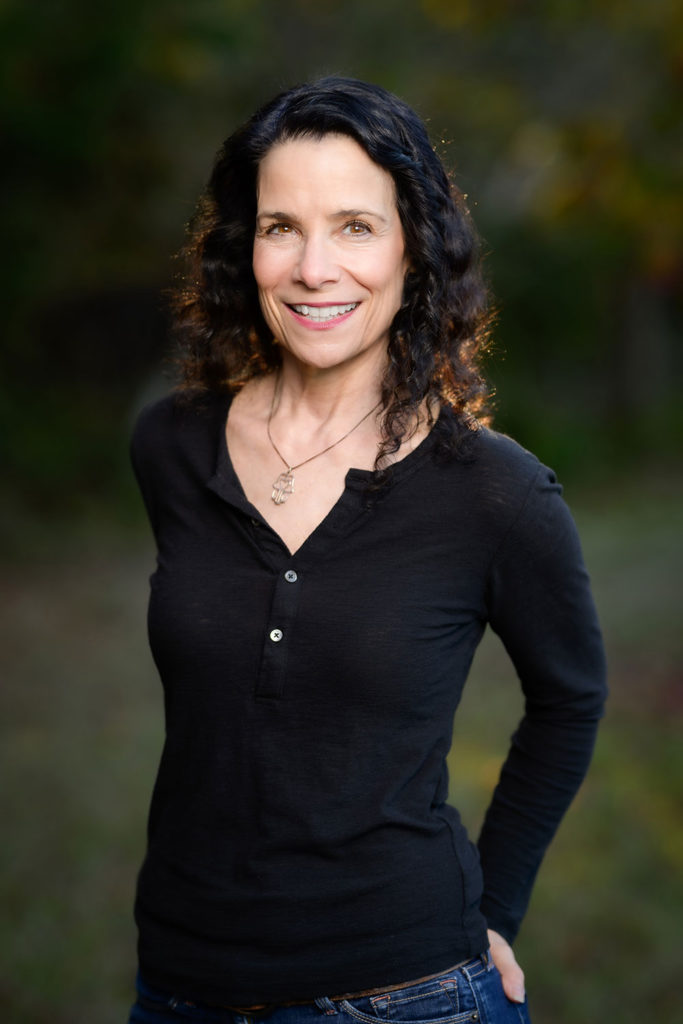
When Gomez learned she had been appointed as Santa Cruz County Poet Laureate early this year, she had about two weeks before the deadline to submit a proposal for the Academy of American Poets’ prestigious Laureate Fellowship. These $50,000 awards are granted to support poets serving in civic positions around the country in the creation of interactive and responsive poetry projects.
With all due respect to poets, it is a rare one who can both envision a large-scale community program like Rising Voices and compile the extensive paperwork to secure funding in a matter of days.
But anyone who knows Gomez knows she regularly moves (metaphorical) mountains for her community. Her belief that poetry is a healing, connective force—an art form capable of transforming people overlooked by traditional education systems—has shaped every facet of her literary career. For over a decade, she has taught poetry in jails, prisons, juvenile halls and recovery centers, co-founding the Santa Cruz Poetry Project with former Santa Cruz County Poetry Laureate Ellen Bass to bring writing workshops to incarcerated men and women in 2014.
She is also a celebrated poet in her own right. After a storied career in law and entertainment in Southern California, she earned an MFA in poetry from Pacific University and quickly became a force in Santa Cruz literary life and beyond. In 2024, she published her collection Inconsolable Objects, which went on to win the 2025 Paterson Poetry Prize. Her style is dark and whimsical, never shying from life’s tragedies, but finding mythic hints of beauty and humor therein.
“When [Gomez] shared her vision of offering Poetry Workshops to over 300 students in our county, I literally choked on my tea,” says Audrey Sirota, the arts coordinator at the County Office of Education. “I said I was not sure how this would be possible. Ye of little faith! I did not realize the tenacity and driving vision that our new Santa Cruz County Poet Laureate had.”
In fact, Gomez’s proposal for Rising Voices did not stop at the sprawling network of poetry workshops. The project also established the Youth Poetry Collective, where teen writers meet weekly at Santa Cruz High School to study craft, workshop and network with literary professionals. Finally, a Rising Voices Anthology is in the works, with publication and promotion set for this spring.
“Poetry magic happened!” Sirota says.
Knocking Poetry Off Its Pedestal
The hardest part about teaching poetry to teenagers might be the word poetry itself.
Walk into any classroom and ask how many students like it, and you get a few brave raised hands. Gomez has devised a clever routine for this situation—one that she walked us teaching fellows through in training before we started our individual workshops.
“So my next question is, ‘How many of you listen to rap?’” Gomez instructs. She has seen countless rooms of teens respond with enthusiasm.
“So then I say, well, then you do like poetry,” she explains. “Rap is the most popular form of poetry being written today.”
Students stare back skeptically, so she challenges them. She reads a line aloud, and asks them to guess whether it belongs to a rap song or a poetry anthology.
“It is deadly, terrifying.
It is the Inquisition, the revolution.
It is beauty itself.”
“Rap,” they say.
It’s William Carlos Williams.
“Hell is empty and all the devils are here.”
“Rap,” they insist.
It’s Shakespeare.
When she reads an actual rap lyric—De La Soul—the room grows noisier, confused and delighted.
In that moment, as Gomez often says, “we knock poetry off its pedestal.” The students’ ideas of the artform as arcane and dreadfully academic collapse.
“You already speak poetry,” Gomez tells them. “Now let’s write it.”
If You Can Write a List, You Can Write a Poem
Any poet knows that even if you want to write a poem, sometimes the words just won’t come to you. Gomez prepared a series of lesson plans and prompts designed to conjure the muse in the limited amount of time we had each week with our students. Teaching poets were encouraged to add their own spin on the activities.
At Seabright High School, for example, Duffy begins with a freewrite: two minutes, no sentences required. Just pour words onto the page. Then the class builds a collaborative poem from the chaos—drawing out every second or third word, throwing them onto a whiteboard, shaping meaning from the chaos. The point is not to produce a poem but to normalize experimentation.
“Get everyone’s voice in the room,” Heather says.
From there, she hands out tiny notebooks provided by Rising Voices—palm-sized books that fit in a pocket—and sends students outside for a brief observation exercise. Notice something. Write it down. Come back. The steps might seem simple, but it is in their very simplicity that poetry begins to percolate.
Inside, with guidance on the theme or the literary device for the day, students start to turn their notes into poems.
A similar process of mindful observation happens at the Hartman Alternative School inside juvenile hall, where Gomez herself has taken on the workshop sequence.
“I’ve had kids say, ‘I can’t write a poem,’” Gomez says. “And I’m like, just write a list of the things that are around you.”
Bars on the windows.
The fluorescent lights.
The water cooler dripping.
The linoleum floor.
“Now title it,” Gomez says.
Suddenly the poem becomes “Juvenile Hall”—an inventory of a distinct and complex space in some teenagers’ lives.
Other list poems we’ve generated have explored the interior world. One SLVH student, Fiona Spear, wrote a list poem thrumming with the defining emotion of modern teenage life:
Anxious that it will all fall apart.
Anxious it will never start.
Anxious they won’t like me.
Anxious I won’t like them.
Anxious to look back and see someone I hate.
Anxious to end up with a doomed fate.
Anxious about everything.
As one of Gomez’s students at the Hartman School reflected, “This has given me a really good coping mechanism. I hope to keep writing poetry so I can use it no matter where I go.”
For every weighty exploration of difficult emotion and experience, there is an example of teenage humor and grace. Right before Thanksgiving, in the spirit of gratitude, I tried out a lesson on odes in my workshop. We read Pablo Neruda’s wonderful “Ode to a Large Tuna in the Market” and discussed the mystery with which Neruda imbues a mundane market fish. One of Ms. Ruby’s students read the famous first stanza aloud.
The students proceeded to glamorize and glorify unexpected elements of the holiday season, from sweet potatoes to folding chairs, to the crackling leaves outside.
Across the county, at Pájaro Valley High School, former Watsonville Poet Laureate Bob Gomez was teaching poems that week rooted in place. One of his students, José Figueroa, wrote “Watsonville Poem”:
In Watsonville, mornings smell like berries and worn out dreams.
A paycheck is thin like fog.
Hope hangs on laundry lines.
Meanwhile, Ash Raznik, a member of the Rising Voices Youth Poetry Collective and a student at Cypress High, wrote “Bloody Fruit,” a compressed meditation on pomegranates:
Lovely, goddessly.
The coming of spring and fall.
Tears, casualties, earthquakes, Queens, revolution, strength, revenge.
Bitter coziness, perfection, butterflies, a snack, a journey, grief, heroes lacking blood, not water, goes well with tea, a trap, sleep, death release and that’s that.
Later, Ash reflected on all the metaphorical power of one small object. “I think in a lot of ways a pomegranate is a very simple thing,” they say. “To me it’s a lot more. … It’s one of the few fruits you know best because it’s messy. And I think I like that concept a lot.”
To unlock thoughts and words like these is a great joy for all involved. In these moments, we see ourselves in the world around us; even better, we see the world inside us.
Rising Voices began as Gomez’s project. It became our project as teaching poets. But it now belongs most fully to the teenagers who have filled its pages and classrooms with voices that refuse to be ignored.
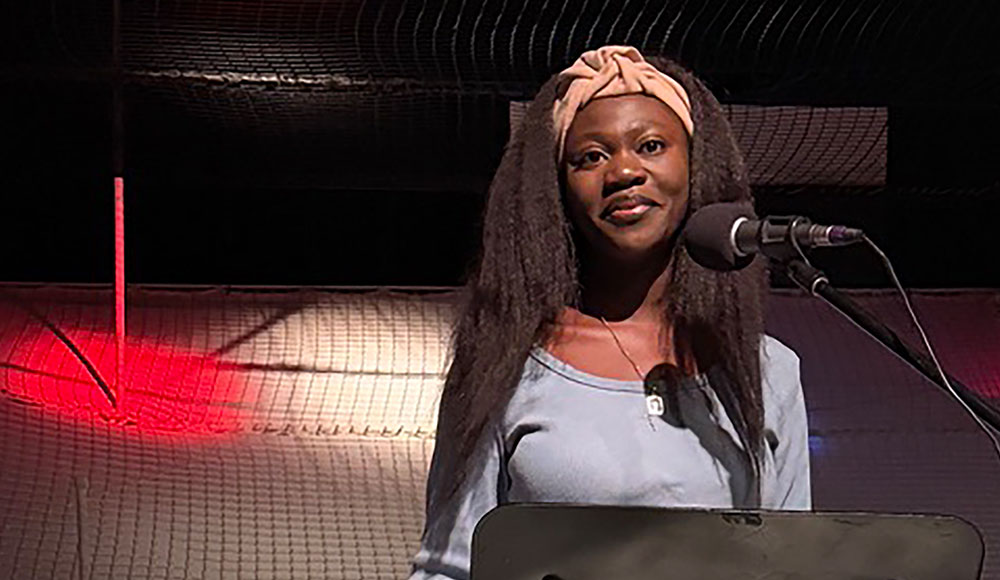
Earlier this month, Vicky Tinnell, one of the students in the Rising Voices Youth Poetry Collective, stepped up to the mic at the Inter/Act reading series celebration of the Youth Poet Laureates program, a sister initiative that shares Rising Voices’ belief in the power of youth expression. Most readers that night were YPL finalists and ambassadors, but during the open mic portion, Tinnell ventured forward to do her first open mic.
Originally from the Democratic Republic of Congo, Tinnell joined the Rising Voices Youth Poetry Collective at the suggestion of one of her teachers at Santa Cruz High. As part of a prompt for epistolary poems, she wrote “Dear Kids in America.” It reads,
Here I’m black, but not the right kind.African, but not the version you romanticize in movies.
I’m Congolese, but you don’t know where that is.
You ask if I’ve seen lions.
I’ve seen worse.
It’s a poem that changes the air pressure in the room, and it keeps building:
You want me to become something
But I already was something
Back when I was barefoot in the red dirt
Chasing goats and dreams with no English in my mouth
And no anxiety in my chest
Now I have Wi-Fi and panic attacks.
I have iced coffee and a heart that beats in two places.
Her reading was the kind of moment that feels sublime to adults looking on, but seems to go almost unnoticed by the teen who created it. Tinnell smiled shyly when she ended and went back to the familiar territory of her phone in a sparkly case, her bubbly chat about friends and purchases and her birthday. Teenagers get a bad rap for being angsty and self-centered, but what I’ve seen through Rising Voices is the opposite: they create electric snapshots of human experience without even noticing how brilliant they are.
Funders sometimes ask for quantifiable outcomes, but Rising Voices’ supporters understand something essential. “No one has asked for numbers,” Gomez says. “Because the proof is in the poems.”
I think of these lines Adyzinha Stepka, a student in my workshop, wrote, and I know Gomez is right about that:
The glow of the streetlights behind the last still green maples illuminated us,
captured our laughter in their faint viridescent light.
Rarely have I wanted anything more than I wanted that moment to last forever.
How do you quantify a poem? You don’t. You simply make space for it to happen again and again.
To that end, this spring, the Rising Voices Youth Poetry Collective—those teen writers who meet weekly to study craft and debate their favorite lines—will assemble the inaugural Rising Voices Anthology. They’ll select, edit and order poems from the program. They will design the cover, and prepare for a launch event at Kuumbwa Jazz Center during the Ripple Effect arts festival. Soon, the anthology will circulate through bookstores and libraries, slip into backpacks, and live on family bookshelves.
Seeing one’s own poem in print is not a small moment. It rearranges a young person’s sense of self. It tells them that their interior world is not only valid but valuable—that we care about them, that we honor this brief time of life when a human is lightning in a bottle.










Outstanding and inspiring story.
Thank you.
Alan Fox
Founder of Rattle poetry magazine.
I work in the county jail and have seen poetry transform Incarcerated Persons. Nancy and her team have done a fabulous job of getting the word out to unconventional populations that poetry is not scary but can heal.
This is an amazing program. As a teacher in NC. I developed a similar program for At-Risk kids called ‘Basketball Poets’ winning an Innovation Grant and involving the NC Poet Laureate Kay Byer and nationally known author Sharon Creech. This program ran for over 10 years until I retired in 2015. I still use poetry with teens as a substitute teacher and find the same power in kids voices expressed as poetry. The ‘proof is in the poems’ for sure. I will be visiting Santa Cruz next Spring and would love to meet Rising Voices students and teachers. I could volunteer as well. Please share contact info. Thanks. Soooo glad poetry is alive and well in the lives of teens in Santa Cruz.
Terrific coverage of an exciting and dynamic program, Ms. Mahmassani. A rewarding read.