
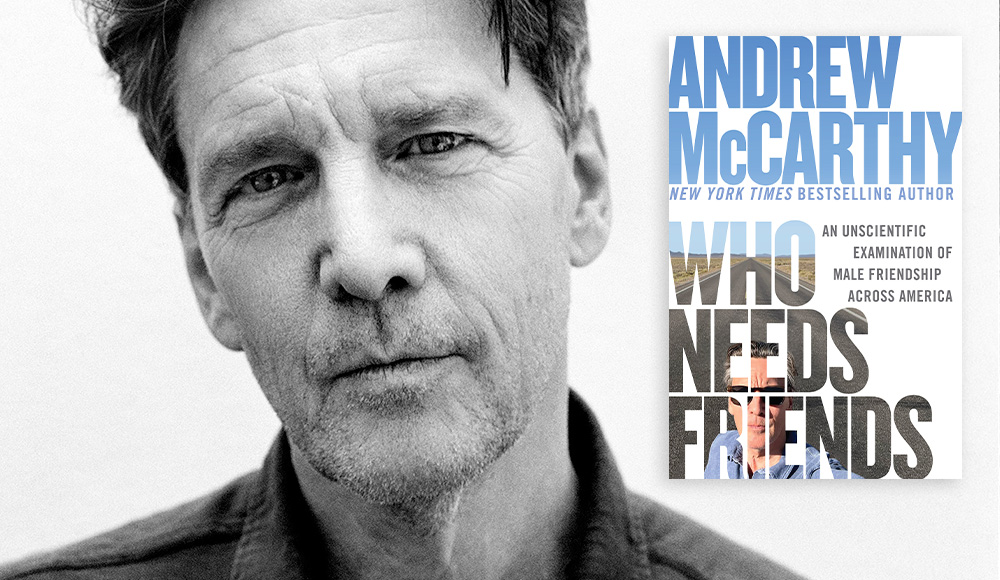
It turns out Andrew McCarthy, the actor whose earnest, likable presence helped define an era of 1980s popular movies, from St. Elmo’s Fire to Pretty in Pink to Less Than Zero, doesn’t just play a writer on the screen, he really is a writer—a good writer with a lot to say.
McCarthy will be at the Rio Theater on Saturday, March 28, talking about his latest book, which I can’t recommend enough, if you’re someone who has wondered why men aren’t able to make a priority of friendship the way women do, especially as they move from the active merry-go-round of the twenties (captured in St. Elmo’s Fire) to the inevitably more isolating forties and fifties and sixties.
“On the rare occasion I did form a new connection, the motivation to nurture it was often lacking,” McCarthy writes in Who Needs Friends: An Unscientific Examination of Male Friendship Across America.
“Whether a reaction to the hollowness of some insincere friendships made during my early fame, or a fearful nature, or just becoming set in my habits, I found myself uninterested, even unwilling, to reach out to new friends. No matter—I was happy in my own company and with that of my wife and children. And there was always work. Life felt full—at least full enough.”
Then one day at home in New York, McCarthy’s 21-year-old son Sam asked him: “You don’t really have any friends, do you, Dad?”
McCarthy started thinking about it and took a kind of inventory on his friends, and had to face the fact that friendships that once felt vital and nuanced now felt stale and at times rote. He and his friends didn’t see each other that much. When they had time to talk, it was usually just enough time to catch up, not to explore anything in a meaningful way.
His son’s question set McCarthy off on an internal journey and an epic road trip, like Sal Paradise and Dean Moriarty racing around the country in Jack Kerouac’s On the Road, seeking out friends to reconnect or recharge or just explore friendship in all its facets.
This is a fun, full-speed-ahead travelogue. “Something on my dashboard pings, breaking my road-induced trance,” McCarthy writes in an early chapter on visiting Ohio. “I’ve gone too far west. But the ping is telling me I need to fill my gas tank. On the outskirts of Brookville, Ohio, I turn into what can only be viewed as further deterioration of American culture and ingenuity—the combination gas station/convenience store/fast-food restaurant, which has become inescapable across the country. These over-lit, soulless pods of supposed plenty have cancerized the environs of small and midsize towns, where other, more locally nurturing options might prosper. That this is low-hanging fruit for complaint does not make it any less true. I find such places depressing in their ‘convenience’—peddling alienation.”
McCarthy is that rare sort of writer who brings you along with him on the ride, which fits, since it was actually in travel writing that he found his voice. He talks about a fall 1995 day in Vietnam like it was yesterday. He was walking down the street in Saigon when a friendly kid on a scooter pulled up next to him and struck up a conversation.
“Hop on!” the kid said. “I give you ride.”
“Leave me alone,” McCarthy told the 16-year-old kid.
That wasn’t happening. McCarthy climbed aboard that scooter and spent the day with the boy. Before that, he’d been an actor who loved to travel and wanted to write about it, and after that, he found his voice as a travel writer.
“That day changed my life, yeah, absolutely,” he said. “He wouldn’t leave me alone.
He showed me where his mother painted the public garden, where his father got arrested, and the temple where he was dragged to. That was the first thing I ever wrote. I was so excited in my hotel room, I just grabbed a piece of paper and wrote down what happened. … I felt like myself from the toes up. I wrote that and just thought: My god, there I am.”
McCarthy’s friends’ project could end up taking him forward to uncharted territory. It’s one thing to tell stories from your days as a young film and stage actor, and quite another to veer off in an unexpected new direction like this, basically offering a kind of intervention to increasingly friendless guys in their forties and fifties and sixties who could use a nudge. As the usually stodgy Kirkus Reviews gushed in a positive review, “Thoughtful and well written—and a good prompt to call an old friend.”
McCarthy’s 10,000-mile trip was not just about talking to old friends; he also looked for opportunities to talk about men and friendship at any chance he had. “People are reluctant to discuss friendship because it has no immediacy, no monetary value,” McCarthy writes, but give them an opening, and they often surprise you.
“The rewards of my cross-country efforts far outweighed the discomforts of the road or any emotional risk I at times felt,” he writes in the book’s final pages. “These reunions have helped me to reclaim access to an expansive, secure, playful, and generous part of myself I thought had been worn down by life, or at the very least, a part I felt I could no longer readily access. How grateful I am to have been proven wrong.”
See Andrew McCarthy 7pm Saturday at the Rio Theatre, 1205 Soquel Avenue, Santa Cruz, tickets at tickettailor.com. 1 ticket + 1 book ($33.97) or Double package with 2 tickets + 1 book ($39.98). Photo with the actor included.