

Recently, I got a call from an editor friend with a wellness-related question: “Have you ever heard of tapping?”
As a wellness zealot in Santa Cruz, I assured him I had. Of course, I had. The practice of tapping, formally known as Emotional Freedom Technique, or EFT, has been around for decades, living on the fringe between acupuncture and mindfulness, occasionally making its way into the mainstream before retreating again. Like many alternative practices, it’s been easy to dismiss as either a little too out there, or too simple to take seriously.
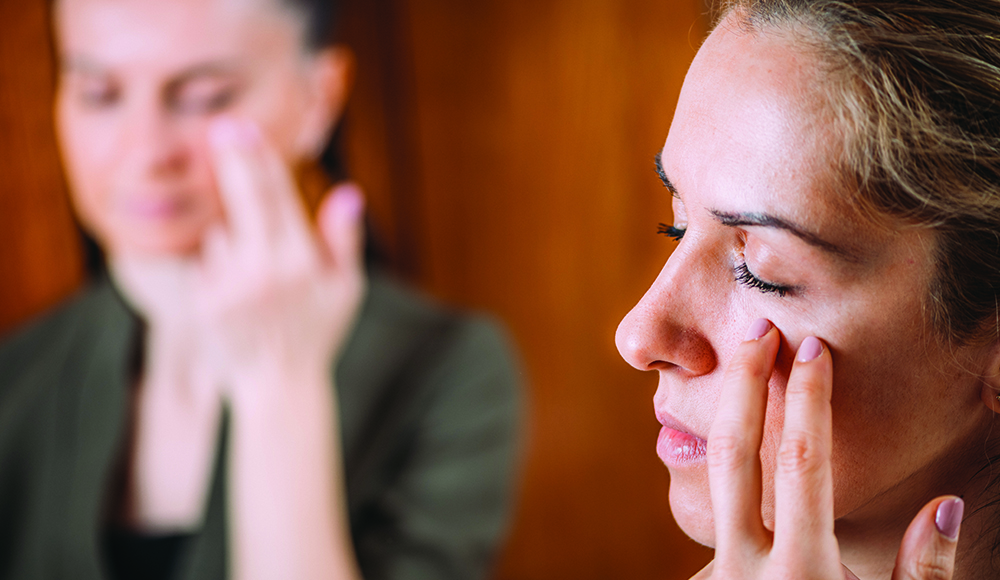
Tapping, for the uninitiated, involves gently tapping on specific points on the face and body, many of them the same meridians used in acupuncture, while focusing on an emotional issue, stressor, or physical sensation.
Practitioners often pair the tapping with spoken phrases that acknowledge discomfort while reinforcing self-acceptance. For example, “even though I didn’t follow through on my commitment, I love and accept myself.” That’s it! The guilt, the self-judgment, and the disappointment now have an alternate route to release.
It looks simple. Almost suspiciously so. No equipment, no prescriptions, no expensive retreats required. Which, historically, is exactly why many of us have side-eyed it.
And yet.
The wellness world has changed. Or maybe it’s finally caught up. Practices once labeled “alternative” are now being studied, regulated, and somewhat awkwardly embraced by institutions that once rolled their eyes. Meditation is prescribed by doctors. Breathwork shows up in corporate retreats. Psychedelic therapy is inching its way into legitimacy. Against that backdrop, tapping suddenly doesn’t seem so fringe after all.
What makes EFT particularly interesting is that it lives at the intersection of psychology and the body. Unlike traditional talk therapy, tapping doesn’t require a deep dive into the narrative of your past. You don’t have to relive every detail or make sense of every feeling. Instead, you tune into a sensation: anxiety in the chest, tightness in the jaw, a looping thought, and work with it directly, through the body.
There’s growing research suggesting that EFT can reduce cortisol levels, calm the nervous system, and help regulate stress responses. Some studies have shown promising results for anxiety, PTSD, phobias, and chronic pain. Skeptics rightly point out that more large-scale research is needed. But even the skeptics tend to agree on one thing: tapping appears to be safe, low-cost, and accessible.
And in a moment when stress is no longer episodic but chronic, woven into daily life through news alerts, economic pressure, climate anxiety, and digital overload, those qualities matter.
What struck me most as I revisited tapping wasn’t whether it “works” in a clinical, double-blind, gold-standard way. It was how well it reflects a broader shift in how we’re learning to relate to ourselves. Tapping asks us to slow down, notice what’s happening internally, and engage with discomfort rather than powering through it. It’s less about fixing and more about befriending what’s there.
That alone is radical.
In Santa Cruz, where yoga studios outnumber banks and conversations about the nervous system are as common as surf reports, tapping feels oddly at home. It aligns with a culture that values self-inquiry but doesn’t always want to intellectualize everything. Sometimes we don’t need another insight; we need regulation. We need to feel safe enough in our bodies to let something shift.
I’ve spoken with therapists, coaches, and longtime meditators who use tapping not as a replacement for other modalities, but as a complement. A way to unstick moments when the mind understands but the body hasn’t caught up yet. A bridge between awareness and embodiment.
Of course, tapping isn’t a magic wand. It won’t erase trauma, cure disease, or spare us from the messiness of being human. And it’s not for everyone. Some people feel awkward doing it. Others find it surprisingly emotional. Like any practice, it works best when guided thoughtfully and used with discernment.
But maybe that’s the point.
Wellness, at its best, isn’t about chasing the next big thing or collecting techniques like merit badges. It’s about finding tools that help us meet ourselves more honestly, especially when things feel overwhelming. Tapping doesn’t promise enlightenment. It offers something quieter: a way to pause, check in, and remind the nervous system that, in this moment, we’re okay.
So when my editor friend asked if I’d heard of tapping, what he was really asking was something else entirely: Is this worth paying attention to now?
I think it is. Not because it’s new, but it brings us back to the present moment, where we are.