

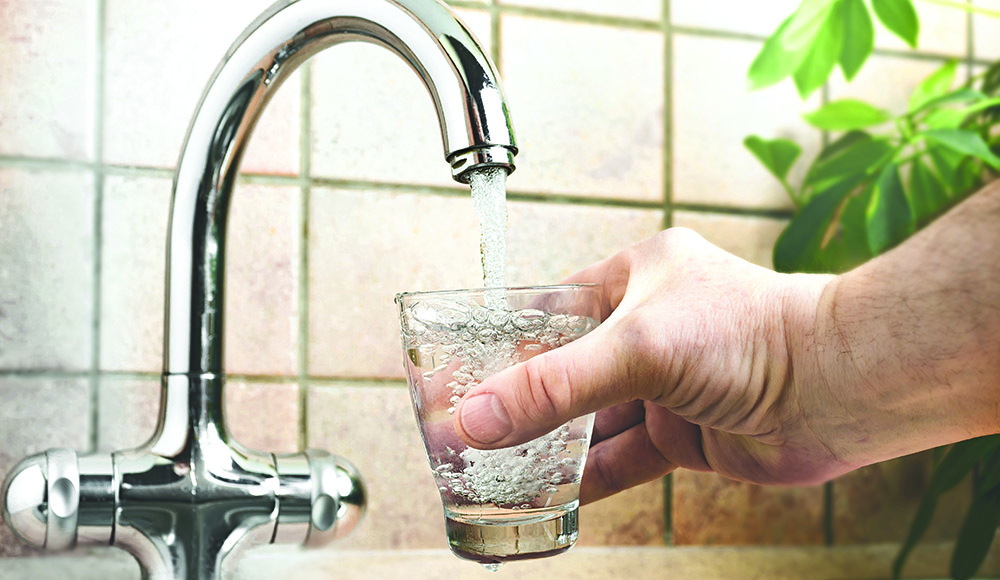
In late February and early March,thousands of Santa Cruz South County residents received letters warning that tests had detected chromium-6 above California’s new drinking-water standard in more than twenty groundwater sources. One South County woman said, “That’s the same poison that was in the water in the Erin Brockovich movie. Do I lose my breasts or lose my uterus?”
Chromium-6 has a hell of a reputation, thanks to Brockovich taking on PG&E in Hinkley, CA, and subsequently the Julia Roberts movie. But the situation in Santa Cruz County is different. Local scientists say the chromium-6 detected here appears to come from the natural geology beneath the Central Coast, not from industrial pollution. While the numbers that triggered the letters exceed California’s new regulatory limit for chromium (10 parts per billion,) they are still far below the concentrations that helped Julia Roberts win an Oscar. In the famous Erin Brockovich-PG&E case, chromium-6 concentrations in groundwater near the industrial source reached tens of thousands of parts per billion. The readings that triggered notices in parts of Santa Cruz County are from natural sources, generally between about 10 and 40 parts per billion,thousands of times lower. Before we start picturing tanker trucks hauling bottled water up and down Highway 1, here’s what scientists and water officials say about the situation: the discovery deserves attention, chromium-6 is not a great long-term diet, but we are not in crisis.
What chromium-6 is
Sierra Ryan, Water Resources Program Manager for Environmental Health, Santa Cruz County, says, “Chromium-6 is a metal found naturally occurring in parts of Santa Cruz County. It is found in the geologic features South and East of Valencia Creek. In some locations it exceeds the recently changed California Drinking Water Standards.” Under the right conditions, trace amounts can convert into the hexavalent form and dissolve into water. Ryan says, “It is naturally occurring, we have no history of industry that would cause contamination.”
This process has been documented in aquifers throughout California. Blair Robertson, a public information officer with the State Water Resources Control Board, said the phenomenon is well known to hydrologists. “In much of California, including parts of the Central Coast, chromium-6 in groundwater is largely associated with natural geology, specifically chromium-bearing rocks that can release it into water under certain conditions,” Robertson said.
Why the notices went out now?
The reason residents are hearing about chromium-6 now has less to do with new contamination and more to do with new rules. California recently adopted a maximum contaminant level of 10 parts per billion for chromium-6 in drinking water, one of the strictest standards anywhere in the world. Water systems must now notify customers if levels exceed that threshold. The new standard reflects California’s precautionary approach to public health. Long-term exposure at high concentrations has been linked to cancer risk, so, regulators set limits designed to protect people over a lifetime of drinking water.
When do chromium levels become dangerous?
How high does the level of chromium-6 in water have to get before is causes cancer? The honest answer is: No amount is thought to be completely ideal, but very low amounts mean very low risk.There is no cliff where chromium-6 suddenly becomes dangerous; the risk rises gradually, and regulators argue over how much risk is acceptable.
0.02 parts per billion (ppb)was set by the Office of Environmental Health Hazard Assessment (OEHHA) as the level associated with about aone-in-a-million lifetime cancer risk for someone drinking that water every day over a lifetime (EPA.) California’s current legal drinking-water limit is 10ppb for chromium 6. It reflects what the state determined was feasible to require of water systems while still protecting public health (California Water Board).
Should people worry?
Robertson explained that California’s standard includes a large margin of safety. “Exceedances don’t mean the water is immediately unsafe to drink,” he said. “They trigger regulatory requirements, but they do trigger regulatory requirements to bring the levels down.” The current federal standard for total chromium in drinking water is 100 parts per billion. Canada regulates chromium-6 at 50 parts per billion. The highest naturally occurring readings seen locally, according to county water experts, are less than half of the federal standard and below the Canadian limit.
Santa Cruz has spent years debating water supply solutions, including the desalination plant voters rejected in 2014. Some residents have wondered whether that decision played a role in the chromium-6 notices. I asked Sierra Ryan if the Desalination Plant had been built, would we be having this conversation? She said that we would.
“The desalination plant would have served the City of Santa Cruz and some of Soquel Creek service areas. Chromium-6 is found in Watsonville, which wasn’t part of the planned service area. Soquel Creek would likely still use some of their wells in the south part of their service area, and numerous small water systems would also still be facing this issue.” The geology beneath Santa Cruz County would still be there regardless of how coastal cities produce water.
Soquel Water District Program Manager Melanie Mow Schumacher says, “Since this new state regulation has been set, there are several water supplies in our county that need to address it. Soquel Creek Water District currently has a treatment project out to bid and we aim to begin construction later this year.”
If there is a takeaway from this story, it may be this: drinking water systems are constantly evolving as science improves. Water managers test for contaminants more precisely than ever before. Standards change. Regulations tighten. New treatment technologies emerge. Chromium-6 is a known carcinogen, but the difference today is that it is being detected because monitoring has improved and standards have become more protective. If you’re concerned about your water, that’s a good thing to be concerned about. Reach out to your water department. I found them very responsive.









Please consider bottled water is not legally required to test for Chromium-6. Quality testing is up to each bottled water company. Buying water in plastic, often non-recyclable bottles may not reduce risk of drinking Chromium-6 and other potentially toxic chemicals. Some home water filters, esp. reverse osmosis (RO) and specific filter types can remove Chromium-6. Thank you