After five years as a volunteer EMT-Firefighter in the fire service, Ryan Masters hung up his pager on Dec. 31. He revisits his time in the Zayante Fire Protection District and reflects on the challenges that face modern-day volunteer firefighters.
First, the fire pager convulses like an epileptic seizure. It spews static and a shrill sequence of piercing tones. Adrenaline floods your bloodstream. Your heart rate spikes. By the time the dispatcher’s voice drones the location of the incident and the nature of the emergency, you’ve stood up from your desk or leapt from your bed or dropped whatever else you were doing, jumped into your turnouts, and run for 2490, the quick-response fire rig in your driveway.
It’s any time in the day or night, but usually late at night. You key the handset, attach 2490 to the call, flip on the code-three lights, and roll.
Unlike professional firefighters, volunteers are on the clock 24/7. There are no set hours. You’re never off. You don’t really get paid, so it’s not a job or hobby. It’s a lifestyle, a passion, a never-ending adventure—and, if you allow it, volunteer firefighting can become an all-consuming obsession.
“Volunteering?” you say. “How hard can it be? Can’t anyone do that?” Well, anyone can try, but it’s not a simple thing to complete the training and serve for any length of time. Yet volunteers form the backbone of the U.S. fire service.
Most Americans are shocked to learn that nearly 70 percent of all U.S. firefighters are volunteers. That’s the way Ben Franklin designed it back in 1736. While John F. Kennedy urged Americans to give back, Franklin expected it. In his mind, community service was the underlying engine of the great American experiment.
But here’s the rub: 2026 is a far different time than 1961 was, let alone 1736. Fewer people are willing or able to be volunteer firefighters—especially here in Santa Cruz County, where the median income is six figures. Most young people, those best suited for the unique rigors of firefighting, must live with their parents and hustle multiple jobs to get by or else leave the area for cheaper housing.
In this day and age, a fire chief’s biggest headache is maintaining a consistent, capable roster of volunteers. More often than not, the bulk of the work falls on just a handful of shoulders. And, when I signed up in 2021, the Zayante Fire Protection District was no exception.
I FIGURED I’D CLEAR BRUSH
When I joined Zayante at the ripe age of 48, I didn’t expect to fight fire or perform emergency medicine. I was a middle-aged man with zero experience in such matters. I couldn’t even tie a proper knot. Like many people, I figured a “volunteer” cleared brush on the weekends, washed the fire engines, maybe helped out at the annual pancake breakfast.
When I started observing Tuesday night drills as a prospective recruit in the fall of 2020, I didn’t grasp the extent of the firefighter shortage in Zayante. The department was undergoing a leadership change and operating with a skeleton crew. They needed warm bodies. Fast. Before I knew it, I was enrolled in a five-month paramilitary academy (An experience detailed in “Anxiety, Courage and Adrenaline Inside Firefighter Academy”, Good Times, Jan. 18, 2022).
After I graduated from the fire academy in June of 2021, there was no ramp-up period. One day, I was a cadet. The next day I was a firefighter. “You may not feel like a firefighter at first,” Chief Dan Bonfante told us during the academy, “But you’ll look like one and when you show up, the public’s sure-as-hell going to expect you to act like one.”
By design, the academy brainwashed me. The fire service isn’t something you do halfway. Both head and ass must be totally willing to operate within the fire service’s hierarchical structure. “Freelancing,” or doing your own thing, can lead to disaster. Literally. “Don’t become the emergency,” was a phrase we heard a lot on the training grounds.
For the first few years, I felt a deep responsibility to respond to every call. I never turned off my pager. Missing an incident was more torturous than the anxiety of responding. I didn’t want to let Zayante down. The fire service became the most important aspect of my life, subsuming my 9-5 job as a writer, my hobbies, my family…everything.
Unless I was injured or traveling outside of the fire district, I was never without that pager. It clung to my hip or rode in my pocket or crouched on my bedside stand like a hard, black-plastic monkey paw. On a whim, I’d wished to be a firefighter in 2020. That pager came to represent the consequences of tampering with fate.
Before long, everything sounded like the pager: the washing machine changing cycles, a song on the radio, the garbage truck rumbling outside. For the first couple years, even these false alarms triggered a massive adrenaline dump. It was a crazy way to live.
AN ALL-RISK DEPARTMENT
The Zayante Fire Protection District is an all-risk department that serves 15 square miles of the roughest and most remote terrain in Santa Cruz County—from Graham Hill Road in Felton to the Santa Clara County line, near Redwood Estates. All-risk means that we respond to everything: downed powerlines, a gas leak, a motor vehicle accident, a low-angle rope rescue, a vehicle, structure, or wildland fire, a hazardous material spill, a debris flow, an escaped horse, you name it.
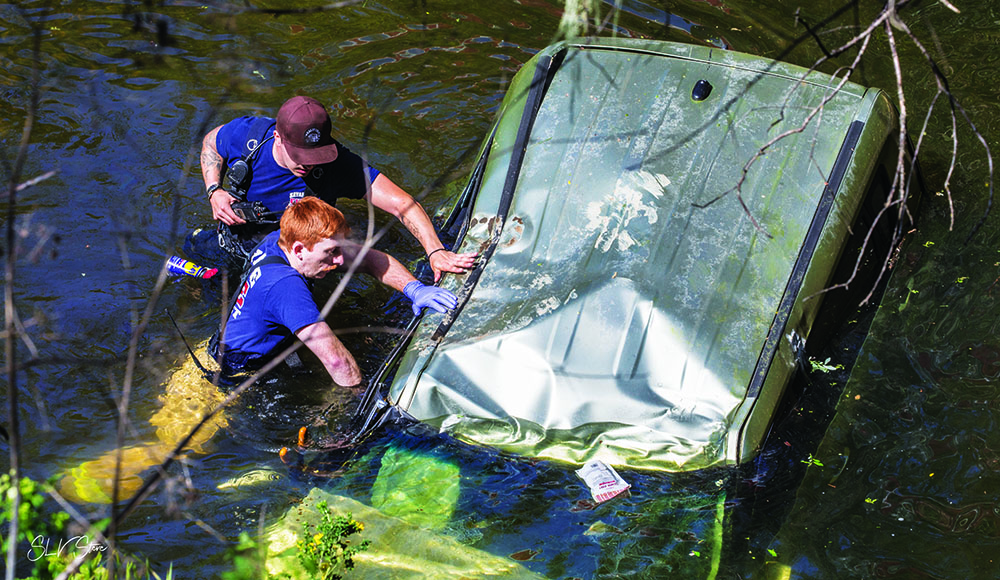
Lompico, the box canyon I call home, is considered the fourth most dangerous community in California for evacuations. There’s one way in and one way out—a serpentine two-lane, redwood-and-fern-lined road that follows the course of Lompico Creek out to East Zayante Road. People crash vehicles into Lompico Creek all the time. Last year, we had three separate incidents in a 10-day period. Alcohol is almost always involved.
Although it’s being gentrified, often by naive homebuyers with no experience in the Santa Cruz Mountains, Lompico is one of the last wild places in the county. And it’s not just wild because of the mature redwood forest, ultra-rare, unique sandhill ecosystem, and abundant wildlife, including mountain lions. It’s wild because there are still some old-school outlaws up here.
When I was a young man, in the late 1980s and 1990s, Lompico was not a place you entered without a good reason. Even today, many of the roads aren’t maintained by the county and sheriff’s deputies only visit when summoned, usually in pairs.
In the academy, they warned us that the most dangerous thing about being a first responder is the public. They were right. When you’re out on Lompico Road in the middle of the night directing traffic, you have to stay on your toes. Drunk and frustrated people who “just want to get home” can do really dangerous, unpredictable things behind the wheel of a car.
Likewise, when announcing yourself at someone’s front door, it’s standard operating procedure to stand off to the side. Some of Zayante’s population is well-armed and authority-adverse. Although firefighters and EMTs are on scene to keep people safe, not arrest them, certain people just don’t like uniforms and flashing lights.
IT’S ALL ABOUT THE MEDICALS
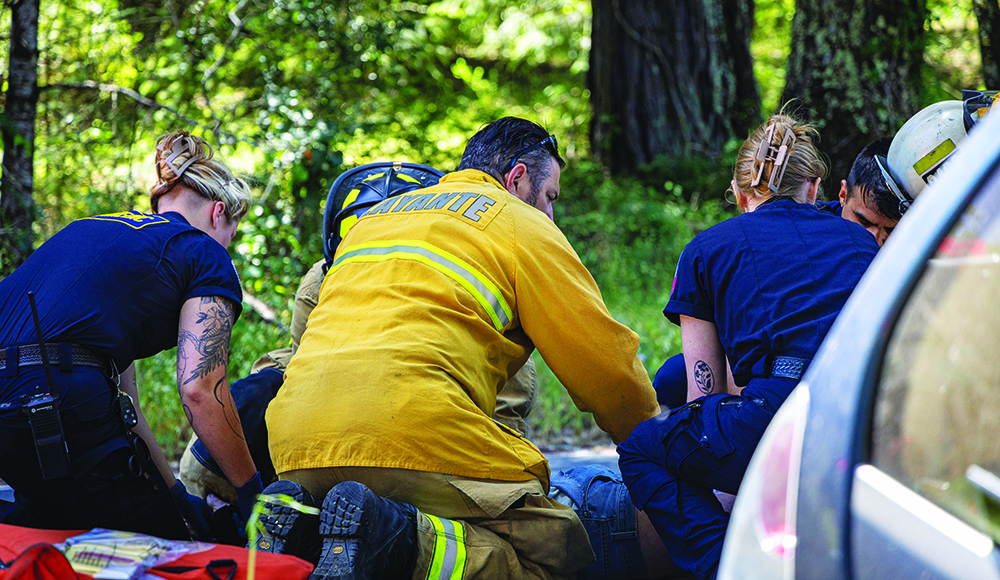
Of course, volunteer firefighting would be far simpler if the calls were confined to skills we learned in academy—fighting fire, rope rescues, wires down, gas leaks, etc. Unfortunately, what our instructors failed to mention is that we’d rarely use those skills. More than 80 percent of the calls I ran during my time as a volunteer firefighter were medicals.
And medicals are what makes the job so tough. The stress of being first on-scene to deal with heart attacks, strokes, unconscious patients, broken bones, deep lacerations, domestic violence incidents, sick or injured children, suicides, and dead bodies is hard to overstate.
When I joined Zayante, the department only had a handful of certified EMTs so—on my own dime and time—I completed a 10-week EMT course at Defib This, the now-defunct training center in downtown Santa Cruz. While the training wasn’t as physically grueling as the fire academy, it tested me mentally and emotionally.
When I was 18, I was in a brutal van accident that maimed and killed friends. So I don’t enjoy overly gory movies. I can barely tolerate emergency-room dramas on TV. Needless to say, EMT and firefighter were never on my career Bingo card.
Yet few people elicit my respect like career paramedics and EMTs. They’re superhuman. While I was training to be an EMT, I worked a 12-hour shift with King American in San Francisco and a 12-hour shift with AMR in Santa Cruz County.
On a call in the Tenderloin, two men tried to break into the ambulance while we were working on a critically ill patient. The King American paramedic calmly slid open the door, stuck her head out, and said, “Not today, gentlemen,” immediately defusing the situation.
My AMR shift in Santa Cruz County began with 20 minutes of CPR on an elderly woman’s lifeless body, per county policy. Eleven hours and eight calls later, the shift ended with 20 minutes of CPR on the lifeless body of a teenager. Again, per county policy.
At the end of both those training runs, I was totally drained and ready to sleep for three days. For the pros with whom I worked, it was just another shift. They got up and did it again the next day.
IN LOMPICO, YOU’RE
OFTEN ON YOUR OWN
A good friend from the academy was hired by the San Francisco Fire Department around the same time I started at Zayante. After a few years, we found time to compare notes. As it turned out, he rarely had a chance to open the medical bag on calls because the San Francisco paramedics were almost always on scene at the same time as the firefighters.
When I told him what life was like at Zayante—the 24/7 calls, the lack of any real time off, the endless medicals, he was agog. “I can’t believe you’re doing that for free,” he said, shaking his head. To be clear, volunteer firefighters are paid a nominal sum per call—usually between $12 and $15, but it barely covers the personal cost of being a firefighter.
EMTs practice Basic Life Support (BLS) emergency medicine, which is limited to patient assessment, CPR, AED usage, hemorrhage control, splinting, and emergency care for medical/trauma emergencies. The only real medicine we can give them is oxygen.
But I quickly learned that if I arrived on scene and acted with some semblance of calm authority, it was usually enough to lower their blood pressure, which was a start. My job was to keep them alive until the paramedics could arrive. Yet thanks to Zayante’s labyrinthine warren of crumbling roads, that could take up to 20 minutes.
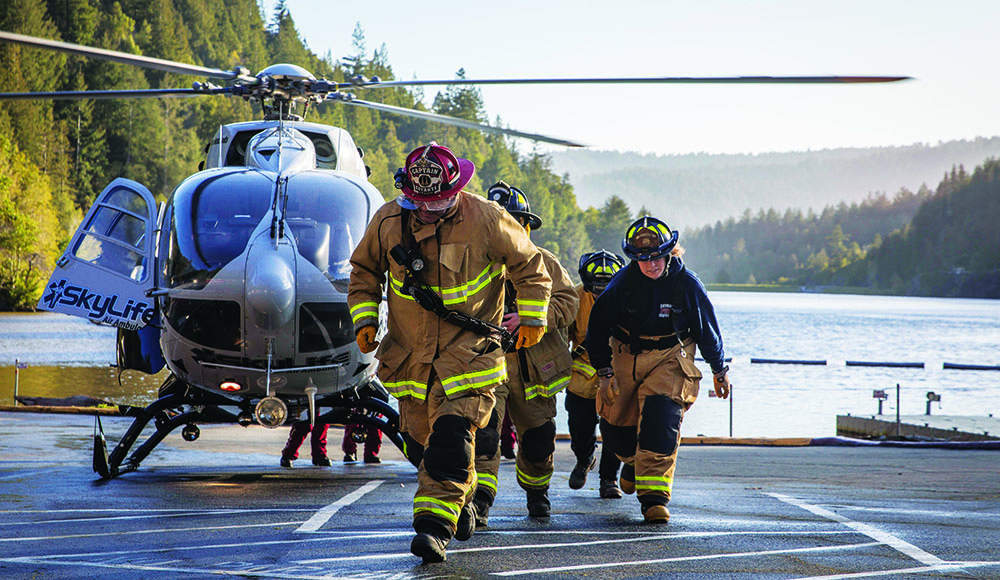
For the record, Santa Cruz County is not a great place to be critically injured. We have no trauma center so, more often than not, we must LifeFlight patients over the hill to San Jose.
COVID-19 AND FENTANYL
The COVID-19 and fentanyl epidemics coincided with the first few years of my service. They were not mutually exclusive.
During this time, the fentanyl was absurdly strong and Narcan, the nasal spray that reverses life-threatening opioid overdoses by binding to brain receptors, wasn’t yet readily available to the public. Unfortunately, the isolation imposed by COVID-19 was deadly for a lot of opiate users. Often, it was too late by the time we arrived.
Narcan, however, proved to be a wonder drug. If we could reach the patient in time, one 4-mg dose could be the difference between life and death. The beauty of narcan is it carries no negative side effects. I delivered three 4-mg doses to a patient once. And sometimes, if paramedics aren’t sure what the problem is, but it looks like an opioid overdose, they’ll give the patient narcan just to be safe. There’s no downside.
Yet COVID was also an ugly killer. Strapping a bag valve mask on someone who sounds like they’re drowning in their own lung fluid is harrowing. The look of fear in their eyes silenced any arguments, in my mind, about the merits of vaccination.
I was one of the first people in the county to receive the COVID-19 vaccination. I wore a KN95 mask and Nitrile gloves religiously on every call. I never contracted the virus.
I’VE SEEN FIRE AND
I’VE SEEN RAIN
We had our fair share of wildland fires during my time at Zayante, but we thankfully didn’t experience anything like the 2020 lightning complex fires again.
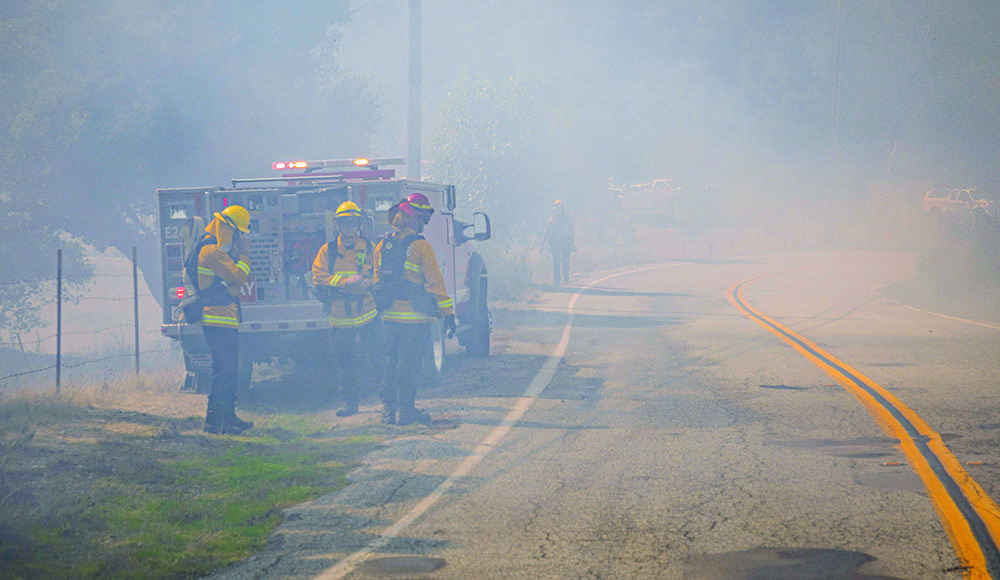
More often than not, the wildfires were stopped in their tracks before they could get bigger than a few acres. These quick responses were usually the work of Cal Fire handcrews and an efficient Cal Fire air attack, which launches from the Alma helitack base, near Lexington Reservoir.
In 2022, Alma upgraded their old Huey helicopter to the new, more advanced Firehawks and, as of mid-2025, it operates night fire suppression capabilities seven days a week. That’s good news for residents of the Santa Cruz Mountains.
While I expected wildfires, I couldn’t have foreseen the ferocity of the wind and rainstorms of 2022 and 2023. Beginning on New Years Eve of 2022, storms began dumping rain, deluges that measured between eight and 13 inches at a time.
These downpours turned the earth into a moist goo that had a tendency to slough off in massive debris flows. These slow-moving, inexorable landslides were unpredictable and terrifying to witness. They destroyed everything in their paths.
The high winds were even more destructive. Gusts up to 80 mph roared through the mature redwood forest. They downed trees, damaged dozens of homes, and disabled countless powerlines.
The storms were dangerous, but, as volunteer firefighters, we had a responsibility to protect the public, so we were out in it.
The 2023 storm cycle ended in March with a tornado that roared like a jet engine overhead and left a trail of shattered wood behind. It took me and my partner hours to clear a path down to Station 2 on the roads.
WAIT SIX MINUTES AND GO
When I arrived, Zayante had the second-worst response times of any department in the county. This was exacerbated by two things: First, every summer and fall, many of Zayante’s firefighters returned to seasonal jobs at Cal Fire. Second, Zayante would send our most experienced volunteers out on strike teams to help fight big wildfires raging around the state. It was one of the few ways we could generate much-needed revenue.
Because of this, I found myself as the primary responder for nearly three months in the late summer and fall of 2022. Zayante was under a lot of pressure to bring our response times up, so I slept in the fire station as much as possible, and did my best to encourage the handful of other available firefighters to do the same. During this period, I was, more often than not, alone.
My chief at the time told me, “Wait six minutes. If no one else shows up, take 2466 [the ambulance] out alone. AMR will be there soon.” It was a nerve-wracking experience, but it built a lot of confidence.
That December, at the department’s sparsely attended Christmas party, I was named Firefighter of the Year and given a child’s plastic fire helmet as an award. I threw the plastic helmet away the next day, but its meaning wasn’t lost on me. Don’t expect to be celebrated or rewarded for your service—no one really gives a damn you’re doing this.
THE BAD ONES
While most of my fellow volunteer firefighters seemed to shrug off the bad calls, I internalized them, turning them over and over in my mind, ruminating long and hard on what it all meant in the big picture. Which is a bad idea.
I was first on scene to a structure fire in Lompico and the chief put me on the patient, a middle-aged man with third degree burns on 25 percent of his body. I cut away his tracksuit while he screamed in my face. I’ll never forget the way his burnt flesh and hair smelled in the back of the ambulance on our way to the LifeFlight landing zone.
I responded to a father who’d committed suicide, his wife and son still in the house. I intubated him in the back of the ambulance on the way to Dominican.
I bear-hugged the naked corpse of a man from a bathtub so we could put him in a body bag. His body had already experienced rigor mortis and his contorted limbs made him look like he was dancing into the bag. He was exactly my age.
I found an old man living alone with Parkinson’s. He stood, frozen and incapable of moving under his own power, black widows crawled around in every cobwebbed corner of the house.
To be honest, I can’t bring myself to write about the worst ones. To its credit, Zayante offered us therapy, but no one else accepted the offer, so I never felt comfortable bringing it up. Admitting that you were traumatized just wasn’t part of the culture during my time there.
And, trust me, your friends and family don’t want to hear about it. They can’t really understand or simply don’t want to, for reasons of their own. So I just kept going, bad calls stacking up in my mind.
Maybe the hardest part was the fact that these were more than just strangers. They were my neighbors—sometimes people I knew. Volunteer firefighting is real community service. You are serving the very people you live with. It’s a daunting dynamic and a big responsibility.
THE FEAR AND RESENTMENT
During the last two years in the fire service, I grew moodier, less patient. I snapped at people, including my wife. I developed resentments towards other firefighters who I felt weren’t “pulling their own weight.” I cursed Ben Franklin. What a stupid model for a firefighting force. Why weren’t we getting paid or paying professionals to do this?
Worse, I began to dread going to drill on Tuesday nights and stopped responding to every call, which created even more stress and self-recrimination.
All of the skills we use in the field—both firefighting and medical—are “perishable,” which means, if you don’t consistently drill and train and practice, you’ll forget how to tie a clove-hitch or throw a ladder or perform a blood-glucose test.
And if you don’t run a call for a week or two, doubt seeps in. It’s like big wave surfing. When winter rolls around and you see big numbers on the buoy readings, you get butterflies, wondering if you can still do it.
By late 2025, I knew I wanted out, but I felt I couldn’t retire until Zayante had found enough committed firefighters to take my place—firefighters who didn’t just show up for drills and fires, but who could also show up to the medicals in a timely fashion.
Here’s the problem. If you don’t live in the district, there’s no real point in being a volunteer firefighter. You’re never going to arrive in time. Even if you do live in the district, but are more than six minutes from the station, you’ll never be first out on an engine or in an ambulance. You can sleep at the station, but, in my experience, that takes a toll on your family after a while.
As 2024 turned into 2025, I feared I’d be responding to calls until I lost my damn mind or made some kind of egregious, unforgivable error. It was an unfortunate headspace. Yes, a lot of this stress was self-generated and probably just a deflection of the PTSD that I’d built up over the years, but some of it was legitimate.
THE END OF THE VOLUNTEER ACADEMY
During my time in the fire service, recent graduates were expected to serve as instructors for subsequent academies. In 2022 and 2023, I put a lot of time into the academy as an instructor, devoting many weekends to teaching new recruits the skills I’d been taught.
On Feb. 19, 2023, a 38-year-old cadet named Dan Lamothe experienced medical distress while in the Maze, an enclosed space exercise on Ben Lomond Mountain. Despite the instructors’ best efforts, he died on the training grounds.
I wasn’t on hand when Lamothe passed, but I knew and respected the man, not just from working with him during the previous six weeks of training, but from the local music scene. He was the bassist in a band called Stellar Corpses, which I’d admired.
Although other external factors were at play, Lamothe’s death more or less marked the end of the volunteer fire academy in the mountains. That meant Zayante’s new recruits weren’t going to be trained in any formal way. They’d have to earn their Firefighter I and EMT certifications in-house.
In 2025, Zayante continued to attract new, gung-ho volunteer firefighters, but few lived near enough to the station to respond in a timely fashion, so most of the work continued to fall on the shoulders of the same skeleton crew of grizzled veterans.
But I was done. By year’s end, I felt like more of a liability than an asset. After a long discussion with my wife, I decided it was time. I dropped off my gear at the station and submitted a letter of resignation to the chief and the board.
WHAT I MISS MOST
Nearly seven months later, I still don’t regret that decision. Five years was a long time to be fully committed to a mission like the Zayante Fire Protection District. I’m proud of what I accomplished.
In addition to the calls and the Firefighter of the Year honor, I helped revive Station 2 in Lompico; pass Measure T, which funded the day crew at Zayante; raise a bunch of money for the department; and confront a fundamental anxiety about human suffering.
Ultimately, the best part of firefighting was not the calls. It was the people. The core group I served with were some of the hardest working, most humble, talented firefighters and emergency medical professionals in the county.
I watched first responders like Tim “Finn” Stilwell, Britteny Raynor, and John Amadeo give everything they had to the fire service, consistently showing up under any and all circumstances. All three are firefighters to their core. It is their identity. They absolutely love everything about it.
And, in the end, I served under a remarkable leader. Chief Jeff Maxwell is one of the best operational minds in the county. He has the unenviable job of maintaining a functioning volunteer force with little more to offer it than a pat on the back. I watched him guide Zayante from a state of near-chaos to an economically healthy organization. And during the last two years of my service, it was hard to beat him to the scene of an incident. He’s a man who shows up and tells you the truth, whether you like it or not. I respect him a great deal.
WHAT ABOUT YOU?
Which brings me to you. Do you want to experience the adventure of a lifetime? Can you handle the trauma? Can you take the suffering? Can you operate on minimal sleep? Can you keep it together when everything begins to sound like the pager? Then Benjamin Franklin wants you. Figure out which fire district you live in and give them a call. Cruise down on a Tuesday night and observe a drill. Maybe you’re up next.