
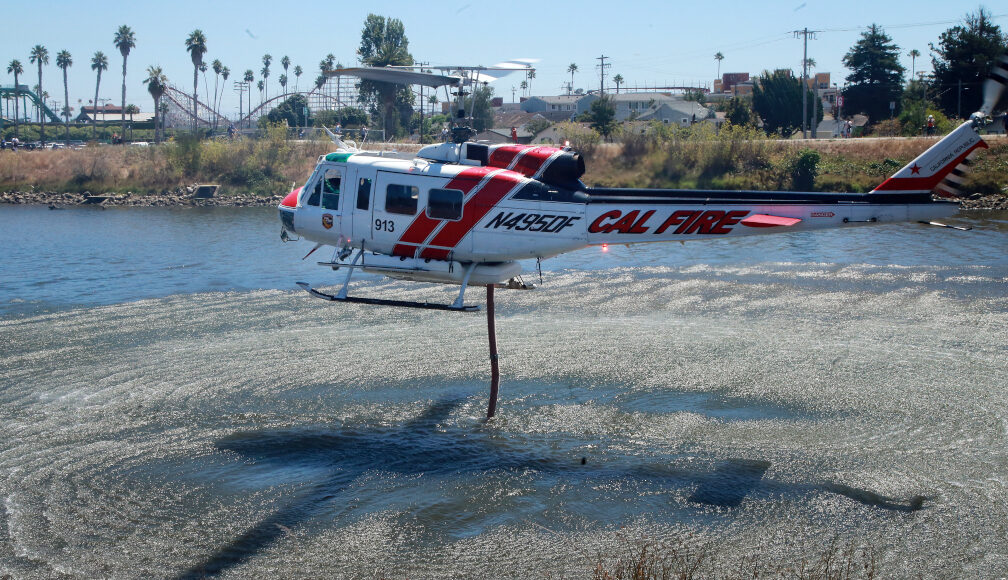
On Friday, firefighting helicopters swooped through downtown Santa Cruz to suck water out of the San Lorenzo River, spraying onlookers and sending hats flying.
While both the flames in DeLaveaga Park and those up Highway 17 at Glenwood Cutoff were brought under control relatively quickly, it was a stark reminder for locals that, two years after the CZU Lightning Complex fire, wildfires remain an ever-present threat.
“As we can see from today’s event in DeLaveaga and other fires around the West, it is essential that we prepare for future fires and other disasters,” says Third District Supervisor Ryan Coonerty. “It is a major challenge, but the community has been great about stepping up.”
So how to prevent a repeat of 2020’s devastating blazes? It’s a tricky proposition, with a number of possible solutions to pursue.
Coonerty, whose North County constituents bore the brunt of the CZU fire, notes Santa Cruz County has been partnering with homeowners to remove brush and trees and take other steps to harden properties, on top of working to increase firefighting capacity.
While experts agree that shoring up our defenses on an individual level is one of the best ways to be proactive, some point to bigger shifts in our thinking that need to occur to ensure our communities remain safe from wildfires.
What action should be taken depends, in part, on how you define the problem. Unlike other recent fatal forest fires, the CZU Lighting Complex was an entirely natural phenomenon sparked by stormy weather and fueled by detritus that hadn’t been cleaned out by fire in decades. But it was supercharged thanks to climate change and the lack of state firefighting resources available when called upon.
Now, residents of smaller towns are taking matters into their own hands, gaining skills volunteering on Cal Fire work in other areas, and stocking up on tools that can be used the next time a wildfire hits the Santa Cruz Mountains.
The Ben Lomond community raised hundreds of thousands of dollars for an agile fire truck specifically designed to battle wildfires. A couple firefighters went and picked it up from Kansas a few weeks ago, and the department is currently outfitting it with equipment, says Ben Lomond Fire Protection District Chief Stacie Brownlee.
“When Cal Fire came and told us, ‘Just let it burn to the town,’ I was like, ‘No,’” she says, recalling the harrowingly quick spread of the CZU fires.
Brownlee says it’s not that the state agency didn’t want to help, but that it was strapped by budget cuts made years earlier.
“People in this area got mad that Cal Fire wasn’t able to fight that fire,” she said. “They were tapped out.”
That’s why Brownlee is a proponent of doing what you can to keep your own home from igniting. That means making sure hedges and potted plants are at least five feet away and removing dead leaves from roofs and eaves.
It’s particularly important, she says, given how hard it is to pick up the pieces afterwards.
“I think people need to understand that it’s extremely hard and expensive to rebuild your home in Santa Cruz County,” she says. “You have to follow the new fire codes.”
There were 30-35 homes that were destroyed by CZU in Ben Lomond in 2020. The first resident was just recently approved to return, to a property up Alba Road.
But with people moving to the area from Silicon Valley and elsewhere, Brownlee says it will be important to educate newcomers on the multiple evacuation routes available.
Last week, Zayante Fire Department Chief Dan Walter congratulated four of his firefighters on a job well done after two weeks of fighting the Oak Fire near Yosemite National Park and the McKinney Fire in Siskiyou County, as part of a Santa Cruz County strike team.
“They worked their butts off,” he says. “It was pretty steep terrain. There was a lot of hiking and dragging hoes.”
It didn’t used to be that way. Before so many low-level offenders were released from prison to reduce the chance of coronavirus outbreaks in state institutions, there were more incarcerated firefighters who worked on the crews. Many of those inmates handled jobs like digging that don’t require specialized training.
“We went from six crews down to one,” he said of the California Department of Corrections’ contribution to wildfire battles. “What used to be prisoner work is now firefighter work.”
But he says the state has been trying to hire additional crews, though that’s easier said than done.
“Nowadays the mentality seems to be, ‘If I can’t make it happen on my phone, I’m not really interested in it,’” he says. “Someone’s got to learn to use a shovel one day.”
While the CZU fire wasn’t sparked by power company equipment, PG&E has been responsible for other blazes, and Walter says he’s glad to see the company taking action to shut off power to prevent forest fires. But, he says, this has posed a critical new question—how do you let people know it’s time to go when the electricity has been turned off?
“Reverse 911 doesn’t work if you don’t have power,” he says. “The internet doesn’t have backup battery power systems.”
Walters says California needs new regulations to force providers to put such systems in place.
PG&E declined to comment for this story.
Andrew S. Mathews, the chair of the Department of Anthropology at UCSC, says humans have inadvertently been designing more fire-prone landscapes around the globe for years.
“We need to learn what ‘good’ fire is, to build a culture of good fire, so we don’t have ‘bad’ fire,” he says. “And that means restoring fire in the places it’s helpful.”
Wet-season “good” fires that reduce the chance of out-of-control “bad” fires in hot months should be seen as necessary and constructive, he says.
“I’ve done research in Mexico and Italy,” he says. “Fire use in both places is very stigmatized, very forbidden.”
The beneficial effects of fire on the landscape, something known to both California’s Indigenous populations and American ranchers, are just now beginning to dawn on state leaders and residents, he says.
“The history of making fire illegal means it’s only quite recently that people are able to talk about prescribed burning,” he says. “The 20th century has been a history of shutting down fire. The combination of long-term fire suppression and climate change means changing our understanding of fire—and how we use fire—is happening pretty much everywhere in the world.”