A new fence installed along the coastal bluff in Capitola is crumbling, a result of faulty installation. Local planning officials say the contractor will be reinstalling the fence in the coming weeks.
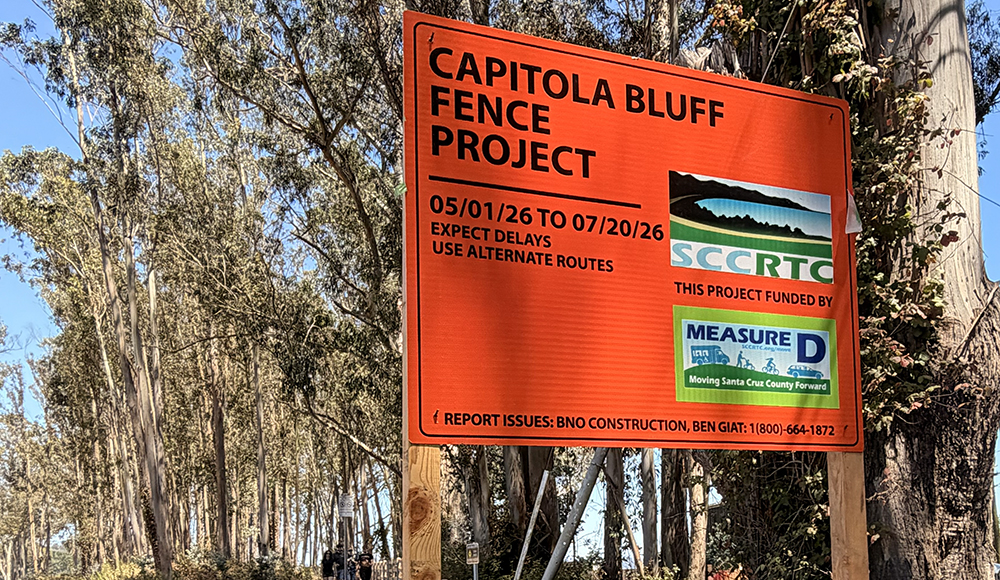
Built in late April and early May, the Capitola Bluff Fence Project is within a right-of-way owned by the Regional Transportation Commission (RTC).
The project is near a popular series of dirt bike jumps that officials removed after determining they were dangerous.
“It’s not really an entertainment trail,” says RTC director of capital projects Amin AbuAmara. “So hopefully they will find another place for these bike jumps.”
There is technically no trespassing on the right-of-way, since the RTC owns it, AbuAmara said.
However, since the makeshift path has been there so long, and is overlooking an unobstructed coastal view, the commission worked with the community to ensure any structures meet local regulations.
The project consists of 1,300 linear feet of wood-style pre-fabricated concrete fencing winding through coastal vegetation adjacent to Park Avenue from Grove Lane to the 850 Park Avenue condominiums.
The chosen color—Sequoia Sand—replicates an enticing, authentic wood look and feel. The fence is designed not to block access, but “kind of guides the people away from the edges of the cliffs,” AbuAmara said.
The project was proposed by the SCCRT and funded by Measure D, a comprehensive package of transportation initiatives passed in 2016.
While the fence is located within Capitola city limits, the property is part of the Santa Cruz Branch Rail Line, constructed and maintained by Santa Cruz County Regional Transportation Commission (RTC), Capitola Public Works Director Jessica Kahn stated in an email.
The fence “will be repaired when they get the material on site,” said Vice Mayor Gerry Jensen, who serves as Capitola’s RTC commissioner. “It was either installed incorrectly or it was a manufacturer deficiency.”
The RTC continues working with the manufacturer, supplier and contractor to repair the fence “at no cost to taxpayers, RTC or City of Capitola,” Jensen said.
As director of capital projects, AbuAmara oversees this project for the RTC. “This is a split-rail fence using concrete rail and posts,” he said. “Generally they are more durable than the wood split rail fencing.”
The RTC selected Texas-based Hilltop Concrete to manufacture the precast fencing. “There are limited manufacturers in the United States that do this specific type of installation, and they are subject to specifications like reinforcement in these units so they can withstand some loading,” AbuAmara said.
Reliable manufacturers of the concrete split rail fence are so few in the United States that “you can count them on your fingers,” he said.
For public works contracts, agencies are prohibited from sole-sourcing materials by requiring a specific state or geographic brand to ensure bidding remains competitive, AbuAmara noted.
The RTC determined that concrete would be more durable and less maintenance than wood, but something happened during the manufacturing process to undermine the compressive strength of the cement, AbuAmara said.
Whether the mix had the wrong amount of water, the wrong time to cure or misplaced steel reinforcement bars, somewhere along the way of production, officials found that some of the rails have less compressive strength than the manufacturer promised.
Amara said the manufacturer will retrieve the batch number and test everything that is there. “They will give us the product,” he said. “They are acknowledging some of these may be mistakes in manufacturing, especially the cracks or exposed reinforcement.”
WHAT COMES NEXT?
Unfortunately, sometimes a project does not sit well with some members of the community, and the fence has been exposed to vandalism.
Working with the Coastal Commission, the RTC designed a path with both upper and lower trails in an effort to sustain exposure to ocean views, and ‘no trespassing’ signs near houses, but “Once you pass that fence, you are exposed to danger,” AbuAmara said. “That fence was broken. They broke into the rails and just broke it down.”
The project contractor BNO Construction and Hilltop Concrete have been cooperative, said Jensen.
“They acknowledged that maybe there has been a mistake in the mix and they want to make it whole,” he said. “It is not definitive. We haven’t arrived at a consensus with the manufacturer yet.”
DOES IT COST MORE THAN WOOD?
The fencing material is under warranty by the manufacturer with a contract value of $155,265, according to AbuAmara.
“We will hopefully reach good solutions with the contractor and manufacturer,” he said.
Although more expensive than wood, planners selected the material, a rebar framework surrounded by reinforced concrete, since it is typically more resilient and longer lasting than wood. In June, Jensen visited the site and climbed up the fence.
Sure enough, the cement boards broke.
“The rebar placement might have been incorrect material,” he said. “I appreciate the leadership of the RTC and how fast they jumped on it. It’s a thing that’s going to prevent some tragedy in the future.”
The project is now awaiting new material, and fencing should be complete in the next four to six weeks, Jensen noted.
“Concrete is good in compression but in tension it’s weak. When it comes to tension like a beam hanging between two columns, you have to reinforce it,” AbuAmara said.