
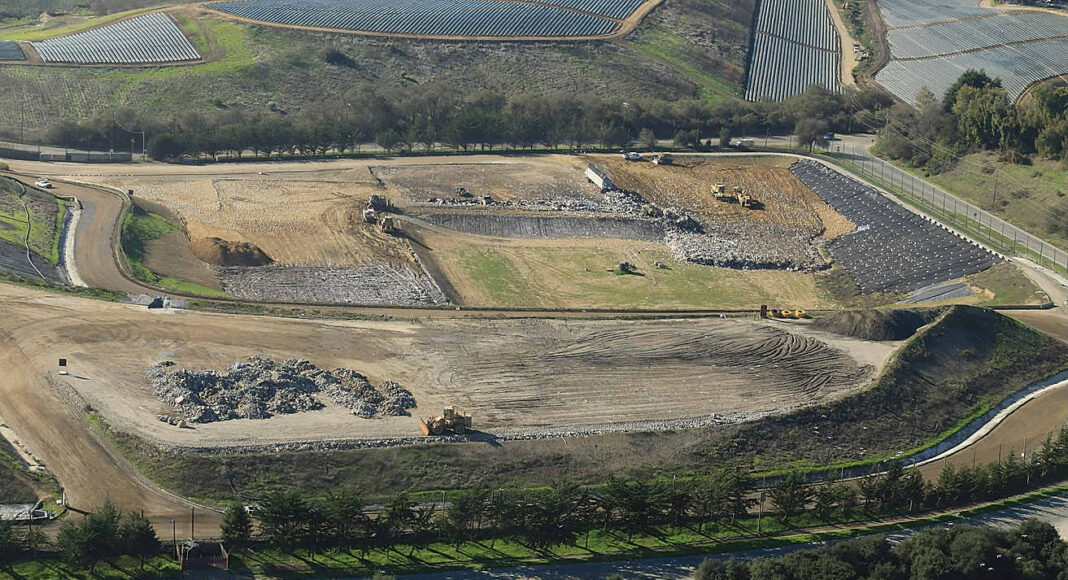
Santa Cruz County is planning a major overhaul of the Buena Vista Landfill near Watsonville as the facility approaches capacity, but the county’s proposed project could cause permanent damage to sensitive oak woodland habitat.
That was among the findings presented Wednesday evening during a public meeting on the Buena Vista Landfill Redevelopment Project, which would convert the existing landfill into a waste transfer, recycling and organics-processing facility.
The county’s draft environmental impact report (EIR) also identifies an alternative that would avoid the project’s most serious environmental impacts.
Nicole Steele, a project manager with the county’s General Services Department, said the landfill currently receives about 75% of the county’s solid waste and is expected to reach capacity sometime between 2030 and 2038.
The county hopes to complete construction of replacement facilities by 2031.
Under the proposal, two transfer stations would be built at the landfill, located at 1231 Buena Vista Drive.
One would serve residents and small commercial haulers, while the other would accommodate the county’s contracted garbage hauler. The project would also include facilities for processing organic waste, recycling improvements and the realignment of Harkins Slough Road.
Rather than burying garbage at Buena Vista, workers would consolidate waste into larger trucks for transportation to other disposal facilities.
Without the project, Steele said, residents and garbage haulers would have to travel to the regional waste facility in Marina, about 19 miles farther south, or use the Ben Lomond Transfer Station.
The project also includes restoring drainage systems, improving wildlife crossings and creating a wildlife corridor between Gallighan and Harkins sloughs.
But Kate Elliott, director of environmental planning and compliance for Harris & Associates, said the proposed location of one transfer station would require removing coast live oak woodland, considered sensitive habitat.
The EIR identifies that damage as significant and unavoidable because replacement trees would take 30–40 years to provide comparable habitat.
The county evaluated 15 alternatives and selected three for detailed environmental analysis.
One would relocate the public transfer station to the southeastern portion of the property, avoiding oak woodland but bringing operations closer to residents of the Buena Vista Migrant Center and Tierra Alta affordable housing complex.
Another would consolidate the transfer stations, recycling operations and organics-processing facilities on adjacent property north of the landfill, where old greenhouses and vacant structures currently stand.
Elliott said the latter option, known as Alternative 3, would avoid the unavoidable habitat damage while improving operational efficiency.
The facilities would also be enclosed, helping control noise, debris and pests.
The county identified Alternative 3 as environmentally superior because it would affect fewer nearby residences. Another alternative would potentially affect up to 36 residences, compared with one under Alternative 3.
Elliott emphasized that the county is not required to select the environmentally superior alternative.
The county has considered various landfill replacement projects since the 1990s. Earlier proposals included a regional composting facility and potential locations for a new landfill, but none moved forward.
The current project has been under development since 2019.
The draft EIR, released Oct. 26, is available for public review, with comments due by 5pm Dec. 10.
County officials expect to complete the final EIR in spring 2027, followed by hearings before the Agricultural Policy Advisory Committee, Planning Commission and Board of Supervisors.
The project would also require California Coastal Commission review and additional permits.
Construction is tentatively scheduled to begin in late 2029 and finish in 2031, with the landfill expected to close between 2032 and 2038.
More information is available at tinyurl.com/5yf37skr