
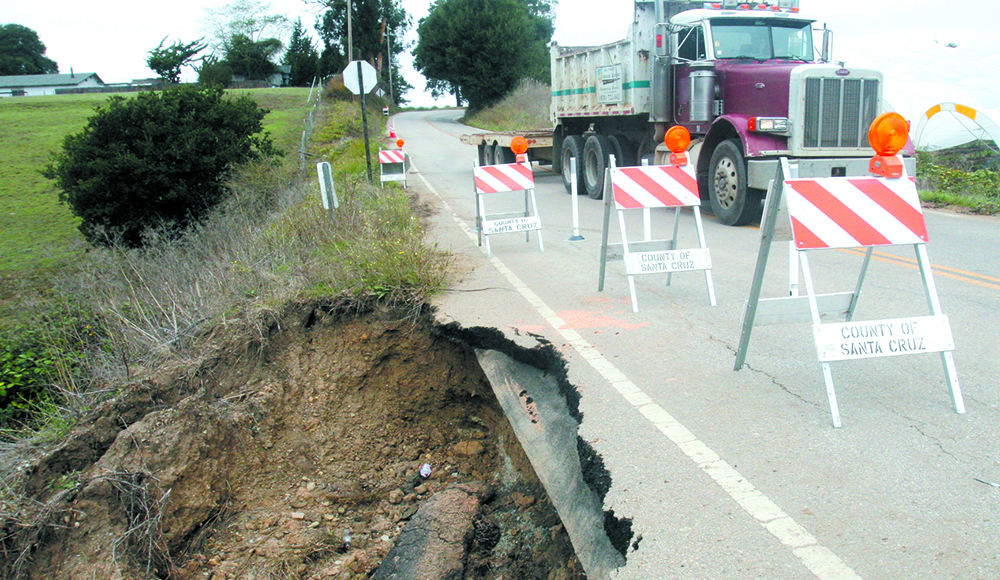
The deterioration of the county’s 600 miles of roads and finding a way to fix them was top of mind for the County Board of Supervisors last week.
“I’ve got streets that haven’t been repaved in 60 years,”said Supervisor Kim De Serpa. “People want their roads repaved and they deserve it.”
With Santa Cruz County’s road maintenance backlog projected to more than double over the next decade, the Board of Supervisors voted unanimously Nov. 10 to explore new funding sources and ways to improve the county’s troubled and hazardous road network.
The decision followed a lengthy discussion of a county report showing that $473.3 million has been spent on streets over nine years, even as aging roads, deteriorating drainage systems and repeated winter storms have left the county with a substantial backlog of needed repairs.
That backlog, currently estimated at $294 million for pavement maintenance alone, could grow to $683 million by the 2034-35 fiscal year.
The county’s pavement condition index currently stands at 57.8 on a 100-point scale. Without additional funding, that number is projected to fall to 36 by 2034-35.
The board also approved an amendment by De Serpa creating an ad hoc committee comprising herself and Board Chair Monica Martinez to work with county staff on funding solutions that would not significantly reduce other county services.
The committee will focus on updating an existing road assessment, advocating for state and federal funding changes and exploring other revenue sources, De Serpa said.
The discussion comes amid calls to dedicate 10% of the county’s discretionary general fund tax revenue to roads, a proposal that would redirect approximately $22.9 million annually from other services.
County Executive Officer Nicole Coburn warned that such a move could require eliminating approximately 125 positions and cutting general fund departmental contributions by more than 9%. She said public safety, health and human services would likely face the greatest impacts.
“There are pretty significant consequences to setting aside general fund monies,” Coburn said.
According to the report, the county spent an average of $52.6 million annually on roads over nine fiscal years. Nearly half of that spending, approximately $228 million, went toward disaster response and repairs.
Excluding disaster work, annual spending averaged about $27.3 million.
But the county’s roughly 600-mile road network continues to deteriorate faster than available funding can address.
Public Works Director Matt Machado said the county currently operates on a roughly 40-year pavement resurfacing cycle, far longer than the 10-year cycle he considers preferable.
The report estimates that maintaining roads in their current condition would require approximately $29.5 million annually for pavement work, compared to the $6.3 million the county currently spends.
Machado also pointed to declining gas tax revenue as vehicles become more fuel-efficient or transition away from gasoline.
Supervisor Manu Koenig, who has advocated increasing general fund contributions to roads, questioned whether the county is doing enough to address its infrastructure needs.
He noted that approximately 901 of the county’s 3,300 culverts are failing or in poor condition.
Machado estimated that repairing or replacing deteriorating rural culverts alone could cost approximately $40 million.
The county recently secured $3.8 million in federal funding for culvert improvements over three years.
Koenig said that amount represents only a fraction of what is needed.He also questioned the county’s reliance on grants, which frequently require local matching funds that might otherwise pay for neighborhood road repairs.
“Maybe 10% is too much,” Koenig said. “But I think 1% is definitely too little.”
He said he intends to bring forward a proposal at the board’s next meeting to increase discretionary general fund spending on roads.
The report also raises questions about how the county spends its existing transportation funding. Currently, Measure D sales tax revenue is divided among the five supervisorial districts according to road mileage, with individual supervisors working with county staff to select paving projects.
According to the report, that system does not necessarily prioritize roads in the worst condition and can increase costs by spreading work across numerous smaller projects. The report recommends exploring a countywide system that prioritizes road conditions, traffic volumes and cost efficiency.
It also found that the average cost per mile for Measure D pavement overlay projects increased 38%, from $337,000 in 2018-21 to $465,000 in 2022 and 2024.
Supervisor Justin Cummings opposed the 10% general fund proposal but suggested updating County Service Area 9D, which generates approximately $2.6 million annually through parcel assessments. Those assessments have not increased since 1983.
Cummings said improved parcels currently pay approximately $4.70 monthly, while unimproved parcels pay $2.35.Restoring the assessments to their original purchasing power could generate about $7.3 million in additional annual revenue, according to the report.
Other options under consideration include increasing hotel taxes, renewing and expanding Measure G, issuing bonds backed by road assessment revenue and establishing a new assessment on rural properties.
De Serpa agreed that roads need more attention, but said she could not support a proposal that would substantially reduce funding for public safety and other essential services.
She cited deteriorating roads throughout her district, including Hames Road, Beach Road, Cathedral Drive and streets in Rio del Mar and Seascape.
During public comment, representatives of Communities Organized for Relational Power in Action and the Community Action Board warned that diverting general fund revenue could undermine services for vulnerable residents.
The county is working with a consultant to evaluate funding options and expects to return to the board Feb. 23 with findings and recommendations. Staff also plans to present strategies by June 29 for improving road program costs, project prioritization and delivery.
For now, the unanimous vote advances the search for additional funding without committing the county to a particular tax increase or general fund allocation.