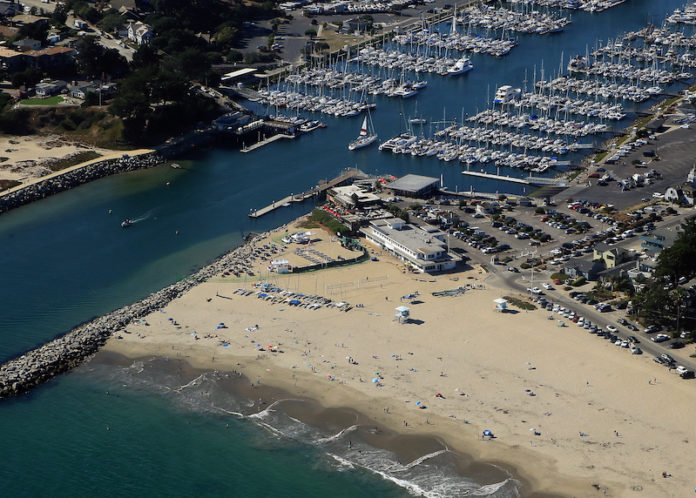
A decade ago Santa Cruz was caught up in Durbin Mania. Restaurants and bars were packed with people watching our local heavy metal kid rising through the ranks of television’s American Idol season 10. A former cupcake shop handed out Durbin cakes to crowds at Pizza Hut on 41st Ave as fans cheered his performances of Carole King’s “Will You Still Love Me Tomorrow” and Muse’s’ “Uprising.”
He placed fourth in the TV contest, but was a winner here.
His homecoming concert at the Santa Cruz Beach Boardwalk drew 30,000 fans, the largest concert ever held in Santa Cruz.
Writer Kristen McLaughlin set out to find out where he is now for our cover story. And the answers are surprising, from making soundtracks for an exercise bike to playing in eight bands, to working with one of the top music producers in the business, Alan Parsons, who engineered Pink Floyd’s Dark Side of the Moon.
He’s returned home to our county and in a great success for a musician—particularly one whose career started by selling pizzas at Domino’s—he’s bought a house in Watsonville.
“I love finding new ways to make music a career,” he says. “My entire philosophy ever since I knew I wanted to do music for a living, I knew I didn’t want to live on tour. I want to be a working musician, supporting my family and doing what I love.”
.Looking for a green new meal in Felton? You’ll want to read Andrew Steingrube’s Foodie File about Emerald Mallard, a French-accented high crust dining establishment gunning for some Michelin stars.
You’d be hard-pressed to find a more exotic blend of music than that served up by the Hu, Mongolian musicians adapting their traditional sounds to heavy metal. If you check out Bill Kopp’s story you might wonder if they should enter American Idol. Why not?
Where do the Monarch butterflies go in the summer and why do they come to Santa Cruz, aside from all the dispensaries and home brews? You will get the answers in Richard Stockton’s article about the upcoming Monarch celebration at Natural Bridges State Park. You’ll also get good news on the new bridge that restores the plural to the park’s name.
You can not only see the 1940s history of Santa Cruz come to life, but you can travel back in time to be a part of it, when you see Who Killed Simon Braggart?—the 418 Project’s fall offering, written about by Mathew Chipman.
Check it out and be a star, which we know you already are.
Thanks for reading.
Brad Kava | Editor
PHOTO CONTEST
ON THE FENCE Four amigas hanging out at Arana Gulch. Photograph by Maria Choy.
GOOD IDEA
The Santa Cruz County Board of Supervisors approved a two-year pilot program to permit Microenterprise Home Kitchen Operations (MEHKOs) to operate in Santa Cruz County. MEHKOs are small-scale food service operations that can serve and deliver food from a home after meeting certain requirements and obtaining a Health Permit.
MEHKO accepts applications starting Jan. 1.
“This is an exciting opportunity to support our residents in their efforts to earn additional income and share their culinary talents with the community,” said Supervisor Bruce McPherson.
GOOD WORK
Cabrillo College will host Hostile Terrain 94, a free exhibit focusing on the humanitarian crisis at the border. Participants can share stories about how they have been impacted by U.S. border enforcement policies and migration. It has been exhibited in more than 120 locations across five continents.
Dr. Jason de León, UCLA professor and director of the Undocumented Migration Project, will speak. He has written two books, The Land of Open Graves: Living and Dying on the Migrant Trail and Soldiers and Kings.
Cabrillo will feature the exhibit at its Aptos campus Oct. 14–Dec. 6. A reception and artist’s talk will take place Oct. 16 followed by a book signing and viewing of the exhibit. Free and open to all.
QUOTE OF THE WEEK
“I don’t understand why saying unhoused is better than saying homeless.” —comedian Josef Anolin
We in the San Lorenzo Valley deserve a leader like Monica Martinez. Monica has run complex, grant-funded nonprofits while developing extensive partnerships. She can navigate the complex bureaucracies of the County and Sacramento to deliver lasting value for our community.
She will leverage her decade + of managing large, complex nonprofits, where she dealt with similar challenges. Our water infrastructure is outdated and one disaster after another has damaged them further: drought, fire, windstorm, flood and landslides. Water outages mean kids miss school or businesses cannot serve customers.
We need to build partnerships and bring resources into our community. Monica knows how.
We are not ready for the next big fire: Most of our fire hydrants lack adequate pressure. We need to upgrade 25 miles of waterlines and several tanks to be fire-ready. We need to rebuild a major supply line to be ready for the next drought.
Large state and federal grants will be key to this work. Monica has done that for years. We must help our neighbors who still cannot rebuild after the 2020 CZU Fire. Customers of private companies like Big Basin Water and nonprofits like Forest Springs Mutual need our help. Without formally connecting to San Lorenzo Valley Water, families cannot demonstrate they have the water supply needed to rebuild.
Consolidating will require complex legal agreements and partnerships. Monica has done that, too. Bringing our infrastructure up to date and rebuilding our communities will require expertise navigating issues across the local, state and federal levels of government. Let’s elect Monica to get it done.
Bryan Largay | Director San Lorenzo Valley Water District
(Views are my own and not necessarily the District’s)
CUT NEW GROWTH TREES
I have been to National Parks across the entire state of California with my family. We have enjoyed the natural beauties of Yosemite, Pinnacles, and Redwood National Park, whose beauty is all due to the long-standing and ancient trees that reside in these parks. I would hate to see the places that I cherish so deeply be destroyed due to the logging of old growth trees.
These trees create the vibrant ecosystem of much of California and provide a home for a diverse array of wildlife. Not only will getting rid of old-growth trees be detrimental to the wildlife the trees support but they also have a great effect on the absorption of carbon waste. So how can the logging of these ancient plants be prevented? Instead of cutting down old trees, cut down the new ones. The Forest Service policy must apply to all old-growth and mature trees and forests on federal forest lands and completely end the sale of old-growth to timber mills. As a voice for CALPIRG, I urge the Biden administration to take action to preserve the beauty of California’s forests and slow the rise of carbon emissions.
On this beach I wander while I’ve got no sense of time with my feet in Capitola, cold Corona twist of lime. No worries on my shoulders while I’m rolling with the tide Come with me if you want to, Capitola on my mind
—James Durbin, “Capitola on my Mind”
In the Lost Boys, Santa Cruz native James Durbin sings classic rock covers. Durbin Unplugged is a solo acoustic show. In the self-titled band Durbin, he rips out heavy metal originals and the occasional cover of Judas Priest’s “The Ripper” from 1976’s Sad Wings of Destiny album.
Closer to home, James Durbin has a new song out, and a New Year’s Eve event that is not to be missed. This year will be a rebranding of the event and a roaring ’20s theme. “We are really looking forward to that,” Durbin says.
With a multi-octave vocal range and enigmatic and powerful stage presence, singer/ songwriter/ musician Durbin, 35, has plenty of irons in his sonic fire.
“I love finding new ways to make music a career,” he says. “My entire philosophy ever since I knew I wanted to do music for a living, I knew I didn’t want to live on tour. I want to be a working musician, supporting my family and doing what I love.”
This approach has enabled Durbin to carve out a diverse career with not only live concerts but also a lucrative record contract, voiceovers and even a gig with Peloton, the bike software company.
Durbin currently sings in eight bands, “eight different active projects,” he said. Among those bands are Tainted Love in the Bay Area, Mustache Harbor in Sacramento and the Lost Boys in Santa Cruz. “About half are consistently performing,” he said. “That keeps me super busy.”
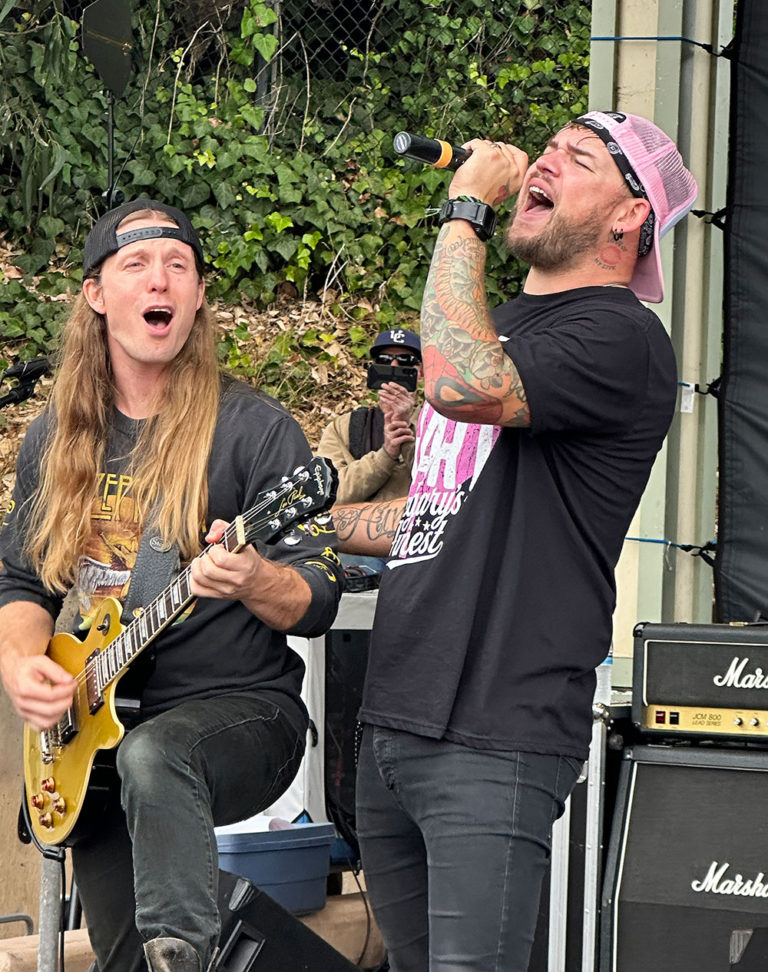
Joining him in the Lost Boys is a new lineup of musicians: Dylan Rose on guitar, Ian Babcock on bass and Conner Bruce wielding drumsticks.
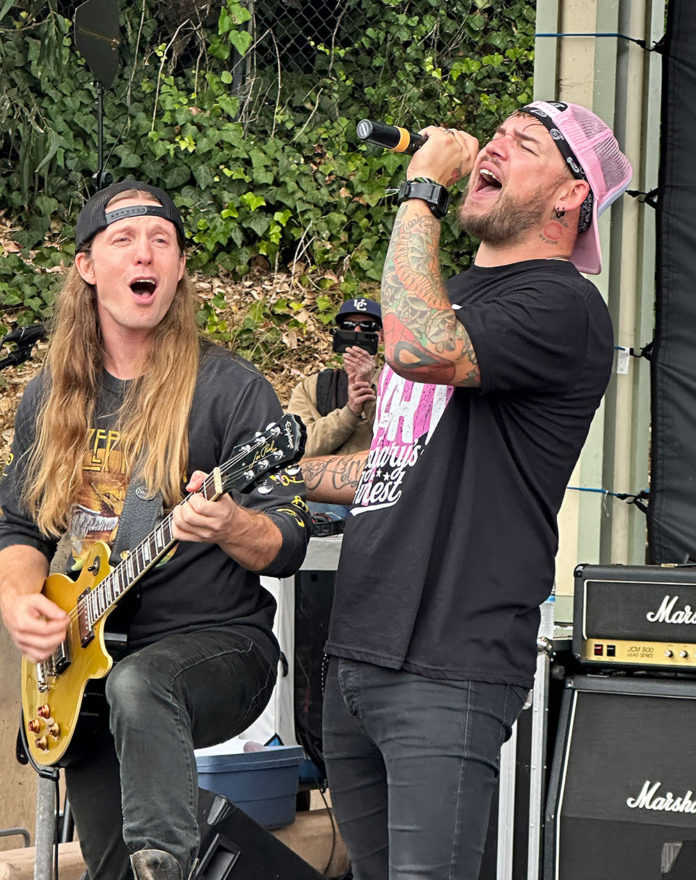
TEARING IT UP James Durbin and new Lost Boys guitarist Dylan Rose. PHOTO: Tarmo Hannula
Singing across the genres from ’80s pop to prog rock to heavy metal, he’s also an international recording artist, signed to a multi-record deal with Italian record label Frontiers Music SRL. He has toured all over the United States and the world, including the Philippines (Araneta Coliseum in Manila), Italy, Canada, Nova Scotia, Mexico, Dominican Republic and a USO show in Kyrgyzstan.
Indeed, Durbin has secured steady work in the music industry ever since he set foot on the stage of American Idol, Season 10, where he was a finalist in the Top 4 with iconic performances including Carole King’s “Will You Still Love Me Tomorrow” and Muse’s’ “Uprising.”
Asked about his most memorable performance on Idol, Durbin said it is probably King’s hit tune. “That was a game changer because I was so intent on being the rock guy,” he says. Starting the song a capella, it really stands out, although there have been a couple other contestants who took the same approach.
Durbin says he was fortunate to receive union wages through SAG/AFTRA on American Idol and the American Idol Live! summer tour. All contestants who make it past the auditions are compensated for their televised performances. “It was probably a six-figure year that first year,” he says. That’s earned, not netted, he notes. “It was also more than it is now.”
After wrapping up the American Idols Live! summer tour in 2011, Durbin was a featured guest artist with Santa Cruz’s White Album Ensemble, released several albums on his own, and in 2018 he became the lead singer of Quiet Riot, touring with them for more than two years.
More recently, he recorded a collaboration with international music producer Alan Parsons (the Beatles, Pink Floyd, the Alan Parsons Project).
Some gigs are more unlikely than others. Durbin does voice-over work for Disney and Amazon; most notably he voiced Turbo Man, a toy from the movie Jingle All the Way, for a doll released by Funko two years ago. “It’s Turbo Time!” James says in his best superhero voice, batteries not included.
Another somewhat niche gig, Durbin currently works from home as a Level Designer creating soundtracks for Peloton, the fitness and software company based in New York City. “I’m making workout levels set to music look like a video game using Pro Tools,” he says. As an independent contractor for a production company, Cape Corpus Creative, Durbin uses musical input tools like MIDI (Musical Instrument Digital Interface) to design the levels using rhythm and different velocities, he says. Not too shabby for a boy from Live Oak who used to sing karaoke at a bowling alley.
Local Roots
Currently living in Watsonville with wife Heidi and their three children, Durbin grew up entirely in Santa Cruz, attending Live Oak Elementary School and Shoreline Middle School.
He got involved in theater at an early age. “I went to Soquel High specifically for their theater program when my older sisters were involved,” he says. “I was in the Soquel High productions when I was 10 and 12 years old when they needed a little kid. They taught me how to sing in French.”
After Soquel High theater director Maggie Kline retired, Durbin switched schools and began acting locally with All About Theater and Kids on Broadway. Durbin performed as Tony in West Side Story, the beast in Beauty and the Beast and Oscar in Sweet Charity.
“He is one of the most talented vocal singers we’ve had,” says Lindsay Chester, executive and artistic director of All About Theatre. “James just commanded the stage with a presence that one could only really compare to one of the greats, as if he was born to be on the stage.”
Chester described working with Durbin, who was diagnosed with both Tourette syndrome and autism, as a celebration of individuality and talent. “One of the things that really stood out to me is he was an advocate for people with Tourettes.
“He shifted the narrative from James Durbin with Tourette to James Durbin the artist,” she says. “The fact that he did that seamlessly, almost without thought, I think that changed the culture behind the stigma with Tourette.”
Durbin’s talent was not only empowering, but accepting of that narrative. “Some people sing from pain and stuff, challenges, deep and passionate love,” she says. “James knows how to experience life.”
Last spring, Chester started working with the next generation of Durbins in the theater program for his daughter Kinzee’s school, Watsonville Charter School of the Arts. Last spring, Kinzee, 9, played Nigel, the leading pelican in Finding Nemo. “She is her own unique person, very natural on stage,” Chester says. “It is just beautiful to see that handing off to the next generation.”
A Father’s Inspiration
Durbin draws a lot of inspiration from his father. “My first guitar was a hand-me-down from church when I was about 9,” he says. “My dad was a musician. I wanted to do all the things he couldn’t do because of his addictions.”
James’ father, Willy Durbin, was a local bass player until his untimely passing in 1998. “For him once he got off stage he needed to keep that validation from people,” Durbin says. “I don’t need that. I get it when I step through the doors and see my kids and wife.”
Even in death, his father continues to surprise him. Recently, James tracked down a vinyl pressing that his father played on with Steve Marriott from Humble Pie.
“I’ve actually gotten to know him more in death than I feel like I would ever have had the chance to in life,” Durbin says. “I’ve sought him. I’ve gone to great lengths to find albums that he’s played on, get a sense of his passions and his character as an individual.”
After his father passed away, James’ grandmother purchased a memorial bench on Capitola Esplanade, and that is where Durbin has always gone to feel a connection with his dad.
Ode to Capitola
Durbin’s songwriting occasionally invokes the Santa Cruz locale. In 2013, he wrote a song about Santa Cruz when he was in Nashville. A music video followed, produced by local promoter Matthew Swinnerton, all funded privately and locally, Durbin says.
“Capitola on My Mind” made its debut at the Crow’s Nest Beach Party July 11. After his band The Lost Boys played the Capitola Art & Wine Festival on the Capitola Esplanade, Durbin sat down with his ukulele on the beach and penned the opening lyrics. “I just wrote it right there,” he says. “The thing with ukulele is you can simplify the songwriting process. It’s tiny. I’ve got bigger fingers than the frets.”
The introspective “Capitola on My Mind” draws heavily on memories in the village, such as meeting his wife at the Fog Bank, singing karaoke and getting banned from the beach for wearing dinosaur masks and claws to scare tourists. “I got a bout of inspiration and wrote. It’s very personal to me. It’s twice as personal,” he says. “I just put a melody to it.”
Durbin reconnected with Swinnerton to produce a music video for “Capitola on My Mind.” They recorded the demo, and will release that single sometime next year.
NEWLY FOUND James Durbin with the Lost Boys. PHOTO: Tarmo Hannula
Eight Bands and a Record Deal
Even though he left Quiet Riot in 2019, their label decided to keep Durbin under contract. Italy-based Frontiers Music SRL has produced albums over the years for legacy bands including Journey, Scorpions, Dokken and Quiet Riot.
“During the pandemic I was writing an album, and I was forced to write it alone,” Durbin says. “I said, ‘OK let me just write the coolest mix of Dio, Priest, Maiden and put all of my heavy metal influences in a soup.” The first album, Durbin, came out in 2021 and a second album, Screaming Steel, followed in March. “It’s gotten some great traction,” Durbin says. “And Frontiers is an internationally based record label. With their reach, it’s gotten some worldly traction.”
In addition to his heavy metal work in Durbin, he is the frontman/utility man of Clean Break, a Frontiers studio band, which will release “American Warrior,” a metal single and lyric video Oct. 10 from the album We Are the Fire.
Mustache Harbor is a zany mix of “’80s hair and ’90s flair,” Durbin says, a “yacht rock” tribute band. If you’re not familiar with the genre, “yacht rock” is smooth-sailing and soft rock such as the Beach Boys, Steely Dan, Elvin Bishop and Toto. “In that, I don’t appear as myself,” Durbin says. “I appear as Sandy Ravage.” It’s been a longstanding and successful touring band playing large halls, venues and casinos nationwide.
Rounding out his roller coaster of bands is the Disney-mixed-with-hair-metal band, Metal Street Boyz, a mix of “good ideas that could go any direction,” Durbin says.
Another Santa Cruz connection
More recently, Durbin has been recording with Grammy-winning mix engineer Alan Parsons of the Alan Parsons Project. Around 2010, through his work with Dale Ockerman, Durbin collaborated with musician Julian Colbec, who was working on a DVD course with Parsons called the Art & Science of Sound Recording. “They brought me in and had me sing on one of Alan’s songs. It’s basically like a how-to course,” Durbin says.
A decade later and with another creator Armand Ruby, Durbin went into ParSonics, Parson’s recording studio in Goleta. “I think I went in and sang on someone else’s song, and Julian proposed the idea that we do a song,” Durbin says.
They recorded “Give ’em My Love” for Parsons’ new album, From the New World (2022). “I was just there a couple of weeks ago doing another song I wrote,” Durbin says. “I first worked with him when I was 19 or 20 and now I’m working with him at 35.”
Since Parsons, too, is signed with Frontier Music, the label was “really happy about that,” Durbin added. “They get a little bit more return on their investment from both of us.”
Ockerman, 71, has known Durbin since he was a teenager, as James was a student at Ockerman’s Musicscool. Ockerman is a founding member of the White Album Ensemble, a Beatles concept band that still performs.
When Durbin’s homecoming concert took place after leaving American Idol, Ockerman was the guy who arranged a backing band before 30,000 fans, the largest concert ever held in Santa Cruz.
As Ockerman tells it, he first met Durbin after he and his wife, Connie, were watching a Kids on Broadway performance of Beauty and the Beast. “All of a sudden the Beast comes out and he’s just singing his tail off,” Ockerman says. “Connie said, ‘It’s like a new Elvis.” He also heard James singing with a band of kids at an event in Bonny Doon.
James would eventually attend Musicscool on a scholarship. “So I taught him some blues harmonica like the way Mick Jagger would play that rock harp,” Ockerman says. “This was in the back of a music store in Santa Cruz. He sounded like Steve Perry or Bon Jovi. He was just being himself.”
Ockerman was very proud of Durbin’s achievement on American Idol. “He was always very courteous,” he says. “He was surrounded by his sisters and mom. He loves metal, which is unique. When they wanted him to sing Neil Diamond, James would say, ‘I’d really rather do ‘Heavy Metal,’ a song by Sammy Hagar. He always knew what he was doing.”
In his 20s, Ockerman was performing Top 40 songs with different bands. A multi-instrumentalist, he toured with the Doobie Brothers (1988-1996), Chuck Berry and sometimes played with Durbin’s dad. “He was this really excellent bass player,” Ockerman says. “He could just play all the styles. I really had fun playing with him. I thought he was the best bass player in town.” Like they say, the apple doesn’t fall far from the tree.
Durbin is playing solo at Cottage Creek Vineyards in Morgan Hill Oct. 13. Check out Durbin’s new song “Capitola on My Mind” on Youtube and Facebook. And ring in the New Year with James and Heidi Durbin at the Lost Boys New Year’s Eve celebration Dec. 31 at the Back Nine at the Inn at Pasatiempo, 555 Highway 17, Santa Cruz. Tickets go on sale this month.
It’s ideal for me when it’s a little overcast, a little gloomy. I like being comfortable in a sweatshirt but also taking it off. A breeze is good when you go out and the leaves aren’t gone yet, but they’re all orange and red and pretty to look at.
Ronan Johnson, 19, Barista at Lulu Carpenter’s on Pacific
CLAIRE
I like the leaves falling, and I like that it’s not Summer anymore, it gets way too hot in the Summertime. It makes walking home from school easier.
Claire Madsen, 15, Student at Pacific Collegiate School
KIM
Right now, is a perfect October day. October has the best weather for Santa Cruz — it’s predictably warm and sunny. It’s not the New England Fall with the crisp nip in the air, but I’d rather have this.
Kim Madsen, 58, Contract Negotiator
NATALIE
Gray and foggy all day, so I don’t feel like I’m dying all the time in my room.
A perfect October day would be overcast, a nice crisp temperature, and I get to spend it inside drinking a warm beverage like a nice, spicy, seasonal chai.
Odessa Cross, 30, Library Assistant at Santa Cruz Public Library.
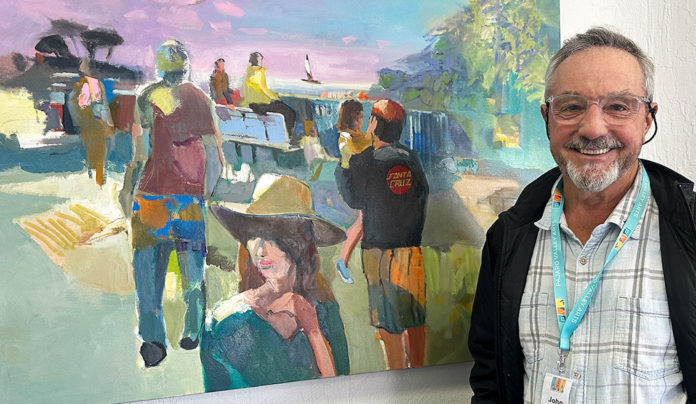
Through Oct. 20, art lovers in Santa Cruz County can take a peek inside the studios of working artists as part of the 39th annual Open Studios Art Tour.
The event spans the county. This weekend, from 11am to 5pm, South County artists will put out the welcome mat. And Oct. 19–20, tours will happen across the whole county.
The 2024 tour includes 307 artists who will showcase works in glass and jewelry, ceramics, wood furniture, drawings, paintings, sculpture, textiles and more.
“The show looks great this year,” says Open Studios Coordinator Ann Osterman. “There are 45 first-time artists this year, loads of veterans and everything in between.”
New this year are satellite shows at the Porter Building in Watsonville and the Santa Cruz Art League in Santa Cruz.
“They are a great way to show artwork from our more remote parts of the county, from places in Watsonville Corralitos, Bonny Doon, Davenport, Soquel hills and elsewhere,” Osterman explains.
“It’s really a nice partnership,” Osterman says. “Judy (Stabile) was generous enough to reach out and be a part of the show. It’s a great way to give a little bit of love to artists who don’t usually get a lot of traffic because of their location. It’s really a jump start to the entire tour.”
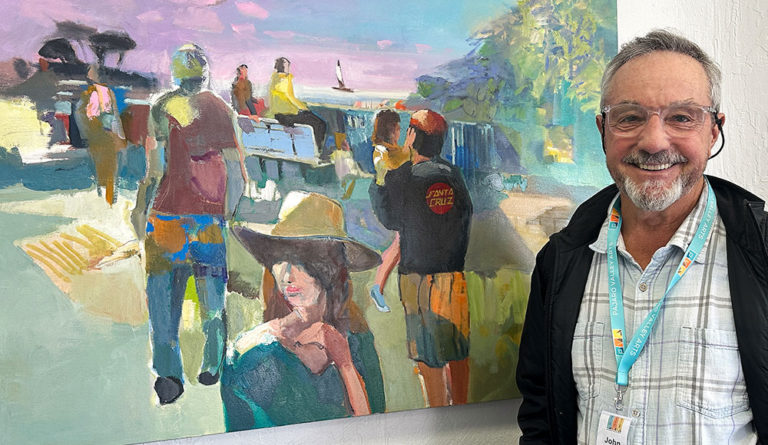
The Porter Building show—under the umbrella of Pajaro Valley Arts—runs through Oct. 20 and features 35 artists from La Selva Beach, Watsonville, Davenport,Bonny Doon, San Lorenzo Valley and Scotts Valley. The Porter Building is located at 280 Main St., Watsonville; visit pvarts.org for schedule.
The Santa Cruz Art League will also feature work by many artists, also through Oct. 20. The Art League is located at 526 Broadway, Santa Cruz; visit scal.org for schedule.
Created in 1972, the DC Comic Anti-Hero Swamp Thing tells a story about the conflict between humans and the environment. When making decisions about the natural world, Swamp Thing challenges our human-centered belief that we alone possess intrinsic value. Godzilla may be our dystopian climate change epiphany, as the monster we awakened in the sea stomps ashore; but as for embracing our wetlands to make our shore sustainable, the ecological Swamp Thing is the monster we need to heed.
This is not a DC Comic image. I asked Chatgpt4.0 to draw me a picture of the spirit of the wetlands. Why would we want to drain this guy’s home?
I gotta come clean. For months I’ve resisted hiking the Watsonville wetland trails because I had a preconceived notion that they were nasty places, not meant for humans. There could be hidden creatures that slither and wiggle around your legs. Bugs, crawling and flying things that sting and bite. A step into a marshy place can have mud skoosh up around your foot and creates a sucking sound when you struggle to pull it out.
But I kept reading that wetlands, these swamps, play an enormous role is helping us with climate change. It didn’t take long for my stroll on the paths of the Watsonville wetlands to convince me how fundamental these damp, spongy places are to the struggling organism we call Earth. I’ve turned into a swamper.
What is Watsonville Slough like to hike?
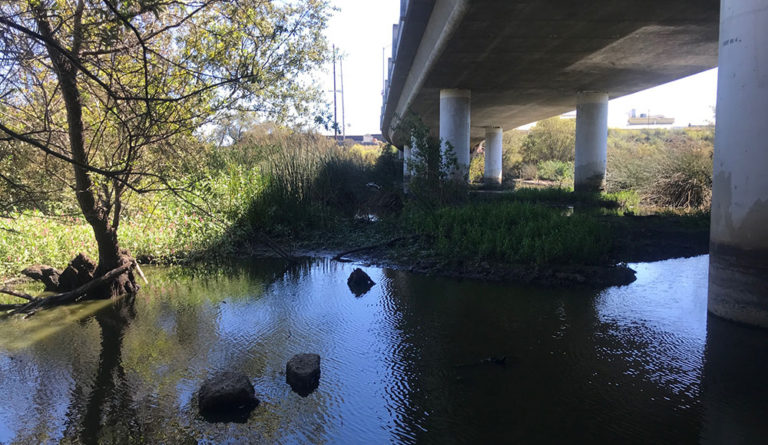
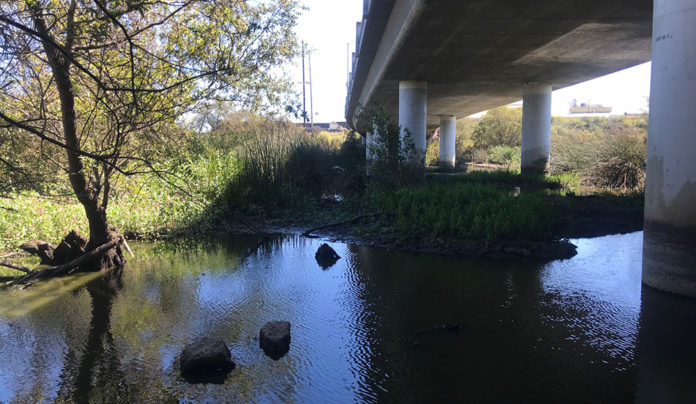
It’s cool. You often walk under a heavy tree canopy, on wide, smooth dirt paths, along running creeks and winding rivers, by buzzing ponds, lakes ringed with dark pools of ferns and tulles. The feeling of peace I get when I stare at that slowly moving river turns off my brain. I imagine Huckleberry Finn and Jim drifting by on a raft. Here’s a river I could float away on. I’m pretty sure this is where Swamp Thing would live. The place feels vibrantly alive, every life form tuned in to every other. Walk beside these rivers, streams and swampy pools and you can feel how these wetlands are a source of ecological vitality. It is no surprise to learn that wetlands play a huge role in our ability to manage risks from climate change. They clean polluted water, they can store floodwaters, they can recharge groundwater, and they are essential habitat for keeping endangered species alive (ecology.wa.gov).
Regarding the “Drain the Swamp” crowd…
Since Ronald Reagan, conservative politicians have campaigned to “drain the swamp.” They don’t get it that to call the federal bureaucracy a swamp is an insult to swamps. Donald Trump wanted to “drain the swamp” so he could hire whatever he found at the bottom; that turned out to be climate change denier Scott Pruitt, whom Trump put in charge of the EPA. That’s like hiring The American Tower Corporation to run the California Coastal Commission. That’s why Swamp Thing is my preferred monster: he does not put up with anyone screwing with his wetland home.
Wetland turns out to be essential for our eco-system and is one mid-range solution to “coastal squeeze.” Santa Cruz County Planner David Carlson tells me that coastal squeeze is when structures, like sea walls, prevent natural coastal habitats from migrating inland as sea levels rise. Passive erosion is how beaches stay alive; you gotta have erosion if you want your beach. Restoring our wetland is a natural way to absorb flooding from sea level rise and makes our coast more resilient.
Here is what is happening in Watsonville: the $599 million Pajaro River Flood Risk Management Project is designed to give 100-year flood protection to Pajaro and Watsonville. Barry Baker of the Land Trust of Santa Cruz County says, “Wetlands work for controlling flooding by absorbing floodwater and by allowing more space for the water to flood takes pressure off upstream resources” (South Bay News, CBS).
Gary Griggs, a distinguished professor of earth and planetary sciences at the University of California, Santa Cruz, wrote in the Santa Cruz Sentinel, “The ocean is a thread in the background, trying to push onto the land, and we try to push it back. Native people didn’t have hotels or malls, they just migrated.”
Beach Flats in Santa Cruz used to be a wetland at the mouth of the San Lorenzo River. The Awaswas Nation (Ohlone) lived here for 12,000 years and understood that wetlands are a critical working part of the whole. Geomorphologist Dr. David Revell said, “The ocean is the most powerful force on the planet; why would we pick a fight with it? It’s going to be rising for the next several thousand years, and to hold a line in the sand is crazy. We need to ask, ‘How do we get out of the way?’”
Walking in Swamp Thing’s Footsteps
I park in the Harkins-Slough Road parking lot at the south end of Ramsay Park, 1301 Main St., Watsonville. Harkins Slough is the largest and most north-reaching slough in the Watsonville system (watsonvillewetlandswatch.org). I walk into the park to find massive earth moving projects, construction is everywhere. This 26-acre Community Park is going to become the center of south county; what they are building is amazing. It’ll have a baseball/softball field, basketball courts, a bicycle pump track, children’s and tots’ playgrounds, a family center, tennis courts, volleyball courts, a skate park, soccer field, and access to the trails and the levee. The Watsonville Slough Connector Trail Project at Ramsay Park will establish urban trails within the park and add a trail between Main Street and Harkins Slough.
This is the brand-new Ramsay Park Pump Track, or maybe it’s a flat parking lot and my camera lens was on shrooms. One hundred yards beyond the track is the Watsonville Slough Trail.
Just 50 steps away from the Ramsay parking lot I encounter a houseless guy camped out in a big blue tent. He has a solar panel above the tent. He is camping in an unauthorized place, and will not let me photograph him, but he says that he is a wetlands scientist immersing himself in the environment he’s studying. I ask him if there is a spirit in the swamp.
“There is a spirit here and it moves at night on two legs.”
OK, so he is crazy and houseless … but still, the guy has a solar panel hanging over his tent.
A hundred yards from the parking lot I encounter a high-tech homeless camp, solar panel and all.
The Watsonville Wetlands and Godzilla Rising
Godzilla is our dystopian epiphany, an embodiment of the revelation that by destroying natural balance with CO2 emissions we have awakened a monster that has arrived upon our shores. In our time of climate change, Godzilla is the perfect monster to represent the consequences of our actions.
Harkins Slough is the largest and most north-reaching slough in the Watsonville system. I’m pretty sure this is where Swamp Thing would live.
Godzilla treats us and our communities with the same distain we do. Now when we see the giant beast rise out of the ocean and trudge toward the shore, we bear the weight of a lifetime of missed chances to do something. As the hot air burns our lungs, we wonder why we didn’t do more, or why we didn’t do fucking anything.
That’s why I see Swamp Thing as our redemptive monster. A living embodiment of power and truth in our environment, Swamp Thing protects both us and the environment, from each other. He shows us how to get out of the way. The Awaswas Nation who lived here migrated, and eventually so will we.
According to Watsonville’s city website, these are the top 5 reasons to visit the wetlands of Watsonville:
• Great spot for birding with over 220 species of birds.
• One of the largest remaining freshwater wetlands in the Central Coast of California.
• Over seven miles of walking, biking, and jogging trails for the whole family with 29 easily accessible trail entrances.
• Diverse wildlife to discover, including muskrats, bobcats and tree frogs.
• Free guided nature Walks offered every Sunday through the City Nature Center located in the back of Ramsay Park at 30 Harkins Slough Road
Watsonville Wetlands hiking info: With a total 8.3-mile point-to-point trail near Watsonville, it’s lowland flat, a popular trail for mountain biking, running and walking. The trail is open year-round and is beautiful to visit anytime. Dogs are welcome and may be off leash in some areas.
Remember when punk bands were punk bands? When it was just a couple of musicians getting together for the love of music, playing live and having fun? Outpatient X remembers.
“We never want to stop having fun because that’s what it’s really all about,” says guitarist and co-vocalist, Shane Bauleke. “Having fun and meeting new people.”
The three piece skate punk act ferociously dropped into the local scene last year and hasn’t stopped grinding. Back in May they released their debut record, Deceptive Optimism and have played a plethora of shows from benefits to bar gigs and venues. Now, they are gearing up to play with fellow local acts, F.U.X., Schlep and San Francisco’s Blunt Force Karma this Saturday, October 5th, at the Blue Lagoon.
“Personally, at the end of the day I just want to play shows,” agrees vocalist and bassist, Isaiah “Zay” Folks. “It’s addicting.”
Harkening back to the most punk rock of origins, Outpatient X formed through a “musicians wanted” ad online. Bauleke and his brother Kai–aka the “Vanilla Gorilla” and Outpatient X’s drummer– were looking for a third person to jam with and had put out the wanted post on Bandmix.com.
“It was a really nasty winter,” Folks– who works as a crewmember of a whale watching tour boat–remembers.
“We couldn’t work and couldn’t surf because the ocean was too rough. I couldn’t go [rock] climbing because everything was wet and I couldn’t go snowboarding because I couldn’t afford the gas since I wasn’t working. I just sat around in my room, playing guitar and watching YouTube videos of NoFX and thought ‘I want to be in a band.’ So I looked up band websites and immediately found Bandmix.com.”
The rest–as they say–is history.
The three began jamming and quickly realized something magically was forming.
“A lot of our songs are very real,” Bauleke says. “They’re authentic because they’re all real-life experiences about heavy shit that we–and people–have to deal with and go through.”
And that’s where the Deceptive Optimism name comes from. On the surface, Outpatient X’s songs explode with upbeat, fast, punk rock energy drawing from groups like Green Day, Bad Religion, Social Distortion and –of course–NoFX.
However, sit and simmer with the lyrics and it’s quickly apparent their music isn’t simply three chord hero worship. Instead, Outpatient X has no problem laying out the horrors of life like drug addiction, catastrophic environmental collapse and the struggle of living with severe mental illness.
“I have bipolar disorder but I spent 17 years in denial,” Folks says. “That’s 17 years of not even admitting to myself that I have this thing. And now–finally–I’ve come to the point where I’m ready to talk about it.”
It’s the subject of two of the band’s tracks off the EP, “Genetic Lottery” and “Scription.” While the former explores Folks thinking about bipolarism, what it means to have been born with the disorder (to have won the genetic lottery),and a generation of self-medicating people living with trauma and mental illness. However, the latter dives into the consequences of having a mental illness. For Folks it meant breakdowns, police and brief stints of institutionalism without his medication.
The EP’s grittiest track is also the one it chooses to end on. In “Gen” Folks sings about a friend of the same name who died of a heroin overdose due to her own mental struggles. In the most harrowing part of the song, he screams “Fuck! Oh Fuck! She’s Not Breathing!” followed by gut-wrenching, repeated cries of “Wake Up!”
Whether it’s on the recording or performed live, the emotional realness commands attention and takes the listener from enjoying a punk song and traps them in the nightmarish moment of seeing a loved one die before their eyes.
“Heroin sucks,” he says pointblank. “We did the vocals in one take because we wanted to capture the emotions. I can still hear [Bauleke’s] dad in the control room say ‘Holy shit’ when we did it, which made me collapse crying.”
It was Shane and Kai’s father, Matthew Bauleke, that got the brothers into music in the first place. Along with being a Santa Cruz punk band, Outpatient X has deeper ties to the scene’s history through Matthew who was in the late 1990’s local punk act, The Undecided. Deceptive Optimism was also recorded by Bart Thurber who’s worked with a plethora of celebrated Santa Cruz punks like Fury 66 and Riff Raff along with more infamous bands in the larger punk scene such as the U.K. Subs and Cocksparrer.
“I’ve worked with him before and he’s great,” Bauleke says. “The dude is a legend.”
While still celebrating the release of Deceptive Optimism, the Outpatient X trio is looking ahead with a full-length sometime in 2025. But for now, they are honing in on playing more shows with the possibility of planning a tour in the not-too-distant future. No matter what they do, the guys promise not to lose sight of their focus.
“It’s all fun,” Folks says. “It’s fun to play shows. It’s fun to post fliers. It’s fun to meet new people and network. With a band it’s a communal high.”
If you go: Saturday, Oct. 5th, 2024. 8pm, The Blue Lagoon, 923 Pacific Ave., Santa Cruz. $10. 423-7117.
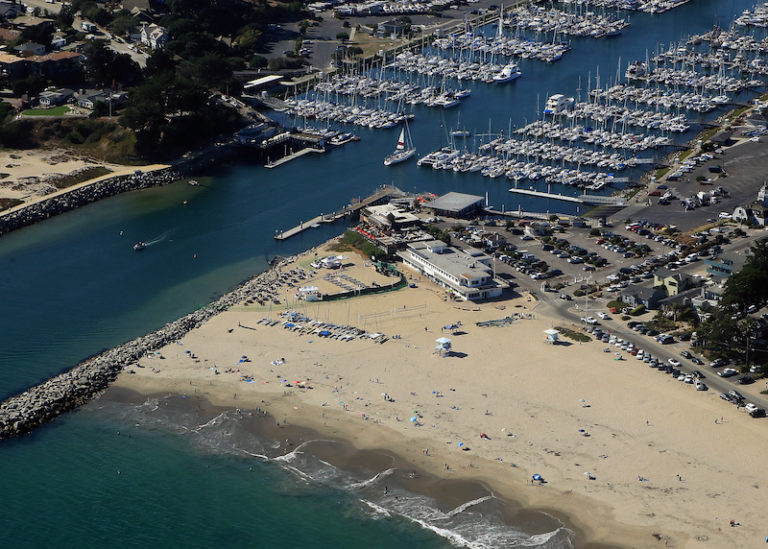
A second suspect in the Aug. 8 double-shooting at a beach concert in the Santa Cruz Harbor has turned herself in to Santa Cruz Police.
On Sept. 30 Jakaella Porter walked into SCPD and was arrested and booked for criminal conspiracy and attempted homicide, said Katie Lee, Community Relations Specialist for the City of Santa Cruz.
The investigation is still ongoing. One victim has been released from the hospital, while the second remains hospitalized due to the severity of injuries.
Background
Santa Cruz Police had already arrested Moses Dollar, 27, after he was captured in the Los Angeles area on Sep. 18. He was booked into Santa Cruz County Jail and charged with attempted murder. The shooting erupted following a beach concert at the popular Crow’s Nest restaurant near the mouth of the harbor.
He is being held without bail, jail records show.
Porter has been identified by investigators as the female suspect in the case and a warrant had been issued for her arrest.
Initial reports were of two men shot, with one suffering up to six gunshots to the chest.
Witnesses said that after a brief altercation in the Crow’s Nest parking lot, a male in his early 20s opened fire on two men and fled the scene in a black Dodge Charger. The suspect was wearing a red puffy jacket and was accompanied by a female of indeterminate age.
What is your most memorable twisty movie or TV show?
ANJANA
Dark, the German time travel series. The acting was great, and the plot and the storyline was done really well. Every episode had suspense and you had to watch to see what would happen. — Anjana Parandhaman, 33, Researcher at UCSC
PRATEEK
I’m watching Three Body Problem and there’s a twist every week. They’re trying to solve a mystery behind behaviors causing scientists’ disappearing or dying. They have to play this game to figure it out, and there’s always an interesting surprise. — Prateek Burman, 37, Data Science Manager
ISA
It’s an anime called Code Geass, and it has the craziest ending. The main character tries to reclaim all of Japan from the British Empire, and then his best friend—well—I don’t want to spoil it. I predict a lot of endings, and I think it was the only thing that I couldn’t. — Isa Gervacio, 18, Environmental Science Major, UCSC
ELLIOT
The cartoon, Monster High: Frights, Camera, Action! Draculaura thinks she will be the heir to the vampire throne, but no. The twist was so insane to me. It blew my mind at 8 years old. It cracked my egg. Like, it fried my egg. Monster High really twisted my perspective on life, like wow, anyone could be The Vampire Queen! — Elliot Lockwood, 18, Anthropology Major, Chico State University
TY
Fight Club. I felt like I was really invested in the whole movie, and I felt like it was a movie that I really needed to rewatch. — Ty Jagielo, 18, Game Design Major, UCSC
LILY
Blink Twice. It’s a recent movie that came out last month. It’s a thriller, and I really like thrillers. It was very suspenseful. It’s not really supernatural, but I don’t want to spoil it. — Lily Pinzini, 18, Student
School districts in Pajaro Valley, Live Oak, Soquel, Bonny Doon and Scotts Valley are asking voters to approve $525 million in school bonds. The districts cite degraded plumbing, electrical issues and leaky roofs as some of the problems in outdated buildings.
PVUSD is asking its voters to vote ‘Yes’ on Measure M, which, if approved, would be the largest bond, coming in at $315 million. Measure M would not only fund repairs, but also renovate classrooms for robotics, coding and engineering education. The bond would raise $18.3 million annually for the county’s largest school district with 17,000 students.
The high number of bonds on the ballot and their high price tags are not unheard of, according to Santa Cruz County Superintendent of Schools Faris Sabbah. But it is a reflection of the accumulated needs districts are addressing.
“I do think that—and you know, this is from my experience—having five bonds at the same time is, you know, it’s not totally unusual, but it’s kind of on the higher side of the number of bonds that occur,” Sabbah said.
“But I just think that it is as a result of each of those districts evaluating that they currently need the bonds at this time, either to address needing new facilities, or possibly building workforce housing or addressing their deferred maintenance needs.”
Live Oak School District is also addressing the need for workforce housing. That district has placed Measure N on the ballot, which is solely directed at creating housing with a $45 million bond.
“Our hardworking and devoted teachers and staff are essential in providing a high-quality and nurturing educational environment where every Live Oak student can thrive,” reads part of the argument for the measure. “But the critical shortage of local affordable rental housing is making it challenging to attract, hire and retain experienced and committed educators and staff members.”
LOSD secured a $44 million bond after voters approved Measure H back in March, and those were set aside for repairs and upgrades to school buildings.
“When I visit schools, I see that this is a common concern from families and from teachers, educators and the administration of really needing an improvement to those facilities,” Sabbah said. “And so, this is why it’s necessary for the schools to go out for these bonds.”
For PVUSD, the last major bond measure was 2012’s Measure L, which approved a $150 million bond that has funded construction and rehabilitation projects at nearly every facility in the district. Most of the money went to build an athletic field for Pajaro Valley High School, which lacked one until its completion in 2021, 17 years after the school opened in 2004. The district spent the last of the funds repaving and repainting projects.
However, PV High is still in need of an athletic pool and a performance art center.
But why do our schools need to put their proverbial hand out during election season in the first place?
Bond Or Bust
Bonds are loans from the state government that taxpayers end up paying back with interest. But first, voters in a given district need to approve ballot measures that designate what the funds will be used for. Usually, these are used for construction or improvement facilities such as hospitals, housing and schools. Once voters pass a bond measure they are agreeing to pay back that loan with interest, usually through increased property taxes.
Measure M would raise property taxes for homeowners within the district by $60 for every $100,000 of assessed property valuation. So, if a home is valued at $1 million, the homeowner could see a $600 increase in annual property taxes.
Voters would only be responsible for the measure passed within their school district. But before districts can put a bond measure on the ballot, they need to be able to match the state’s contribution.
Unlike some states, California does not set aside money for the upkeep and maintenance of the state’s 10,000 K-12 public schools. The funds that schools do get from the state go mostly to paying teacher salaries and students’ daily needs.
Sabbah says that about 90% of the money is spent on those basics and the 10% or so left over is not enough to fund big projects.
“The money is so tight that it doesn’t allow for, you know, putting money aside, generally speaking, in most of our schools, to be able to utilize it for these construction projects,” he said.
State lawmakers are aware of the problems schools are facing and have drafted their own measure to go before voters Nov. 5.
Proposition 2, if passed, would authorize $10 billion in bonds for the repair, upgrade and construction of facilities at K-12 schools, charter schools and community colleges. The bonds would raise $500 million annually over the next 35 years to repay the bond.
“I strongly support Proposition 2, which would provide money to match local contributions for school renovation and new construction,” said California 17th District State Senator John Laird “Passage of Proposition 2 would mean that state money would be there to match these local districts if their bond efforts pass.
“Funds from the last school bond measure ran out a few years ago,” he added. “The state has been budgeting money one year at a time from its general fund for school construction. But due to the recent state budget shortfall, continuing to support school construction depends on the passage of Proposition 2.”
On the Ballot
Measure L: BDESD’s measure for $7 million in bonds to fund infrastructure repairs, improve facilities and safety.
Measure M: PVUSD’s measure for $315 million in bonds to fund the expansion of career/technical education, upgrades and repairs, help improve safety and provide workforce housing.
Measure N: LOSD’s measure for $45 million in bonds to fund the construction of workforce housing.
Measure O: SVUSD’s measure for $85 million in bonds to fund infrastructure repairs, improve facilities and safety.
Measure P: SUESD’s measure for $73 million in bonds to fund infrastructure repairs, improve facilities and safety.
We are not ready for the next big fire: Most of our fire hydrants lack adequate pressure. We need to upgrade 25 miles of waterlines and several tanks...
With a multi-octave vocal range and enigmatic and powerful stage presence, singer/ songwriter/ musician James Durbin, 35, has plenty of irons in his sonic fire.