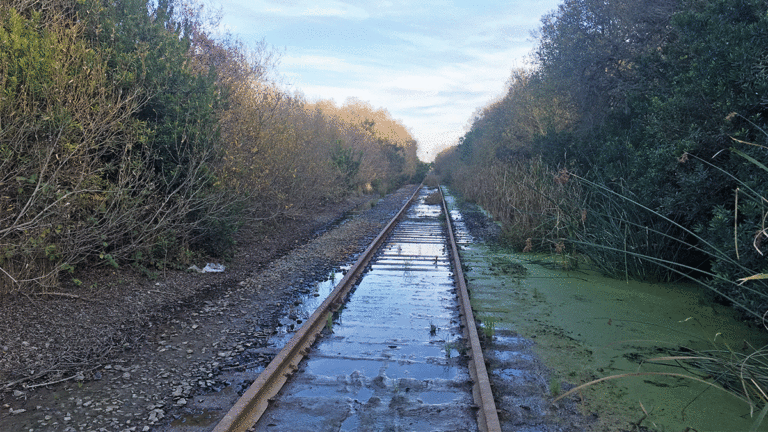
[Editor’s note: This is part 2 of a series on issues surrounding the rail corridor. Part 3 runs on May 9. Read part 1 here.]
“I’m not saying you guys are scoundrels,” clarifies Scotts Valley City Councilmember Randy Johnson during a tense back-and-forth at a recent Santa Cruz County Regional Transportation Commission (RTC) meeting.
For several minutes, Johnson, a member of the RTC, has been pressing the leaders of the freight company Progressive Rail about their intentions for rail car storage on Santa Cruz County’s rail line. Andy Schiffrin, an alternate for Commissioner Ryan Coonerty, did the same just before him.
Things are touchy because Iowa Pacific, the financially strained current operator of the rail line, has made a habit of parking cars on the line indefinitely. Both men want to make sure that the blight doesn’t continue under the next partner.
“I can appreciate what you’ve gone through, and it’s not the way we do business,” Progressive Chair Craig McKenzie assures Johnson at the April 19 Scotts Valley meeting.
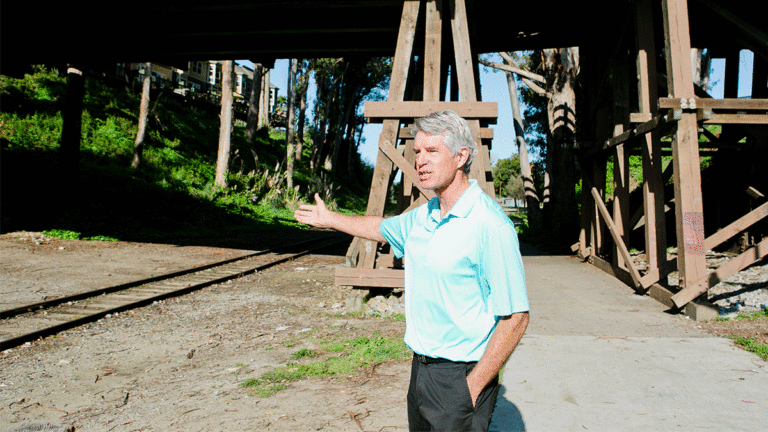
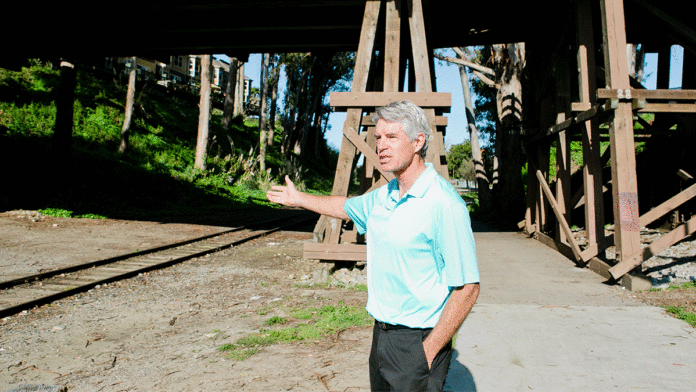
McKenzie is visiting from Minnesota, along with fellow Progressive Rail officials, as they negotiate through what they hope will be the final stages of a contract to become the new freight operator for the local line, which has become a lightning rod.Some activists say the county could and should rip up the tracks to pave a wider bike and pedestrian path than the one the RTC already has planned. McKenzie says Progressive has shown a lot of flexibility because it wants to come to Santa Cruz County even foregoing guarantees that the company has pushed for in contracts elsewhere.
“We’re not Iowa Pacific,” McKenzie adds. “The commission’s doing a fantastic job, looking after our references and investigating us. We’ve never had any unpaid bills.”
Progressive President Dave Fellon promises their company will be an economic engine for the county. McKenzie knows some audience members have heard rail opponents share negative stories about Progressive’s neighbors in other towns, but says those are “very selective, very one-sided.”
Still, Johnson worries about the clout that the rail industry carries. “What we know is that once we hand over the keys to Progressive Rail, this commission loses a lot of authority and control,” Johnson says.
George Dondero, the RTC’s executive director, says there’s a sense of urgency for the commission to pick a new rail operator, lest it run afoul of federal law.
After a contract gets signed, the rail line would need repairs before opening up north of Watsonville because of storm damage, and the RTC recently approved $500,000 for inspections and recommendations of work for bridges and other infrastructure.
Progressive Rail’s plan for Santa Cruz County is divided into a few phases. The first would be freight service, followed by an occasional excursion train to Davenport, which would ultimately be followed by passenger service. Passenger service would hypothetically be a new venture for Progressive, but Dondero says the RTC could instead jointly run passenger service itself, perhaps via a partnership with METRO.
Josh Stevens, a 21-year-old Santa Cruz resident, thinks a commuter train would be a great fit for Santa Cruz County one day. After the meeting, he says that until a commuter train does come, freight by railroad would take a few trucks off the road. He likes them both for their carbon-reducing benefits and for safety reasons. “If we’re able to alleviate that in any way, shape or form, we should,” says Stevens, who’s wearing two layers of black jackets over a black T-shirt from the show Rick and Morty.
Gail McNulty is the executive director for Greenway, which supports tearing up the tracks for a wider trail, and she worries that Progressive Rail has ulterior motives, given McKenzie’s previous ties to the oil industry. She believes that Progressive, if approved, could end up drilling offshore in the Monterey Bay—even penning a post on Greenway’s website titled “Tell the RTC to Protect Our Coast!”
If that sounds like fear-mongering, that’s because it almost certainly is.
The Santa Cruz Sentinel reported last year that drilling, if it ever got approved, in the Monterey Bay would be extremely difficult to do, technically speaking. Dan Haifley, executive director of the O’Neill Sea Odyssey, says that the more recently added southern portion of the National Marine Sanctuary—which is farther offshore—is being reviewed, along with other marine sanctuaries, per an order from President Donald Trump. But it’s nowhere near Santa Cruz. It would take an act of Congress for the rest of the bay to get approved for drilling.
“The chances of that being lifted are as likely as them drilling in Yellowstone,” Haifley says.
McNulty has implied the Coast Dairies National Monument could open for drilling, too. But Ben Blom, field manager for the Bureau of Land Management’s Central Coast field office, calls that scenario “highly unlikely”—given that the federal government doesn’t own the mineral rights.
McNulty admits that Greenway’s talk of drilling is “all hypothetical,” and without any proof, but she feels “desperate times call for desperate measures.” And she knows the talk of drilling sounds like fear-mongering, but also insists that she is legitimately scared by Progressive.
Greenway hired an environmental law firm out of San Francisco to write a letter to the RTC arguing that approving the new rail contract without a thorough review would violate the California Environmental Quality Act (CEQA).
County Counsel Brooke Miller says that CEQA could, in theory, require such a review in order to establish new freight service—but not when the RTC is simply picking a new operator. “This letter makes a lot of blanket statements about how CEQA might apply, and it’s not really specific to what we’re doing,” says Miller, who’s writing a response. “We have a different set of facts here.”
Some of the complex legal and environmental questions could soon have more answers, once the RTC staff releases the contract, which it will do before the commission votes.McNulty says her board actually told her not to work anymore on investigating Progressive, because they want her working on Greenway.
But McNulty did recommend we talk with residents of cities in which Progressive currently operates, like Pam Steinhagen, who runs a daycare next to the railroad tracks in Lakeville, Minnesota, Progressive’s hometown.
Steinhagen says Progressive has repeatedly ignored her complaints over the years—about lewd graffiti tagged on their rail cars, about cars behind her business, about the company’s propensity for starting trains without warning when school gets out, even though young kids sometimes walk under the cars.
“There’s really nothing we can do,” she says, “other than talking to our congressmen.”
[dropcap]I[/dropcap]n January of 1910, a small notice appeared in the pages of the Santa Cruz Evening News entitled “Beautiful New Home Planned.” The article noted that San Francisco-based financier William T. Sesnon and his wife Mary Porter Sesnon were planning to build what would be dubbed in the press as their “palatial country home” on the grounds of the former Porter estate (where Mary Porter Sesnon had been born and raised), located just east of Soquel on a knoll with sweeping views of Monterey Bay.
The landscape architect for the Sesnon home was John McLaren, the legendary Superintendent of Golden Gate Park. McLaren oversaw the design of the park’s famed Japanese Tea Garden, which had been created for the California Midwinter International Exposition of 1894, and which figured prominently in the landscape design of what would be named “Pino Alto” in honor of a tall and solitary pine tree that had been reportedly planted decades earlier by Mary’s father, Benjamin Franklin Porter, on the grounds of his once-thriving tannery and sprawling family lands.
The actual construction work was to include “the terracing of the grounds, the building of reservoirs and artificial lakes,” all for the then-gargantuan sum of $50,000. For the next several months, progress of the construction was documented in local newspapers. By the spring of 1911, the project was complete, and the Sesnons sent out invitations for an “informal housewarming” at their new summer estate,
The housewarming was a truly Northern California affair, bringing the state’s business leaders, artists, literary and political figures to the Sesnon home in Soquel. More than 300 visitors were in attendance on Opening Day.
During the week following the Pino Alto inaugural, there were lengthy accounts of the celebrated gathering in the regional newspapers. “The most notable social function in the history of Soquel was the magnificent reception given by Mr. and Mrs. Sesnon at their recently completed home,” Grace Lee’s “Social Chat” column in the Santa Cruz Sentinel noted. “It is an epoch in the history of our town, and one of the most valuable assets of this locality.”
The Sentinel also sent the celebrated writer Josephine Clifford McCrackin—the author of The Woman Who Lost Him and a pillar of Bret Harte’s distinguished staff at Overland Monthly magazine—to cover the opening celebration. She would chronicle events at Pino Alto for the next several years, not only in the Sentinel, but in the nationally renowned Overland Monthly, as well.
“The time is too short to devote to descriptions of the Chinese room, the dining hall, the breakfast parlor, the suites on the second floor, the endless and numberless rooms, all thrown open on Saturday night, to the guests so cordially received by Mr. and Mrs. Sesnon,” McCrackin wrote.
The highlight of the evening, according to McCrackin, occurred when three young children, one of them the Sesnons’ daughter Katherine, “appeared on stage, charmingly costumed, and executed the most graceful pas de deux in a character dance taught by Mrs. Sesnon, which dance was a prelude, so to speak, to the appearance of Mrs. Sesnon as Terpsichore [the Greek muse of dance and song] herself. It was an entrancing sight, and people, without knowing it, crowded each other to get one last look. The applauding and positively wild cheering lasted even after the group had quit the stage.”
Later that summer, McCrackin would once again single out the performance of Pino Alto’s beloved hostess—who, it was noted, executed a “Dance de Ballet” in which she was accompanied by “the ballet corps from the Grand Opera House” in Soquel.
“In reality it was a poem, a dream of fair angels,” McCrackin observed, “gliding, gracefully, willowy, lithe,” with “Mrs. Sesnon herself, in costume, most becomingly draped and dressed.”
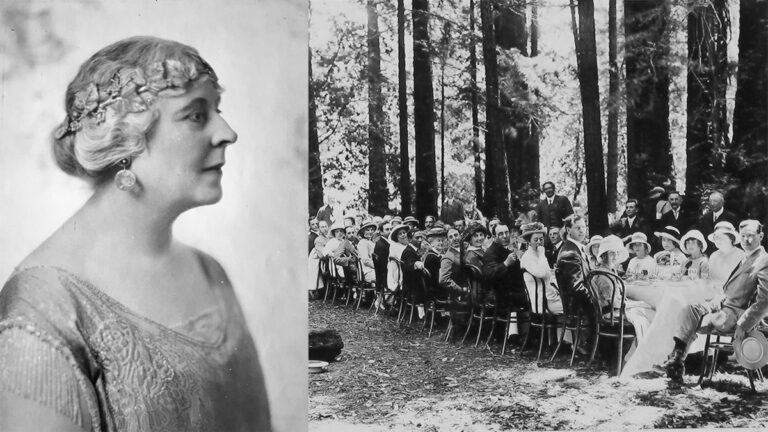
[dropcap]F[/dropcap]or most of the next two decades, the Sesnons would host lavish gatherings, or salons, during the summer months at Pino Alto. As with the inaugural affair, Mary Porter Sesnon and her artistic sensibilities would assume center stage, both literally and figuratively, at all of these events.
While Mary Porter Sesnon’s name is well-known to those in the region who have attended exhibitions in the widely respected gallery named in her honor at UC Santa Cruz, little has ever been published about her or the powerful artistic vision and social drive that not only defined her life, but also underscores her continuing legacy.
SOCIAL STUDY Mary Porter Sesnon, left, with Charles C. Moore and an unidentified woman at Pino Alto, 1911. Porter-Sesnon Family Archives.
The scion of one of Santa Cruz’s oldest and wealthiest 19th-century families, Mary Porter—or “May’ as she was known to family and friends—was born in 1868 and raised on the family land, then located along the old Santa Cruz-Watsonville highway (today Soquel Drive). She was trained in the arts—music, dance and watercolor—and traveled extensively with her family, while her father, Benjamin Franklin Porter (after whom Porter College at UCSC is named), expanded the family land holdings and business activities to the far reaches of the state.
Perhaps most importantly, Benjamin Porter built his daughter an art studio on the property that she forever cherished. Wherever she resided in California, the Porter property in Soquel would always be her second home and forever held the dearest place in her heart.
Mary Porter Sesnon’s life—and the artistic, intellectual and social expressions of it that were revealed for more than two decades at Pino Alto—is now the subject of a fascinating exhibit at the gallery that bears her name, curated by the gallery’s talented director, Shelby Graham, and it includes a number of family artifacts never before made public. Funded by the UCSC Arts Division, this seminal exhibit shines a bright light on the details of a life that go far beyond a name.
As a complementary component of the Mary Porter Sesnon exhibit, the Porter College Faculty Gallery will be hosting a compelling exhibit featuring the works of Sesnon’s great granddaughter, Molly Porter Cliff Hilts, herself an alumnus of Porter College (1981) and a celebrated artist in her own right, currently residing in Portland, Oregon, and following in the traditions of her great-grandmother.
Entitled “State of Wonder,” Cliff Hilts’ work fuses a multitude of visual media—photography, printing (using wax), lithographic ink, oil, and graphite—creating powerfully haunting images that create deeply emotional encounters. Vast and dreamlike vistas are juxtaposed with intimate photographic transfers as a way of linking memories of place to specific familial or personal events. It’s a perfect complement —and provides a dynamic one-two artistic/historical punch.
[dropcap]A[/dropcap]lthough the Porter name is omnipresent throughout Santa Cruz County—around UCSC, Soquel, Cabrillo College, Nisene Marks, Watsonville, and even into Pájaro in Monterey County—as with Mary Porter Sesnon herself, the family history is remarkably unknown in the region, and much of what has been written is, frankly, inaccurate.
Although precise dates and sequences in many accounts vary, the Porter family legacy here actually stretches back to the Gold Rush era, when a trio of Porter cousins—George K., John T., and Edward F. “Ned” Porter—made their way from New England to Santa Cruz County and engaged in a wide array of entrepreneurial activities.
In 1853, another cousin, Benjamin (Mary’s father and a brother of Ned) made his way to California by crossing the Isthmus of Panama by foot, before joining his protean family members in Soquel. Immediately upon his arrival, he became active in the local economy and in the mid-1850s purchased the Soquel Tannery along with his cousin George K. Porter and a friend, C.W. Moore.
Once again, various historical writings present conflicting dates and activities for the Porter cousins, but in the 1890s, eminent California historian Herbert Howe Bancroft sent a research team to interview Benjamin Franklin Porter, while the family was residing in Los Angeles. Bancroft asserts that Benjamin Porter landed in San Francisco “on his twentieth birthday, with $80 in his pocket, which he loaned at three percent per month, and went to work at cutting and chopping redwood trees.”
The 1860 Federal Census lists the two cousins, George and Benjamin (both 27) living in Soquel; George is listed as a “master tanner” while Benjamin is listed as a “tanner.” By the beginning of the Civil War, Benjamin began purchasing large tracts of land just east of Soquel on which the tannery continued to expand its operations (and on which Cabrillo College today is situated).
He and his cousin George later purchased an expansive tract of land in Southern California that comprised nearly the entirety of the San Fernando Valley (think Chinatown a generation earlier than the time portrayed in the classic film starring Faye Dunaway and Jack Nicholson). But Benjamin Porter, like his daughter, always favored his adopted home in Soquel. “I am paying taxes in twelve counties,” he once famously declared, “but this is the spot of them all. Here, I can get away from the multitudinous cares which come into the life of every man of business activities. This is a safety valve and place of rest.”
ART IN THE FAMILY Molly Porter Cliff Hilts’s show ‘State of Wonder’ complements the exhibition at Porter College dedicated to her great-grandmother, Mary Porter Sesnon. PHOTO: JINX FAULKNER
In addition to their activities in business and economic enterprise, the Porters were integral components in the civic and political life of the region. John T. was elected County Sheriff; Ned was named Soquel’s first postmaster; and George was elected to the California State Senate. Benjamin served as a supervisor in Santa Cruz County in the early 1860s; so did Ned. John T.’s son, Warren Porter, would later be elected Lieutenant Governor of California.
In the autumn of 1867, Benjamin traveled to New England, where he married his childhood family friend Kate Hubbard, and then returned to California, where they soon started a family. The couple’s first child—the only one to survive into the 20th century—Mary Sophia “May” Porter was born in Soquel on Oct. 9, 1868 (not 1869 as is recorded on her headstone, nor 1870 as recorded elsewhere); according to family lore, a twin brother of Mary’s died at birth. Another daughter, Sarah H. “Sadie,” was born in February of 1871.
The two Porter girls were the darlings of Soquel, then Los Angeles (where they moved in 1882) and San Francisco (where they resided in the 1890s). At the wedding of one of their cousins here in Santa Cruz, Mary played the wedding march on piano. At an 1894 social hosted by the Calvary Church in Santa Cruz, it was reported that a “feature of the program was Miss Sarah Porter, who possesses a sweet voice, which has been carefully cultivated. Miss Porter sang two operatic selections and a ballad. Each number was heartily encored.”
Her sister Mary, according to the account, “made all of the guests happy by telling them their fortunes. She was kept so very busy that it was a late hour before all those who desired to listen to her ‘unravel the mysteries of the future’ were satisfied. Miss Porter, who is a decidedly bright young lady, made a decided success.” At the golden wedding anniversary of their maternal grandparents in Soquel, Sarah performed as a vocalist, while Mary performed a solo on the banjo.
[dropcap]I[/dropcap]n May of 1891, Mary (listed as “May”), Sarah and their mother all submitted applications for U.S. Passports. They departed from San Francisco that month, eventually embarking on an ocean liner from New York to London. A short notice in the Sentinel asserted that the “object of their visit to the old country is for the purpose of completing [the sisters’] musical education … They will be absent from America for a year, but are undecided to reside in Paris or Berlin.”
It wasn’t until nearly two-and-a-half years later—in November of 1893—that the trio returned from their European sojourn. The following year, it was reported that the Porter mother and daughters spent two months during the fall at the family’s “country residence near Soquel.”
Then tragedy struck. In May of 1895, Sadie was diagnosed with typhoid fever leading to pneumonia, and died in San Francisco at the age of 24. The San Francisco Chronicle noted that “she was prominent in musical and social circles” and “that she had a host of friends.” Mary would eventually be the lone descendant—and lone heir—of not only her father and mother’s vast estate, but also of her Uncle Ned’s estate, who also had extensive residential and commercial holdings in the Soquel township.
[dropcap]T[/dropcap]he following year, in December of 1896—after Mary and her mother made a series of short visits throughout the state—Mary married a family friend, William T. Sesnon, a promising businessman and civic leader who had served as Deputy State Secretary of California and as Clerk of San Francisco County. Born in 1860, Sesnon was the son of Irish immigrants whose father had died when he was a teenager, leaving him resourceful and also ambitious. He graduated from Hastings Law School, and while uninterested in the practice of law, he was drawn to civic and entrepreneurial activities.
By 1891, he was a guest at Porter family functions, where he joined Sarah Porter in vocal performances. Following the death of his father-in-law, Sesnon would later expand the Porter family business and real estate holdings into successful oil ventures, manufacturing sites and land development. The Sesnon couple would have four children—Porter (1899-1991), Katherine (1901-1922), Barbara (1902-1987) and William Jr. (1905-1979)—all of whom were raised spending their summers at the Pino Alto estate.
Long before they built their expansive “country home” in 1911, the Sesnon couple and their growing brood often spent long weekends and most of their summer months at Pino Alto, enjoying the company of Mary’s extended family. Large gatherings included pig and beef roasts, barbecued fish caught off Capitola, and lots of games and performances. The events were often used as a way to raise money for local churches and charitable organizations. In 1898, the Santa Cruz Evening Sentinel announced that “a garden fête is soon to be given at the Porter place, Pino Alto, for the benefit of the Episcopal Church of Capitola.”
These gatherings were almost always documented in the local press, and the family’s daily activities were often reported as well. The Porters—and later the Sesnons—were treated like celebrities in the greater Santa Cruz community. “A very handsome and natty rig dashed down Pacific Avenue Friday afternoon containing Mr. and Mrs. Wm. T Sesnon and guests,” the Evening Sentinel reported in August of 1906, shortly after the Great Earthquake and Fire in San Francisco. “It attracted considerable notice.”
After the Sesnons built Pino Alto, the gatherings ratcheted up a notch or two, as both William and Mary were closely involved with the most prominent business and civic leaders in the state. In 1912, William was elected President of the San Francisco Chamber of Commerce, and the following year he was appointed to a “Commission Extraordinaire” by U.S. President William Howard Taft for the purpose of meeting with foreign leaders in advance of the Panama Pacific International Exhibition (PPIE) in San Francisco. Charles C. Moore, the President of the PPIE who owned a large estate in the foothills overlooking Santa Cruz, was also a regular guest at Pino Alto, where plans for the international exposition were often the center of conversation.
The Pino Alto salons were organized around performances—or “stunts”—much like the celebrated summer gatherings at the Bohemian Grove on the Russian River in Sonoma County. These performances included music, dance, singing, orchestral arrangements, vaudeville acts, skits, and readings. There were also a multitude of recreational activities (hikes, tennis, swimming at the nearby beach, bridge and mahjong) carefully organized by Mary. Early phonograph recordings and radio programs were played, and silent films were also screened, including The Argyle Case, a lost masterpiece produced by and starring early screen star Robert Warwick.
Judging from the salon book signings, archival photographs and newspaper accounts, men were usually in the majority at these affairs, but women were significantly represented and children often accompanied their parents. At a time when women were often excluded from such gatherings, Mary Porter Sesnon demanded—and facilitated—their active participation.
[dropcap]I[/dropcap]t should be noted that the fêtes at Pino Alto were often used to raise money for causes dear to the heart of Mary Porter Sesnon. Perhaps the most notable occurred shortly after the opening of the estate, when Mary raised funds (and provided the land) for the construction of the Porter Memorial Library in Soquel (still located on Porter Street in Soquel, named after her Uncle Ned).
Mary held fundraisers for a multitude of other causes, including the Soquel Improvement Club, the Parish Guild of the Cavalry Church and the San Francisco Opera Company. The Sesnons also hosted dinners for prominent foreign diplomats, including those from Brazil and Japan visiting the U.S. in preparation for the PPIE. One banquet at Pino Alto featured 16 officers from the U.S. Chamber of Commerce. Another hosted 100 cast members of the play Julius Caesar, visiting Santa Cruz in the summer of 1921 for a special performance at the Casa del Rey hotel on the local waterfront.
One columnist for the Santa Cruz Evening News assessed the gatherings in the most glowing of terms. “The charm of the hostess alone makes the visits delightful,” it was noted. “From early morning, when so many enjoy a brisk canter down the country roadsides, followed by an appetizing breakfast out of doors, until evening when lights are lowered to enjoy a novel motion picture or an informal dancing party is arranged—every moment brings some new delight.”
When William Sr.’s health deteriorated in the late 1920s, the once thriving salons at Pino Alto came to an end. William died in 1929 and Mary—following an extended trip to the South Pacific, New Zealand and Australia—passed away upon her return to San Francisco the following year.
While the Sesnon children and their families made frequent use of the estate during the next decade, the property was eventually sold off, first to the Salesian order in 1942, before it was finally purchased by Cabrillo College in 1974, where it became known as the Sesnon House. The mansion was badly damaged during the 1989 Loma Prieta Earthquake (it was only a few miles from the epicenter) and was rebuilt to its present glory in the 1990s. Today the facility is used for college and community events, and serves as home to the Cabrillo College Culinary Arts and Hospitality Management Program.
Descendants of the Porter-Sesnon family have also made large donations in honor of their family at the University of California, Santa Cruz: Porter College is named after Benjamin Franklin Porter, while his daughter’s love of art and community is commemorated at the Mary Porter Sesnon Gallery, where her grand spirit is finally being honored with an exhibit celebrating her life and times that goes well beyond her name.
Portions of this story have appeared elsewhere and are excerpted from the forthcoming Santa Cruz is in the Heart: Volume III.
The ‘Mary Porter Sesnon and Pino Alto’ Exhibit runs through Saturday, May 12, at Mary Porter Sesnon Galley at UCSC’s Porter College. There will be a curator and alumni walkthrough on April 28, from 2-4 p.m., and a Sesnon Family Sign Dedication at Porter Koi Pond on April 28 at 3 p.m. Hours: Tuesday – Saturday, 12–5 p.m.; Wednesday 12-8 p.m. 831-459-3606.
‘State of Wonder,’ featuring works by Mary Porter Sesnon’s great-grand daughter, Molly Porter Cliff Hilts, runs through Saturday, May 12, at Porter Faculty Gallery at Porter College. Hours: Tuesday – Saturday, 12–5 p.m.; Wednesday 12-8 p.m.
Sunday evening is the Wesak Buddha Full Moon Festival. Since Winter Solstice, Disciples around the world have been preparing for the full moon of Taurus. A time when the Forces of Illumination stream into the Earth. Humanity everywhere senses something unusual and new is occurring. Humanity’s aspiration for illumination increases and thus responds to the impact of the coming Wesak (Sacred Water) festival.
Each year during Taurus (at full moon time), the Buddha makes his yearly approach (visit) to the Earth plane. He brings with him a great blessing and Will from the Father, from Shamballa, where the Will of God is known.
On Wesak day, in a valley hidden deep within the Himalayas, a magnetic field has been prepared which attracts the Buddha. There, Disciples (the NGWS), Hierarchy (inner world government), Christ (Pisces and Aquarian World Teacher) all world avatars and teachers are in prayer and meditation. On a rock ledge is a crystal bowl, filled with the mountain waters. Moments before the Buddha appears, the Christ and Masters perform a sacred geometric dance along with the sound of Oms. This creates a sacred vortex through which the Buddha is able to descend and appear.
Each year the Buddha visits, the Earth is lifted up into increased frequencies; energies of great potency are released into the etheric body of the human family. The Buddha remains within the field of the Earth for eight minutes. The work done by Disciples is that of great love. The purpose of receiving the Buddha’s blessing is to bring illumination (Taurus) to the minds of humanity.
Disciples thus become “light bearers” and “light conductors”, expanding hope within humanity, the hope humanity needs to overcome the present darkness. This work we do together supersedes time and space. We hear the words in our hearts … “We are ready Buddha, come!” We drink from the chalice together. Humanity, Hierarchy/Christ and Shamballa align. World consciousness everywhere is heightened, enhanced and lifted up.
ARIES: Finances and resources, personal and with others, are highlighted. Careful attention is needed along with concentration, efficiency, economy and strength. Accomplish these day after day in a slow consistent rhythm. You may uncover more resources. So many things are hidden. Remember others who have much less. Share and tithe, a constant reminder. Tithing creates great abundance.
TAURUS: You want to move consistently into the future with new ideas and plans but there are so few who understand, fewer with your illumined vision, and even less with your force of will and stamina. Always you strive for poise during transition times while sending prayerful requests for able, intelligent and financial assistance to manifest. Your prayers prepare the field. Remain in the garden.
GEMINI: Deep feelings, emerging from early life at home are playing out in your present relationships. Because of this you must be careful of thoughts and communication. Careful that you don’t become part of the difficulty or project onto others your wound. Don’t hide your vulnerability. Showing yours eases barriers hampering heart-felt communication and contact. You want love. Love comes from intentional contact.
CANCER: You may experience stress and over-responsibility in daily life as constant change occurs everywhere in your life. These daily changes reflect the pulse of the humanity playing through your body. You need deep rest, stabilization and remaining within the safety of home. Make changes in small ways. When viewing the big picture stand with compassion and dispassion. Children bring both blessings and hard work.
LEO: It seems you need retreat and solitude in order to cultivate your creative freedom. You may feel separated from others should your communication be harsh. You’re very intuitive. Observe thoughts carefully. Is daily life feeling like a transformation is about to occur? Are financial needs being served? A sudden revelation occurs which expands you into other worlds. Take us with you.
VIRGO: Small changes occur in creating big changes. Money may feel restricted, communication may be hidden, there’s a desire to run away from home. It feels like the seeds of the future, life-changing seeds, are breaking through. You’re restless for emotional independence. Moving forward is hard. Allow inner spiritual intentions to hold you. Transformation arrives for a long visit.
LIBRA: You’re called to a past situation and then to a present-future one. The past holds and keeps you for a while in order to be liberated. The present/ creates optimism. However, there is a duality. One thought contains judgment, the other love. One keeps you spiritually lonely. The other embraces you. Can you identify the two sides and where you’re positioned? Forgiveness is alchemical. The past needs this philosopher’s stone.
SCORPIO: Changes are occurring behind the scenes, internal changes affecting your future. These changes come with a revelatory impact. Since you will live within this field constantly, be aware of a need to serve others. Be aware of growing compassion and becoming a mentor and model for others. As Scorpio is the warrior of the zodiac, you’re prepared for the coming times where the death of the old finally occurs. Strength will be called for.
SAGITTARIUS: You’re restless, yet duty-bound, responsible yet rebellious, seeking security yet craving freedom, pleased yet dissatisfied and stimulated with conflicts. You’re a paradox once again. Allow the contradictions to work themselves out. They create new insight, revelations. They are the Harmony Through Conflict process Sagittarius works through to bring new awareness forth. Then you step into the future.
CAPRICORN: Do you feel pulled between self and responsibility to family. Are you able to communicate clearly what your needs are? Do you need new communication skills for others to understand you better? You are definitely on the “cross” of change. It’s imperative you learn how to communicate to others. Have you learned compassionate communication techniques (nonviolent communication) yet? Your family would love them.
AQUARIUS: Some Aquarians may be traveling the world soon seeking community. Some are experiencing honor and popularity, expanded social and work reputations, tending to financial responsibilities, developing new business or life plans. Some are experiencing a flowering of spirituality. Some are realizing they are good. Some are doing more than they thought capable. And succeeding. Keep going,
PISCES: You need flexibility in great amounts as interruptions and unexpected events occur in all parts of your life, geographically and in terms of your self-identity. You cannot prepare for what will happen. You can only soothe the waters with knowledge that what occurs is redesigning your life in ways you could never have designed for yourself. You’re capable, sensitive, sensible and smart. And being looked after always.
Free will astrology for the week of April 25, 2018.
ARIES (March 21-April 19): Imagine you’re one of four porcupines caught in frigid weather. To keep warm, you all have the urge to huddle together and pool your body heat. But whenever you try to get close, you prick each other with your quills. The only solution to that problem is to move away from each other, even though it means you can’t quell your chill as well. This scenario was used by psychoanalyst Sigmund Freud as a parable for the human dilemma. We want to be intimate with each other, Freud said, but we hurt each other when we try. The oft-chosen solution is to be partially intimate: not as close as we would like to be, but only as much as we can bear. Now everything I just said, Aries, is a preface for better news: In the coming weeks, neither your own quills nor those of the people you care about will be as sharp or as long as usual.
TAURUS (April 20-May 20): The Simpsons is the longest-running American TV sitcom and animated series. But it had a rough start. In the fall of 1989, when producers staged a private pre-release screening of the first episode, they realized the animation was mediocre. They worked hard to redo it, replacing 70 percent of the original content. After that slow start, the process got easier and the results got better. When the program completes its thirtieth season in 2019, it will have aired 669 episodes. I don’t know if your own burgeoning project will ultimately have as enduring a presence, Taurus, but I’m pretty sure that, like The Simpsons, it will eventually become better than it is in the early going. Stick with it.
GEMINI (May 21-June 20): The coming weeks might be an interesting time to resurrect a frustrated dream you abandoned in a wasteland; or rescue and restore a moldering treasure you stopped taking care of a while back; or revive a faltering commitment you’ve been ignoring for reasons that aren’t very high-minded. Is there a secret joy you’ve been denying yourself without good cause? Renew your relationship with it. Is there a rough prize you received before you were ready to make smart use of it? Maybe you’re finally ready. Are you brave enough to dismantle a bad habit that hampers your self-mastery? I suspect you are.
CANCER (June 21-July 22): The Hollywood film industry relies heavily on recycled ideas. In 2014, for example, only one of the ten top-grossing movies—Interstellar—was not a sequel, remake, reboot, or episode in a franchise. In the coming weeks and months, Cancerian, you’ll generate maximum health and wisdom for yourself by being more like Interstellar than like *The Amazing Spider-Man 2, Transformers: Age of Extinction, X-Men: Days of Future Past, and the six other top-ten rehashes of 2014. Be original!
LEO (July 23-Aug. 22): Long ago, in the land we now call Italy, humans regarded Mars as the divine protector of fields. He was the fertility god who ripened the food crops. Farmers said prayers to him before planting seeds, asking for his blessings. But as the Roman Empire arose, and warriors began to outnumber farmers, the deity who once served as a kind benefactor evolved into a militant champion, even a fierce and belligerent conqueror. In accordance with current astrological omens, Leo, I encourage you to evolve in the opposite direction. Now is an excellent time to transmute aggressiveness and combativeness into fecundity and tenderness.
VIRGO (Aug. 23-Sept. 22): You sometimes get superstitious when life is going well. You worry about growing overconfident. You’re afraid that if you enjoy yourself too much, you will anger the gods and jinx your good fortune. Is any of that noise clouding your mood these days? I hope not; it shouldn’t be. The truth, as I see it, is that your intuition is extra-strong and your decision-making is especially adroit. More luck than usual is flowing in your vicinity, and you have an enhanced knack for capitalizing on it. In my estimation, therefore, the coming weeks will be a favorable time to build up your hunger for vivid adventures and bring your fantasies at least one step closer to becoming concrete realities. Whisper the following to yourself as you drop off to sleep each night: “I will allow myself to think bigger and bolder than usual.”
LIBRA (Sept. 23-Oct. 22): The bad news is that 60 percent of Nevada’s Lake Mead has dried up. The good news—at least for historians, tourists, and hikers—is that the Old West town of St. Thomas has re-emerged. It had sunk beneath the water in 1936, when the government built the dam that created the lake. But as the lake has shrunk in recent years, old buildings and roads have reappeared. I foresee a comparable resurfacing in your life, Libra: the return of a lost resource or vanished possibility or departed influence.
SCORPIO (Oct. 23-Nov. 21): I hope the next seven weeks will be a time of renaissance for your most engaging alliances. The astrological omens suggest it can be. Would you like to take advantage of this cosmic invitation? If so, try the following strategies. 1. Arrange for you and each of your close companions to relive the time when you first met. Recall and revitalize the dispensation that originally brought you together. 2. Talk about the influences you’ve had on each other and the ways your relationship has evolved. 3. Fantasize about the inspirations and help you’d like to offer each other in the future. 4. Brainstorm about the benefits your connection has provided and will provide for the rest of the world.
SAGITTARIUS (Nov. 22-Dec. 21): Now is one of the rare times when you should be alert for the potential downsides of blessings that usually sustain you. Even the best things in life could require adjustments. Even your most enlightened attitudes and mature beliefs may have pockets of ignorance. So don’t be a prisoner of your own success or a slave of good habits. Your ability to adjust and make corrections will be key to the most interesting kind of progress you can achieve in the coming weeks.
CAPRICORN (Dec. 22-Jan. 19): Capricorn author Simone de Beauvoir was a French feminist and activist. In her book A Transatlantic Love Affair, she made a surprising confession: Thanks to the assistance of a new lover, Nelson Algren, she finally had her first orgasm at age 39. Better late than never, right? I suspect that you, too, are currently a good candidate to be transported to a higher octave of pleasure. Even if you’re an old pro at sexual climax, there may be a new level of bliss awaiting you in some other way. Ask for it! Seek it out! Solicit it!
AQUARIUS (Jan. 20-Feb. 18): Can you afford to hire someone to do your busy work for a while? If so, do it. If not, see if you can avoid the busy work for a while. In my astrological opinion, you need to deepen and refine your skills at lounging around and doing nothing. The cosmic omens strongly and loudly and energetically suggest that you should be soft and quiet and placid. It’s time for you to recharge your psychospiritual batteries as you dream up new approaches to making love, making money, and making sweet nonsense. Please say a demure “no, thanks” to the strident demands of the status quo, my dear. Trust the stars in your own eyes.
PISCES (Feb. 19-March 20): I believe it’s a favorable time for you to add a new mentor to your entourage. If you don’t have a mentor, go exploring until you find one. In the next five weeks, you might even consider mustering a host of fresh teachers, guides, trainers, coaches, and initiators. My reading of the astrological omens suggests that you’re primed to learn twice as much and twice as fast about every subject that will be important for you during the next two years. Your future educational needs require your full attention.
Homework: Choose two ancestors with whom you’d like to have closer relationships. Contact their spirits in your dreams. Testify at Freewillastrology.com.
Sibley Simon remembers having an epiphany after his daughter’s second daycare closed because workers lost their housing. Simon, an angel funder with a tech background, says he decided that his next entrepreneurial venture would focus on the impacts of the housing crisis, a cause he had already championed as treasurer of the Homeless Services Center (HSC) and a philanthropist.
Simon believes Santa Cruz has only two options from which to choose.
“We either could gradually become a wealthy, exclusive community, where a lot of our economy can’t keep existing here,” he says. “Or we can build denser downtowns and expand downtown a bit. Those are our two options. There’s no no-change option. And in my view, the first one is a much more disruptive change than the second one.”
Simon is developing a new housing investment model, one he believes could be scaled to other communities throughout California.
The fund, New Way Homes, aims to bring affordable housing to the Monterey Bay at a time when the rising cost of housing is pricing residents out of the area. The new model would bridge the gap between government-funded affordable housing and the homes built by “market rate” developers—who typically build for-sale homes at the higher end of the price spectrum, because that’s where the profits are.
Some investors have begun to see the New Way Homes vision as providing a different kind of place for them to watch their money grow, albeit a little more slowly. Investments from employers could help their employees continue to live and work locally, as most Santa Cruz residents are renters.
Dignity Health invested $200,000 and Santa Cruz County Bank has invested $50,000 in the New Way Homes fund. Foundations, Simon says, look to give away about 5 percent of their assets every year. “More and more are doing impact investments at a 3 percent return level,” says Simon, whose much-anticipated low-income complex at the HSC has hit unexpected delays because of land ownership issues and other technical details.
Social impact investments from the private sector are gaining ground elsewhere, too. Cisco announced in late March a $50 million grant to a San Jose organization called Destination: Home. Affordable housing loans have been coming in locally from the Monterey Bay Housing Trust, a partnership between Monterey Bay Economic Partnership and Housing Trust Silicon Valley. Additionally, a $250 million bond is expected to be on the November ballot to support affordable housing.
Simon says that the area grows very gradually in both good economic times and in bad—partly because Highway 17 serves as a bottleneck, separating it from the major economic job center of Silicon Valley. And housing construction, he explains, hasn’t kept up with the gradual growth.
In order to maximize the social impact of these investments, Simon, who is still in the pre-development planning stage with his funding venture, hopes to focus on infill, construct a large number of smaller units—instead of building fewer big units—and put them in vacant or underutilized properties within the county’s downtown areas.
These units would be what some housing experts call “affordable by design.” They’ll be less expensive to build compared to standard housing complexes, and they’ll get built according to environmentally sustainable standards in walkable locations, requiring fewer parking spots as a result. The investments will cover pre-construction costs, which Simon says are the most difficult aspect to fund. He’s also pushing for the county and city to enact stronger bonus density ordinances so nonprofit developers can qualify for density bonuses under state law. The law lets developers seek exemption from certain zoning requirements if necessary, potentially allowing more units per acre, if they house enough low-income or senior residents.
The city of Santa Cruz recommended a bonus density update as part of its 100-or-so housing recommendations in December. The county’s Housing Advisory Commission will discuss a potential ordinance change for the unincorporated area on May 2 in supervisor chambers.
Simon isn’t the only one getting serious about housing construction downtown. Developer Owen Lawlor recently submitted his much-discussed plans to build several levels of housing on two major downtown lots south of Cathcart Street, including at the Taco Bell lot.
Simon says the housing market has become extremely constrained and competitive. The result, he says, is a rental application process that often becomes “an auction,” if a landlord wants it to be. “100 people for one unit,” Simon says. “What that means is rent’s going up real fast for just a lack of a little more supply.”
Units built for his projects, he says, will be rented at or below the median rent, which is currently around $2,000 for a two-bedroom unit.
New Way Homes will offer investors minimum annual interest payments of around 3 percent, but Simon would like to get them to a 6 percent return over 10 years while developers complete their projects. Speculative real estate businesses, in contrast, seek three times that return, but Simon says many investors may not be interested in what those developers are doing.
Simon says that ever since he and his wife, Nina Simon, who runs the Museum of Art and History, moved to Santa Cruz 11 years ago, he has tried to be an active part of the community. After volunteering to restore Evergreen Cemetery, he found himself focusing on the issue of homelessness and helped start the 180/180 initiative—now called 180/2020—which has set its sights on ending chronic homelessness. Simon is still in the planning stage for housing units at HSC for the chronically homeless—one of New Way Homes’ projects.
That project, which would provide wraparound services to residents, is in the thick of challenges, partly because the complicated site has been built up, little by little, over the decades. Some of the land is owned by the city, some of it by HSC. Simon had hoped to submit plans by the end of last year, but there are also challenges with parking and a big storm drain for the Harvey West neighborhood that goes under the campus.
District Two County Supervisor Zach Friend says he’s seen a change in the approach by many in the community as they’ve come around to Simon’s point of view. Friend has heard more people say that it isn’t right when someone has to earn $70,000 a year to afford a decent apartment in Santa Cruz County. Parents and grandparents are seeing their kids move away once they become adults because they can’t afford to live here anymore, he says.
“I think there’s a sense in the community that if we don’t do something, the character in the community will shift as it becomes a place for second homes, for vacation homes—in essence, for the rich to be able to recreate—as opposed to our community to create and live,” Friend says, “and contribute to the community at large.”
The Diversity Center Youth Program and Santa Cruz Teen center finished their “Unify, Decolonize, Thrive” mural at Louden Nelson Community Center in March after months of work. The mural is the first of its kind in Santa Cruz—representing past and current persecution and an idyllic future for queer youth and other underrepresented communities. Many participants said the process made them feel more included, supported and visible.
But soon after its completion, someone painted over a quote and “Go Home Trannys” appeared in black marker under the title. In retrospect, Diversity Center Youth Program Coordinator Jamie Joy says the vandalism wasn’t surprising.
“It won’t be the last time that someone decides to vandalize or deface the mural,” Joy says. “This was always a part of the conversation from the very beginning—we needed to make sure we set aside enough money for anti-graffiti coating.”
The coating hasn’t been applied yet—Joy says they have been waiting for the weather to clear up.
“The whole mural feels vulnerable to the public until it has been sealed,” Joy says. “I’m hoping that hearing about how it has impacted people positively will change people’s mind, but if they are already set in their ways, I’m not here to change their minds. My job is to uplift the people I work with.”
For the 40 or so youth, muralists and facilitators that worked on the mural, the vandalism is far outweighed by the amount of support they’ve gotten. Since the site is so public—right on Laurel Street across from the Santa Cruz Police Station—it received a lot of feedback and positive reinforcement. Joy remembers passersby honking horns, stopping to compliment them, or helping paint while waiting for the bus.
When planning out the mural, local artists Emmanuel Garcia and Oliver Whitcroft helped lead workshops with youth around the county. They heard overwhelmingly that the youth wanted to broaden the scope of issues to encompass underrepresented and marginalized groups, not just LGBTQ+.
“A lot of the projects that the youth are working on aren’t coming from the self, they are coming from educational institutions,” Joy says. “There was a lot of ownership that young people took from the project, and that was the goal from the beginning, that engagement.”
From start to finish, the planning and painting process took around a year. The final product is a timelapse from past to present and future that begins with WWII Japanese internment camps, Chinese indentured labor, slavery and sale of tribal lands—all of which occurred in Santa Cruz County. It then transitions from grayscale to vibrant colors, where intersectionality and equality frame the DAPL protests, a Black Lives Matter activist at the Baton Rouge protest, the Stonewall uprising, the Aids Memorial Quilt, and former Santa Cruz Mayor John Laird—one of the first openly gay mayors in America. Amid the forest, rainbows and sunlight, the mural transitions to the future, where diversity and nature are celebrated and embraced by everyone.
But the project wasn’t at all easy. Joy remembers the biggest milestones being the funding part. Since they had never spearheaded such a mural project, they said that they really underestimated the funding.
“With its very public placement, we recognized that it was going to create a shift in Santa Cruz culture,” Joy says. “As soon as we realized that, we were like ‘we need more money.’”
They were awarded a grant from the arts council, but were in need of more financial support. The group of youth, artists and coordinators went to the Santa Cruz City Arts Commission, where they presented their mural idea and intent.
“It was intimidating because this predominantly white affluent group of people was going to decide whether our people’s history was going to get represented or not,” Garcia says. “Things are changing and the voice of youth is so powerful, that’s hard to deny when you see how passionate and aware they are.”
When they went before the SCCAC, their project received not only approval but applause from the commissioners. They then had what Garcia remembers as a celebratory “mini dance party” in the parking lot.
“It was just so validating,” says 18-year-old Sadie Reeve, one of the presenters who has been part of the Diversity Center Youth Program on and off for the last six years. “To say we are here, there is a reason for this mural and the fact that they said ‘yes, we agree,’ was so important to all of us.”
Once the mural was complete six months later, the Diversity Center held a celebration in honor of the mural and those who made it all happen. There were hugs, laughs, rainbow tape, impressively large scissors and lots of moms crying.
“I know that our county is one of the safer places in California, but it still has its challenges and problems,” Reeve says. “To showcase our history in the mural, whether its countywide or countrywide, has brought forth a change in a way that people view the youth here.”
“Weird Al” Yankovic is best known for his parody songs, but they’re only half the story of his career. In fact, since he first started putting out his records in the 1980s, they’ve all contained a roughly equal number of parodies and original songs.
The parodies made his career—hell, his two Michael Jackson spoofs “Eat It” and “Fat” won him Grammys. Meanwhile, his originals were critically scorned, especially in the beginning. It wasn’t until seven albums into his career, after 1992’s Off the Deep End, that rock critics were willing to concede, as Christopher Thelen did in a 1999 review, “it’s strange to admit, but the originals on Off The Deep End actually are, at times, stronger than the parodies.”
But is it really so strange? In recent years, Yankovic originals like the Devo-inspired “Dare to Be Stupid” and the doo-wop deconstruction “One More Minute” have proven to be among his most enduring songs. In 2013, Erik Adams of the AV Club wrote that Yankovic’s best originals “weather the passing years better than most of [his] direct parodies.” And I think most They Might Be Giants fans will agree at this point that Yankovic’s “Everything You Know is Wrong” is the best song TMBG John Linnell never wrote.
It’s about time his originals got their due. When I bought my first Weird Al album as a pre-teen, I wasn’t cool enough to know that “Mr. Popeil” was a take-off of the B-52s—I didn’t even know who Ron Popeil was—but I still thought it was hilarious. I had never read the Weekly World News, but I loved “Midnight Star,” his song celebrating the weirdness of “The Incredible Frog Boy is On the Loose Again”-type tabloids. I still think his original, Talking Heads-inspired “Dog Eat Dog” (“Sometimes I tell myself, ‘This is not my beautiful stapler!’/Sometimes I tell myself, ‘This is not my beautiful chair!’”) might be the best song he ever wrote.
Yankovic has noticed this shift, too, but, surprisingly, he doesn’t see the new appreciation of his originals as some new validation of their quality.
“I don’t know when the turning point was, maybe 10 years ago or so,” Yankovic tells me. “For the first couple decades of my career, I think people just kept waiting for me to go away. Like ‘Oh, Weird Al, he’s back. Aren’t his 15 minutes up yet?’ Just waiting for me to leave. Now that I’ve passed a certain mark, I think the nostalgia factor has kicked in. Like ‘Oh, I grew up with Weird Al’ or ‘he defined my childhood,’ or whatever people are saying. Now I’ve become such a part of their lives that a lot of my stuff gets looked on more fondly, I think.”
In true Weird Al style, he’s turned this phenomenon on its head with a stripped-down tour that features sets filled with his original songs—some of which he’s never played at shows before—and a few parodies, billing the whole thing as the “Ridiculously Self-Indulgent, Ill-Advised Vanity Tour.” The very funny promos for the tour promise “No costumes! No props! No video screens! Performing a bunch of obscure songs you barely remember. Nobody thought this was a good idea. But he’s doing it anyway.”
In reality, however, the idea for the tour came not out of self-indulgence, but from the realization that he has been playing his parody-heavy sets, dominated by stage design and costumes that often recreate the look of his music videos, for decades now.
“I knew that the parodies were sort of the main draw, so I would always give the people what they want and do an audience-pleasing show. But it occurred to me that I’ve been doing that for 30 years, and the shows have been getting bigger and bigger, and the audiences have been getting bigger and bigger,” says Yankovic. “And I thought ‘you know, we just need a change of pace for the band’s mental health. We just wanted to do one tour where we go the opposite direction and do a very scaled-down tour without any of the theatrics, and just go out there as musicians and do the songs. And not even do the hits—just do songs that the hardcore fans would be familiar with, stuff we’ve never done live before.”
He emphasizes that this is not some kind of new direction for his music. “We wanted to do a possibly once-in-a-lifetime thing where we’re doing these deep cuts and doing it in a very intimate setting,” he says.
Weird Al Yankovic performs Thursday, May 17, at 8 p.m. at the Golden State Theatre in Monterey. For more info and to buy tickets, go to weirdal.com.
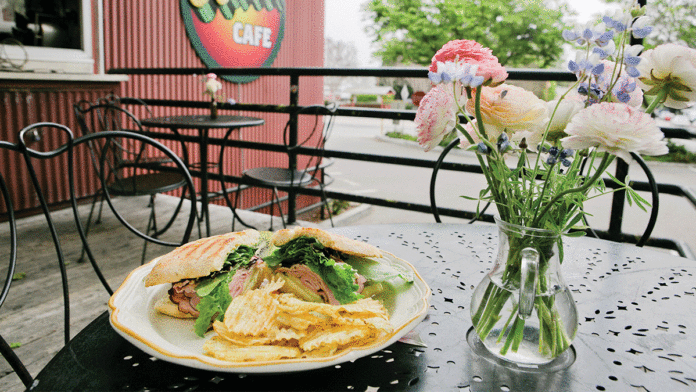
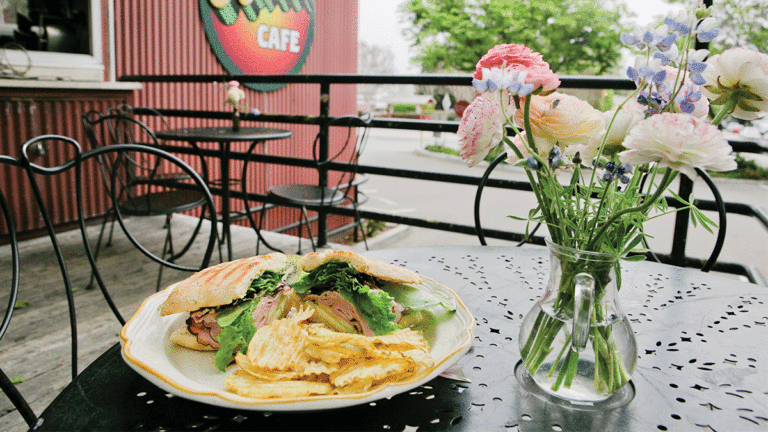
A cozy, homey destination, River Cafe has long been famed for fresh-baked breakfast pastries and fragrant lunch specialties. Recently challenged on all sides—it can’t help that the foot traffic from Oasis has come to a halt, and so has the traffic on River Street, thanks to endless road work—the plucky little terrace eatery continues to hold forth. Organic items line the blackboard listing of lunch and breakfast, e.g. half panini plus a side will run you $12. I decided on a ham, apple, cheddar and Dijon panino plus a side of gorgeous spring salad of gigante beans, paper-thin sliced radishes and baby spinach, and then I turned my eyes toward the Eden that is River Cafe’s pastry display. Farmhouse Apple Cake ($4.5 for a generous slab) nestled prettily in its cast iron skillet. Muffins, seasonal fruit crisps, each in individual white baking bowls, tempted me. Scones with fat strawberries looked, you guessed it, good enough to eat. And I almost caved at the sight of a fresh rhubarb galette ($6). In the end I chose the apple cake, very eggy and custardy, laced with the farmhouse aroma of warm sliced apples. Next time, I promised myself, I’ll try the grilled cheese with pesto panino.
Everything about River Cafe feels like someone’s grandmother’s kitchen. Small in footprint, the tiny space looks out onto the world that wraps around it—Hive & Hum, Patagonia, and the now-defunct Oasis. I always love sitting in the sunny window over coffee and a scone at the high wooden counter that lines two of the cafe’s miniature walls. I enjoy perusing the line of elegant olives, hot sauces and exotic honeys on the wall opposite the main counter.
When I got my lunch order home, we tore into the panini and enjoyed the flavor contrasts of warm ham and green apple, nestling in a blanket of melted cheese and baby lettuces. The attractive salad of beans and radishes proved mysteriously free of flavor, and needed salting and peppering. Another side dish, of roasted Brussels sprouts and walnuts had been infused with a distinct hint of honey—a nice touch that brought out the faint bitterness of the cruciform. The apple cake was also under flavored, very delicate, almost invisible in terms of spicing, making me wonder whether the kitchen is neglecting to taste before presenting their wares in the showcases. Still, it’s a sweet spot for coffees, breakfasts and lunch made with fresh organic ingredients. River Cafe, 415 River St., Santa Cruz. Open daily 7 a.m.-4 p.m.
Mega Sale on the Hill
You might wait all week for Friday happy hour, but serious gardeners in our area wait all year for the UCSC Farm & Garden’s annual Spring Plant Sale, which sets a broad table with the region’s largest offering of organically grown everything! Veggies, herbs, and flower starts, as well as favorite landscaping plants. Check it out—more than two dozen tomato varieties—heirloom, canning and slicing—a wide range of specialty peppers from colorful to hot, lots of lettuces including green and red butter, romaine, and specialty types, Asian greens, broccoli, cabbage, cauliflower, summer and winter squashes, pumpkins, leeks, cucumbers, kale, and you have the picture. If it’s a vegetable, you’ll find it at this giant botanical event.
The Spring Plant Sale happens Saturday and Sun, April 28 and 29, in the Barn Theater parking lot at the base of the UC Santa Cruz campus, corner of Bay and High streets. Members can arrive one hour early each day, but for the rest of us this incredible plant sale runs from 10 a.m.-3 p.m. on Saturday, and 10 a.m.-2 p.m on Sunday.
This issue of Home & Garden is all about finding your space. If you’re a woman in Santa Cruz County who is also a crafter, maker, artist, that space just might be the Craftsmen Collective in Soquel. Founded by a floral designer, this beautifully curated space is a hotspot for the two things we obsess over in these pages: amazing design and the culture around living plants. Read Maria Grusauskas’ story on page 12 to get some insight into one of the most innovative and interesting maker spaces in Santa Cruz County.
If you’re thinking of joining the many people who have joined the Tiny House movement—which is thriving in this area thanks to a number of factors, from environmental consciousness to the high cost of housing—then Richard Stockton’s story about how he converted an Airstream trailer into a happy little home might help you find your space. Think of it as Extreme Makeover: Tiny House Edition. It’s funny stuff, and worth a read even if you’re only really interested in gigantic, towering homes.
If you’re looking for something different in your gardening life, Dig Gardens may be the space for you. Our story in this issue explains how Cara and Will Meyers built their business into the place in Santa Cruz for succulents and other gardening fixations.
Speaking of succulents, Christina Waters is ready to tell you how they can change your life—as in actually shake up how you see the world. Just turn to page 16. And Lily Stoicheff has some suggestions for those who want to combine their love of gardening and fermenting. I’m telling you, this issue is a dilly of a pickle.
The idea of a “progressive split” on local issues is nothing new—certainly the Santa Cruz political landscape is proof that progressives aren’t in the kind of philosophical lock-step they’re often imagined to share.
The debate over the direction of post-earthquake downtown Santa Cruz in the early ’90s could get pretty vicious—especially when it came to issues like chain stores and the sleeping ban. The desalinization issue was divisive a few years ago. But the way the question of what to do with the rail trail has polarized environmentalists somehow seems even more rancorous. The heated battle between those who want to see a cyclist-friendly trail-only solution and those who want “rail and trail” has spun off in many directions, and this week Jacob Pierce delivers the first in a series of stories about the issues involved. The amount of time he’s spent out in the field (as in, literal fields) with activists from both sides is remarkable, and the story reflects that depth of research.
I also want to take a minute to acknowledge the GT staffers, including Pierce, who were announced last weekend as the winners of 2017 California Journalism Awards. He won third place in the Coverage of Local Government category for his story on housing issues, “Building Material.” Georgia Johnson was a finalist in the same category for her article on the defunding of women’s self-defense classes, “Defense Spending.” Lily Stoicheff won a second-place award in the Enterprise News Story category for her cover story “Santa Cruz’s Restaurant Crisis.” And I won second place in the Profile Story category for my cover story on the Santa Cruz Symphony, “Maestro on a Mission.” Congratulations to all!
Thank you for your article on the Santa Cruz American Music Festival, with the sad news that it may no longer be happening, and the fascinating memories and insights of Phil Lewis. This well-organized festival, in its lovely location, will be sorely missed if it is unable to return. The community will have lost a great way to welcome summer, especially lovers of live-music in outdoor venues—not to mention the many businesses that benefited from the Festival directly or indirectly.
The challenges of running a small music festival are well delineated in the article, clearly demonstrating how difficult it is to make a go of it. Those of us working on the Redwood Mountain Faire understand this, since we are facing many of the same challenges of ever-increasing costs. Only the fact that it is a fundraiser for more than 20 local community organizations ($300,000 in the first eight years) helps us deal with that—because that helps motivate over 300 volunteers to help run the Faire, and encourages many businesses to provide discounts and sponsorships.
Also helping are the many local fine arts and crafts vendors, the many children’s activities, and the low cost that make it both a great music festival and a fun family event. We hope that those missing their annual Memorial Day music festival will find that the Redwood Mountain Faire on June 2 and 3, at Roaring Camp in Felton, may help to fill the gap in their lives since we’ve all lost the SCAMF for this year and possibly longer. Thanks to Phil Lewis and the others who made it such a great event.
NANCY MACY | STEERING COMMITTEE, REDWOOD MOUNTAIN FAIRE
Class of ’65
I am a proud member of the first class ever to attend UC Santa Cruz when it opened in 1965. While all UCSC alumni care about their campus, those in my class, the “pioneer” class, have a special affection and sense of responsibility for this unique and beautiful California treasure.
For this reason, we and others were deeply dismayed to learn that UCSC’s administration had agreed to a hastily developed, ill-advised plan to build new student housing on inappropriate, historic, ecologically sensitive East Meadow of the UCSC campus (GT, 3/28). That meadow has been set aside for preservation from the beginning, in every one of UCSC’s Long Range Development Plans.
Accordingly, on March 25, I wrote to Chancellor George Blumenthal to inform him of a national petition to oppose the East Meadow development plan. The petition today has 51,980 signatures from concerned alumni, former employees, local citizens, parents, and grandparents.
Opposition to this ill-conceived plan is spreading rapidly, especially following the March 27 release of a 600-page Draft Environmental Impact Review (DEIR). This preliminary analysis happily identifies several options that are viable and desirable alternatives to destroying East Meadow.
The Chancellor’s response thus far, while explaining the campus process for the plan, unfortunately has not indicated willingness to consider a more thoughtful and deliberative process, offered how irreparable damage can be avoided, or how to address the concerns of these 51,980 people.
Today, therefore, I have written to the Chancellor again to tell him that all signers have been asked to request an extension of the public comment period so there will be time to consider alternative, less destructive sites for development.
Michael M. Gerber, Ph.D. | Professor (Emeritus),UC Santa Barbara
PHOTO CONTEST WINNER
Submit to ph****@*******es.sc. Include information (location, etc.) and your name. Photos may be cropped. Preferably, photos should be 4 inches by 4 inches and minimum 250dpi.
GOOD IDEA
CONSTRUCTIVE INPUT
We’ve all seen the signs in front of road construction that say “Your tax dollars at work.” Santa Cruz County’s taxpayers now have an opportunity to get involved in overseeing such work, as the Regional Transportation Commission is accepting applications from community members looking to serve on the Measure D Taxpayer Oversight Committee. The independent body will review how funds generated by the transportation sales tax are being spent. Measure D passed in November of 2016 with more than 67 percent of voters supporting it.
GOOD WORK
WINGING IT
Young families should know not to play in the street, but apparently not everyone has gotten the memo. A mama duck and her nine ducklings were spotted crossing Highway 1 on Friday evening and causing a minor traffic buildup in the process. Mary Racioppi told KION that the mama stopped in the median, looked both ways and kept on walking. The news website also shared a photo of the adorably nerve-racking incident, and reported that the feathered family made it across the highway safely.
QUOTE OF THE WEEK
There is always a multitude of reasons both in favor of doing a thing and against doing it. The art of debate lies in presenting them; the art of life lies in neglecting ninety-nine hundredths of them.
This issue of Home & Garden is all about finding your space. If you’re a woman in Santa Cruz County who is also a crafter, maker, artist, that space just might be the Craftsmen Collective in Soquel. Founded by a floral designer, this beautifully curated space is a hotspot for the two things we obsess over in these pages:...










 This issue of Home & Garden is all about finding your space. If you’re a woman in Santa Cruz County who is also a crafter, maker, artist, that space just might be the Craftsmen Collective in Soquel. Founded by a floral designer, this beautifully curated space is a hotspot for the two things we obsess over in these pages: amazing design and the culture around living plants. Read Maria Grusauskas’ story on page 12 to get some insight into one of the most innovative and interesting maker spaces in Santa Cruz County.