Here’s the thing: I’m a Charles Dickens geek. A Christmas Carol is probably my favorite novel, for both the economy of its storytelling, and the scope of its story. I have an insatiable appetite for the Carol, and I’ve seen every version, good, bad, and ugly—from Alistair Sim and Bill Murray to Mr. Magoo and the Muppets. Still, glutton that I am for this Dickensian feast, you have to wonder how anyone could possibly find anything new to bring to the story.
The answer is The Man Who Invented Christmas, a delightful fantasia on the writing of A Christmas Carol at a pivotal moment in the life of its author. It’s based on Les Standiford’s nonfiction book on how Dickens, beset by financial and family worries, set out to write and publish a Christmas book in only six weeks. But dry facts are transformed into delicious fiction by scriptwriter Susan Coyne, who combines Dickens’ real life with the volatility of his active imagination—whose impudent characters keep overflowing into every other aspect of his life.
Directed by Bharat Nalluri (Miss Pettigrew Lives For a Day), the movie begins in 1842, where Dickens (Dan Stevens) is treated like a rock star on a speaking tour of America. A year later, after three poor-selling “flops,” he promises his anxious publishers he’ll produce a Christmas story in time for the approaching holiday—although he hasn’t an idea in his head.
With a new house to furnish and an ever-burgeoning family, Dickens roams the London streets in search of inspiration—an elderly waiter at the Garrick Club; beggars in the street. But it’s not until he overhears the young Irish nanny, Tara (winsome Anna Murphy), telling a spooky story to his children, that Dickens gets the idea for a ghost story set on Christmas Eve—as experienced by a greedy, covetous old sinner named Scrooge (Christopher Plummer), who calls the season “Humbug!”
As the story takes shape in his head, Dickens’ characters come alive onscreen, haunting him like Scrooge’s ghosts, occupying his study to egg him on, or criticize his story. (They’re like actors backstage, waiting for their script.) Meanwhile, in the real world, his publishers reject the first stave of his story; Dickens angrily returns their check, pays to publish the installments, and hires illustrator, Leech (Simon Callow), out of his own pocket—while desperately trying to finish the book. The arrival of his perpetually impecunious father (Jonathan Pryce), the role-model for Mr. Micawber, further complicates things.
Coyne is the ideal translator of this material, well-versed in acting, writing and theater. (She created the hilarious, cult Canadian TV series Slings and Arrows, about the tension between art and commerce in a modern Shakespearean theater company.) Her scenes of Dickens at work ring especially true. Every writer has experienced that moment: the idea has come, you’re just starting to commune with your characters, and boom! Somebody knocks on the door. The phone rings. Your story dissolves and you’re back in the real world.
And Stevens is a master of the eye-rolling slow burn as Dickens, reacting to every interruption with teeth-gritting cordiality. He’s great as the physical embodiment of the writing process (which is generally not a spectator sport), stalking around his study, having animated conversations with characters only he (and we) can see.
But what’s most interesting about Coyne’s interpretation—and it sneaks up on you amid the fun and frivolity—is the way Dickens himself is shown to have a dark side that also informs his work. Beneath his unfailingly polite and jovial exterior, he too has begun to forge a chain; it’s not yet as long as Scrooge’s, but redemption must be sought before he can move on.
You don’t have to be an expert on the Carol, or Dickens’ oeuvre, to appreciate the sly gusto with which Coyne and company weave references to Dickens’ world and his work into the fabric of their film. Yet this is a highly original work of holiday cheer: witty, bracingly unsentimental (yet honestly moving), and hugely entertaining.
THE MAN WHO INVENTED CHRISTMAS
**** (out of four)
With Dan Stevens, Christopher Plummer, and Jonathan Pryce. Written by Susan Coyne. Directed by Bharat Nalluri. A Bleecker Street release. Rated PG. 104 minutes.
Two days after the official opening of Dungeness crab season, I found myself happily squished around a table in my friend’s living room with a dozen other guests, reaching for my umpteenth crab leg from a large silver bowl. Using a metal cracker, I shattered the rust-colored shell to reveal the cream-colored meat, and gently pulled a soft chunk free, drawing it through spicy harissa aioli before bringing it to my lips.
Like many Californians, I know this taste well. Dungeness crab is one of winter’s culinary delights, and after a dismal and brief 2016-2017 season in which toxic levels of domoic acid made the crabs unsafe to eat, the opening of the commercial crab season on Wednesday, Nov. 15 was eagerly anticipated by many. My friend and accomplished home cook Tallula Preston was among them and wasted no time in inviting me and a few other lucky friends over for a crab boil. Fresh crab truly is a cause for celebration, and the communal hands-on cracking and peeling creates a festive atmosphere. If you have the means, I highly recommend gathering your “framily” together to welcome back our West Coast crustacean.
Commercial crab season is open until June 30 next year, but the best crabs are available in winter. Dungeness crab is native and abundant in the area, and the Monterey Bay Seafood Watch rates pot-caught crab a “Good Alternative,” so now is an opportunity to eat plentifully and support local fishermen. H&H Fish Co. in the Santa Cruz Harbor, Reel Good Fish in Moss Landing, Stagnaro Bros. on the Wharf, and Fish Lady in Soquel all purchase crab from local fishermen, as do most of the local markets.
As guests tore into the seasonal treat, an attending East Coaster posed the question of which was better—Atlantic blue crab, lobster or Pacific Dungeness. Most quickly decided there was no contest.
For Preston, as for many other locals, it’s personal: “I love seafood, and to me, crab is our seafood here in the Bay Area and the Central Coast,” she says. “Dungeness crab is one of the best things in the world, and we live in a place where it’s so plentiful. In my family, it’s always been our tradition to eat it around Thanksgiving and Christmas. As much as I love lobster, it’s not my home crustacean.”
When you taste a superb Riesling, such as the one made by the newly opened Integrity Wines, it’s as if the clouds parted and delicious nectar rained down. Integrity’s Riesling impressed me greatly when I tried it at a food and wine event in October.
Riesling can be a bit of a black sheep—and its reputation got rather ruined some time ago with lots of tawdry stuff on the market, but this one made by winery owner Mark Hoover is one of the best Rieslings I have tasted in a long time. I contacted Hoover and he tells me that his wines have just gone into Deer Park Wine & Spirits—a top-flight liquor store in Aptos which holds wine-tasting events with guest winemakers—usually for around $3. From 4-7 p.m. Friday, Dec. 8 the winemaker will be Mark Hoover of Integrity.
Grapes for this 2016 Riesling ($20) were harvested from Santa Lucia Highlands, and the beautiful flavors and aromas result from two different pickings. “During fermentation,” says Hoover, “both lots gave off an amazingly Jolly Rancher apple candy aroma, and I was worried I had screwed the wine up. Fortunately, that aroma gave way to a much more complex set of aromas which we get to enjoy.”
Rieslings can be rather sweet, but that sweetness means it pairs well with spicy food such as Indian or Asian. But for me, this honeysuckle beauty is perfect just by itself.
Integrity Wines, 135 Aviation Way, Suite 16, Watsonville. 322-4200. Tasting room is open Noon-5 p.m. Saturday and Sunday.
Holiday Open House on the Summit
Celebrate the holidays at Burrell School, Loma Prieta and Wrights Station wineries—complete with live music, food vendors, wine specials and artsy crafts. Fashions by Lula Roe, Shelley’s Biscotti and live music at Burrell School. At Loma Prieta Winery, there will be light complimentary appetizers, a chance to taste a vertical trio of Karma Vineyard Pinotage, and a free reindeer cork ornament with any three-bottle purchase. At Wrights Station, enjoy holiday jazz by Bob Burnett, along with food and vendors, including Wine Charms Designs by Steff. The festive event is from noon to 5 p.m. on Dec. 9 and 10.
The lighted boat parade is back, and more lit than ever: this year’s theme is “Holiday Magic!” One of the most anticipated holiday events of the year, mariners decorate their boats with lights and holiday decorations and parade them across the harbor for your oohing and aahing pleasure. There are few things more magical than watching the festooned boats glide through the harbor on a cold December night. The event will happen rain or shine, so grab a hot chocolate and a blanket and get there early for a good seat. The parade can be viewed from either side of the harbor, so feel free to stroll along the channel, too.
INFO: Saturday, Dec. 2. 5:30 p.m. Santa Cruz Harbor, 135 Fifth Avenue, Santa Cruz. santacruzharbor.org. Free.
Art Seen
Christian Guenther Glass Exhibit
Among artisan crafts, glasswork is in a category of its own. It has got to be one of the riskiest crafts ever—not only is the final product incredibly breakable, but the entire process of molding glass requires temperatures above 2,550 degrees Fahrenheit. Christian Guenther will showcase his nearly 30 years of working with glass beginning this First Friday. His work is based on our coast and other natural environments, and the show will feature around 50 glassworks and sculpture. INFO: Opens Friday, Dec. 1 and runs through Monday, Jan. 1. Opening reception Friday, Dec. 1, 6-9 p.m. Felix Kulpa Gallery, 107 Elm St., Santa Cruz. felixkulpa.com. Free.
It’s gift season, and what better gift than a book? The Scotts Valley chapter of Friends of the Santa Cruz Public Libraries is holding its annual Holiday Book Sale for all of your gift needs. There will be gently used books, CDs and DVDs. There are sure to be some real literary gems, plus all proceeds benefit the Scotts Valley Friends group.
INFO: 10 a.m.-4 p.m. Scotts Valley Branch Library, 251 Kings Village Road, Scotts Valley. fscpl.org. 427-7700. Free.
Sunday 12/3
Pleasure Point Holiday Fair
Did you miss Black Friday or Small Business Saturday? Don’t fret, there are plenty of opportunities for you to support local businesses, like the Pleasure Point Holiday Fair. There will be artisan crafters from across the county and beyond, for all of your handmade soaps and candles needs. If you’re looking for something a bit more permanent, check out the reclaimed wood decor and home goods, and maybe snag some holiday salted caramels for good measure.
The Tannery is one of the most creative hubs in the county, and their Winter Arts Market is a prime example. The annual event features around 30 Tannery artists, including ceramicists, jewelers, sculptors, framers, and musicians. Bike Santa Cruz will host a Light Up the Night bike ride, light-up costumes are encouraged and free bike lights are provided (while supplies last). While you’re there, check out the newly opened cafe, which will offer $5 kids meals, s’mores, cider and hot chocolate.
INFO: Friday 4-8p.m. Saturday and Sunday 10 a.m.-4 p.m. The Tannery Arts Center, 1010 River St., Santa Cruz. tanneryartscenter.org. Free.
Friday 12/1
‘Melissa, So Far’
Gateway School believes there isn’t enough conversation around gender identity, particularly at a young age. With this in mind, Gateway’s middle school production of Melissa, So Far tells the story of a transgender fourth grader who feels disconnected from the body she was born with. Originally based on the novel, George by Alex Gino, the main character is initially bullied and isolated because of her identity, but finds solace and support in her friends and family. The performance takes aim at and promotes the important conversation around gender identity at all ages. Support a greater conversation around transgender identity and meet the author and playwright during its second ever performance.
INFO: Shows at 1 p.m. and 8 p.m. Broadway Playhouse, 526 Broadway, Santa Cruz. gatewaysc.org. 423-0341. Free. Limited seating, advance registration recommended.
[dropcap]N[/dropcap]othing that Andy Weir says in his calm, understated, chuckling-at-himself voice can begin to explain how this unassuming software engineer from Livermore—just another productive drone in the Silicon Valley hive for countless years—turned out to be the One. He has no idea himself. He keeps waiting for the chiming of his alarm to jolt him from what must surely be a dream.
None of this could possibly have been real—not the giddy experience as an unpublished writer posting the chapters of his geek-out novel The Martian on his personal website, one by one, àla Charles Dickens, and finding that thousands of people were grabbed by his story and wanted more; not a sudden publishing deal with Random House; not No. 1 bestseller status, not the movie starring Matt Damon. And not the chance to publish his second novel, the new moonscape crime drama Artemis.
“It was a charmed existence,” Weir told me in a recent phone conversation, with a combination of openness and self-mockery. “It was really awesome. I tried to be as grateful as I could at the time because I told myself, ‘It’s probably not going to happen again.’”
There was silence over the phone as he let it sink in that he was utterly, painfully sincere in having no idea if lightning could ever strike twice for him.
“Of course I’ve got the ‘imposter syndrome’ thinking. I’m like: I don’t know what I did right. Really, I don’t know what the hell I’m doing. All I can do is write stories that I myself would enjoy reading.”
Weir is onto something there. If more writers would focus on telling stories they themselves wanted to read, the world of writing would do a much better job of connecting with readers, absent many an unfortunate detour through the landscape of the mannered, the trendy, the showy, the unreadable. It’s like cooking: A good place to start is whipping up a meal that tastes delicious to you. At least one person is going to be happy—and, chances are, others will as well.
Not every fan of The Martian loves Artemis, which surged to the top of the bestseller lists as soon as it was published in November, reaching No. 6 on the New York Times hardcover fiction list its first eligible week, and it might be a while before any undergraduate seminars focus on Weir’s literary merits. He’s not a once-in-a-generation literary talent like Jennifer Egan (Manhattan Beach), Viet Nguyen (The Sympathizer) or Nathan Hill (The Nix). Andy Weir is the One because he’s given us a feel-good reminder of the power of the imagination, and he can inspire anyone and everyone to pursue their own writing, maybe even becoming rock-star huge.
Weir has talent, but mostly he has ideas. He has no fancy degrees, no privileged bond with a great-writer mentor; he’s your basic writer next door.
“One of my main influences was the movie Chinatown, which is really about the growth of a city and everything that has to happen for that to move forward. When I was working on Artemis, I kept thinking: this is similar to Chinatown. So I watched the movie again.” — Andy Weir
Weir has gone from nowhere on the literary map to front and center, all because he’s a guy who loves stories, a guy who believes in the power of what used to be called daydreaming, and his amazing run of success can and should serve as inspiration to anyone with an idea, anyone wanting to let their mind race, anyone who believes in the power of an imagination powered by a sense of fun and unfettered by the closed-window heavy breathing of writing-seminar “notes” or trends in writing.
Weir is the One, as well, because he’s a perfect test case for the way the internet now makes it possible for an individual with passion and stamina to put out a story that might resonate with others. He’s the future of publishing, or at least its avatar, not because of his prose style or his flawless psychological insights into his characters, but because he understands the importance of taking a reader for a ride. (Cue up appropriate Jimi Hendrix lyrics.)
One of the pleasures of reading an Andy Weir novel is the certainty we have that we know exactly who Weir is, just from the story he tells. Yes, like Mark Watney, the main character in The Martian, and Jazz Bashara, the straw that stirs the drink in Artemis, he’s a sarcastic, wisecracking kind of guy. Yes, he loves science, and puts in the time to get it right. I even had the feeling I could picture Weir in his childhood, out in a California field somewhere, firing off Estes model rockets into the sky.
“Did you ever play with model rockets?” I asked him, just for fun, knowing full well he’d say yes.
“Estes! Big time!” he said. “I designed my own.”
Once again, in Artemis, Weir soars. He blasts off, delivering a breezy joy ride sure to appeal to a wide audience, especially anyone who shares his enthusiasm for what he calls his “holy trinity” of major influences: Robert Heinlein, Isaac Asimov and Arthur C. Clarke.
Weir will be in conversation with UCSC professor of Earth & Planetary Sciences Francis Nimmo at Santa Cruz High School on Tuesday, Dec. 5.
I don’t read much science fiction nowadays. Actually, as the father of two small girls, busy as the co-director of the Wellstone Center in the Redwoods writers’ retreat center in Soquel, I don’t get much time to read books at all. So when my older brother Greg, a lifelong fan of science fiction, emailed me a couple years ago and told me I needed to read a book called The Martian, I ordered it right away—and burned through it in a rush of pure joy.
Weir’s follow-up is a far more ambitious undertaking. For me, it didn’t have quite the feel of uninterrupted dream that The Martian did, pulling you along inexorably, but in some ways I like Artemis better. It doesn’t feel like a one-off. It feels like a conduit into an entire world of revving imagination, akin to the Heinlein, Asimov and Clarke I read in my teens. For me, this kind of storytelling has power and social relevance. A lot of perspective can be packed into stories that have the liftoff of science fiction.
Artemis is a tale all about the kinds of power plays that take place when deals have to be made to handle population growth despite scarce resources. Sound relevant and contemporary? Californians understand this very well, and setting the story on the moon in some ways harked back to an earlier era of expansion in this state.
“I wanted the book to be about mankind’s first city that isn’t on Earth, and to me it was very obvious that that was going to be on the moon,” Weir told me. “Colonizing Mars before colonizing the moon would be like if the ancient Britons colonized North America before they colonized Wales. I love stories that take place in off-world colonies. There’s the frontier spirit you see in TheMoon is a Harsh Mistress, but I also thought of lesser-known Heinlein, like Farmer in the Sky, which is set on Ganymede. We’re basically talking about a frontier society in space.”
Which takes us back to California. As the novel was taking shape in Weir’s imagination, he found himself drawing inspiration from movies even more than science-fiction novels, specifically a 1974 classic starring Faye Dunaway and Jack Nicholson, and set during California’s water wars of the early 20th century.
“One of my main influences was the movie Chinatown, which is really about the growth of a city and everything that has to happen for that to move forward,” Weir says. “When I was working on Artemis, I kept thinking: this is similar to Chinatown. So I watched the movie again.”
It’s a great movie, with a script from Robert Towne that’s considered one of the best in the history of cinema. No one who has seen it will forget the younger Nicholson with tape on his nose, playing Jake Gittes. I highly recommend reading the Weir novel and then watching the movie again as a way to explore how one creative work can infuse and inform another. Both have about them a feeling of gradually uncovering deeper truths.
In the case of Artemis, the drama also hinges on a power play over resources. It’s complicated, but here’s the basics of the setup: Jazz Bashara is estranged from her father, a master welder, who like her lives on a small colony on the moon called Artemis. She works as a porter—a low-income, low-profile job that serves as a useful cover for her other occupation: a large-scale smuggling operation with the help of an Earthside pen pal she’s been close to for years. Through her smuggling operation, she meets a wealthy businessman named Trond Landvik who offers her a million credits to engage in some major sabotage—an insanely difficult mission that she, wanting the money, decides to accept. She comes up with a good plan, and almost pulls it off, sabotaging all but one of the automated mining harvesters operated by Sanchez Aluminum. Then she goes to see her wealthy businessman client—only to find him murdered. It turns out that the enforcer of a Brazilian crime syndicate—which, this just in, owns Sanchez Aluminum—has murdered the businessman and is now after her, only he’s a little off his game in the low gravity of the moon, putting him at a disadvantage. By teaming up with her estranged father, and a lovable geek named Martin Svoboda, who becomes an unlikely love interest, Jazz brings her schemes to an unlikely conclusion. Anyone who says they saw it all coming—the kind of hair-ball analysis regularly coughed up online—is full of it.
“I would love for Artemis to be a series. I’m working on the next book already.” — Andy Weir
Weir’s most daring choice with Artemis was choosing to narrate his book in the voice of his female lead character, Jazz. Even many fans of the book have some issues with a middle-aged white guy trying to write in the voice of a woman in her 20s. Writing in the New York Times, for example, N.K. Jemisin went glib: “She talks and acts like a Middle American white man.” Even Kirkus, in a swipe I have to call bizarre, took a shot at Weir for thanking his publisher and U.K. editor and other women in his acknowledgements “for helping me tackle the challenge of writing a female narrator.” What’s wrong with that? Kirkus thought acknowledging help made it sound “as if women were an alien species.”
Hold on there. Reviewers often don’t know much about how books actually get written—they’re more the sit-back-and-snipe types—but fine-tuning voice takes work, and one always asks for help. If you’re narrating a book with a character from England, and you yourself are from California, you get help to hunt for anywhere you can improve—that doesn’t mean you think people from England are an “alien species.”
Weir couldn’t win, in other words, but he knew that going in—and he’s disarmingly open about how harrowing it was to go with his impulse to build the book around a young woman. “That was probably the biggest challenge in the book for me,” he told me. “I don’t know if I did a good job or not. Some people have strong reactions, saying, ‘This is horrible. Andy Weir doesn’t know anything about women.’ There are demographics that would never accept a female lead written by a man under any circumstances—you may not have a female lead written by a man, period.”
He’s right about that, of course, but he’s surely going to piss some people off by saying so. It probably helps his cause that he’s matter-of fact-and mild about the observation—not angry, not combative, just accepting of conditions, like an engineer planning a rocket launch.
“I was interested in developing a female character who was a flawed person, with shady morals, who makes bad life decisions,” he says. “These are all character flaws that if I had applied them to a man, people would say, ‘OK,’ but applied to a woman, some people say, ‘All women aren’t like that.’ The Martian had no character depth. No one accused it of being literature. This time, I wanted deeper characters. No one’s going to talk about it with the Pulitzer committee, but I hope I stretched myself.”
They are interesting quandaries. Weir wrote the book knowing full well that given the proclivities of Hollywood producers, and given the success of the film version of The Martian, the new novel he was writing had a decent shot at hitting the big screen. So in writing a vehicle for a sarcastic, flawed young woman character who also happens to be smart, resourceful and complex, he was working in a small way against the historically male-dominated tradition of science fiction, which thankfully has slowly begun to diversify. That said, of course any author is fair game, and if people find some of Jazz’s lines clanging, so be it.
Here’s a pretty good test case: “I stared daggers at Dale. He didn’t notice. Damn, I wasted a perfectly good bitchy glare.”
I thought the line was funny. I thought it came through that Weir was having a lot of fun with his writing. Then again, I am a reader of a similar age and background to Weir himself.
The novel has been optioned, and I’d be stunned if it didn’t hit the big screen with a young actress nailing the part. In fact, I think we’re going to be seeing a lot of Jazz Bashara for years to come. Weir definitely stretched himself here, and I for one am glad he did.
“I really tried to convey Jazz’s flippant attitude,” he said. “It was much harder to write Artemis than The Martian. The Martian was so much more simple. It was a lot of math problems, and I’m good at that. Complex human interaction is more challenging. Mark is more or less flawless. He makes errors, but there’s no moral ambiguity to him. He’s a guy with no personality flaws other than being snarky sometimes, where Jazz has made very bad decisions and most of her problems are self-inflicted. She had everything she needed to get a start in life—a parent who loves her, an education. She still managed to piss all that away.”
Some readers are put off by her endless wisecracking and sarcasm, but again, on the screen that could work out just fine.
“She has a sarcastic sense of humor,” Weir says. “That’s just me. I think everything I write is going to be through that lens, because that’s just who I am … I don’t have an idea what a character looks like. I don’t get a visual. Like when I wrote The Martian and finished, I couldn’t have told you what color Mark Watney’s hair was. Like with Jazz, I don’t see her. I know she has olive skin. I’d like her to be played by a woman who has that skin tone.”
As for what we can expect next from Weir, he’s not going anywhere. The ideas keep exploding out of his active imagination.
“I would love for Artemis to be a series,” he told me. “I’m working on the next book already, just a few thousand words so far. I’m working on that, but don’t want to get too enthusiastic yet. What if people don’t like Artemis? If it goes over well, I can see a whole series of books.”
Andy Weir will read from and discuss ‘Artemis’ in conversation with Francis Nimmo, UCSC professor of Earth & Planetary Sciences, at 7 p.m. on Tuesday, Dec. 5 at Santa Cruz High School, 415 Walnut Ave., Santa Cruz. Hosted by Bookshop Santa Cruz, ticket packages are $29.43, and include two tickets and one copy of the book. bookshopsantacruz.com, 423-0900.
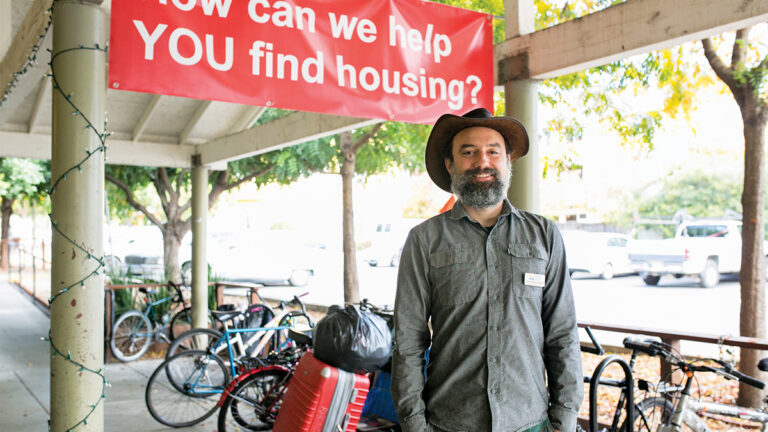
Mayor Cynthia Chase remembers sitting down earlier this year with teachers, parents, and students at Mission Hill Middle School to discuss Santa Cruz’s rising housing costs.
The students on the other side of the table that evening ran through a long list of beloved teachers and after-school employees who had all left over the years—each squeezed out by steep rents in a quickly evolving town.
“It’s really the fabric of the community that changes,” says Chase, who just this week wrapped up her year-long listening tour, during which she talked housing with locals at churches, in breweries and in their homes—in groups as small as three, and as large as 50.
Within the housing economy, Chase says teachers fall into an awkward gray area. Many make slightly too much to qualify for the deed-restricted housing created by the passage of Measure O 38 years ago. And yet, she explains, “they make just enough that they can’t afford the market rents.”
Here in Santa Cruz, Mayor Chase herself is a renter who once lived in an affordable Measure O unit. As her one-year term as mayor draws to a close, Chase’s tour is scheduled to culminate in a discussion during the Santa Cruz City Council meeting on Tuesday, Dec. 5 to examine the state of housing locally. A 40-page staff report will be online by Wednesday, Nov. 29, laying out everything Chase heard from the community.
She says that possible solutions may include revisiting fees for in-law units—also called accessory dwelling units or ADUs—and orienting new housing to be closer to transit. And the City Council, she says, supports finding new revenue to fund affordable housing, now that redevelopment funding has dried up. Former mayor Don Lane and former county treasurer Fred Keeley are working on a possible 2018 bond measure to do just that. Meanwhile, renters from the Lower Ocean neighborhood are clamoring for rent control, as well as increased protections for renters.
Behind all of this is a question with an answer as important as it is elusive: What are the best affordability rules for new housing developments?
Many Santa Cruzans say the current requirements are ailing an already fragile housing ecosystem, either because the rules are too loose or too strict—depending on who you ask.
When it first passed in 1979, Measure O required that 15 percent of housing units in a new complex be reserved as affordable. But once construction slowed years later, the City Council loosened those requirements to let developers pay an “in-lieu” fee to fund future affordable housing projects instead.
Worried that stiff requirements are yet again strangling the housing supply, the planning department has floated the idea of reducing the requirement, possibly down to 7.5 percent, to better meet pent-up housing demand.
Loosening those requirements may sound like a peculiar way to make housing cheaper, but Lee Butler, the city’s planning director, says that in order to bring down rents, the city has to meet demand and thus build more housing—even if it isn’t all “affordable.” And the tighter the city’s regulations, Butler says, the more difficult it is to build anything. “It’s going to take a lot of new housing to come online to create a dip in price, because we’re in such a deficit,” Butler says.
Maybe so, but City Councilmember Chris Krohn campaigned on the opposite idea when he successfully ran for election last year.
Krohn believes that new housing developments should make 25 percent of their units affordable, increasing that share from 15 percent. And he says it’s time to abolish the in-lieu fee, instead forcing developers to actually build their required affordable units. Far too little of the city’s housing is deed-restricted, he says. “Not all housing is equal,” Krohn states. “Building anything isn’t the goal.”
Krohn isn’t the only one suggesting that the city refuse to allow developments that don’t prioritize low- and middle-income tenants.
Pushing the envelope, attorney Gary Patton went so far as to call for a 50 percent affordability requirement in any new development, via a Santa Cruz Sentinel column earlier this month. Developer John Swift called that suggestion “asinine” during the Monterey Bay Economic Partnership’s State of the Region conference.
But Patton insists he is serious—even though he knows it’s a big ask. The former county supervisor admits that such a change could make it so incredibly expensive to build housing that nothing would ever get built again, although he thinks that’s OK because he doesn’t believe new housing construction could ever make a dent in affordability.
The evidence, however, shows that line of thinking isn’t true, says Sibley Simon, an affordable housing advocate. Simon has been deconstructing the data for a paper he’s writing about the housing in the region. He found that for a two-year period starting in 2013, virtually no new units got built, and any miniscule housing construction was likely canceled out by houses getting turned into vacation rentals. During that period, rents climbed 20 percent, Simon says, creating what he estimates to be an increase in demand of 2,500 units countywide.
Simon believes it would take fewer than 5,000 units—affordable or not—to get the county back to being “merely a very expensive place to live, as we were 10 years ago.” Even if developers built half that, Simon says it would make rents more manageable for renters.
Statewide reports have come to similar conclusions about the need for more housing construction because building has not kept pace with California’s population growth.
A report from the state’s Department of Housing and Community Development indicated that California needs to build 180,000 units per year for the next 10 years, essentially echoing similar findings from the state Legislative Analyst’s Office.
Of course, the reasoning behind Patton and Krohn’s thinking is simple enough—tie developers’ hands in hopes that it forces them to build more housing. But the logic behind the alternative is equally straightforward: There is too much competition for not enough housing, and so several hundred new units would provide some much-needed breathing room.
Worried about traffic and overcrowding, Krohn says the city should focus on other approaches, like building teacher housing. Superintendent Kris Munro tells GT that the city’s school district is currently looking into workforce housing with a feasibility study. While Simon supports that model, he says there’s a bigger ecosystem too that Santa Cruz can’t lose sight of.
“I’m totally in support of housing for teachers, but we need our housing market in general for a wider variety of people as well,” Simon says. “Still, if we get great housing for teachers, then they get that housing, and there’s a little less competition for the other housing that people can barely afford out there.”
Krohn realizes that if Santa Cruz tightens its affordability requirements, some for-profit housing developers may walk away, but he believes that’s all right because nonprofit developers—who are comfortable with slimmer margins—will take their place and step up to the table.
But here’s where that gets complicated: Simon, the executive director of New Way Homes, fits that profile perfectly. He’s busily preparing to submit a plan to build a 100 percent affordable complex within the footprint of Homeless Services Center. But even Simon says that there’s only so much nonprofit developers can do. Nonprofit developers, like himself, rely on grants to make their projects pencil out, and there’s only so much government cash to go around, he says.
When it comes to affordable housing, politicians and advocates often kick around the term “sweet spot”—the ever-elusive magical percent that would maximize affordable units without making developers walk away. Simon thinks that number could come in lower than the current 15 percent requirement, as does Don Lane, another longtime affordable housing advocate. However, they both say that whatever the number, it should have some flexibility, with special incentives—for instance, if an apartment building is going to be much bigger, it should have a bigger fraction of its units listed affordably. Or perhaps, Simon says, buildings with more affordable units should not be held to quite the same burdensome parking standards.
But Patton—a proponent of tightening, not loosening, the requirements—feels the typical laws of supply and demand don’t apply here in Santa Cruz when it comes to housing. The town can build as much as it wants, he says, and all of those homes will get snatched up by out-of-towners, who are either looking to commute to jobs in higher-paying Silicon Valley or use their new places as second homes.
Simon says the answer here is to build the kind of diverse housing portfolio that Santa Cruz wants to see—smaller units for locals, and not vacation homes by the beach. And anyway, the problem may not be unique to Santa Cruz. The Legislative Analyst’s Office found that a 10 percent increase in rents in one county leads to a five percent increase in the neighboring county.
Patton says living in a desirable community like Santa Cruz carries an unfortunate curse. He notes that 2015 research out of the University of British Columbia found that startling numbers of homebuyers in Vancouver were coming from Asia, and condominiums there began to sit vacant, almost by the city block.
Since then, however, Vancouver has created a tax for empty housing units, as well as on foreign homebuyers. Butler says that, on the suggestion of local activists, city planners are looking into both of those ideas.
“Different country—and the legal questions would need to worked out,” Butler says. “But it’s great that we have an involved community that’s seeing these things and saying, ‘Hey, this is something we should be thinking about.’ The more people get involved, the more of a difference we can make.”
Mayor Chase has a lot of memories from the past year’s listening tour. Some people cried as they recounted their struggles. Chase was frankly surprised that, during the whole year, she did not hear anyone say that Santa Cruz should not allow any new development whatsoever. The question is clearly where to put the development. And when pulled together, Chase says, the varied comments on housing construction are difficult to view through one big lens.
“Nobody said ‘nowhere,’ but then it was ‘not here—somewhere else,’” Chase says. “Where that somewhere else is, I don’t know. Because when you add up those ‘not here’s, it ends up being nowhere.”
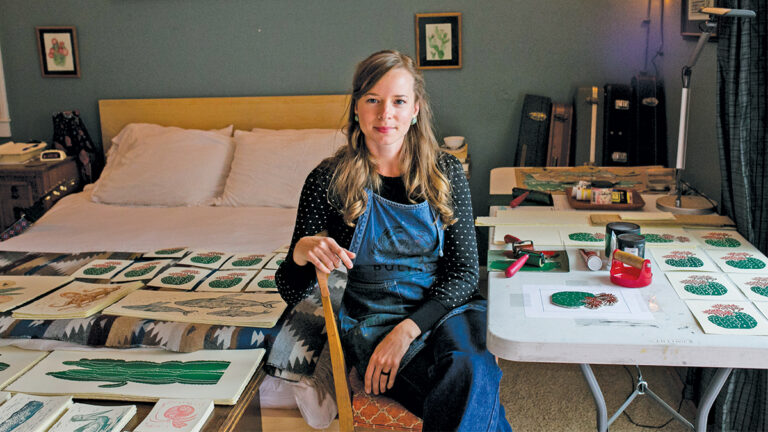
In a small room filled to the brim with beautiful botanic prints, frosted light bulbs and scented candles, Lili Arnold is making magic happen. Though succulent season is over and cacti have gone dormant for the winter, they are Arnold’s printmaking specialty year-round.
Specializing in botanical printmaking, Arnold can make anywhere from 15-50 prints daily while also maintaining her website, numbering and packaging her work, and freelancing. She’s a bit of an anomaly—at only 28, she’s made printmaking into a full-time, successful career from the comfort of her bedroom.
The remarkably tidy 300ish-square-foot studio-bedroom is home to countless paint tubes, around 50 linocut blocks and several mandolins, each of which fits comfortably in its place. Cozied up with a knit sweater and herbal tea, Arnold sits at a makeshift portable table next to her bed.
“Most people are surprised I work out of this room,” she says, looking around it. “I have to be very careful about putting things away and cleaning up so that the clutter doesn’t get out of control.”
But don’t be fooled by the immaculate cleanliness of the carpet or her perfect wavy hair; Arnold is a very busy woman. She’s prepping for the holidays, she explains, apologizing for the prints sprawled across her bed and about the room. With several large protea susara prints hanging over her sink, it’s a wonder she manages to brush her teeth.
“I’m going to start running out of space,” she says. “I am already maxing out here.”
She gestures around the room as she explains how what began as a hobby unexpectedly blossomed into a career. Since graduating from UCSC with an arts degree in 2011, she spent several years in graphic design and textile printing and only took up printmaking as a weekend creative outlet. Amid a pop culture obsession with drought-tolerant plants, her work garnered more interest, and and she eventually began selling it in local shops and online.
Since her work isn’t traditional fine art, she’s her own salesperson—no Sotheby’s here. She admits readily available art online may be taking away some value from fine art, but says that overall, art is much more accessible than it’s ever been. An online presence can make or break a career—and in her case, having more than 100,000 followers on Instagram (@liliarnoldstudios) has its perks. The majority of her direct sales come from social media.
“That is the only reason why I have been able to do this, because of Instagram,” she says. “The only way I make direct sales is by promoting on Instagram and Facebook. I don’t know what I would do without it.”
With her worldwide clientele, it’s fair to say Arnold has made a pretty big name for herself. Her followers ask her for advice on materials and processes, and she often meets other artists through her social media pages. She’s also expanded her wholesale retail to 15 locations from California to Colorado. Her most recent and popular cactus series showcases stunning iridescent blooms diluted by the symmetry and simplicity of their host cactus or succulent.
She’s done several series of prints, including her first ocean series, and multiple commissioned band posters and freelance projects. She says she’s looking forward to starting new projects, and is considering featuring the banksia plant, known for its spikey, woody foliage and bulbous blooms.
“It would be cool to start an entirely new series that’s graduated from the cactus, something a little more complex, a little more interesting,” she says, sipping her tea.
As the daughter of two artists, she says it was inevitable she would go into some creative arts field, though she acknowledges that she didn’t think her hobby would become a career, since the job landscape for art majors is a bit nebulous. But technology influences everything it touches, and art is no exception. Arnold hopes to take a brief break from social media to get back to her creative roots, but can’t stay away for too long, since her sales and promotion depend on it.
“Social media and technology are making art more accessible for people,” she says. “Whether its Etsy or Instagram, social media is giving artists a better chance to be seen and make a career.”
For more information, or to purchase prints, visit liliarnold.com. Arnold will also be selling her work at upcoming holiday fairs, including 5 p.m.-9 p.m. Friday, Dec. 1 at Cosmic Design Holiday Fair, 115 Cooper St., Santa Cruz; 11 a.m.-5 p.m. Sunday, Dec. 3 at the Pleasure Point Holiday Fair at Opal Creative Co., 3912 Portola Drive, Santa Cruz; 11 a.m.-5 p.m. Sunday, Dec. 10 at Lúpulo’s Sip and Shop Event, 233 Cathcart St., Santa Cruz; and 11 a.m.-7 p.m. Saturday, Dec. 16, at the Winter Makers Market at Alibi Interiors Warehouse, 802 Estates Drive, Aptos.
Valerie June’s long, thick dreadlocks lead some people to expect the Jamaican accent of a reggae singer. With just a few words in her thick Tennesseean accent, however, June makes assumptions evaporate, and opens the door to questions about what kind of music she plays.
As she explains it, she’s a songwriter, first and foremost. Her songs journey through folk, blues, soul, country and R&B, so she could broadly be called an American roots artist. But her particular sound—a soulful, acoustic, porch-jam style—is like nothing else. One reviewer remarked that June has the “most strikingly individual delivery [he’d] heard in ages.”
But June sees it as simply writing songs in whatever form they come through.
“I let the song be what it is,” she says. “I don’t say, ‘OK, this has got to be a blues song because I’m a blues singer.’ That’s boring. If I write a rock ’n’ roll song, it’s a rock ’n’ roll song. If I write a gospel song, it’s a gospel song.”
Born in Jackson, Tennessee, June grew up surrounded by music. She’s always loved it and she “just soaked up every single type.” At 21, she picked up a guitar and started writing and performing. At 35, she now plays the banjo and lap steel guitar, as well.
In 2013, the Brooklyn-based June became a global sensation with the release of her major label debut album, Pushin’ Against a Stone. She had previously self-released two albums, but Pushin’ was an overnight sensation 10 years in the making. June found herself the focus of tastemaking publications and shows, including the New York Times, the New Yorker, Rolling Stone, NPR, The Tonight Show and Austin City Limits. She even performed at the White House at the invitation of former First Lady Michelle Obama.
June found herself very busy, very quickly—and for good reason. Pushin’ is a masterclass in artistry, originality and authenticity. The album remains utterly fresh.
This year, June dropped her sophomore release, The Order of Time. Where some artists who make big splashes fail to deliver on their sophomore release, June went deeper into the magic that makes her unique, and emerged with a record that leaves listeners wondering where her talents end.
The Order of Time sees June sharing stories of her family and life. The opening tune, “Long Lonely Road,” is a sparse and quiet song about the sacrifices her ancestors made and the journey through hard times to better days. It sets the tone for an album that’s been called her best work yet.
Recording the new album was a chance for June to step into her own vision and courage. On Pushin’, she was new to the big business of recording and producing. On The Order of Time, she was in familiar territory.
“Pushin’ was my training ground,” she says. “It was me going into the room and learning how musicians talk to each other, how to speak to an engineer, what the language is that producers use with artists.”
On The Order of Time, June was more confident making decisions and directing the sound. She told the musicians what she wanted—and if it failed, they tried something else.
“I was more fearless,” she says.
An open-hearted fearlessness runs through June’s music. She’s acutely aware of the transience of life and the beauty of everyday moments. The Order of Time is an exploration into the big picture questions of life: existence, loss, family, joy and spirit—themes she’s drawn to in the music she loves.
“When I listen to my favorite songs, that’s what I hear,” she says. “Every single moment of this life is special. When you’re in love or when you’re in sadness; when you’ve got the blues, when you don’t have the blues. All these things are really special.”
For June, music is part of the animating and connecting force between all of us humans just trying to figure things out.
“It all seems to be a spiritual thing to me,” she says. “If I get out of my body and just listen to the songs, it’s a spirit talking to another spirit …These songs come from the spirit world—they just exist out there in the ether. Bringing them into this body and sharing the messages that they have is kind of my job.”
Valerie June will perform at 8 p.m. on Sunday, Dec. 3 at the Rio Theatre, 1205 Soquel Ave., Santa Cruz. $27/gen, $40/gold. 423-8209.
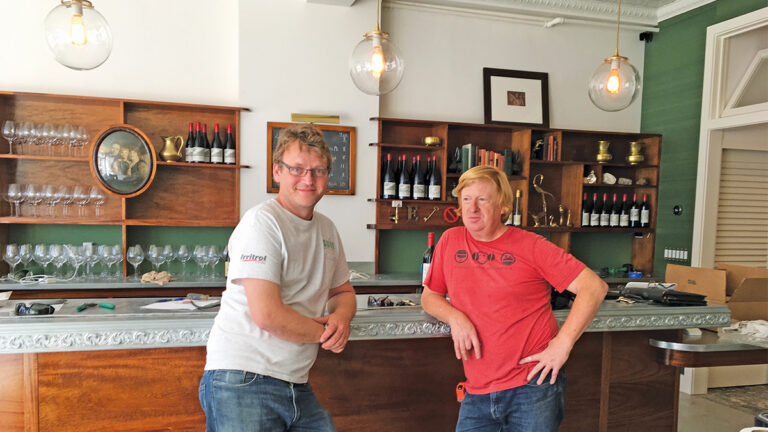
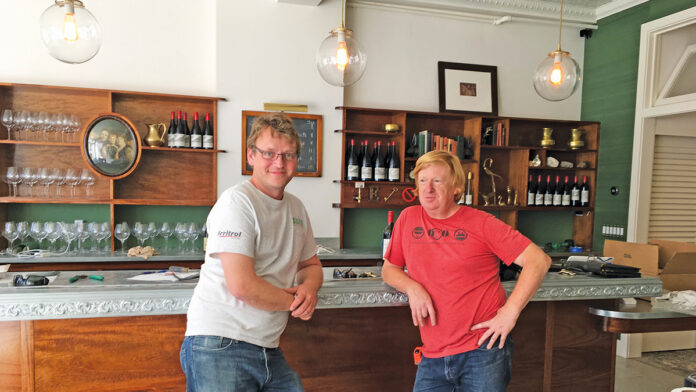
An antique mirror in elaborate gold frame, circa 1880, approximately 12 feet high, holds its dramatic own at the far corner of the new Birichino Winery Tasting Room, a study in 19th century Wild West avant garde decor. Forest green wall treatment flatters the curved mahogany heartwood bar bordered with rare pewter trim. A Buddha perches next to a vintage hand-tinted oval portrait, and sophisticated spherical light fixtures are suspended from the pressed tin ceiling. An astonishing retro flourish—with plenty of postmodern wit—in which to celebrate, pour, taste, and enjoy the vibrant line of Birichino wines. At long last the tasting room is now open—still a work-in-progress, mind you—but open to help nudge us toward the holidays. Congratulations to Alex Krause and John Locke. 204 Church St. in downtown Santa Cruz. 425-4811, birichino.com.
Persimmon Harvest
No one told me that persimmons were extraterrestrial. But clearly they are, as I discovered when I began making persimmon pudding cake last week. My hands were quickly covered with gleaming, gelatinous orange goo, and I flashed back to the latex monster of the sci-fi classic Alien. I had found myself gifted with a huge bounty from the nonstop persimmon harvest that struck Santa Cruz last week. Every yard seemed to glow with the gorgeous heart-shaped Hachiya fruit, dripping from trees whose very leaves echoed the vermillion hue. Seriously, the persimmon has to be the most beautiful fruit. My sweetie painted many oil portraits of the harvest that graced our table this month. My friend Dee is so passionate about persimmons that she freezes the pulp and dries the fruit so that she can both snack on and bake with persimmons all year long. Here’s to the persimmon!
Wine of the Week
The structurally robust and aromatically appealing Tempranillo Pierce Ranch 2013 from the hand of Santa Cruz Mountain Vineyard’s winemaker Jeff Emery. Offered for close to $20 under Emery’s Quinta Cruz label, the ambidextrous red wine partners memorably with chile verde or highly seasoned curries, as with meals of salmon and quinoa, or—yes—a juicy cheeseburger. Recently elevated in our hearts and tastebuds to new status as our house red, this lovely wine yields an aromatic middle bandwidth of dark berries, bay leaves and anise. Perfect for the briskets of Hannukah or any other meal that requires a sturdy, distinguished red wine. At Shopper’s.
Surprise Appetizer of the Week
Sometimes you win and sometimes you don’t when ordering an unknown dish on a menu. This time we won! The place was Ambrosia India Bistro in Scotts Valley, the dish was a global creation of crisp samosa, stuffed with potatoes and peas, plus fresh avocados. It’s called Samosa Avocado Chat—who could resist? and it arrived in a large square dish with the above ingredients covered thickly with a blanket of yogurt spiced with mint and tamarind. Cool yogurt, intriguing spices, and the warm crisp samosa accompanied by fat slabs of ripe avocado. Easily enough for an entree, this bold appetizer gave us flavor thrills and unexpected ingredients—a lot for $6.50. ambrosiaib.com.
Pumpkin Pie of the Month
Everything your mouth wants in the way of a classic, full-bodied, texturally exact pumpkin pie is waiting for you at Kelly’s French Bakery. For roughly $4.75, the Kelly’s pumpkin pie is in all ways—voluptuous filling, tender flavorful crust, just the right spicing—perfect. Seriously, there are many great pumpkin pies in this town (OK, not “many,” but several), but if you order only one example outside the confines of your own homemade pumpkin pie this season, let it be Kelly’s. 402 Ingalls St., Sanat Cruz, open 7 a.m.-7 p.m.
Around midnight Saturday night/Sunday morning, Mercury turns retrograde (Sagittarius, 29 degrees) moving back to 13 degrees by Dec. 22. It’s best to purchase all holiday gifts (sending cards early, too) prior to the 22nd. Something seems to happen to gifts purchased (everything, actually) during retrograde times. The items become empty, unrecognized and not useful. Notice if this occurs.
Sunday is the Full Oak Moon/Sagittarius solar festival (12 degrees). The New Group of World Servers recites the keynote for Sag, “We see the goal, we reach that goal, and then we see the next goal.”We recite the Great Invocation (Mantram of Direction for Humanity), too, radiating the Will-to-Good which becomes Goodwill within humanity everywhere.
Sundayis also the first Sunday of Advent (Latin for “something’s coming.”) Advent wreaths are made which mark the week until Winter Solstice, (new light, birth of the Holy Child in Bethlehem). Advent wreaths (evergreens) have five candles—four violet and one rose candle in the circle with one white candle in the center (lighted Christmas morning). Each Sunday night a new candle is lit, until Christmas when all four candles are lit. Advent wreaths are art forms. Children especially love them. They prepare our hearts to watch and wait. The dark is set aflame. Many photos, ideas, etc. on making advent wreaths can be found on Pinterest and familyholiday.net.
ARIES: It’s possible you will review something from the past that was a deep loss—a person, resource, marriage, an intimacy. Review this loss and turn it around. Make it a gift, a power received, something of great value to you. Review all desires and aspirations. Do you know the difference? Ask everyone around what they value in you. You will learn new things.
TAURUS: You must ponder upon new, different, more inclusive ways of communicating. You realize it’s important to listen with curiosity, asking questions (instead of solving problems) when others speak. With deep listening, great insights occur for both listener and speaker. Search for ways to have more trust. Then you can reveal the deep hidden truths about yourself without fear.
GEMINI: Care for your health in all ways, from morning till night. Make this your priority. Begin with morning exercise before eating. Move onto green smoothies (almond milk, kale, chard, lemon, beets, parsley, apple, pear, spirulina, chaga, barley grass powder). Make cilantro pesto. Eat an avocado a day. Something, both dissolving and refining, occurs with work. Seek to understand a partner’s sorrows. Listen and observe. Maintain quiet.
CANCER: You will consider what in the past brought you joy, what helped you be creative, and what you were enthusiastic about. You will realize you’ve become more than you thought you would be. Non-verbal ways of expressing yourself are appropriate now. Spend most of your time in gardens, museums, places with art, creativity and beauty. Explore all of nature and what it means to be your natural self.
LEO: You may see family and friends from the past, perhaps from childhood. Family may seek to include you in celebrations, attempting to relive their past, which you have set aside. You remember younger years, when you were free and wandering, when the light you lived under came only from the firelight, sun and stars. Impressions from the past seek new interpretations. Plant blue morning glories inside and outside the home.
VIRGO: Over and over the same thoughts and ideas circulate through your mind. You want to discover all aspects of a puzzle, attempting to put it together. Thoughts come to mind but you are unable to articulate many of them. In this unusual silence, your eyes see more than ever before. It’s as if your senses shifted. As one sings, the other doesn’t. Seek to understand everyone’s truths. Let them stand equally with your truths.
LIBRA: When you look around at your living and working and garden environments, you realize you’ve come to love and appreciate and value all of them. They offer a specific calmness and orderliness that you need. They soothe your spirit and provide your life with daily context. They relieve anxiety. You realize you’ve had this all along, since birth. The change has occurred within. Have gratitude for the past. It built your present.
SCORPIO: Over the next several weeks and a bit beyond you assess your self-image. Not what others think of you but what you think of yourself. And then you begin to create a new image. No longer an outer persona, but one more in depth presented to the world. You no longer need to veil, arm or protect a self-image that’s no longer real. You are more and more authentic. There’s nothing to lose, nothing to gain. You’re the Buddha on the road.
SAGITTARIUS: Sorrows and sadness from the past seek a new state of gladness to replace them. All thoughts begin to be clothed in compassion. There’s no longer the question of why. There’s only the feeling of goodness, that life’s precious and paradox is acceptable. You will walk through a door in the next several weeks. You will open that door and then shut it behind you. You will see a mountain with an ascending light. You glimpse of your life ahead. Get good shoes.
CAPRICORN: During this retrograde time, be very aware of new insights, new revelations and new understanding appearing quietly and subtly. All previous experiences, especially sadness, coalesce into new states of knowledge. An old friend makes contact; strange twists and turns of relationships begin to ease. Defeat becomes triumph. Speak your mind with truth at all times. Allow others to adapt to you. Frustration turns to opportunity. Art calls.
AQUARIUS: You don’t allow any glamorous nonsense to be in your life. Everything seems to be changing every moment. This will continue. You will seek stability wherever you find it. New revelations occur. New thinking. Use all of these in your work, present them to the world, allow others to respond and exteriorize whatever is in them. You know your path. It’s always the surprising unusual view. Community calls.
PISCES: Up till now you’ve had a firm grasp of what you want in your future. This is and will change in the coming months. You will accept where you are and the situations you’re in. An old dilemma becomes a great Truth. A philosophy is differently interpreted and you cherish it like a golden apple, a golden coin. Old friends drop away seeking a different path. Your work expands. You build within the crystal square.





 The lighted boat parade is back, and more lit than ever: this year’s theme is “Holiday Magic!” One of the most anticipated holiday events of the year, mariners decorate their boats with lights and holiday decorations and parade them across the harbor for your oohing and aahing pleasure. There are few things more magical than watching the festooned boats glide through the harbor on a cold December night. The event will happen rain or shine, so grab a hot chocolate and a blanket and get there early for a good seat. The parade can be viewed from either side of the harbor, so feel free to stroll along the channel, too.
  Among artisan crafts, glasswork is in a category of its own. It has got to be one of the riskiest crafts ever—not only is the final product incredibly breakable, but the entire process of molding glass requires temperatures above 2,550 degrees Fahrenheit. Christian Guenther will showcase his nearly 30 years of working with glass beginning this First Friday. His work is based on our coast and other natural environments, and the show will feature around 50 glassworks and sculpture. INFO: Opens Friday, Dec. 1 and runs through Monday, Jan. 1. Opening reception Friday, Dec. 1, 6-9 p.m. Felix Kulpa Gallery, 107 Elm St., Santa Cruz.
  It’s gift season, and what better gift than a book? The Scotts Valley chapter of Friends of the Santa Cruz Public Libraries is holding its annual Holiday Book Sale for all of your gift needs. There will be gently used books, CDs and DVDs. There are sure to be some real literary gems, plus all proceeds benefit the Scotts Valley Friends group.
 Did you miss Black Friday or Small Business Saturday? Don’t fret, there are plenty of opportunities for you to support local businesses, like the Pleasure Point Holiday Fair. There will be artisan crafters from across the county and beyond, for all of your handmade soaps and candles needs. If you’re looking for something a bit more permanent, check out the reclaimed wood decor and home goods, and maybe snag some holiday salted caramels for good measure.
  Gateway School believes there isn’t enough conversation around gender identity, particularly at a young age. With this in mind, Gateway’s middle school production of