

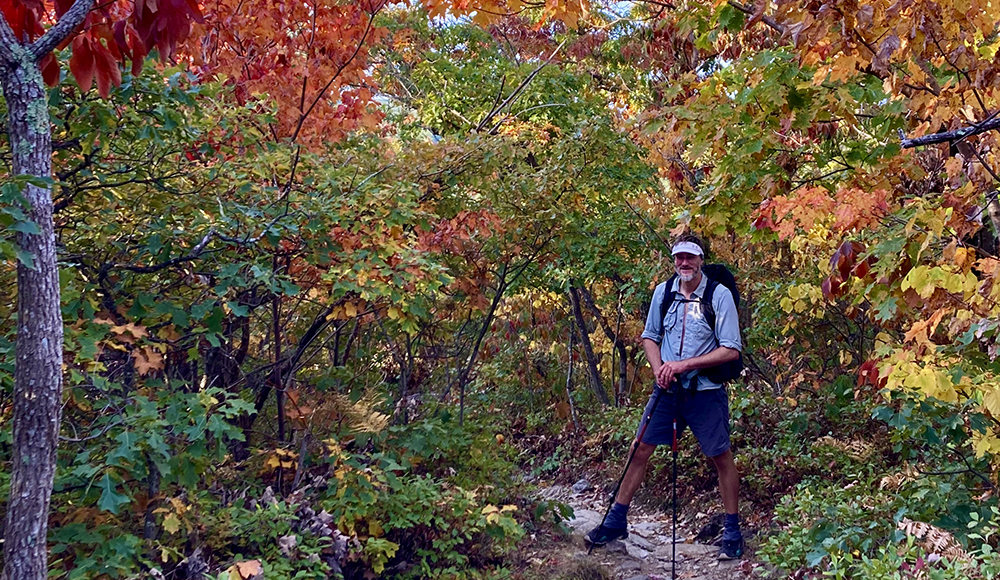
“Some people say the only way you really train for a thru-hike is you get out there and do it,” hiker, Slow Burn.
Late in the summer of 2025, Santa Cruz County’s native son, Jared Perry, had accomplished something only 700 people in the world had done. Jared had completed thru-hiking three of America’s most noteworthy and notorious trails, and by doing so, received the Triple Crown award.
The Triple Crown is the Heisman Trophy of thru-hikers, and the Stanley Cup of trail blazers. It means you walked, from start to finish, the Pacific Crest Trail (PCT), the Continental Divide Trail (CDT), and the Appalachian Trail (AT).
It’s not difficult to imagine that for most Americans, thinking about taking six months off, to walk from Mexico to Canada, is put into the category of: impossible. But for the wide array of people who do it, or attempt it, impossible is just another day on the trail.
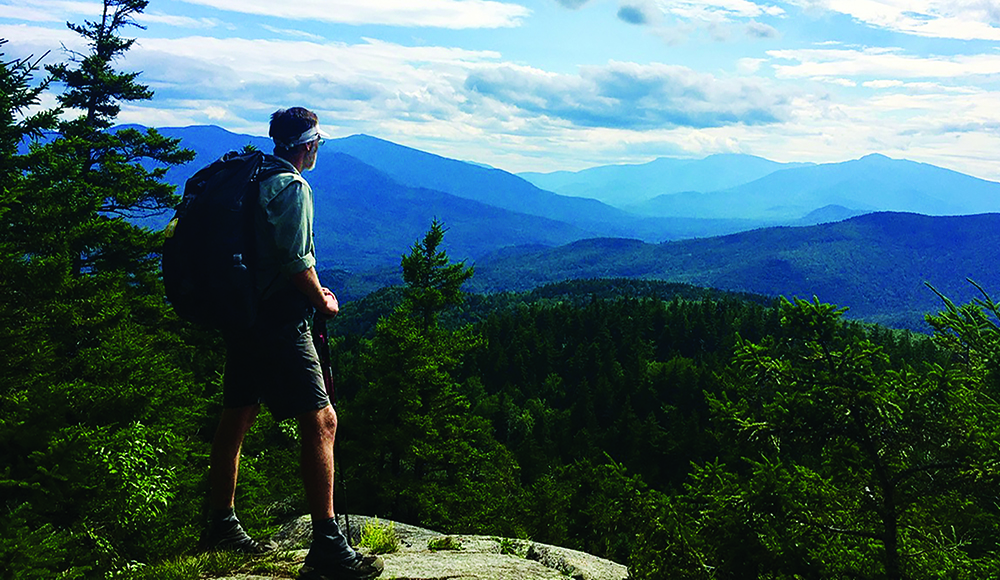
MAVERICK
Jared Perry was born in San Jose, but don’t hold that against him. His father Mike, was a member of the Carpenters Local Union 405. In between working full-time, Mike began building a home for his family in Aptos, where they relocated when Jared was five years old.
By his own account, Jared was a hyperkinetic kid growing up who got involved in whatever he could find that involved motion.
“I played soccer, baseball, and football,” he says. ‘When I got to Aptos High School, my sport was skateboarding, which was not looked at as a sport back then. But now it’s in the Olympics.”
His easy laughter is something that makes others feel comfortable. The 41-year-old has a thoughtful, inviting, and kind disposition. But Jared’s easy-going nature camouflages his intense drive and passion. Often organizing large groups of friends for backpacking adventures and foraging in every shrubbery for potential edible greens, his life, when he has a choice, takes place outside.
“I was carried up Mt. Shasta as an infant. So I guess that qualifies as my first hike,” says Jared.
LODGE POLE
His father Mike’s branch of the Perry family has always embraced the outdoors with gusto, making it an important, essential part of one’s upbringing and experience. With an intergenerational family cabin deep in the woods of Northern California (laid waste in 2021 by the Dixie Fire), hiking, and being amongst the Red Fir and Mountain Hemlock, was as common as shared meals around the dining room table.
Mike Perry is a big guy, and has the body of a man who did physical labor his entire life. But, he also possesses an extremely clever mind that seeks out facts about the world, where he then begins cataloguing information, savoring on the details, and sussing out how to build it, find it or make it happen. What today is called rabbit-holing and homesteading
In 2012, just a few years into retirement, Mike was investigating online about the Pacific Crest Trail (PCT) and one thing that stood out was that the halfway point was at the family mountain cabin. “I’ve been hacking portions of the Pacific Crest Trail with my folks growing up, and my family. Jared and I were hiking a section of the PCT and he had mentioned that it would be nice to do some overnight backpacking and do a larger section. So that prompted me to get on the internet and see what was out there. I discovered a long distance hiking group. I initially thought that if I trained myself enough, I could do half of it,” says Mike who completed the entire PCT.
“His idea was, wouldn’t it be cool to start in Mexico at the border and hike all the way to the cabin? The more research he did about the trail, he found it was way more expansive than he thought. It went all the way to Canada,” Jared recalls.
Eventually, Mike asked Jared if he wanted to do this walk as a joint venture. A father and son bonding experience. An Amazing Race where the prize was companionship and adventure. And there were strong reasons to do it as a team, they reasoned. Number one was safety. They knew they wouldn’t be alone on the trail. There would be other people on the trail. A lot of other people, as it turns out.
TRAIL NAMES
Another aspect of this micro-culture is that when one is on the trail, one adopts, or is given, a trail name. Jared accepted the Triple Crown as Maverick, a name given to him when he played a season on the Santa Cruz Beach Boardwalk volleyball team. “I was afraid of getting a crappy name,” Jared admits.
Mike walked as Lodge Pole, a name given to him by his daughter.
“So that was Jessica. It wasn’t given to me by a hiker, which is traditional for the trail names. Jesse and I have done plenty of hiking, so I feel like it was appropriate. I was thinking of other names like Warner Valley or Chester. Jessica abruptly said, ‘No, it’s not going to be Chester,’ though, I still think that’s logical, because Chester is where the cabin was,” Mike laughs.
On the trail, you might meet people who go by the names of Shroomer, Jester, Huff and Puff, Weathercarrot, Big Stick, Ratatouille, Breezeway and Kismet.
SLOW BURN
Eric Rupp is another local trail enthusiast who began his first hike in 2023. At 63-years old, Rupp was fresh off a deep recent trauma. He had precious little backpacking experience. What he did have was a desire to do something that would push his personal boundaries. So he decided to walk 7,000 miles.
“A lot of people on the trail, when you talk to them, and you do get a chance to do that, they’re going through changes in their lives,” says Rupp. “The hike doesn’t represent a ‘period’ in their lives, it represents a ‘comma’. It was the same for me. I was leaving a marriage. A long-term marriage. I basically had an opportunity to run away and join the circus. So I took it.”
Rupp is a section hiker. Like many others who cannot take the time to do the entire six month walk, Rupp would hike parts of the trail at different times. In 2023, Rupp began the PCT in April. But by June, the higher altitudes of the Sierra Nevada mountain range became impassable.
“2023 was the biggest snow year since the Donner Party in the Sierras. That’s just the way it panned out, much to everyone’s shock and awe. And so what that meant for most mortal humans is that you’d hike from the Mexican border, through the desert, and up to the Sierras, which basically was Kennedy Meadows South,” Rupp recalls.
When Rupp started walking the trails, he would often get as far in one month, as younger hikers would get to in two weeks, which is when he received his trail name, Slow Burn. “I came back knowing things that I didn’t know about, and that changed my life,” Rupp says.
And there you have it. Besides the rigor and the internal fortitude of thru-walkers, there’s something less apparent and more transcendent happening on the trails of America. People are returning to peak physical movement, walking and snowshoeing through pristine nature, in order to heal what ails them. It’s an American Walkabout. John Muir and Henry David Thoreau’s ghosts are acting as sherpas and emotional midwives to those seeking completion of their soul on the trail.
MICRO WEENIES
You’ve decided that your goal is to join the 0.000175% of the population and earn your Triple Crown. Once you get a grasp on a general direction of where you will be walking for the next six months, and your physical and mental training is in motion, one of the biggest “to-do” items is to get your backpack to weigh as little as possible. That starts with obtaining ultralight gear and eliminating all ‘gram weenies’ as they are called within the tribe. “Removing tags off clothing, buttons that you don’t need on shirts, and if the zipper is not needed, it’s got to go,” says Jared.
The gremlins of long-distance hikers are the extra pounds of gear that you have on your back. Sleeping bag, snow shoes, poncho, thermals, and toiletries. It’s a much longer list. Each extra ounce can feel like a pound after just 10 miles. Jared would dry out his toothpaste and, using a carpenter’s razor blade, carve out thin slices for his travels. Mini green Chiclets for good dental hygiene, whilst in the middle of nowhere.
Slow Burn says: “My gear was bona fide ultra light. So my base weight was around 13 to 14 pounds. And then you add food and water. So, at the heaviest, it would be seven days of food, and that’s 14 more pounds. Now I’m up to 28lbs. Add 3 liters of water and now I’m up to 34lbs. But most of the time I’m hiking lighter than that. There’s no reason to carry more weight than you need.”
Jared says: “My pack ended up with the food and water being 45 lbs. Which is really heavy by today’s standards. So with all the work I had done, and all the diligence of dehydrating toothpaste, I still ended up carrying 45 lbs. And then I started shedding what I didn’t need and ended up at about 30 or 35 lbs.”
TRAIL ANGELS
There’s a large load of decisions and determinations to consider when doing a long thru-hike. And all of it is woven together with a tremendous amount of hope, and fingers crossed. One thing that keeps hikers supported, and in some instances alive, are the Trail Angels. At one point, an unorganized group of good Samaritans who would leave much-needed water at certain junctures, or catch thru-hikers when they made visits to towns, and welcome them in like the weary travelers they are.
For Maverick and Lodge Pole, those angels started back at home in Corralitos, where Mike’s wife, Cindy, and his daughter, Jessica, led a detailed, often comically dramatic routine of assembling much-needed care packages. The packages were sent ahead to strategic towns that the duo would eventually walk through.
COYOTE
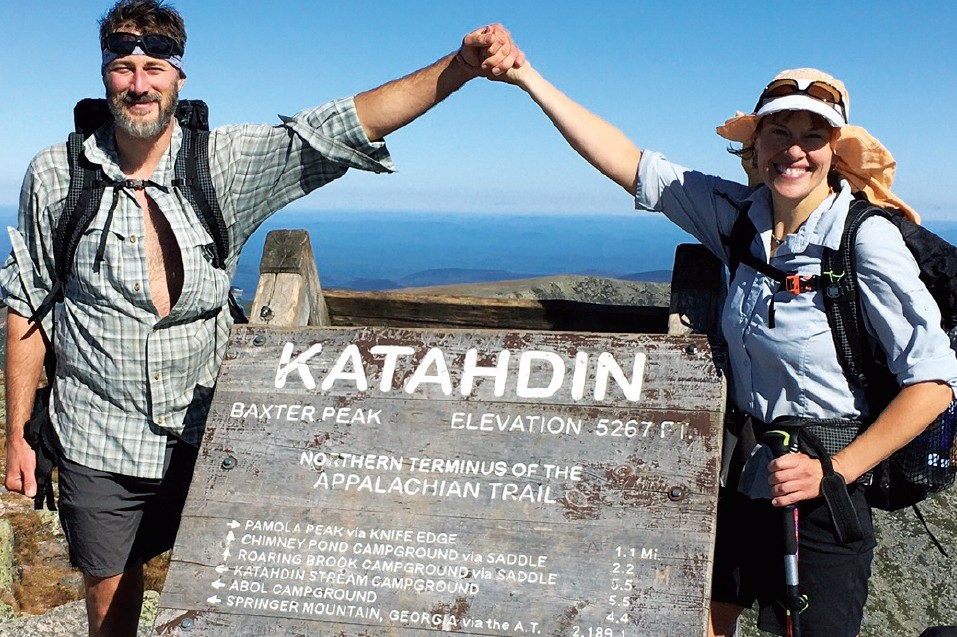
Jared had heard of Coyote before they met. “I knew she was a legend,” he says gleefully. “I actually saw her during the early part of the Pacific Crest Trail. My dad and I stopped into a trail angel’s house to do laundry, and that night around a bonfire, I saw her. I recognized her from the movies,” says Jared.
Coyote is a celebrity amongst the in-the-know thru-hikers. Appearing in several documentaries about trail life, Coyote is a no-nonsense, adventuresome, experience-seeking, ball of energy with boundless inspiration. And while she seeks no acclaim, her written diary of life on the trail is exquisite.
“Because we’ve been walking south with fall, a beautiful carpet of autumn leaves covers the ground. This, too, slows us, because the crunchy leaves hide all the nooks and crevices between the rocks. But it sure makes for gorgeous days in the woods. Under the canopy, everything seems brighter – golden and glowing. The ‘green tunnel’ has become a golden tunnel. It’s pure enjoyment. From the ankles up,” Coyote wrote in October of 2024, somewhere in Pennsylvania.
In the long-distance hiking world, Coyote is known as a repeat offender. “So I had hiked the Appalachian Trail (AT) first in 2004,” Coyote recalls with ease. “The PCT in 2008, the CDT in 2012, and then another long-distance trail called the Pacific Northwest Trail in 2016, and that was right before I met Maverick at a hiker gathering. We sort of met each other and decided, ‘Oh, you’re really cool. But bye. I got to go. I signed a contract,” says Coyote with a wink.
While Coyote worked for a year in Antarctica, as a field coordinator for scientists, Jared was building homes in the Bay Area (and still pondering) his Triple Crown. The potential relationship had been back-burnered.
The two stayed in touch, and started dating in 2019. They found out about the Great North American Eclipse, a unique planetary experience best viewed in Maine in late 2023, and made a plan. “Why not tack on a six month walk to a five minute experience,” Coyote quips.
“We went to Maine to see the eclipse. But because it was April and May and we didn’t want to start in that kind of climate, we flew down to DC and got on the Appalachian Trail in the middle and hiked it in what we call a flip-flop. Which is in two parts. We went from basically the middle of the trail down to the southern terminus in Georgia. Then we flew up to Maine and we hiked South from the northern terminus down to the middle. And, that’s how we did it. We also knew this would qualify Maverick for the Triple Crown,” Coyote relates, obviously relishing the details.
FAMILY DUO
As much as Jared enjoyed hiking with his father, or the solitude of hiking solo, or even with new trail friends, when asked the best thing about doing the AT (and completing the Triple Crown) was, “To be able to hike it with my partner,” Jared replied.
“We already knew some of our capabilities. How far we could go, and what we could do together. We’ve been trail-tested as a couple. A lot of couples don’t hike together. We walk at the same pace. So, we get to walk together, and it’s comfortable. So many people don’t have the same pace, and if you’re off by a little bit, after 10 miles, you end up really far apart from each other.
“By comfortably hiking at the same pace, we got to point things out to each other. And I think my most memorable time on the trail was walking south through the fall, the color change in New England. We had a whole month of walking through a rainbow forest with crunchy leaves underneath our feet.”
On the trail, self-realizations abound, relationships with others are strengthened, bonds are forged, some find love, and some look for Bigfoot.
SQUATCH
Scott Herriott, trail name Squatch, loves making documentaries about thru-trail hikers, as well as the elusive search for the long-rumored Sasquatch. His film The Flip Flop Flipping Trilogy, about the AT, and Still Walking, about the PCT, are perfectly captured moments in linear space, of perhaps the most American tradition of all time, walking in nature. Of course, he also made Asquatchalypse Now ( a documentary about. . .you know) and Unverified (his first feature available on Amazon Prime).
“I’ve done both the AT and the PCT,” Herriott begins. He talks fast, his mind divergently landing on several topics at once.
“I’m at best a mediocre hiker. I’m basically a section hiker. I completed those trails in chunks. I met Coyote in ’08 when I was doing my fourth and final film about the PCT. She was part of Team Bad Wizard. Shane ‘Jester’ O’Donnell was also making a film that year of his thru hike (Wizards of the PCT). I was doing the remaining 1,400 miles that I needed to do to complete the PCT. And Coyote ended up being in both of our films,” Herriott says.
There must be some sort of energy that flows through the primal forests, mountains and landscapes across America. Because certain hikers seem to symbiotically harness a different mode of energy that breaks them apart and brings them together again, like waves upon the shore.
INJURIES
Through all the tales of healing, and wonderment and magic – walking 8,000 miles, in snowstorms, deserts, lightning strikes and flash flooding doesn’t happen without some missteps and hopefully, narrowly averted tragedies.
Jared began the idea of thru-hiking with one singular thought, “I wanted to avoid a serious injury. I knew I would push through it, but when I actually did get an injury, it was a lot harder to push through than I had thought. But it was really rewarding,” he says.
Taking a three-year break after completing the PCT, Mike, then 61, and Jared, 30, were planning to conquer the CDT. They started together in 2016, but only Jared completed the trip.
At one point on the CDT, close to the border of Colorado, in a privy in lower Lagunitas Campground, Jared and Mike, now fully in Maverick and Lodge Pole mode, found a lost camper who had died of exposure and starvation. Stephen “Otter” Olshansky had gone missing months before and ended up barricaded in a campground bathroom, until the end.
It wasn’t a sign, or a potent omen, but something unplanned for was just up ahead.
Mike says: “So on the CDT I made about one-third. I had done about 1,000 miles of a 3,000 mile trail. The higher elevation was messing with some medication that I was on. I felt sick. But more so, I felt homesick. I missed my wife’s retirement party. On the CDT it’s hard to get phone reception and my body was falling apart. I lost 25 pounds. I just wanted to get home to my wife.”
Jared completed the final 2000 miles, solo.
END OF THE TRAIL
It has been said that walking the trail warps time. You wake up, pack up your camp’s debris and detritus, and start walking, again. You’re Bill Murray in Groundhog Day. Besides breaks to pee, or for taking a breather, or to catch an eye-popping vista, you’re constantly in motion. Everything you see is fresh and novel. You hear new sounds like Mormon Crickets and dippers, wrens, finches and warblers. Time begins to stretch out. Six months on the trail, they say, begins to feel like years. You begin to feel like you are really milking the most you can get out of life. You feel robust and healthy. Tomorrow you’ll walk another 12 hours.
The trickster, Coyote, has other thoughts. “The trail warps time? Initially, that was also my feeling, in the beginning, when I started thru-hiking. But I feel like the so-called ‘real world’ is what has warped our perception of time. The trail is actually you tapping into something that is more real, more natural, more in circadian rhythm, more biological, and more intrinsic to us as human beings,” Coyote laughs before walking off to her newest adventure.
This summer, Maverick and Coyote and Squatch are going to walk Patagonia.
Squatch’s documentaries are available at squatchfilms.com and Jester’s documentaries can be found at tbwproductions.com
READ ON! Our Health & Fitness issue awaits:
It’s a Beautiful Race: the 16th annual She Is Beautiful 5K/10K Run
Not Just a Gym: Santa Cruz Core Fitness and Rehab and Athletic Club









Such a great article. Inspirational!