
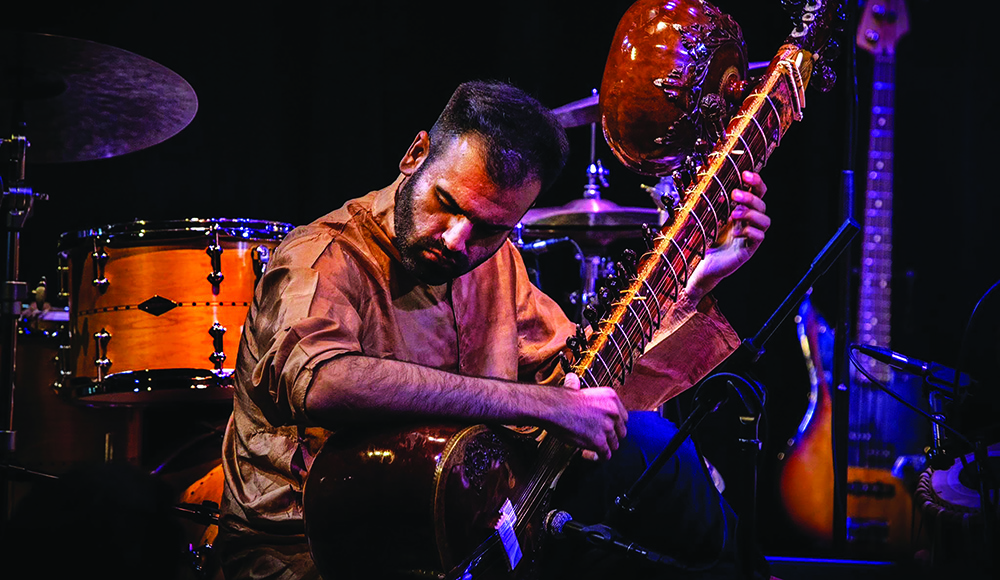
Intergenerational multi-instrumentalist and UC Santa Cruz alumnus Keshav Batish exudes a focused intensity and compassionate disposition that transcends his performances. He is bringing his latest musical work, his third album, Sonic Kinship, to the Kuumbwa Jazz Center on Monday, July 20.
Keshav is a hereditary practitioner of South Asian music, whose origins can be traced back over 3,000 years. Raised and trained in Hindustani classical and folk styles by his father Ashwin Batish and aunt Meena Batish, Keshav also soaked up the food, smells and culture of the Batish India House on Mission Street.
It is impossible not to note that Keshav’s father, Ashwin Batish, is recognized as a world-famous sitar and tabla player whose breadth of work features diverse collaborations with everyone from Zakir Hussain to the Violent Femmes.
Ask anyone in Santa Cruz about the Batish family and you will feel a rush of warmth and lovely thoughts. Stories of being invited into the Batish home and being treated like family. Showing up at the Batish India House for an evening of intercultural exchange. It’s rare to have a family revered by so many people in a small beach town community.
For Keshav, growing up surrounded by all this music and talent and culture just seemed normal. So when it comes to teaching, Keshav tries to bathe his students in the same sonic chutney.
“First of all, to present it in a classroom situation, I did the best I could to immerse the students in the music before we even started,” Keshav says from his home in Santa Cruz.
“I personally learned through osmosis. That’s the best way I can describe it. My path through music was through the culture. I impress this upon my students. It’s not just about the notes. It’s about the language. It’s about the food. It’s about the idea of sonic kinship. It’s about that feeling of togetherness that I certainly feel when I’m playing it. And I feel it when I’m teaching it. I also feel it when I’m talking about it with you. It’s all entangled, to use a quantum term,” says Keshav.
Keshav is quite scholarly when it comes to describing his teaching process, and is quick to compliment how incredibly bright his students are.
“I was taught not to discern via ways of thinking. Everybody has their own way of processing information. My job as a teacher is not only to teach one way, but to teach in a conversational manner. The first part of a Hindustani performance is called an Alaap. It’s often mistranslated in academic readings as ‘unmetered or unbound,’ because they themselves don’t know the depth of the language. What it actually means is conversation,” Keshav says.
Sonic Kinship is both a formal and commercial release. It was part of the dissertation that Keshav finished at UCSC, where he recently earned a Doctorate of Musical Arts in Composition.
Joining Batish onstage will be Kristen Strom on tenor saxophone, Shay Salhov on alto saxophone, Scott Sorkin on guitar, Stan Poplin on double bass, and Dahveed Behroozi on piano.
“These musicians intermingle on every level in their lives, not only with each other as humans, but also through conversations we have with nature and our environment at large. These are all themes that are very literally and metaphorically reflected in Hindustani music,” Keshav says.
“It’s some folks I have played with in the past, as well as some first-timers in the band. Stan Poplin was actually my band director at UCSC when I was a student there. Kristen Strom and Scott Sorkin actually began as my father’s students at San Jose State when they were undergraduates. They took a raga jazz course with him,” Keshav laughs.
“I’ve known of them since childhood. It’s a real honor to get to play with them in this capacity. These are some of the greatest musicians out there. I feel very lucky,” Keshav concludes.
Keshav Batish will be performing on Monday, July 20 at 7pm at the Kuumbwa Jazz Center, 320 Cedar Street, #2, Santa Cruz. Tickets are $29.14 in advance and $31.50 at the door. More information at kuumbwajazz.org