
Young voters barely turned out for the June primary, while people over 55 made a heavy showing.
Registered voters over the age of 55 displayed a turnout rate of about 67.83%, while those between the ages of 18-34 had a turnout rate of about 29.52%, based on figures provided by the Santa Cruz County Clerk’s office.
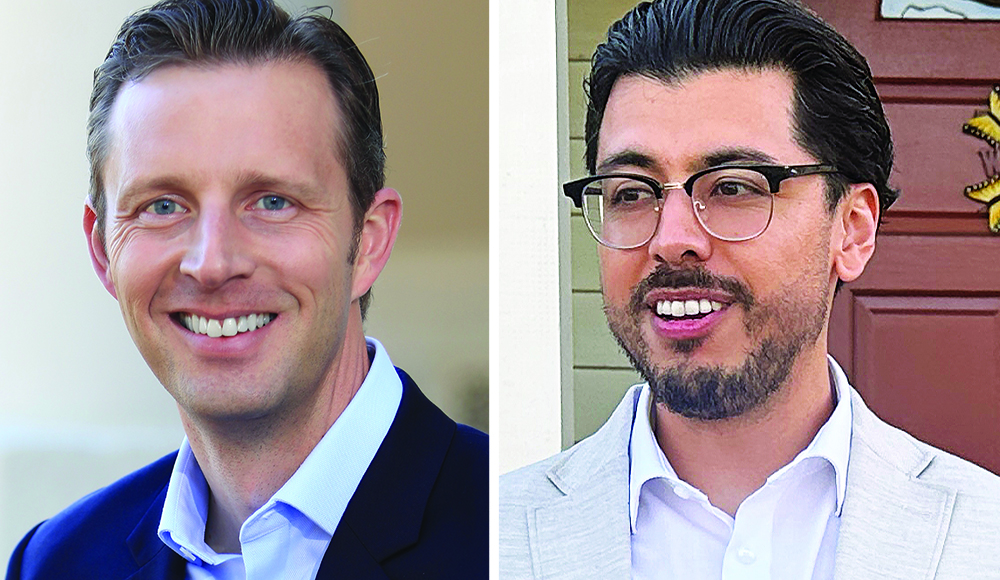
“You would see a shift in how national political parties, state political parties and local candidates respond to those issues because they would see a database shift in who those voters are,” said former County Supervisor Zach Friend, referring to the fact that young voters have such a low turnout.
Young voters in Santa Cruz County have the potential to swing elections and have done so in the past, said 22-year-old Kameron Tessier, the former Statewide President of California College Democrats, and a recent UCSC alum.
If students and young people were to vote more actively in the county, “we would see a lot more results for candidates who have the interests of students and Santa Cruz County at heart,” said Tessier.
Most political candidates focus their campaigns on reliable, high-propensity voters, who tend to be older, more affluent homeowners, Friend said. As a result, elected officials focus on issues that matter to those voters.
“And it’s an unfortunate self-fulfilling prophecy. I mean, the same people show up. Those issues are the ones that are heard. People feel disaffected because their voice isn’t being heard. They show up once. They express their thoughts, and then they believe they’re not being heard,” said Friend. “All of it is true, and yet the cycle at some stage has to be broken.”
If young voters were to vote consistently in every election, including local, it could have a large impact on the way that local politics are approached, added Friend, even if it doesn’t feel like it might have an impact.
About half of Santa Cruz County registered voters, at about 87,340 votes, cast their ballots in Santa Cruz County, according to Secretary of State Shirley N. Weber, almost 10% higher than the rest of the state, with a recorded 50.30% turnout, compared to the state’s overall 40.80%, according to the secretary of state’s office.
Compared with two past countywide elections, turnout was lower this June, with about 60.53% turnout in the November 4 2025, Statewide Special Election, and about 77.76% turnout in the November 5 2024, General Election, according to figures from the County Clerk’s Office.
One of the biggest factors in election turnout is the type of election it is, explained Eric McGhee, a Policy Director and Senior Fellow at the Public Policy Institute of California. Presidential elections are generally going to see higher turnout than a primary or special election.
“When you get down to some of these smaller races, you have to be more dedicated to voting, or have a better sense of what the connection is to the things that you care about in order to be motivated to participate,” said McGhee.
The June election was the first test in the race to take the state’s governor’s seat, selecting two candidates, Democrat Xavier Becerra and Republican Steve Hilton, to face off in the General Election on Nov 3, the last day to register being Monday, Oct 19.
Locally, the county’s unincorporated areas procured the highest number of voters, with approximately 50,146 people casting a ballot, according to figures provided by the County Clerk.
Of the cities, Santa Cruz had the highest rate of voters recording about 52.95% turnout rate, with about 20,830 voters. Ryan Coonerty had 47.8% of the vote, and Ami Chen Mills had 20.51%. Both secured the two available spots in a field of five candidates in the battle for Santa Cruz mayor, and will go on to face each other in a run-off election this fall.
In the southern district of Santa Cruz County, elected representative Tony Nuñez won District 4 county supervisor with an almost 20%-point lead that barely edged over the 50% of the vote required to claim victory, unseating incumbent Felipe Hernandez, earning 3,944 of the 8,510 votes cast.
Watsonville recorded the lowest turnout, recording about 32.26% turnout rate with about 7,677 people casting ballots, according to figures provided by the County Clerk’s office.
“I think that overall, this is a win for district four and for South Santa County in terms of them wanting their voice to be heard at the ballot box,” said Nuñez, referring to the fact this election saw an increase of almost 2,000 ballots from the 2022 June 4th District Supervisor race—from 6,536 total votes in June 2022, to about 8,510 this past June.
The constituency and residents that make up the South County are completely different communities than Santa Cruz city, said Nuñez, and there are many reasons why there is a lower voter turnout, such as language barriers or documentation status.
“When I talk to just voters in general, but especially young voters and especially Latinos and Latinas, there is a sense within those populations that their vote just doesn’t matter,” said Nuñez. “They feel disenfranchised by what is happening within the country, within the community.”
They choose not to vote because they feel like nothing will change, said Nuñez. “I think that is a really, really difficult issue to resolve. But again, it’s never going to change if we don’t take the steps to try to change it.”
If there is anything this last election proved, it is that District 4 wants change, Nuñez added.
Improving civic engagement will require making government understandable and approachable to the general public, said Nuñez, pointing to the successful campaign of New York City Mayor Zohran Mamdani, who ran a campaign that utilized social media to connect with voters.
“Because it’s not about how we get more people involved in local government,” said Nuñez. “It’s how we make government more approachable to normal people.”