

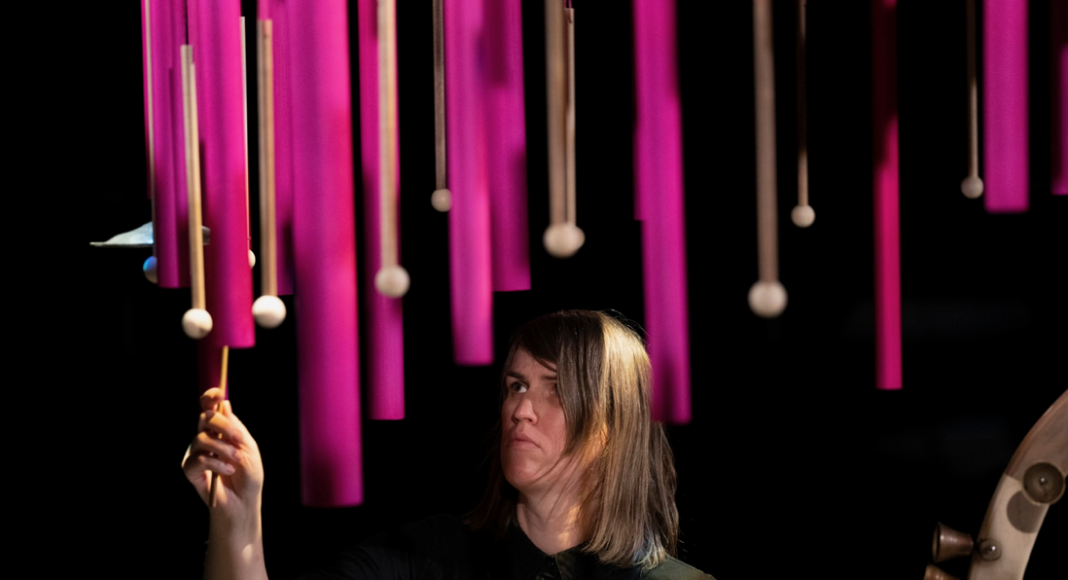
After the stagnant 30-minute concert-closing piece by Sarah Hennies at the 2026 Cabrillo Festival of Contemporary Music, I felt nothing but pity for the orchestra and outrage for my fellow audience members. This was not the programming that had, in the past, propelled the Festival to thrilling heights.
It was a tedious, mind-numbing exercise in acoustical terrorism. We were held hostage by a performance narcissist who misused the skill and expertise of a large orchestra to proclaim her hatred of the current social landscape. The effect was excruciatingly dull.
So insulting to orchestra and audience alike was the irritating, seemingly uncomposed piece, that most of us enduring its performance on Saturday August 1 were physically numb when the sequence of sounds finally stopped. Hennies admitted that the piece was created through free association. A sonic tantrum guided by the perpetrator’s unconscious.
The visual arts have long been weaponized in the name of de-skilling, of eradicating anything that smacks of beauty or training or mastery. In the name of radical inclusion, gone is the encouragement of pride and enjoyment that comes with learning new skills, practicing those skills and polishing them to new expertise.
Post-modernism, with its insistent rejection of narrative arc, its self-congratulatory reverse snobbery, is, in the words of Millennials, so yesterday. Hennies’ anti-classical approach has been done and done. It takes new music nowhere. It reaches for nothing beyond its own self-absorption. A swamp of self-help disguised as originality.
Hennies’ soul-deadening half hour illustrated that the colonization of art by narcissism has a disturbing grip on the world of contemporary music. Or at least the music increasingly programmed by the once-provocative and exciting Cabrillo Festival of Contemporary Music.
Having read Hennies’ background and interviews with her in national publications, I agree that she sounded good on paper. But did anyone actually listen to her work? Did anyone think to vet the piece—I won’t call it music—that was presented during the second night of the Festival?
Long passages of barely audible wooden sticks lightly drawn across the strings of violins. Long, long passages. The occasional gong. The odd drum here and there. The repeated phrases of noise that went on for what felt like eternities. Thirty minutes of hostility. Thirty trivial minutes.
Here was work aggressively expanding the frontiers of mediocrity. What we heard was a loosely strategized tantrum flung in our faces by a self-absorbed poseur trying to find herself at public expense.
I applaud any and all efforts by inquiring individuals to find themselves. Surely the pursuit of self-knowledge can be worthwhile, but not at the expense of authentic artistry.
Yes, there is worthy new music being composed. For example, Norwegian composer Nils Asheim has scored folk language practices of the Northern Sami into a haunting piece for choir and string orchestra, performed in Carmel at the Bach Festival a month ago.
That same Festival offered a profound Nuits, Adieux written 30 years ago by Kaija Saariaho, involving choral ensembles, each singer with two microphones amplifying and processing their sounds at non-synchronous intervals. The effect was staggering, beautiful, mysterious, and utterly fresh in its overall impression. Again new music rife with imaginative processions of sounds and words. A piece designed to open minds rather than shut ears.
The Cabrillo Festival has been known to present compositional work that stretches the exceptional abilities of its orchestra. What went wrong here? Why fail to specialize in musical ideas that push the frontiers beyond any single individual’s wants, needs, and issues?
Can we blame COVID? Or the retirement two years ago of savvy Executive Director Ellen Primack who had finessed a programming structure that made us all proud? Hard to tell, but the word “community” was repeated many more times than the word “creativity” in the introductions to the evening’s program by current Executive Director Riley Nicholson.
Is community now the primary goal of a once adventurous new music Festival? What happened to provocative? Or the mission of bringing the most exciting and skilled new composers to the Festival?
In the words of one regional music director, last night’s final hour was “torture.”










Hard for me to tell, sounds like you may have not liked this piece.
When one piece gets too avant garde at an avant garde music festival, can someone let this author know that Casey Kasem top 40 is only an earbud away
Sounds like it was plenty provocative to you
Instead of writing a right wing screed, motivated by comfort-seeking in protective traditionalist hierarchies, and which ironically displays a stunningly self-indulged pettiness, as well as an obvious laziness in clearly having failed to take the time to understand contemporary musical landscapes from which the artist is drawing from, the author could have actually engaged with the work and leveled any sort of compelling critique beyond hollow, warmed over bile that could have come from any uptight conservative with an axe to grind over the past handful of decades. Privileged positionality is always embarrassed by its own lack of rigor.
Torture. Terrorism. Hostages. are we reviewing concert or responding to national security threat?
Refreshingly candid and dead-on. I was there and concur that the piece was terrible–the kind of thing that gives “new music” a bad name. Good for Waters to have the courage to speak the honest truth. Good criticism is healthy for local culture, especially in the context of a reputable festival like Cabrillo.
Dear Christina,
I’m surprised that, as a reviewer, you chose to ignore 3/4 of a concert program (and the previous night’s concert) to rail against a single work. I’m surprised that you wrote about it as if you never read the program notes or Festival literature to understand that the work was part of the Creative Lab, a brand new composition project designed to afford composers an opportunity to experiment with the orchestral form. I’m surprised that, in the context of a new music festival that champions new works and world premieres, that you actually expect to like every work on a program or believe that for every person who might have felt “tortured” there might actually be others who found it intriguing. I’m surprised that you put the onus of programming on the arts administration, circumventing the Music Director. But, mostly, I’m surprised you were so patently cruel and denigrating to an artist—whether their piece failed, in your opinion, or not. It was a rant rather than a professional review and doing harm to artists and the cultural community is beneath who I’ve known you to be.
Next up for Christina Waters, the Director of Programming at the Trump Kennedy Center. You go, Girl!
I found Sarah Hennies’ new work compelling, visceral, imaginative, and inspiring. I hope to hear the work again and was proud of Cabrillo Festival for commissioning such an expansive new work. The musicians performed it with excellence and care, as they played everything on the program (including two other world premieres, which the author of this article failed to mention entirely). Aaron Copland’s Clarinet Concerto was also a thrilling addition to the program, showcasing the virtuosity of soloist Carlos Ferreira and the professionalism of the entire orchestra and organization, who shared that they’d needed to pivot just days before the concert due to an injury that prohibited another soloist from performing a new work that was initially scheduled for the Saturday night program. Any mention of the world premieres on the Friday night program is also absent from this article (which reads as a rant, not a review, as another commenter suggested). This article is an embarrassment to the publication and damaging to the arts and culture landscape that is already so fragile in this time. Shame on this author for publishing such a disgraceful article and shame on this publication for allowing it to be released.
Count me as one audience member who found the Hennie piece impossibly dull, pointless, and way too long. When it finally ended I clapped enthusiastically, turned to my friend and said, “Yay, it’s over! That was torture!” As a longtime supporter of the Cabrillo Festival, I don’t expect to like everything I hear, but this piece stood out as particularly bad. Christina Waters had the courage and musical knowledge to articulate why the emperor had no clothes. Apparently, based on some of the comments, that was a no-no. If you criticize a piece, you must be a right-wing Trump supporter. What? When did the Festival become so political, with only one acceptable point of view?
I am so sorry to say that I agree with every word in Christina Water’s piece. I turned to my neighbor when it was over and said that the piece was misnamed and should have been titled ” a visit to the seventh level of hell in dante’s infirno”. Creativity and exploration are one thing. Self indulgence is another. There were other excellent pieces that night and the night before that could have had praise, but this one was outstanding in its awfulness. I was literally in pain from the desire to leave.
I’m sad to read such a bitter and angry piece.
I suppose it’s nice that the person who penned this article had “read Hennies’ background and interviews with her in national publications.” It would probably be nicer if the author had actually listened to any of Hennies’ previous compositions, or had any knowledge about the type of music she was reviewing.
Or, judging from this unsettling, vitriolic, and deeply weird diatribe, even listened to the piece.
For all the toxicity spewed in this article, there are shockingly few specifics about the piece itself. And what few specifics exist are either extremely thin or just plain wrong.
For example, there was no “occasional gong” in The Grain House. In fact, there was no gong in the piece at all. The gong onstage was used in Stacks, the other excellent world premiere on this program by D. Riley Nicholson (which went bizarrely unmentioned in this review of the concert–did the author arrive late to the concert and spend all the ink on the Hennies piece in an attempt to cover their tracks?)
It’s hard to not imagine that this reviewer, as some of the previous commenters may have mentioned, had a predisposed agenda going into this assignment. What the author lazily and ignorantly refers to as “noise” were actually deeply rich, complex, and expertly orchestrated timbral textures, expanding the sonic orchestra’s sonic palette and resonating the hall in ways that I have never heard an orchestra accomplish. This piece builds on the rich lineage of similarly pioneering explorers of acoustic phenomena like previous Cabrillo featured composers Alvin Lucier and Pauline Oliveros, and uses the immense talents of the musicians and conductor to take the orchestra’s sonic landscape in haunting and innovative new directions.
To respond to some of the other commenters: I suppose the reason why folks ascribe political and/or conservative motives to the author (in addition to the combination of caustic bile and seemingly endless ignorance about the work and its artistic predecessors) is that this “review” reads as though the author had a predisposed agenda–from the author’s completely irrelevant ‘ok, boomer’ complaint about de-skilling and inclusion in visual arts (perhaps the author should leave contemporary music alone and go bother the visual arts community with this type of ignorant nonsense?) to the author’s claiming, without a shred of evidence or context, that the piece in question was a vehicle for the composer to “proclaim her hatred of the current social landscape.”
This review, as a writer I have recently read put it so eloquently, was “a loosely strategized tantrum flung in our faces by a self-absorbed poseur trying to find herself at public expense.”
This thunderingly unprofessional and staggeringly incoherent mess of a review is an embarrassment to this publication and an affront to the progressive, provocative, and risk-taking Santa Cruz creative community it claims to cover.
Since I retired from the Festival staff in 2012, I’ve been so proud of what the Festival has become. Since that time I have attended every concert, most open rehearsals and always listen to the broadcasts following the Festival on KALW. The Sarah Hennies piece, her first written for Orchestra as part of the Festival’s Creative Lab new works initiatve, was a highlight of the opening weekend. In the lead up to its premiere, I also attended Sarah‘s solo performance at Indexical the Monday before, and listened to her comments at the Meet the Composers forum the afternoon before the concert. By Saturday night, I couldn’t wait for its World Premiere and found myself completely absorbed in the sound world that the Orchestra was able to create from the score. I loved it and can’t wait to hear it again September 6, 6pm on KALW.
I thought the piece was very repetitive and uninteresting but the author here went a bit overboard and should have discussed the other pieces.
I want to congratulate the Cabrillo Festival of Contemporary Music on another magnificent season. We are incredibly fortunate to live in a community that embraces these talented musicians, composers, conductors and support staff with open arms every year. Hearing how much our musicians and creators adore this region is a testament to our local spirit. Experiencing the music take shape during open rehearsals is a true privilege. I enjoy the young composers and the student staff as well. While one self-indulgent, cynical reviewer tried to cast a shadow on the event, their bitterness doesn’t speak for our community. This is a world-class festival, and I applaud everyone who pours their heart into creating such a joyful, transcendent experience. I have ignored this bad apple of a reviewer for many decades but this sad self indulgent piece was brought to my attention. As usual, her views do not represent mine and I find her efforts to denigrate people and places to reflect badly on her.
I want to congratulate the Cabrillo Festival of Contemporary Music on another magnificent season. We are incredibly fortunate to live in a community that embraces these talented musicians, composers, conductors and support staff with open arms every year. Hearing how much our musicians and creators adore this region is a testament to our local spirit. Experiencing the music take shape during open rehearsals is a true privilege. The workshops and opportunities for young composers and conductors is well worth supporting. . While one self-indulgent, cynical reviewer tried to cast a shadow on the event, their bitterness doesn’t speak for our community. This is a world-class festival, and I applaud everyone who pours their heart into creating such a joyful, transcendent experience. I have ignored this bad apple of a reviewer for many decades but this sad self indulgent piece was brought to my attention. As usual, her views do not represent mine and I find her efforts to denigrate people and places to reflect badly on her.
I, too, was really annoyed and disappointed by the Hennies piece- not to my taste at all- but it was only 1 out of 17 compositions played in the 4 major concerts – and the other 16 went from gorgeous and inspiring to merely entertaining and interesting. So Cristina’s commentary seems a little out of proportion.
I spent 2 weeks “marinating” in such an array of music and general delight and expertise experienced in open rehearsals and concerts. There is nothing quite like it and I can only congratulate the staff and board and all the musicians and volunteers that work to make a world-class festival that I get to experience right here!
Hey, Brad, I do commend you for breaking the Goodtimes’ ban on critical reviews. In the past, it was hard to know why I was reading a review, knowing about the injunction against negativity. But this isn’t just a critical review—this is a weirdly ugly attack on the composer herself. Given that the composer is a member of a group being targeted by the federal government at the moment, the Tin Ear Award belongs to the Goodtimes, Christina Waters, and you for not considering how this review would sound. Many of us, friends and colleagues and parents and siblings of trans people, are living in fear and horror at what’s being done to people we love.
“A self-absorbed poseur trying to find herself at public expense””? Where did Waters get that idea, except from the vile stew of her own bias? “In the name of radical inclusion”—really?
A reviewer doesn’t have to love every piece, but basic respect for the composer is mandatory, especially in a community—yes, I loved the emphasis on community!—like ours. I was charmed and provoked by Sarah and her piece, but of course it didn’t appeal to everyone, nor would I expect it to. But I would expect that the Goodtimes, in publishing a review that criticizes the work, would be more careful about publishing a review that reveals the author’s unvarnished disgust of the person who created it.
Yes, please publish critical reviews when warranted. But this review isn’t critical of the music, it’s a reveal of the writer’s poor character. You would have done her a favor by killing it.
Thank you Suki for stating so beautifully what has been on my mind since I read this review.
This isn’t a bad review. This is hate speech. It is offensive and upsetting and it should be taken down. Christina Waters is allowed to dislike the music all she wants but she should never have been given the space to attack Sarah Hennies. I’m embarrassed to live in a community that would print this strangely personal diatribe.
(Interestingly, one notices that the print version of this piece from the Aug. 12 issue includes two new paragraphs about the author’s credentials vis-a-vis the Cabrillo Festival.)
Brad Kava who I hold in the highest esteem as an editor, teacher and music man HOPED/TRUSTED Waters as he stated in his editorial note ….had read everything he had written. I will give you $100 cash today, Waters did not READ the 65 page, We The Dreamers Program. Enuff Brad go to print and apologize for Waters Fox News journalistic torture. P.S. Hennies research correct, thoughts DO come back around the next day!
Brad Kava, In your editorial note this week you asked, “Can a writer and paper have credibility if they only print positive reviews?” Of course they can.
The real question you should be asking, “Can a writer and paper have credibility if they print factual inaccuracies and make wild accusations in place of actual informed music criticism?”
Hey, just because its the Cabrillo Music Festival tp which my wife Lesley and I have donated coming on to 40 years, doesn’t mean because of its world cultural experience it is above criticism and. Critics are important and not all criticism should be thin pablum. I have ben a composer, advocate of new music from the days of Monday evening concerts in Los Angeles, with delightful and challenging composers wach of which wrote their ‘red hering” — there are many wrthy contemporary composers presented on the festival by Alsop, Dennis Russel Davies some to be liked others no so. However especially this years festival and years eading up to it the standard of what’s worth a hearing has gone down. What makes a festival great and wrthwhile is when it can stand up to a critics voice. The controversy itself is important useful to keep everyone,the director, the board running it, the performers, crontributors. Music is such it doesn’t need to be explained eve before its performed. if its interesting enough an explanattionfor or against can be helpful but not a requirement as to whether is is appreciated or not. I salute the Good Times and Christina Waters to have the guts to publish this and hopefull further critiques regarding classical music performers and performances. So you are not mistaken regarding my right to have occasional strong opnions regarding a long life in music, I am Michael Tierra, composer, founder of the United States of America, author of “The Way of Herbs” and concert pianist.
— correction on the above —
Brad Kava, In your editorial note this week you asked, “Can a writer and paper have credibility if they only print positive reviews?” Of course you can have negative reviews.
The real question you should be asking, “Can a writer and paper have credibility if they print factual inaccuracies and make wild accusations in place of actual informed music criticism?”
Throwing the entire festival under the bus because you did not like one piece strikes me as lazy. While Sarah Hennies’ piece may not have been for everyone, the rest of the festival was phenomenal. From the youth Symphony to the free Family concert introducing children to music to the talks and open rehearsals not to mention the other three concerts including the Philip Glass piece “Lincoln” (which I am truly sorry you missed) the festival seemed better than ever to me. Each night I mistakenly thought they would not be able to beat that.
It was only my second year at the festival, so I am still pretty new to a lot of it.
I was able to attend part of two open rehearsals and the finale, and our family hosted a visiting musician, which was a wonderful experience and left me feeling truly connected to the festival in a way that felt personal and intimate, not just as an audience member.
I don’t know all the ins and outs of new music or programming, but I do know what it felt like to be at that closing night reception, joy filled and full of people who clearly love this festival and each other. That community piece is a big part of why I am now hooked as a newcomer. It is not something separate from the art.
I hate to see one piece and one reaction overshadow everything beautiful that Riley and the team built this year.
Grateful this festival takes bold chances.
Already looking forward to next season.
Calling an artist “narcissistic” for using their creative work (successfully or not) to explore social constructs they experience is myopic if not reactionary. What is narcissistic is a local poet who feels prattling about growing up in Beverly Hills is some sort of creative statement.
Serendipitously brought back to these pages! I see being paid $150-ish, perhaps a bit more now in the mid-2020s during such lengthy creative regimes, still allows the SAME kind of writer, the SAME kind of voice, the SAME ( what is it? Entitlement?) kind of SAME to pass off as insight. SAME old same old, just a different decade … talk about not reaching new and thrilling heights. Alas, it’s all subjective isn’t it? Some commenters, including the wonderful EP, nailed it. I betcha there was, at the very least, a glimmer of some good in the performance— and surely a more helpful and constructive way to inspire and provoke thought for both readers and the artist in question in this read.
Excellent and insightful review. I stopped going to the festival when it became apparent it was simply a group exercise in ritual self-abasement by masochistic boomer narcissists addicted to unearned guilt.
I read this review as an attempt to cling to a creative past and a musicality that centers consensus over honest expression. I can’t wait to hear how Hennies continues to push and pull the orchestral form so smartly to meet the day. I found The Grain House to be challenging, deep, and uniquely beautiful. Thank you for your fearlessly expert programming, Cabrillo Festival.