

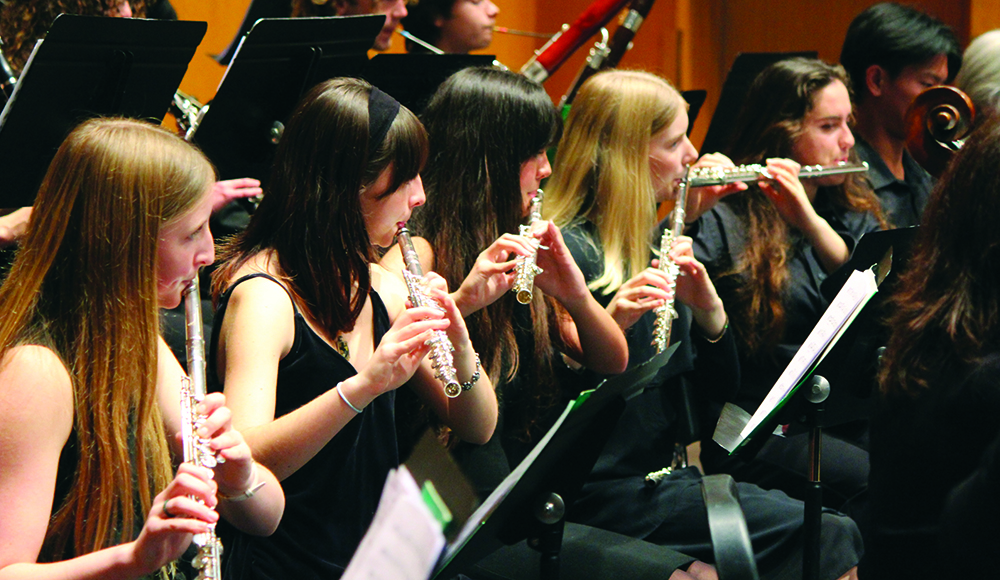
A new maestro, Jeff de Seriere, opens the 30th anniversary of the Santa Cruz County Youth Symphony with an eclectic program designed to thrill musicians and audiences alike. With a doctorate in Musical Arts from Northwestern University and a demanding position as Director of Large Instrumental Ensembles at Cabrillo College, the Youth Symphony’s new Music Director has his expert hands full. His energy is clearly up to the task.
Tell us about the repertoire you chose for the upcoming concert—established classics as well as very new music.
JEFF DE SERIERE: The idea of the eclecticism. I think that should be fun for young players as well as for the listeners. Working with young musicians, it’s important to prioritize the educational aspect, so I chose selections that would speak to the spirit and age of the students. Bruckner’s Overture, one of his early lively works that the students really eat up. The piece by early 19th-century composer Charles-Auguste de Bériot features a violin solo that 14-year-old Greta Geriguis played when she won with a concerto composition. Another is a short piece, Kamisama Tachi from a 2001 Japanese animated fantasy film,Spirited Away. Han’gǔl by Korean American composer Soon He Newbold is drawn from traditional folk songs of Korea. And American Hymn is by a Bay Area composer, Nancy Bloomer Deussen, whose daughter went to Cabrillo. It’s a repertoire that can resonate with our musicians.
Your entry into musical conducting?
In high school at Lakewood, California, I was in the marching band and had dreams of becoming a band director. Everything changed when I saw a video of Leonard Bernstein conducting his operetta Candide and that opened the idea of trying conducting. While at a conducting workshop at Northwestern University in the summer of 2018 my teacher Mallory Thompson asked me whether I had considered going for a doctorate in conducting.
There are many roads to a conducting career and many people are going the academic route, which is what I did. Most recently I worked with Youth Orchestra Salinas as music director, and I’m currently Director of large instrumental ensembles at Cabrillo College, teaching and conducting.
Do you see a rising tide of young musicians in the 21st century?
There are more growth possibilities, which started with the El Sistema program. That was a pivotal moment thanks to Gustavo Dudamel, where social responsibility and musicianship went hand in hand.
Youth symphonies are flourishing in communities where there are already well-trained musicians teaching and performing, as well as good programs in the schools. And Santa Cruz has those.
The SC Youth Symphony allows young musicians to explore a wide range of classical music sources and styles, from movie scores and video game scores, as a possible gateway to a professional career. Yes, video game scores! Youth symphony can lead to professional careers, as well as to expanding the culture and support for future audiences. We’re building a patron base. For the players as well as the young audiences.
Are there particular challenges working with young musicians?
Building a work ethic. It takes effort and practice to build up those chops. It doesn’t just come automatically. Playing together builds community. They need to understand that they are responsible to each other. We’ve got a number of them that could be very successful professionals, and who already have the skills to continue on in a serious way.
SC Youth Symphony 2026-27 concert schedule?
Youth Symphony performs two concerts a year, and also interfaces with the SC Symphony with the Family Concert, which this year centers around Sergei Prokofiev’s Peter and the Wolf. Here they gain valuable experience performing with professionals and working with Danny Stewart.
Walk us through the preparation for a concert.
Youth Symphony musicians rehearse weekly for two hours. The Fall concert cycle starts in mid-September, and we have eight rehearsals that lead up to the performance. The program is chosen in advance, so students have a chance to prepare before we read through the program for the first time. Rehearsals are a precious time where we can work on balance, aligning articulations, intonation/tuning, bowings, and getting into the character of the music. I tend to start working on the big picture, then zooming in on smaller sections to work on detail, and zooming back out again as we get closer to the concert.
Just like athletes, musicians need to do regular work and maintenance to gain new skills, develop agency over their part, and maintain it so they can replicate it. Imagine the music being like a painting/image. When we get started, things are blurry/nondescript. When we get to the concert, we present it in full light, in all its glory. It takes a significant amount of work, but when different people come together to put something beautiful out into the world, you really can’t imagine anything better.
Can’t wait for the upcoming program!
Overture in G minor, by Anton Bruckner
Scène de Ballet, Op. 100 by Charles-Auguste de Bériot featuring violinist Greta Geriguis
Han’gǔl, by Soon He Newbold
American Hymn, by Nancy Bloomer Deussen
Kamisama Tachi (Procession of the Spirits), from Spirited Away, by Joe Hisaishi
Santa Cruz Youth Symphony Fall Concert, November 22, 3pm at the UCSC Recital Hall. Tickets at sccys.org/concerts. Adults $20, Seniors $15, College students ages 19–24 $10; youth 18 and younger $5.