

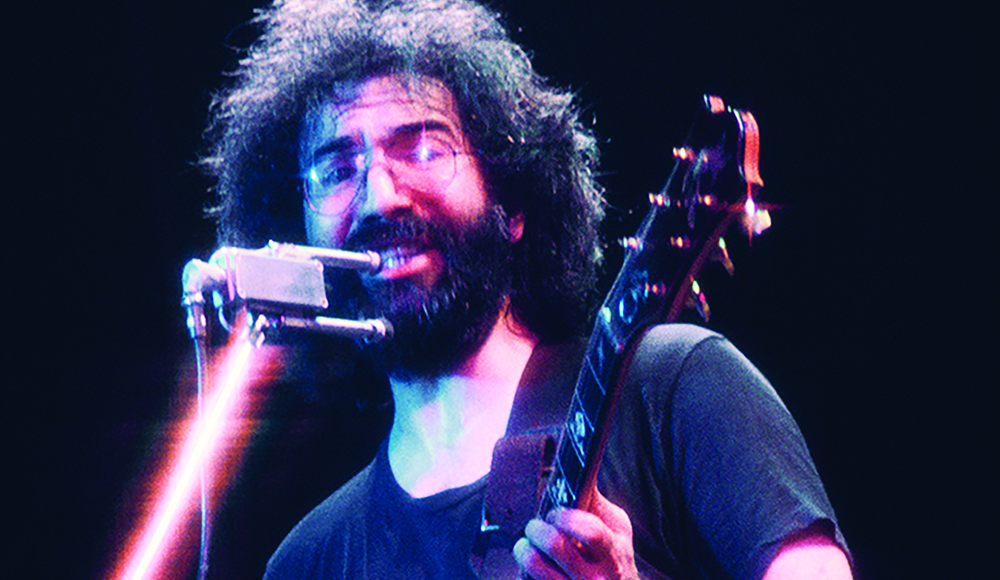
“You would never look at a symphony orchestra or a jazz band and call it a cover band.” –Nicholas Meriwether
(Born August 1st, 1942, the beloved guitarist Jerry Garcia left this earthly realm with a smile on his face a staggering 31 years ago on August 9, 1995. The interlude between August 1st and 9th is known amongst family, friends and Deadheads as The Days Between. This is an exploration of the lasting impact of the Grateful Dead three decades later.)
Santa Cruz contains a cosmically-created spiral-vortex of psychedelia and that’s a fact, Jack (Kerouac). An authentic nature-studded nexus where literary characters from On the Road walked with Merry Pranksters inside the Acid Triangle. Today, the Cruz remains a healthy beehive of activity with illuminated authors, surfing psychonauts, clandestine smugglers, bouncing burners and intergenerational Deadheads all commingling together.
In a word, Santa Cruz is trippy, man.
Even Jerry Garcia’s actual missing middle finger is buried somewhere in the silt of a tributary in the Santa Cruz Mountains. I want to believe this is true because I spent quality time wading in Lompico Creek seeking it.
Any TARDIS, worth its weight and calibrated for a Grateful Dead Stargate, would land somewhere within our county. There’s a low-pressure tractor beam pulling all things Dead down into our regional collective core. And while its exact location shifts, Santa Cruz has always been a repository of the strange, and it continues through to this very moment. So let’s not count Santa Cruz out of the World’s Biggest Weirdo Race, yet, sport fans.
TEN YEARS THE WAVES
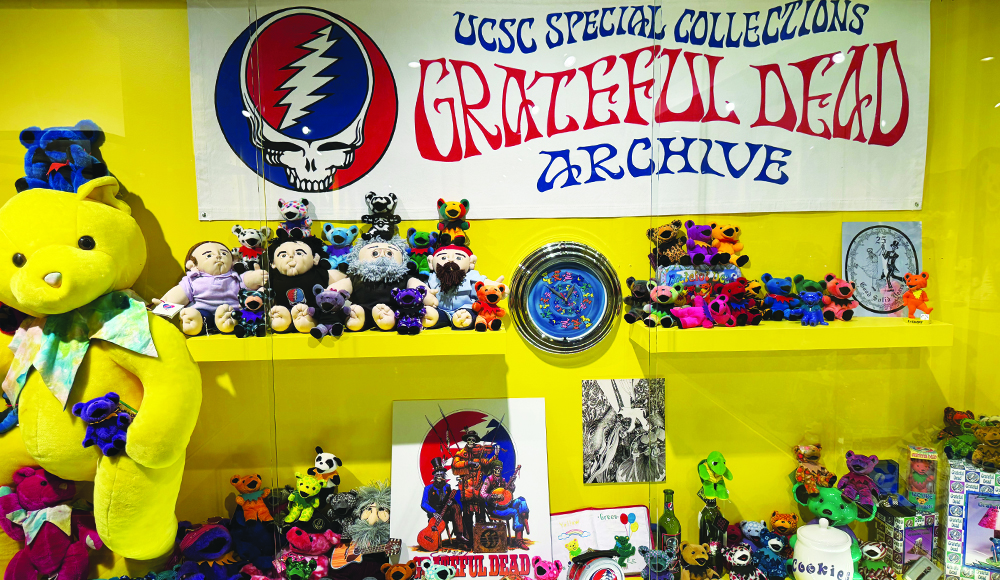
On the hill, amongst the ivory towers and inside the McHenry Library sits the archives of a band called the Grateful Dead. And, among all of the archival collections in America, featuring every musician and hundreds of bands of every genre, what is stored inside the temperature-controlled Dead tomb is unique, comprehensive and without comparison.
It’s been 10 years since original archivist, Scotts Valley resident and Deadhead Nicholas Meriwether, was in charge of the Grateful Dead exhibitions at McHenry Library.
When Meriwether was at the helm of the archive, beating out 400 other applicants, the library had gained not only a polymath who excels at navigating the university’s archaic rules, but Meriwether was also a living, breathing Deadhead who would happily greet and guide you through the exhibits. It was like Willy Wonka leading a tour of the chocolate factory, or Peabody showing you how The Way Back Machine worked.
In 2026, the library’s current online portal (gdao.org) to the Grateful Dead archives is a dizzying encounter with a plethora of audience tapes (with links to archive.org), a cool online exhibit of the band’s Europe ‘72 expedition and a trove of fan art.
Meriwether hasn’t simply faded away since stepping back from UCSC. The eternally young button-up Meriwether has dutifully been the chair of the yearly gathering of true academic Deadhead nerds called the Grateful Dead Studies Association. It’s been part of the Southwest Popular American Culture Association for two decades and features papers and presentations on such intriguing topics as “The Symbolic Landscape and Usable Past in the Lyrics of Robert Hunter.” And, “Let the Words Be Ours: Grateful Dead Lyric Poetry and Merleau-Ponty.”
Luckily for us of the smaller brainpans, Meriwether also contributes spicy liner notes on official Grateful Dead box sets and has written some new essays for the recent Summer Magic 1985 release. Plus he’s a regular commentator on the Good Ol’ Grateful Dead Podcast. And double plus, Meriwether has a parallel gift of gab that reminisces of Terence McKenna. Meriwether can educate and inspire with his eloquent soliloquies.
Consider Meriwether’s (heavily edited) answer to perhaps a not-so-simple question, “Why are the Grateful Dead even more popular three decades after Jerry Garcia’s death?”
“For years, I have been fascinated by the phenomenon of so-called Dead cover bands, which I now no longer see as cover bands, ” Meriwether begins.
“What’s always been the case with the Grateful Dead is that they taught musicians. They not only provided a repertoire, a repertory and a model for playing music, meaning everything from glorious syntheses of disparate influences ranging from the most deceptively simple folk music, to the most complex, avant-garde, classical, and the most intricate jazz.
“But more than that, they modeled a kind of small group improvisation that was built around listening to each other and responding to the moment. And what that means for a Dead ‘cover band’ is that – rather than doing something like the highly orchestrated, note-perfect orchestral arrangements of Pink Floyd music that you see with the Aussie Pink Floyd and Brit Floyd – it needs to be new.
“The improvisation is always a mandate. And that’s always made so-called Grateful Dead cover bands a very different kind of entity. Something that had as much to do with a jazz band playing an old jazz standard or even a symphony orchestra. Which may be recreating a score, but deliberately attempting to make it unique, to make it their own.
“Of course, that’s taken to a whole new level with the Grateful Dead because of that improvisational element. The phenomenon, however, that I think is now becoming remarkably clear is that these bands are no longer cover bands. These bands are now simply taking the Grateful Dead’s model and repertory and saying, ‘This is our inheritance. This is what we do.’ You would never look at a symphony orchestra or a jazz band and call it a cover band. In the same way, that’s what they are doing. That is something that represents the most remarkable legacy,” Meriwether explains.
MISSION IN THE RAIN
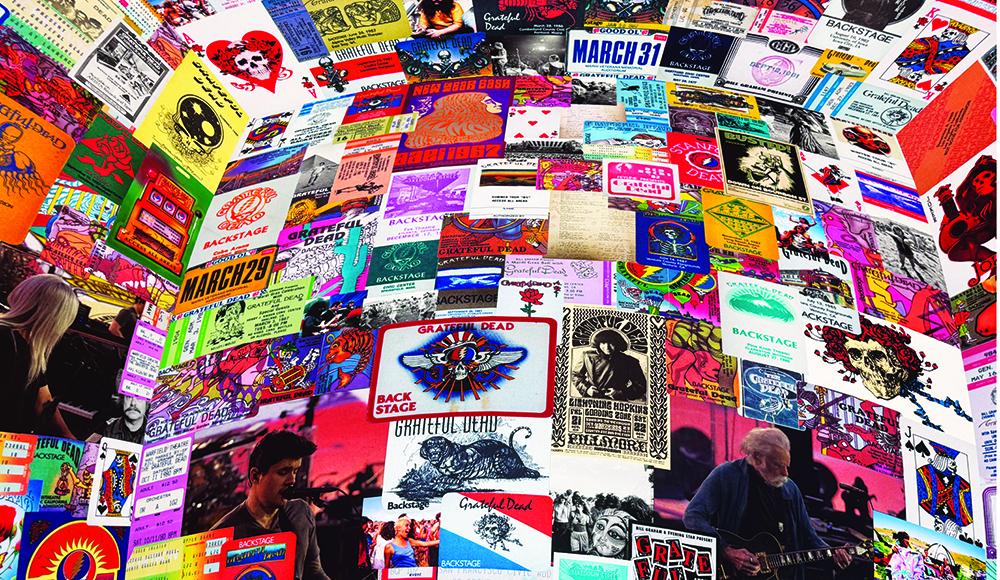
The swashbuckling Brian Rashap is most notably known as the steady bassist for Bay Area darlings The Mother Hips. But Rashap is also an integral part of (Grateful Dead bassist) Phil Lesh’s legacy, known as The Terrapin Family. It’s a sprawling aggregation of humans, curated by Phil’s son Grahame (who headlined the Winter Warmer Festival at Roaring Camp earlier this year).
Not since the Planet Earth Rock and Roll Orchestra have so many Bay Area musicians aligned forces for a grateful good.
Note that Rashap is more than just another musician onstage, he also provided a foundation of support for Phil Lesh as a bass tech, gear repairman, carrying the iconic rig Big Brown around, and even getting involved in production and tour management for Phil Lesh & Friends.
Rashap is a Deadhead down to his well-groomed roots. He recently played The Veteran’s Hall subbing for Roger Sideman with Santa Cruz’s China Cats.
“There’s a bunch of us that have this constant thought,” Rashap says from his home in the Bay Area.
“Somehow we all existed at a time where we were with Phil (Lesh) during Terrapin Crossroads. Phil had (at that time) decided, ‘I want to play with my kid because they’re getting into music. I want to make a safe space for them to learn music.’
“Phil was clear that this was his version of the Grateful Dead. It’s not anybody else’s. It’s not right. It’s not wrong. It’s just his version. We learned by watching him. And Phil would watch our show and say, ‘What are you guys doing? Why are you playing what ‘they’ played? That’s how he referred to the band, as ‘they.’
“We do feel that we need to pay attention to the torch, and how it’s being carried and passed on. It doesn’t matter how big your Jerry rig is. My favorite Jerry Garcia rig ever heard is someone like Dave Zirbell playing a Tele through an old cranked Fender Deluxe or something. It lends to that forward-thinking mission. Someone like Reed Mathis is a great example of that when he’s playing guitar now. It could be on a Garcia ballad and all of a sudden there’s this flurry and it’s in two or three different octaves because he’s using an octave pedal. So it’s a modernized melody of an old standard melody. I like that kind of stuff,” Rashap says.
It appears that Meriwether is absolutely correct; it’s the music played through the musicians that marches on, even after the original band is gone.
But what about the other legacies? The people and characters that filled in all the missing context of the world that the members of the Grateful Dead soaked in. People that seemed more than human.
COWBOY NEAL
If you ever walked down Pacific Avenue and came across two folks sitting behind a tie-dyed table full of ephemera and books about the 1960s – Ken Kesey, Neal Cassady, and the Grateful Dead – then you probably had a nice chat with Jami Cassady and Randy Ratto.
Jami, if you haven’t caught on by now, was one of Neal and Carolyn Cassady’s children and was the sentinel of the vast estate of letters, drafts and manuscripts. Neal Cassady, if you’re still wandering outside the exterior of the bus, was the human bridge between the poet beatniks of the 1950s and the colorful hippie Pranksters of the 1960s.
I picked up one of Neal Cassady’s infamous six-pound sledgehammers off the table. The same hammer, splattered with paint, that the shirtless hopeless fool would twirl and launch and catch all while carrying on several conversations at once, or rapidly jerking his body in the strobe lights of an Acid Test. I was holding THE hammer – or at least one of the hammers.
Jami and Randy and I talked. We laughed. Jami immediately adopted me, and was fond of calling me by my middle name, Neal, which was grandmotherly nice, and surreal.
This is too short of a remembrance for any real justice and grace to be given to Jami who passed earlier this year in a hospital in Oakland due to respiratory failure. What can be said is Jami was beloved amongst her family and provided a crucial hereditary link to the legends and lore that surround the psychedelic side of Santa Cruz.
OPERATOR
Another iconic Santa Cruz Deadhead, active community member and Grammy Award winner is John Leopold.
Drawn to the center of the Dead universe like Richard Dreyfus in Close Encounters of the Third Kind, Leopold uncovered a path laden with dosed breadcrumbs that led him directly into the band’s inner sanctum.
“I met a guy in 1981 at a Jerry Garcia band show, who gave me my first political job,” says Leopold, whose twin brother is also a Deadhead.
“I was hired as a legislative reporter for what we would now call a startup. It was this new service to track legislation for lobbyists. And my job was to go around the state capitol and track bills. I didn’t have to write stories, but I tracked bills. And my father was on the staff of the Senate Appropriations Committee. I got to see the sausage made up close. At the end of the day, when I was done, I would go to my dad’s office so we could ride home together. And he had a WATS line,” Leopold says.
A WATS line was a prepaid phone where you could call anyone, anywhere in the world. That was a big deal in 1981.
“I talked to all my friends. Then I thought of other people I should call. Blair Jackson’s book had just come out: Grateful Dead: The Music Never Stopped. I thought it was a great book. In the back of the book, it said he was the managing editor at BAM Magazine in Berkeley. I called them up.
“I called BAM, and I said, ‘I want to talk to Blair’. And they said, ‘Well, who’s calling?’ And I said, ‘Well, John Leopold from Harrisburg, Pennsylvania.’ He put me right through and I introduced myself and then I gave him my review of the book. And to Blair’s credit, he didn’t hang up on me. We started talking and he told me that he and his wife were going to start this fanzine called The Golden Road. And they were looking for ways to get the word out.
“I said, my brother Dave and I are going to do the six shows on the fall tour. We’d be happy to hand out flyers. And we did. And that became the foundation of the Golden Road subscription base. And so the following summer, in 1984, I came out to California for the first time and stayed with Blair.
“We came out for New Year’s. We came out for Chinese New Year’s. And we came out for the BCT (Berkeley Community Theatre) run. I took my finals early so I could come out for the Frost (in Stanford). Ostensibly it was to work for the summer, but instead I just never went home. I lived with Blair and (Blair’s partner) Regan for the first couple of months, and I sublet David Gans’s (author, musician and host of the nationally syndicated Grateful Dead Hour and the Sirius XM show, The Golden Road) place.
“We had the mayor declare it Grateful Dead Day at Harrisburg in 1984. And that attracted Dennis McNally, who was new in his position as the Grateful Dead publicist. He became aware of us and during the New Year’s run in ’84. We sat down with Blair and Regan and a couple other Deadheads to be interviewed by Time Magazine. I immediately applied to school and ended up here in Santa Cruz in ’86. So that’s how I got involved,” Leopold explains.
SPINNING HEADS
Amongst Deadheads there was a sticker that appeared on trusty rusty VWs, coffee-stained bistro counters and bullet hole stop-signs that read, We Are Everywhere. This idea that Deadheads are prevalent throughout American society is more true now than ever.
According to brilliant author and wordsmith Dennis McNally, in 2024 there were 800 Grateful Dead cover bands. Every major city in America had at least two Dead cover bands. Dark Star has been a ubiquitous sonic psychedelically-tinged charge ringing out from bars, backyards and venues from coast to coast, for decades, with no slowing down.
In Jesse Jarnow’s intricate puzzle book of alternative American history, Heads: A Biography of Psychedelic America (2016), he references Dr. Rebecca Adams who went on tour to study Deadheads. She estimated, conservatively, that there was a population of some half a million Deadheads with a mean age between 23 and 32 in the 1980s.
That means there are currently half a million Deadheads who are between their late 50s and 68. Plus the legions of new fans who joined along the way.
I think it’s fair to guesstimate, and Dr. Adams would agree, that there are over one million Grateful Dead fans in the USA. The legacy is growing.
THE REIGN
Jesse Jarnow, co-host and writer of the granular The Good Ol’ Grateful Dead Podcast, is the author of Heads. The book isn’t just about the Grateful Dead. Although that becomes a major thread. Jarnow also traces LSD through its labyrinthine networks of manufacturers, many of whom were Deadheads. And not least, the stories of the molecules’ lasting, not always wholesome, continued impact on society. It’s a mind-blowing page turner.
Jarnow was celebrated at The MAH when Heads was released in 2016 and introduced at the gala affair by John Leopold.
“Back then I was at a point where the future that we now live in seemed improbable,” Jarnow reports from his home in Brooklyn.
“I should have been taking it way more seriously. But when I wrote Heads, I was not thinking about an incoming fascist takeover of the United States. Things were way rosier during the four years that I was working on that book.
“One of the wild things about a postscript to Heads is that in 2016 it (the fascism) was already happening a bit. Contrary to that, in the years leading up to 2016 was when MAPS (The Multidisciplinary Association of Psychedelic Studies) was starting to get momentum. MAPS was (they are now located in San Jose) another huge Santa Cruz psychedelic connection,” Jarnow recalls.
The young podcaster, author, philosophizer and Deadhead doesn’t just live chewing on the past, he also has his dancing skeleton finger on the pulse of current trends.
“Psychedelics are moving into a more corporate world. Into a more business-like structure,” Jarnow states.
Consider that Definium Therapeutics (NASDAQ: DFTX) is whisking its way through the third stage of clinical trials with LSD.
“That’s not countercultural psychedelics. That places it as part of the larger culture. And that interests me personally less as a writer. Not even legality or decriminalization or therapeutic methods or any of that.
“But I’m also not blind to the fact that it is also part of MAGA culture. It’s a freakier subset. The psychedelic right-wing world. It’s all spectrum,” Jarnow exposes.
FARE THEE WELL
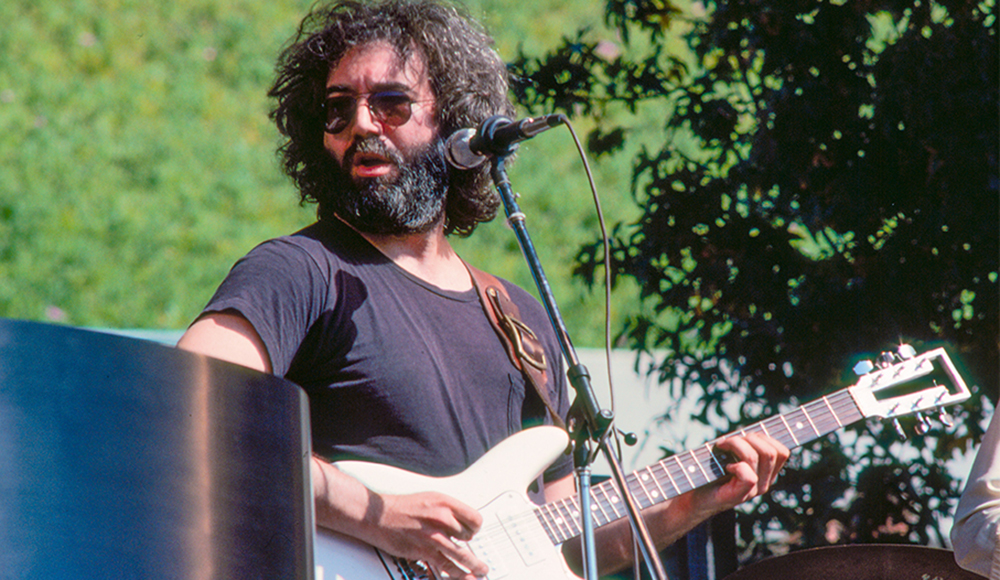
“Jarnow (born in 1978) is the next generation of Grateful Dead historians. If you think about people like Blair Jackson, David Gans, McNally, they sort of defined the field, right? I mean, Blair had the first serious book about the Dead. And then David Gans worked on a number of books. And of course, McNally has the official biography. But Jesse has taken it to a whole other level, if you’ve ever listened to what he’s done with the podcast,” says Leopold.
The future is uncertain, but what can be counted on is this. 1. The music of Jerry Garcia and the Grateful Dead will remain egalitarian and open-source. 2. New savant Deadheads will bring original insights into the band and culture. 3. We can still dance while it’s legal.
And that is an outstanding legacy.
Author DNA was lucky enough to see Jerry Garcia 500 times. He’s not bragging, he’s grateful. votedna.com Jesse Jarnow can be heard each week at dead.net/deadcast David Gans can be heard on Sirius XM’s Grateful Dead channel Sundays 1-3pm.




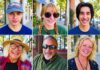
My first Dead show, among many to come, was June 17, 1972, the night after I graduated from high school. The high part continued, because of some fine windowpane that eve. Pigpen’s last show, and he barely moved behind the keyboard. Garcia played pedal steel with the New Riders.
Me and my boon companions ate an entire case of Reese’s Peanut Butter Cups when we returned home (and thank the stars we had a designated driver). The music, as they say, never stopped…
My first show was 7/11/70, Fillmore East-Dead at Midnight. Acoustic, then NRPS with JG on pedal steel, then electric and walked out somewhere between 6:30-7:00 am to the neighboring deli. I was hooked immediately. I was fortunate to see every iteration of the band (save the TC months), and at significant shows being that I lived in the Bay Area for 50 years. In 1986, I got into merchandising and was invited to meet the band at the annual Ventura shows. Sadly they were cancelled due to Jerry’s illness, but also became a primary supplier to them for all sorts of UG merchandise, and continued until I chose to stop in 1999. Thank you to all the cover bands keeping the spirit alive.