


On July 1, a 7–10% permanent yearly increase in UC Santa Cruz parking permit costs quietly went into effect – meaning for faculty and staff, rates will rise from $841.63 in 2026 to $1,355.45 by 2031.
For students, rates will rise from $405.23 to $652.63 by 2031.
This 61% increase is despite uproar during a short public comment period that included a tense town hall March 13 with Transportation and Parking Services (TAPS) Director Dan Henderson and Associate Vice Chancellor Clement Stokes, and a webpage logging 68 pages of mostly negative feedback. Between a lack of meaningful implementation of that feedback on what were defined as “proposed increases,” and TAPS shunning the avenues for formal consultation open to it, many felt the process was pro forma.
The dozen or so people interviewed for this article, some of whom shared documents or spoke on the condition of anonymity, made clear how hikes like this affect quality of life.

It’s nicknamed the City on the Hill, but UCSC is actually many hills.
Even the able-bodied struggle, but for those with mobility issues like Writing Program lecturer Alexandra McCourt, the difference between securing a spot near her classroom at Humanities or at Crown, the next ostensibly closest lot and her office location, is massive.
As a Unit 18 non-continuing lecturer, she’s on the lower end of the pay scale and so feels any extra costs more acutely, and because she shares a car with her rideshare worker husband who moonlights in food delivery, the longer she remains on campus, the less he can earn. They split childcare and bring their daughter to and from school, so the question each day is: who needs the car more?
“It’s a balancing act,” she says.
Shared Governance
UCSC has an impossible supply vs demand discrepancy; more people desire parking spots than there are spots to give. TAPS passively addresses this scarcity by suppression: not everyone who applies for a permit is guaranteed one, and not everyone awarded a permit is guaranteed a spot.
A common theme is fee allocation transparency and dissemination. Students, staff, and faculty have seen campus costs rise and heard how certain measures were cost-saving, but are unable to pinpoint where those pennies pinched went.
Asked to comment on this and other concerns, TAPS director Dan Henderson referred us to Vice Chancellor Scott Hernandez-Jason, head of the Public Information Office, who, in lieu of comment, referred us to a FAQ page buried in the TAPS website. It confirmed crucial information our interview subjects relayed only as rumor.
None of our interviewees seemed aware that TAPS is now a “self-supporting auxiliary enterprise funded entirely through user fees,” whereas certain aspects had been “historically centrally funded.” Shocking construction cost estimates might illuminate why TAPS charges what it does: $100,000 per garage space; $50,000 per paved space; $10,000 per gravel space.
Any surplus will go to a “reserve fund to support future critical capital projects.” These range from “expanding, refurbishing and upgrading” existing lots; paying down a parking structure’s debt; “New Mobility Hubs”; and even a campus sidewalk study.
Legal Studies undergrad Jordan Robinson is dubious that students consider all of these “critical.”
The commission she sits on, Voices for Empowerment and Safety in Transportation (VEST), is designed to research and advise on transportation and parking pricing, access and safety. VEST partnered with University Labor United (ULU), a coalition of campus labor unions, to produce a background document describing the stakes of fee increases for students: 58.2% of them experience food insecurity; 8% experience housing insecurity.
There is no mention of sidewalk insecurity.
“There’s what they’ve perceived as feedback, and what we actually want,” says Robinson, who has paid simultaneously for campus and Santa Cruz residential parking permits. The latter is only $30 per year, versus the $405.23 TAPS wants.
Students had reason to expect they would be consulted. In 2025, they voted to create VEST after a 2023 bus crash killed a campus bus driver and injured five students. They saw their participation as an essential form of self-protection.
Yet neither VEST nor the Student Union Association (SUA) – the main body representing students – were consulted when the plan to increase fees was developed, says Maya Payes, Vice Chair of Internal Affairs for SUA, who also sits on the Student Fee Advisory Committee ex officio.
Because students voted to impose a mandatory Student Transit Fee upon themselves to cover Metro service for graduate and undergrad students, on-campus transportation, and the disability van, TAPS must consult with the Committee about anything to do with it. Minutes reviewed by Good Times corroborate her account: while Henderson came to them in January, he discussed the increases, but not student impact.
The excuse university administration used, according to a letter VEST wrote to Chancellor Larive, was that it had to consult with labor unions first. Did they do this?
It’s complicated.
Whether TAPS should have consulted with the unions, which represent various staff and faculty groups, depends on where each stands in the bargaining cycle. The university administration was required to confer about the parking increase with the Faculty Association, which represents ladder-rank faculty—tenured or tenure-track professors—but did not.
Lecturers like McCourt are outside the Academic Senate, but represented by the UC-AFT. Their contract allows for parking fee increases of up to 10%, explains field representative Jeb Purucker, so the university was not required to consult with them. Some staff employees represented by the UAW, however – student advisors and others – were in bargaining at the time the increases were announced, and so should have been consulted, says Jacob Fontana, an executive officer with UAW 4811.
Consultation with the Senate, composed of all tenured or tenure-track faculty, is mandatory on such matters. It has authority – delegated by the Regents – over curriculum, and consults on budgetary and other issues, a unique relationship called “shared governance.” In a Senate meeting March 11, Larive apologized for the “mistakes and missteps” her administration had made in failing to consult about parking rates, and pledged to consult going forward.
Once included in consultation, Senate committees spoke sharply about the plan’s wide-ranging implications. The Committee on Diversity, Equity and Inclusion noted it will disproportionately affect people who cannot work remotely – e.g., custodians, groundskeepers, kitchen staff – for whom fee increases will represent a higher percentage of their paychecks.
Meanwhile, the Committee on Faculty Welfare (CFW), which consults on faculty well-being issues such as childcare and housing, found the data TAPS provided to justify the increases “difficult to interpret and insufficient for evaluating policy choices.”
TAPS even neglected to confer with, well, itself.
The plan to increase parking rates was not discussed with its own Advisory Committee on Campus Transportation and Parking, charged with advising the administration on parking and transit, including changes to fees and fares, until the week after it was announced. The Committee is chaired by Stokes, to whom TAPS reports, who did not respond to questions from Good Times.
An open letter June 26 signed by over 750 faculty, staff, researchers and undergraduates asked UCSC to “Establish a transparent, evidence-based, participatory process with adequate time (10 weeks) for stakeholders to review and contribute to the development of a campus parking plan that includes students, staff, and faculty through the representative bodies of the VEST, ACCTP, labor unions, and the Academic Senate.”
That 10-week grace period never came. Despite detailed critiques of the plan from all affected constituencies, it was implemented unchanged on July 1. Caught between UCSC’s $81 million budget deficit and expectations to consult with those constituencies, TAPS seems to have decided to act now and ask for forgiveness later. The plan debuted in summer, so the pain hasn’t spread like it will this fall.
But fire season is coming.
On the road again
Cameron Hughes would rise before 5am in his Oakland duplex for his 10am section last quarter, slam his first coffee and hit the road, stop for his second cup in San Jose for peak alertness over Hwy 17, then to his campus office or a cafe for his possible third, where he’d work while waiting for his TA shift to start.
Mercifully, most sections have been either midday or evening, allowing him to skip morning or evening rush hour. But stuck with this “brutal, brutal” same-day routine, he prefers it to the alternative: one fellow TA in the History of Consciousness would sleep at a friend’s house the nights before his teaching days; a professor in his department did the opposite, driving down for lecture, then staying over to recharge.
TAs factor in each other’s travel distances during section assignment negotiations, but any solidarity relies on not everyone coming from afar, increasingly the case. Many submit to Herculean commutes because it’s more affordable and available to live elsewhere. Santa Cruz County has the highest rents in the US, according to a recent report by the National Low Income Housing Coalition.
When you live in a distant city because it’s more affordable, “You’re not a part of the fabric of campus life,” says College 9 Lecturer Jared Gampel.
“Faculty housing is almost as hard to secure as graduate housing,” says Hughes. The “dearth of availability” affects everyone. He worries any savings living in Oakland, threatened when gas spiked, will now be “whittled down to nil.”
A Sociology PhD candidate active in union discussions, Hughes is uniquely equipped to see the systemic “broader social forces” at play: crises of housing and rent; foreign wars increasing cost of living; the federal government’s assault on higher education; state funding, etc. His area of focus allows him to rationalize how UCSC’s budget deficit came to be.
“They are passing those costs on to their employees, who produce value for the University, to absorb,” he says. “They’re not calling it a pay cut, but that’s what it is.”
Writing lecturer Kate Marie Ross says the fee hike will eat into any future raises she might get. From her meager TA training hours, to how tenured professor promotions are contingent more on research than teaching, she feels that “the University doesn’t really value teaching.” TAPS’ proposal to drop the annual increase to 6% in 2032 is no comfort.
“My teaching conditions are the students’ learning conditions,” goes a popular education union motto. Compounding economic pressures have a negative cumulative effect on teacher-student relationships, degrading teaching and learning. Parking is one of those, forcing everyone’s attention elsewhere. Students and faculty need to allocate longer time buffers before class in case the lot they choose first is full. In-person lectures and sections now have to be soft on attendance, with students’ late arrivals and early departures an accepted disruption according to their parking constraints.
In a May 7 letter, the Committee on Teaching argues the fee increases “will directly, negatively impact student learning,” and low-income students will be more likely to skip in-person classes, widening the learning gap between poor and wealthy students. A May 19 letter by the Senate states they have “grave concerns about slow, but long-term detrimental erosion of the University’s teaching.”
“When students have the opportunity to go to a public institution like UCSC with as much prestige that is rightly associated with it, they deserve to have the kind of attention given to them that accompanies that prestige,” says Hughes.
College 9 lecturer Jared Gampel sees how he and his colleagues bolting from office hours to avoid a ticket shortchanges students needing more time from them for clarity or connection.
“All those potential little moments, stolen,” he says.
Gampel worries about the brain drain when academic professionals stretched thin finally snap and leave the UC altogether. He knows several tenured faculty leaving or considering retirement for a host of reasons: austerity; soaring class sizes; the twin intrusions of AI and Zoom. He feels hollowed out by administration’s choices, trapped between “perennial underemployment” and a “landlord that eats up all my wages,” but he’s been here since 2006 and is staying put. While he has a powerful community outlet as a local DJ, he thinks his colleagues and students forced to live far away due to affordability and availability are stars outside of the social constellation.
“You’re not a part of the fabric of campus life.”
Different Spokes
Musicology PhD candidate Lydia Barrett mounts her Trek 930 every workday to commute from Midtown. It’s a considerably shorter sprint by car, but she feels no able-bodied individual should need one on campus, and they’re missing on their roads what she drinks in on the East Meadow bike trail: sightings of coyote, deer, owls.
The caveat she shares is that on-campus bikeability is negated by the dangers off it: scarce lights on Empire Grade; a shoulder instead of a bike lane on Bay Street that merges on a downslope. Every time her battery-powered headlight dies, she thinks she might too.
Anthropology grad Caroline Margolis saw this issue up close in bumper-to-bumper traffic on Bay because of a bike accident. As an LA native, she felt more “assimilated” than her peers. She knew the “traffic math” necessary to survive: time of day ÷ proximity to popular lecture halls + loop bus route = Remote lot choice. For a while, she attended “Covid U” and so had no commute at all.
When she returned to in-person classes, she preferred walking to taking the bus, even if it was a mile. “You wake your brain up on the walk to class, then decompress it on the walk back,” she says.
“The city bus system is good if you need it every once in a while,” says Computer Science PhD candidate Taha Shafiei. Living on Bay Street and Westcliff Drive, not only did the 19 or 20 line rarely meet its promised fifteen-minute standard, but it sometimes wouldn’t show up at all. When he moved to San Jose, he discovered he’d have to pay for the 17 line out-of-pocket, catching it at Diridon Caltrain Station where he’d have to pay for parking daily or monthly – “not financially feasible.”
“It’s been a long time since I’ve been able to afford a place where I could realistically take public transit from,” says Ross, who commutes from Santa Clara. As a new mother, carting all her pumping equipment makes it impossible.
A press release by ULU and VEST June 29 notes: “Parking and transportation are not luxuries. They are a basic need.”
Shireen Nabathian, a Canadian Teaching Fellow in Cross-Cultural Musicology, wants to put things in cultural perspective. “As someone who grew up outside the USA, the reliance on cars here is absurd, unsustainable, and wasteful,” she says.
Shafiei counters that what necessitates leaving campus are basic needs due to lack of meaningful infrastructure, and that the City on the Hill should fortify itself like the nickname implies. “There’s no reason why there cannot be a university-run grocery store or other services on campus,” he says.
Part of the new TAPS plan expands prohibition on parking to all students in residence, except by appeal. Yet instead of shoring up resources, the UC has moved the opposite direction, shuttering food retail and markets.
“Campus is a food desert,” says Barrett. If she doesn’t bring enough to eat, there are few places she says she can refuel.
Literature grad Vee Santoscoy, who did a three-year degree to save money, worked at Merrill Market, the closest thing to a campus grocery with Kresge Food Co-Op in ongoing closure from the endless construction around it. They knew what they sold wasn’t superior quality, but the students who turned to them for everything from dryer sheets to frozen burritos wouldn’t have to “bus to the Capitola Target, or Uber to Scotts Valley.”
Santoscoy bore witness to food insecurity in their regulars. Tuition-paid meal plan “Slug Points” are programmed to expire at the end of the quarter, and students on the lowest meal plan stretch them in the final weeks after expensive dining halls deduct the bulk. One female student ran out two quarters in a row and so Santoscoy intervened, missing a few items with the scanner, or paying for her out of their own paycheck.
“Keep your points,” they told them. “Just eat.”
22 tickets in two years
Even before this hike, many seeking campus parking felt like TAPS saw them as an ATM, none more so than Theater Arts and Dance grad Luna Camitan.
Camitan received 22 tickets in two years. Her welcome to the UC was a fine during move-in, and accelerated from there. The first was $10, a warning; the next was the “regular” rate, which she watched climb from $50 to $75, then it reset each quarter, entitled her to a warning rate again. The single highest was $100, parking in a “C” spot at her Redwood Grove dorm. Her final one May 28, dinged with a $35 late fee when she didn’t pay by June 19, became $110. The latest TAPS plan raised fines by 4% until next July 1, when they’ll climb again.
Outgoing SUA chair Rodrigo “Rigo” Ventura emphasizes how fee increases are “on top of new tuition increases,” when students are “already paying to be on campus to live, eat, and learn.” Many incur parking tickets they can’t afford when they can’t afford a permit. But that wasn’t Camitan’s issue – she could afford both.
“We tried to get myself a specific permit for the Theater Arts lot but they emailed my boss and said it’s not permissible,” she said. As a research assistant for Iris Lab, she needed to flit to and from their campus office multiple times a day. Flyering, doing outreach in town. She pursued an “R” permit as a failsafe and was placed in the 700s on the waitlist. By graduation, she was 100th.
If she couldn’t get the permit she needed and was waitlisted for her second choice, what was she supposed to do?
She decided it was worth the gamble TAPS wouldn’t discover her and white-knuckled it, parking either where she wasn’t permitted or in spots that expired while she still needed them. If that meant setting her alarm for 6:30am to move her car, or waiting all day until between 7:30–9 when one or two of the Theater Arts lot spots tended to open, she’d do it. She stayed vigilant, relying on short-term and ParkMobile spots where she received most of her tickets, and where she encountered interference by TAPS.
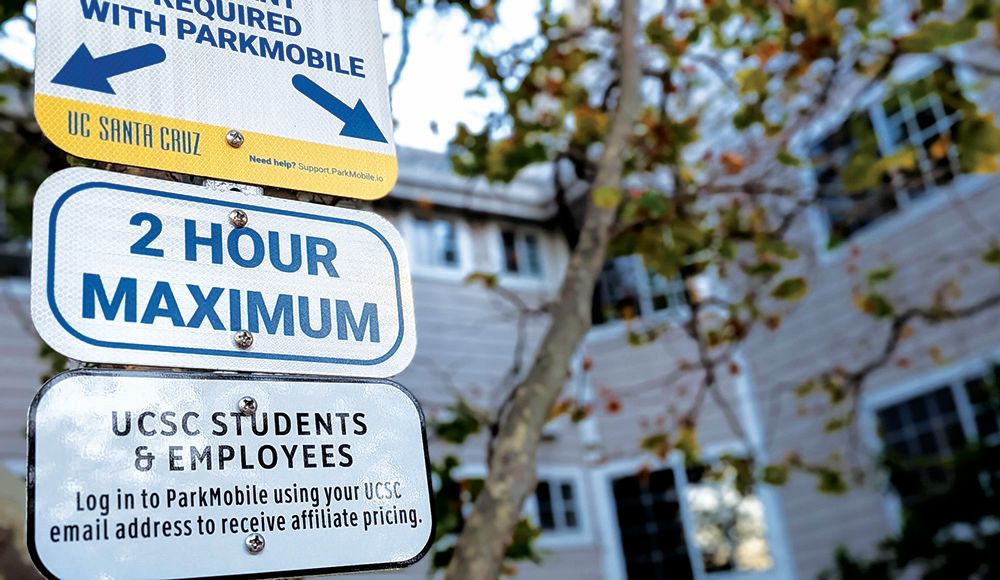
In any city other than the City on the Hill, digital parking meters are built for modern convenience. Camitan watched a required ParkMobile app update wipe the ability to refill two-hour limits from her phone. She finds TAPS’ commitment to turnover “ridiculous,” because if she’s able to pay for parking, “I should be able to continue to pay.”
At the Crown/Merrill apartments, her friend Jonathan Thornton noticed students were having to swap all-day ParkMobile spots the following day, because when they went to add money it only gave them a three-hour ceiling. If they scooted one spot over, all-day privileges returned. When he called ParkMobile customer service, they told him, “‘That’s not supposed to be happening.’”
Staff and faculty have as little recourse as students in overturning fines incurred while discharging their duties. Camitan had to assist a professor when her car was booted while in the process of re-permitting in the new year.
A Jan 30 email to faculty helpfully suggested they can always purchase a ParkMobile spot in the case the “A” and “R” spots they paid for are taken. (The faculty member who provided us a copy had “hate-deleted” it.)
When asked how much the university makes through its ParkMobile partnership, or if Parking Enforcement officers are alerted when a meter expires, TAPS did not respond.
“Everybody wants their pound of flesh these days,” says musician Rick Walker, who thought it was “tacky” that attendees had to pay $20 to park for his former student Oliver Tree’s memorial event at The Quarry Amphitheater July 25. Taylor Posey can’t remember a time he wasn’t charged $20 as a regular Quarry showgoer. As someone with inside knowledge of event production, he says charging for parking is a natural part of recoupment, yet UCSC “might have been in better conscience not to.” As a resident, nothing makes him feel more like “a peon visiting the walls of the great castle.”
Disabled visitors are in for a surprise now that state-issued DP placards and plates are no longer “valid” outright – everyone must display a UC-specific permit picked up at the TAPS office. Their justification is that free access was a “legacy approach” based on when UCSC featured coin-op parking meters, a notion the Senate finds “possibly punitive.” Campus affiliates can grudgingly obey, but how many visitors will know without getting fined first?
As the Senate wrote in a May 19 critique, without budgetary transparency and analysis, “the impression can be created that those who must come to campus can be used as a ‘piggybank’ to extract the maximum amount possible.”
Shafiei bristles recalling how he had to purchase passes for his family to attend his Commencement. The first cost $10, but the second was $40, both valid only from 90 minutes before to one hour after the ceremony.
He alleges that when digital permits debuted, TAPS benefited by creating a false supply. “I know for a fact they sold more Remote permits than there were spots available,” he says.
Before TAPS caught on, students put multiple cars on one permit and split the cost with friends. But that exploitation cut both ways: those cars might all be on campus at once, further limiting parking for everyone.
We heard many workarounds students and lecturers used as desperate measures to avoid TAPS costs and fines, even down to memorizing Enforcement Officers’ rounds like prepping for a heist.
“It was intel people would exchange like currency,” says Margolis.
Unfortunately, like in every casino, the house always wins. Or, to use Shafiei’s gamer terms, people discover an “exploit” in the parking code and slip through it until administration or someone else installs a “patch.”
As much as TAPS workers can be seen as foot soldiers for the university, each is just another UCSC employee whose parking is unsubsidized. They must purchase permits and stick to “A” lots near where their workday begins, according to one TAPS worker who spoke on the condition of anonymity for fear of professional reprisal.
Theater Arts undergrad Ian Grant used to work for TAPS in its Grounds Maintenance division, and had colleagues in Parking Enforcement confide how the contempt they receive wears on them. “They’re subjected to a lot of prejudice implementing these predatory policies that eliminate convenience and autonomy,” he says.
Implementation of the parking plan was immediate, but challenges to its permanence and its various stipulations continue. Students, staff and faculty have outside-the-box solutions, if university administration is listening.
The UAW filed an unfair labor practice charge for TAPS’ failure to consult with two UAW 4811 units while they were in bargaining. The Faculty Association is now in active bargaining with the university. Megan Thomas, an Associate Professor of Politics on the bargaining team, communicated that “The SCFA does not wish to comment now while in negotiations.” VEST and ULU’s collaboration is seen as a breakthrough in negotiatory bodies cohering around shared problems, and representatives continue to meet.
“This issue around parking is one of the first things we’ve tried to do together because it’s affecting all of us,” says Hughes. He clarifies that his sociologist’s eye doesn’t convince him he’s powerless.
“It takes collective action and talking to journalists to raise the issue.”
SOLUTIONS
If you were TAPS for a day, what would you do?
Taha Shafiei, Computer Science PhD candidate:
“Build the City on the Hill like an actual city, with infrastructure satisfying basic needs so affiliates wouldn’t need to leave campus.”
Cameron Hughes, Sociology PhD candidate:
“Collaborate with the city or county to create off-campus satellite parking locations with shuttles.”
Shireen Nabathian, Teaching Fellow in Cross-Cultural Musicology:
“Free express buses from key points like downtown, Capitola Mall, Watsonville, etc.”
Alexandra McCourt, Writing Lecturer:
“An app with up-to-the-minute bus geotagging, arrival times, and line directions (modeled on the Wolfline at North Carolina State).”
Lydia Barrett, Musicology PhD candidate:
“Improve off-campus bike networks, i.e. install lights along the Empire Grade corridor; direct High St traffic one way.”
Kate Marie Ross, Writing Lecturer:
“Subsidize faculty and staff parking; allow staff to update annual parking passes after schedule changes.”
Vee Santoscoy, Literature Grad:
“Not use Automatic License Plate Readers for digital permit verification.”