


Santa Cruz County has grown old. Since 2010, the population aged 65–84 grew faster in Santa Cruz County than anywhere else in California — increasing by 80.9%, according to 2020 U.S. Census data cited by the Seniors Council of Santa Cruz and San Benito Counties.
The numbers reflect a broader demographic transformation that has been aging the county for decades.
In the years leading up to 1965, when UC Santa Cruz opened, Santa Cruz was known as a quiet coastal retirement and resort town with conservative-leaning politics.
That changed quickly.
By 1970, Santa Cruz County had become a young, family-heavy community. More than 35% of residents were under 18, while fewer than 10% were over 65.
What’s happened since then has been more gradual, but no less significant.
Today, only about 18% of county residents are under 18. Nearly half are 45 or older, and about 20% — one in five residents — are now 65 or older.
In many ways, Santa Cruz now looks a lot like it did in the early 1960s — older, greyer, and settling into a different phase of life.
And yet the version of Santa Cruz many people still carry around in their heads was formed during that younger chapter in between.
Miriam Greenberg, a UC Santa Cruz sociology professor whose work examines cities, culture and housing, says communities often continue identifying with the era that felt most defining — even after the population shifts.
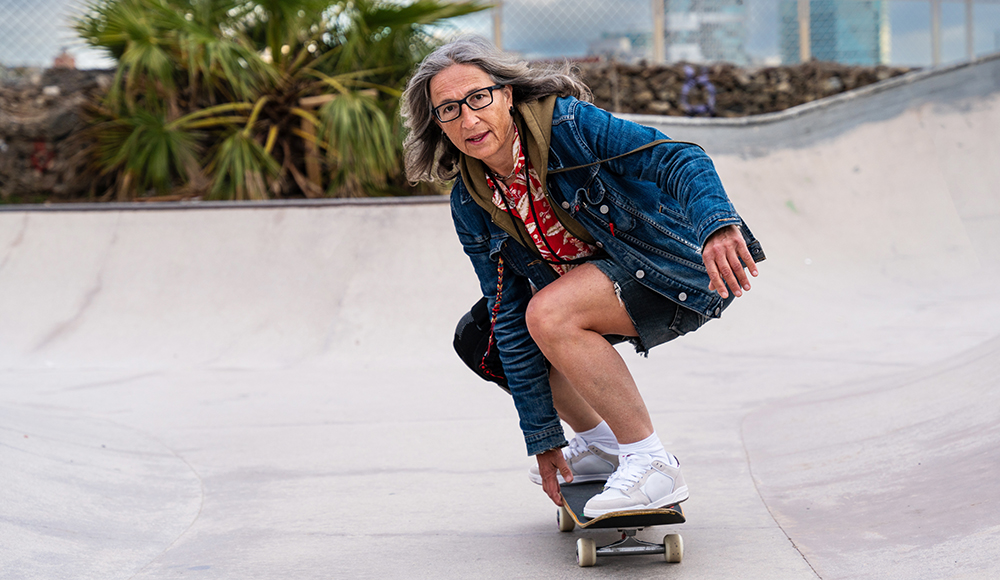
“Santa Cruz became known as a coastal center of the counterculture,” Greenberg said. “That era became associated with youth — surfing, skateboarding, environmentalism, political activism. Youthfulness was a feature of that image.”
And that identity stuck.
Greenberg points to the late 1960s and 1970s as the period when the city transformed into a nationally recognized center of progressive politics, alternative lifestyles and youth-driven creativity. UC Santa Cruz students stayed after graduation, became politically active, and helped reshape local leadership and civic character. Surfing, skateboarding, graphic art, co-ops, communes and environmental activism all became intertwined with the city’s evolving reputation.
That transformation became so pronounced that in their book The Leftmost City, sociologists Richard Gendron and G. William Domhoff wrote:
“From the late 1960s until recently, Santa Cruz, California was the most politically progressive medium-sized or large city in the United States.”
They went on to describe “an unlikely confederation of socialist-feminists, social-welfare liberals, neighborhood activists, and environmentalists” who “controlled the city council from 1981 through the beginning of the 21st century.”
“Berkeley, Burlington, Madison, San Francisco, Santa Monica — none of them had as progressive a government for as long,” they wrote.
The political transformation was measurable at the ballot box as well. In 1980, Ronald Reagan was the last Republican presidential candidate to carry Santa Cruz County.
Since then, the county has moved leftward. California Secretary of State voter registration records show that while Democrats outnumbered Republicans by roughly 2-to-1 in Santa Cruz County in 1990, that gap had widened to more than 4-to-1 by 2022, as Republican registration fell from 37,503 voters to 22,900.
But Greenberg says there’s another part of the story that often gets overlooked: affordability.
“There was a time when young people could afford to live here,” she said. “They could imagine a future here. They had the time and space to build communities.”
“It was an unusually creative period,” Greenberg said. “Young people could stay. They could experiment. They could create lives here.”
Today, most of those same conditions no longer exist.
Santa Cruz has become one of the most expensive housing markets in the country, consistently ranking near the top of national affordability reports. Younger residents — including many UC Santa Cruz graduates — increasingly struggle to imagine building long-term lives here.
“We’re seeing a shift from a time when the culture was actively being produced to a time when the culture is being consumed,” Greenberg said.
She compares it to neighborhoods like SoHo in New York, where visitors flock to experience the image of an artistic scene created generations earlier by young creatives who could still afford to live there at the time.
“The same is true for Santa Cruz,” she said. “The culture and image that became associated with the town were produced in an earlier era.”
That may help explain why Santa Cruz can sometimes feel like two places at once.
The young Santa Cruz still exists — on campus, in late-night pizza shops and packed Halloween crowds downtown. But increasingly, the people who helped shape the city’s countercultural reputation decades ago are now the ones aging in place.
And yet the mythology remains powerful.
The slanted Santa Cruz logo. The “Keep Santa Cruz Weird” bumper stickers. The enduring idea of Santa Cruz as rebellious and youthful. That version of the town continues circulating widely, even as the population underneath it keeps getting older.
“There’s a kind of cognitive dissonance,” Greenberg said. “The culture is still being used to market the town. But the reality is that it’s becoming harder for that culture to survive here organically.”
One of the more surprising Census patterns is that the percentage of residents between ages 25 and 44 has remained relatively stable over time, even as younger and older age groups changed dramatically.
Greenberg believes that may reflect a growing divide between who can afford to build a family life in Santa Cruz and who cannot.
“We’re not seeing young people growing up here to the same degree,” she said. “We’re not seeing young families.”
Instead, the relatively stable 25–44 population may increasingly consist of affluent professionals, tech commuters, remote workers, singles, couples without children, or residents having children later in life.
Shrinking school enrollments and housing pressures reflect broader demographic changes that go beyond any one policy decision.
“It’s so much more expensive to have kids when you’re dealing with housing and childcare,” Greenberg said.
She also points to another growing dynamic: seniors aging in place.
Many longtime homeowners remain in houses they bought decades ago, often without affordable downsizing options nearby. Meanwhile, younger families struggle to enter the housing market.
“We’re seeing seniors kind of trapped in these homes while young families don’t have a place to move into,” Greenberg said.
Failing to address those realities proactively will only create larger strains later, according to Clay Kempf, Executive Director of the Seniors Council of Santa Cruz and San Benito Counties.
“If we just try to maintain the status quo, the sheer numbers are going to bankrupt the state and local jurisdictions,” Kempf said.
All of it raises larger questions about what Santa Cruz is becoming — and whether the city fully recognizes the shift already underway.
Kempf believes Santa Cruz needs to have more honest conversations about the implications of its rapidly aging population.
“So much is denial,” Kempf said. “There’s this fascination with youth.”
Kempf points to shrinking school enrollment as one example of the disconnect.
“A lot of energy is still going into priorities people have historically invested in out of habit,” he said. “It’s not that support for education, or kids, is a bad thing. It’s more that there’s this mindset to ignore the opposite end of the age spectrum.”
Because while the mythology of Santa Cruz may continue revolving around youth, rebellion and creative freedom, the lived reality of the community is moving into a different phase of life.
Santa Cruz is not the same city it was in 1970.
But maybe that’s the point.
Cities age too. The question is whether they’re willing to recognize themselves honestly when they do. ■
Read on — Kristen McLaughlin explores how Santa Cruz senior and social centers are redefining community after 50 in “Too Young?”










Seniors cannot afford to downsize; young folk and families cannot afford to live here. Is there an endless supply of people 25-45 who can afford to pay $3500 for a one bedroom apartment or pay a million dollars for a condo? Santa Cruz is largely built out, but folks hate to see high rise residential buildings going up downtown. While high rises don’t solve anything either because they too are unaffordable for most people, does adding high-end housing stock create any room at the bottom? Who can afford to live in Santa Cruz? What are your ideas for solutions? How can we encourage builders to create affordable housing? Do we need to loosen restrictions and speed up permitting?
The laments about the cost of living in Santa Cruz never cease, but there is little acknowledgement of how that happened and even less interest in doing anything about it. Catering to the rich is very profitable. Helping out young families and the working class not so much. As long as our choices are dictated by maximum profit, solutions are impossible.
As a senior resident living in the City of S.Cruz for over 30 years, I see the shift toward catering to younger people who are likely in the tech field. I absolutely will NOT vote in the next election for a mayoral candidate who chooses to ruin our town by taking campaign contributions from bloated out of the area developers.
I urge other like minded voters to consider this issue.
Also, it is terrific that the Senior Council of S.Cruz and S. Benito counties provide vouchers during summer peak season to be used by low income seniors at our farmers’ markets.
Its the story that we have heard ad nauseum: As I approach retirement age in a house that is far too big for my needs, the math simply does not carry out. Admittedly, I am fortunate (and savvy) enough to have re-financed during the pandemic. Now, I could not afford to buy my own house, nor can I afford to downsize to something smaller (at 6.5%).
AB1893 (the ‘builder’s remedy’) is on full display in our county with medium rise and high density housing going up like gangbusters from Scott’s Valley to Downtown. The Cities/County really have one choice and that is to follow the AB1893 structure or lose all control over zoning, otherwise it will be free-for-all mess.
A core cause of our current situation is the unceasing drive by conservative political forces to deregulate financial markets of all kinds (see the 2007 Financial Crisis). Your vote counts!