
Willie Nelson, one of America’s most beloved potheads, said that weed won’t kill you unless you let a bale of it fall on you. Well, that was when we purchased weed in bales. Those one-kilo bricks of seed-and-stem-laden Mexican weed of yore led to sacred religious rites in dark rooms lit by a solitary candle, where we would water bong our way through both vinyl sides of Sergeant Pepper’s Lonely Hearts Club Band. In college dormitories and apartments across the land, three-foot water pipes would gurgle through the night.
“Panama Red, he’ll steal your woman, then he’ll rob your head.”
—New Riders of the Purple Sage
Not all weed back then had low THC. Legendary strains like Acapulco Gold, a sativa-dominant landrace strain originating in the Guerrero Mountains of Mexico, and Panama Red, a pure sativa landrace strain from tropical areas like Panama’s Pearl Islands, were wildly popular in the ‘60s and ‘70s. They were the strongest strains I encountered, though it wasn’t like I was sending samples to a lab. Leafly currently lists Panama Red at 17% THC.
Today, dispensaries routinely sell flower containing 20–30% THC, but the percentage does not stop there. I learned about dabs from some millennials who introduced me to shatter, a glass-like concentrate that is smoked by using a blowtorch.Much to the amusement of my younger friends, I was soon supine on the floor listening to ocean waves, and we were in Sacramento. Even more popular today is vape pen concentrate with THC that can reach over 90%. What once took a bale might now fit in your hand.
Weed got stronger. But did it get better?
THE POTENCY ARMS RACE
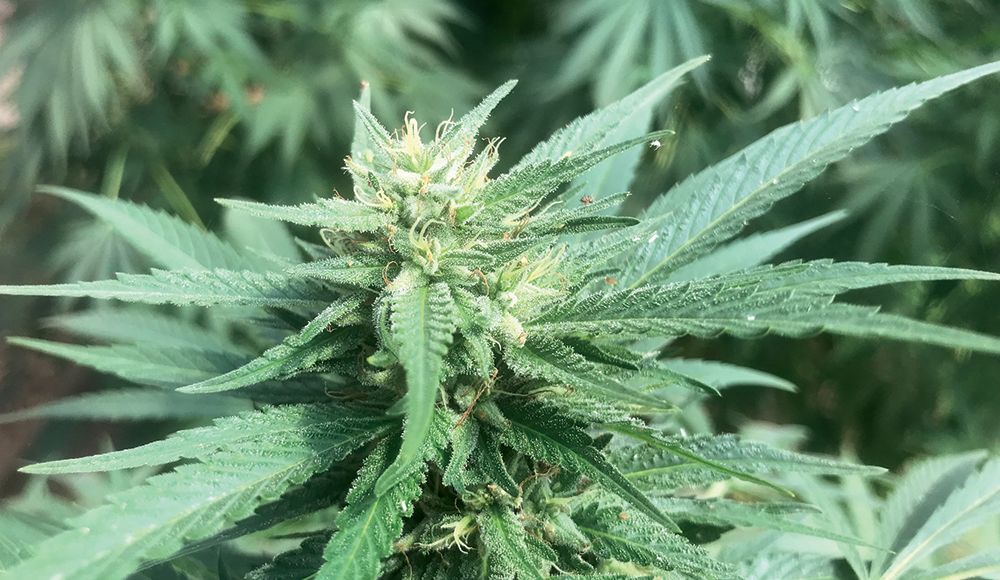
“The rise in THC levels and this push towards higher and higher potency is really unfortunate,” says Dr. Carrie Cuttler, cannabis researcher at Washington State University. “It’s not really THC that dictates the quality of the high.” Cuttler pointed me toward a study called The Nose Knows, where researchers examined how cannabis judges evaluate flower. In that study, higher THC percentages did not find reports of greater enjoyment; the aroma did. Cuttler told me, “The THC level was completely unrelated, a zero correlation between THC level and quality of the cannabis rated by these experts. The only thing that mapped to quality was the smell of the cannabis, which probably is something of a terpene profile.”
Christopher Carr is a Santa Cruz cultivator, host of the ‘“Cannabis Connection” radio program, and California State Fair Cannabis Awards judge. Carr said, “When I am judging, the first thing I do is smell it. I don’t buy off of those (THC) percentages.” He says a 16% THC flower rich in terpenes, the aromatic compounds that give cannabis its distinctive scents and diverse health effects, can offer a more satisfying experience than flower containing twice as much THC.
Today’s growers face a marketplace where THC percentage can determine whether their product sells. Why cultivate exceptional 16% flower when customers are demanding 30%? It’s like judging wine exclusively by alcohol content. Screw Pinot Noir, give me Everclear.
WHAT’S ON THE LABEL,
WHAT’S IN THE PACKAGE?
Sam LoForti, Santa Cruz County’s cannabis licensing manager and principal analyst, believes California’s labeling system has helped create the obsession with THC. LoForti said that growers were already pursuing higher THC percentages as a marketing strategy. “The state disincentivized full spectrum cannabis labeling,” he said. ‘“They essentially just want you to tell the public what the THC percentage is on the labels.”
LoForti told me, “Buyers see 30% THC and assume they’re getting better marijuana. What they’re not seeing is the plant’s broader cannabinoid and terpene profile.” If he could redesign cannabis labels, LoForti would include the harvest date, a fuller cannabinoid profile and more meaningful information about the plant’s genetics.
LoForti says, “The California Department of Cannabis Control could revise labeling regulations, or lawmakers could pursue changes through legislation that would be valuable to medicinal cannabis consumers.”
Freshness concerns LoForti. He says by the time cannabis is harvested, dried, cured, tested, packaged and distributed, it may be two months old when it reaches a dispensary shelf.
“Terpenes degrade. They oxidize,” he explains.
Carr would also like to see labels emphasize terpenes and other qualities rather than THC percentage. He suggests consumers could access detailed laboratory results through QR codes on the package.
Willie Nelson’s old joke still works: THC does not typically cause the fatal respiratory suppression associated with opioid overdoses, though the CDC does warn that super-potent use can cause serious reactions. The focus on THC content bypasses telling us about the plant’s other cannabinoids and aromatic compounds.
To see how it would affect me, I burned a third of a joint of infused THC chronic manufactured in a Watsonville cannabis infusion center and found myself pacing my porch, hearing Jesus remind me to breathe.
I asked, “What in God’s name is happening?”
Jesus said, “You’ll be OK. But for the record, my Father is a whole plant kind of guy.”