

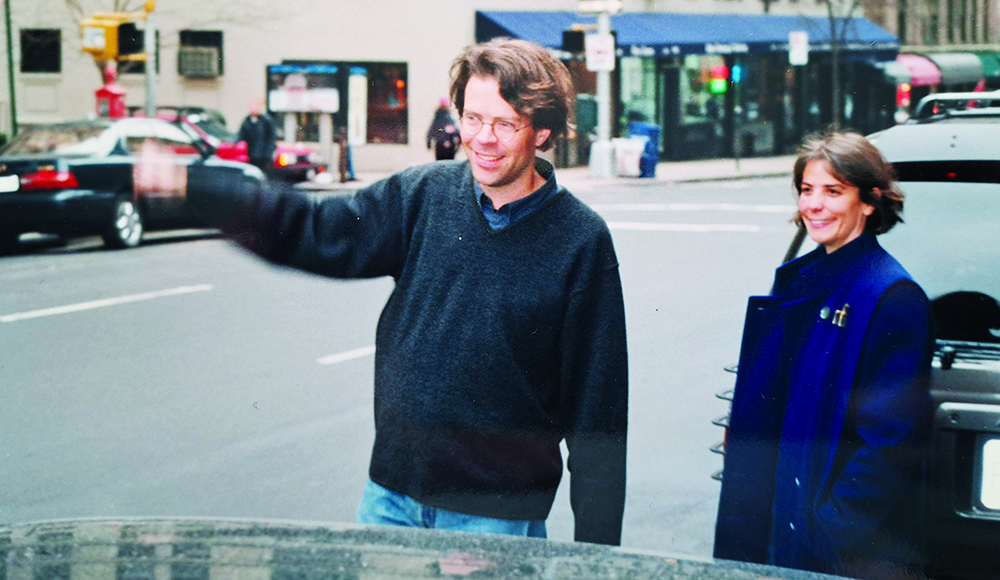
Santa Cruz novelist Jonathan Franzen, a former New Yorker, is dreading leaving California for months of work in New York. The only thing pulling him east is his role as writer on the Netflix series adaptation of his novel The Corrections, a runaway bestseller published 25 years ago this month, which will feature Meryl Streep in the role of family matriarch Enid.
Franzen will need to be in New York, but plans to get himself to an airport and on a plane home to California within an hour after the first season wraps.
“Somewhat against my will, I’m going to have to spend a minimum of three months, more likely four or five, in New York in the coming twelve months,” Franzen told me in a recent conversation on a bench near West Cliff. “I’m not happy about it. I’ve got my life here.”
To understand all that Santa Cruz means to Franzen, you have to delve into the often painful journey of discovery he went through working on The Corrections, which the New York Times Book Review in a recent survey ranked No. 5 among all novels written so far this century. The novel is famous for its portrait of a family, parents Al and Enid, and their offspring, Gary, Chip and Denise, often laugh-out-loud funny, its sharp prose vaulting the sharp humor to a level rarely seen in U.S. fiction.
The Corrections, read fresh now, removed from the hype and occasional controversy with which it was launched, feels like a joyous gift to us all, the rare kind of book that makes anyone reading it feel better about language and about life and about creativity, so full of alertness, you can’t help but be inspired by it.
Born in Illinois, Franzen grew up in the St. Louis suburbs dreaming of one day living in the big city. For years he loved New York City, the subways, the pulsing street life, the activity even late at night when as a writer used to hours of solitary focus, he needed to be out and about among people, even if anonymously.
But by the late ’90s the allure of New York was running its course for him—in The Corrections, “Fifth Avenue” at one point becomes “Filth Avenue”—and he was years into working on a novel he felt was going nowhere.
Finally he found deliverance: out West. Deliverance came because the Santa Cruz area and the Santa Cruz Mountains helped inspire and unlock him, but mostly it came because he’d met a woman, writer Kathy Chetkovich, then living in Boulder Creek, who had studied at Stanford and taught at UC Santa Cruz.
“It all started happening right at the end of the ‘90s and it was significantly related to coming out here to be in Boulder Creek with Kathy,” Franzen told me. “It all became possible because I had met Kathy. Finally I found a person I could be happy with and that makes a difference when you’re writing. It gives a person hope to be with someone you really like and are not ashamed to take out in public, someone who is sane and pretty and smart.”
Franzen has mixed feelings about the Netflix series, as most novelists have about seeing their work brought to the screen, but he does look forward to seeing some of the funnier scenes in the book enacted.
One he mentioned was that unforgettable passage where older brother Gary, at home with his wife and three kids, hits the vodka way, way too hard, in the middle of a days-long fight with his wife, and gets the absurd idea to go outside and trim a hedge in his inebriated state. Soon he has a deep gash, spewing blood, but tries to play it cool and hurries back inside as if nothing has happened, leaving the back door wide open.
“Gary assembled with his left hand an absorptive pad of toilet paper and pressed it to the wound and one-handedly applied plastic surgical tape that the blood and water immediately made unsticky,” Franzen writes. “There was blood on the toilet seat, blood on the floor, blood on the door.”
And here, in a line from Gary’s young son Jonah that Franzen recently recited on the bench near West Cliff: “Dad, bugs are coming in.”
If you find this kind of thing funny—and I for one absolutely do—it’s funny in a way that grabs you and won’t let go. It ought to make for a memorable sequence on Netflix.
Franzen wrote the scene in somewhat appalling circumstances one winter in Ben Lomond. But that only happened when he solved his biggest problem: the character Chip, whose spectacular flameout from nearly securing a tenured position teaching literary theory at a major East Coast university provides the book’s early narrative drive.
Probably the less said about that red chaise-lounge and what Chip does with it the better (don’t want to give JD Vance too many ideas), and even the drug-fueled fling with a student is probably best mentioned only in passing, but safe to say everything about getting the Chip character right represented a tightrope walk.
“I had a devil of a struggle with Chip,” Franzen told me. “Chip was really hard to figure out, how to reach the right perspective where you could be funny but not make you want to take a bath. A shower. I think I must have cracked that problem and I think it was February of ’99 when I came out to see Kathy and she was living in a tiny cabin in Boulder Creek, a 400-square-foot cabin, and it was February, and it was a particularly rainy February.”
Franzen paused to let that image sink in, rainy days in the Santa Cruz Mountains, which is his favorite kind of California weather, one reason he’s not happy about missing this winter.
“The novel was finally going after seven years of false starts and failures,” he picked up the story. “It was finally going, so I had to write every day, so I rented by the week a room at Jaye’s Timberlane Resort in Ben Lomond, which was a very depressing, kind of spongy-carpeted, horrible place.
I was the only person staying there in that rainy February. There would be tremendous rain and even some lightning, a deluge, day after day, wet, dripping, in the redwoods there were only four hours of daylight on a rainy day, and I wrote pretty much the whole Gary chapter in four weeks in that room at Jaye’s Timberlane Resort.”
As for Chip, the breakthrough came on the UC Santa Cruz campus.
“I started to get a handle on Chip at McHenry Library,” he said. “There were two rooms at McHenry, one or two, little work rooms where you could have a table and you could shut the door, but you had to get there at whatever time McHenry opened in the summer, eight or nine. You had to be waiting at the door, and then you had to race the homeless guys, who also liked that room, a place to sleep all day. I’d see them on the stairs and I’d have to walk fast. If you got there at five after nine, forget about it, somebody was in there sleeping all day. So that was a good room too. That novel significantly got going (in California).”
The novel was published on September 1, 2001, ten days before the worldwide upheaval of the 9/11 attacks, to immediate acclaim.
“Buried beneath the Pynchonian pyrotechnics and Sinclair Lewisesque satire” of Franzen’s previous novels, New York Times critic Michiko Kakutani wrote on September 4, “were intimate family dramas that grounded the characters in a recognizable emotional reality and provided an Updikean portrait of the vagaries of domestic life. In his new novel, The Corrections, Mr. Franzen has brought a family and its problems center stage to try to write a sort of American Buddenbrooks. In doing so he has harnessed his penchant for social criticism and subordinated it to his natural storytelling instincts, while at the same time, shucking off the influence of other writers to find an idiosyncratic voice of his own.”
By October 2001 the book would achieve a rare feat for a novel, hitting No. 1 on the New York Times bestseller list, and it would also win the National Book Award for Fiction that year. The book was one everyone seemed to be talking about all at once, and one that for years was a familiar reference point for writers and readers.
Franzen found himself thrust into the limelight in a way he was not ready to handle, as he freely admits now. In fact, going back to his relationship with Kathy Chetkovich, it’s one thing crediting the woman you love with giving you a reason to hope, a reason to write, and it’s another to live a life side by side with that woman who helps you change, really change, over the years, over the decades. Clearly Chetkovich has been good for Franzen.
I did not ask Franzen about the famous controversy that ensued when Oprah chose The Corrections for her book club and asked Franzen to come on her show for an interview, and he managed to get himself disinvited by commenting that he found some of Oprah’s picks “schmaltzy” and “one-dimensional,” setting off hilarious media back and forth in which elitist literary critics who themselves often ranted against Oprah’s picks for being both “schmaltzy” and “one-dimensional,” at Manhattan cocktail parties if not necessarily in print, now lambasted Franzen for being an elitist and a prig.
Franzen found his face on the cover of Time magazine with the headline GREAT AMERICAN NOVELIST and sales for the book took off.
I did not ask about any of this directly, I made a passing reference, possibly a joke, giving Franzen plenty of room to steer clear of a topic I felt he was likely tired of discussing, but he surprised me by tackling the subject head-on and doing so with a gentle, quiet candor that felt very real to me.
“I was a different person twenty-five years ago,” he said, just after we had laughed together over something, and his tone turned suddenly solemn, his voice quiet, his pace slow and deliberate.
“I was not without fault in the Oprah thing. I didn’t know how to talk to the press. I didn’t know how to speak in public. And I was coming from a place of serious alienation and isolation. I was just alone, pretty much unconnected, and had nothing but my ambition, you know. I had a few writer friends, good writer friends, but I had a certain amount of unprocessed arrogance, and I still have that, but I no longer typically let it show.”
Here he paused for a quick, self-mocking laugh, smiling in the light afternoon wind blowing off Monterey Bay. I waited for him to continue.
“You kind of have to have a certain amount of arrogance to say: I’m going to go out there with this novel and there it is,” he said. “To work on something for nine years, as several times it’s taken me to write a novel, you have to think pretty well of yourself to keep going. And I didn’t realize how I would sound, and I was so serious.”
Again, silence opened up. I wanted Franzen to continue and did not dilute his train of thought with any follow-up questions.
“It was beginning with the media training that I voluntarily underwent after the Oprah kerfuffle that I realized: Well that’s not actually a smart way to comport yourself in a public situation,” he said. “You should lead with your vulnerability and you should be funny. There was a certain want of graciousness.”
I had remarked that the way the Oprah episode played out in the media, the “Jonathan Franzen” who came off as supercilious and ungracious did not seem at all like the guy I’d encountered in Santa Cruz in various settings over the years. “You’re right, in the fullness of time, it doesn’t seem like me,” he told me, laughing gently, “but it was kind of me.”
Bookshop Santa Cruz Celebrates The 25th Anniversary of The Corrections with Jonathan Franzen:
Join us for a celebration of the 25th anniversary of The Corrections with the author. We will be celebrating this seminal work with a mix-and-mingle gathering, a special toast, and short remarks. Enjoy small bites and beverages, and get your books signed.
Bookshop Santa Cruz
1520 Pacific Ave
Santa Cruz, CA
Sunday, Sept. 13
7–8:30pm
Free









I had no idea that Jonathan Franzen and Kathy Chetcovitch lived in the best, most sacred community in the world, but I loved “The Corrections” and will re-read it before Sunday.
Thx for the inspo, Good Times. Fine publishing (as always)!