
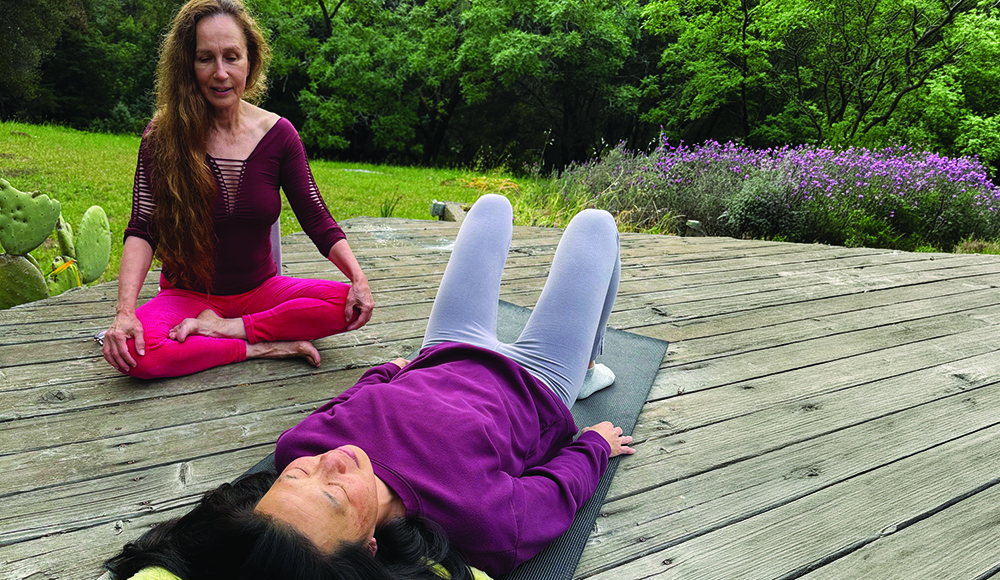
On any given day in Santa Cruz, you might find someone lying on a yoga mat, legs bent, knees trembling. Across town, someone else sits calmly in a room with sensors on their scalp, watching a screen. Down the street, a breathwork circle rises and falls in a rhythmic chorus of inhales and exhales.
Different approaches, same goal: Feeling better in your own body.
As conversations around mental health evolve, so do the tools and methods. Increasingly, people are turning toward nervous system–based methods, practices that go beyond talking and aim to regulate stress where it actually lives: in the body.
So what’s the difference between all these alternatives, and which ones actually work?
A Shift From “Why” to “How”
Traditional therapy often focuses on understanding: Why do I feel this way? Where does this come from? But newer approaches ask a different question: How do I help my body feel safe enough to change?
Because for many people, the issue isn’t insight.It’s being stuck in patterns, tight shoulders, racing thoughts, poor sleep, that don’t shift just because we understand them. That’s where Santa Cruz’s diverse healing landscape comes in.
The Brain Route: Training the Control Center
Neurofeedback, also known as electroencephalogram (EEG) or brainwave biofeedback is designed to optimize brain function and creating lasting change in the nervous system. Santa Cruz Neurofeedback Center was established almost 20 years ago in Soquel by Langdon Roberts, MA and Aimee Pomerleau, LMFT. By measuring brainwave activity in real time, it trains the brain to move out of dysregulated patterns linked to anxiety, ADHD, and stress.
There’s no talking. No processing. Just gradual rewiring using a safe and non-invasive system.
“It’s subtle,” one local practitioner shared. “But over time, people notice they’re less reactive, more focused, more themselves.”
It’s not a quick fix, often requiring 20 to 40 sessions, but for some, especially those who feel stuck in mental overdrive, it can be a powerful reset.
The Body Route: When Stress Needs to Move
If neurofeedback works from the top down, practices like TRE® (Tension & Trauma Releasing Exercises) work from the bottom up.
In sessions with Santa Cruz–based instructor and trainer, Maria Alfaro, clients are guided into a series of movements that trigger the body’s natural tremoring response, a built-in mechanism for releasing tension. Participants often describe it as deeply calming.
“It’s like your body finally gets to finish something it’s been holding onto,” Alfaro explains.
Alfaro has been teaching this practice to clients around the world for over a decade. She has seen that for those carrying chronic stress, burnout, or a constant sense of bracing, this kind of physical discharge can be surprisingly effective.
The Breath: A Built-In Reset Button
Then there’s breathwork, the intentional management and repatterning of the system. This is my go-to practice, one that I use daily, and incorporate into each of my yoga teaching sessions.
From gentle, slow breathing to more active, rhythmic practices, breathwork directly influences the nervous system, helping shift the body out of fight-or-flight and into a more regulated state.
What makes it so compelling is its immediacy. You can feel a change in minutes.
But that’s also its limitation. Without deeper integration, the effects can be temporary—more like hitting “reset” than creating lasting change. Still, as an entry point? It’s hard to beat.
The Middle Ground: Guided Somatic Therapy
Somewhere between structured therapy and body-based release sits somatic therapy, including approaches like Somatic Experiencing, a body-oriented therapeutic approach for healing trauma and chronic stress. Here, the focus is on tracking internal sensations, subtle shifts in the body, and gently working with them to process stress and trauma over time.
Rather than releasing tension all at once, it helps people build the capacity to stay present with their experience without becoming overwhelmed. For those navigating long-standing emotional patterns, this kind of guided integration can be transformative.
These are just a few of the alternative therapeutic practices we have to choose from. So the bigger questions is, which one works? And the answer depends on which mode of release you need right now. Because each approach offers something different:
- Neurofeedback helps retrain brain patterns
- TRE® helps release stored physical tension
- Breathwork helps shift your state in real time
- Somatic therapy helps integrate deeper emotional patterns
They’re not competing systems. They’re complementary tools. Layered together, they create something more powerful than any single intervention, embodying a nervous system that finally knows how to settle.
The Santa Cruz Advantage
What makes Santa Cruz unique isn’t just access to these healing options, it’s the culture around them. There’s an openness here. A willingness to explore. A recognition that well-being isn’t one-size-fits-all.
Because feeling better isn’t about fixing yourself. It’s about learning how to come back a sense of safety and regulation, returning to your rhythm, again and again.
Sometimes that begins with a guided intervention.
Sometimes with a breath. And eventually your mind and body learn to align to guide you back into the present.
Learn More:
- Maria Alfaro: treglobal.org/neurogenic-yoga-team
- Santa Cruz Neurofeedback Center: santacruzneurofeedback.com
- Somatic Healing Collective: somatichealingcollective.com
Elizabeth Borelli is a Master’s in Counseling Psychology candidate and Mediterranean Diet and Lifestyle expert. Find free resources and more information at ElizabethBorelli.com