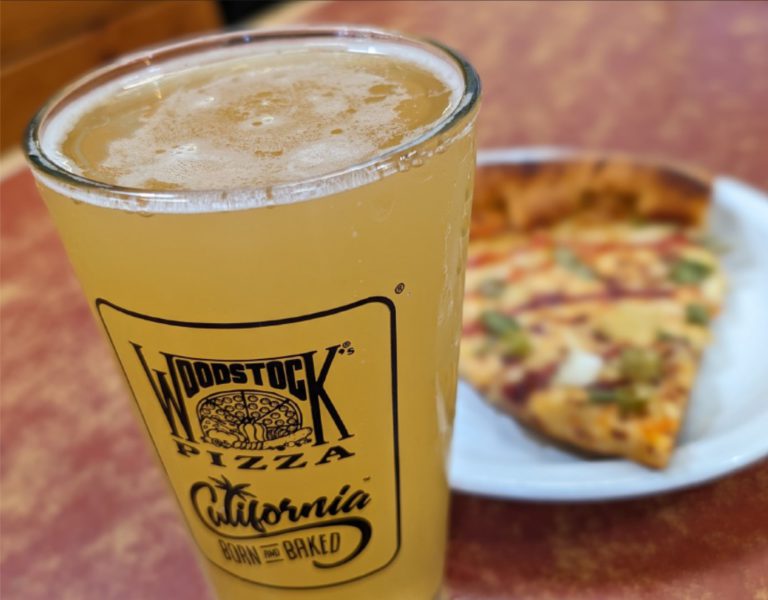
The original plan was modest enough. Then minor went major, and suddenly Woodstock’s Santa Cruz (710 Front St., Santa Cruz) is ready to party like it’s 2025.
“We called it a refresh, but in this case it’s more than a refresh,” co-owner Laura Ambrose says. “We decided once we got started to redo everything.”
There was already a lot to like about the downtown pillar, which reopens in time for graduation weekend this Friday.
Those include the fact that Laura’s husband, Jeff, started out as a delivery guy; employees can join a stock ownership program; and rare late-night hours and rarer $9 pitchers of beer (weekdays after 9pm) are in play too.
Now there’s more to like, including a four-sided bar with a fresh cocktail program and full liquor capacities, a brand-new kitchen, new arcade, new restrooms, enhanced front patio, new back patio, new sound system, new giant TV, and new interior Santa Cruz mural.
The food, though, will remain long on quality and comfort, from the Woody’s Waui pizza to the Tree Hugger salad to the Pogonip veggie sandwich, set against an eye-catching backdrop.
“It’s the same great menu, we’re not changing the food itself,” Laura Ambrose says. “I hope people will be excited by the new look. When visitors have wandered in that’s the first thing they notice, and they say, ‘Oh my god, this is cool.’” woodstockscruz.com
MIKEY LIKES IT
Santa Cruz native and accomplished chef Mikey Adams has worked at some high-wattage spots, including now-departed Restaurant 1833 in Monterey, Shimo Modern Steak in Healdsburg and a bunch of San Francisco spots, including One Market, St. Regis Hotel, Proper and seafood-driven/live-fire-friendly Angler on the Embarcadero, where he helped it keep a Michelin star. But the dream was always to return home and cook at a Surf City restaurant. Now that’s been realized with his hiring to help Alderwood (155 Walnut Ave., Santa Cruz)—which reopens 5-9pm Wednesday through Sunday starting this Friday, June 14—re-galvanize its glory, with lots of wood-fired fish. “I’m stoked to collaborate with local producers to bring their finest to our kitchen,” he says. alderwoodsantacruz.com.
GO SWIMMINGLY Trout Farm Inn (7701 E. Zayante Road, Felton) is doing a fun outdoor dining-concert evening overlooking Zayante Creek Friday, June 15, with local wine, beer or cider and passed hors d’oeuvres, then dinner by Chef Sebastian Nobile and a live concert by John Craigie. That fits into a nice—and summer-friendly—lineup of ongoing activities like 9am-2pm Saturday-Sunday brunch, 11am-5pm daily pool deck-social club fun, 3-5pm weekday happy hours and 10am Sunday yoga. Anyone up for a little yoga + swim + brunch? thetroutfarm.com…Another summer adventure idea: Head south, because Big Sur is back open—Highway 1 is safe to navigate, and the stoplight system shuttles people south and north with surprising speed. Meanwhile destinations like Deetjen’s Big Sur Inn, Nepenthe, Esalen and brand new The Village are as magical as ever, dishing seasonal and well-sourced foodstuffs to rival the rampant natural wonders…Take it away Virginia Woolf: “One cannot think well, love well, sleep well,” she once noted, “if one has not dined well.”
For David Espinoza’s mom, Olivia, opening her namesake café was a full-circle moment. She was born in Mexico and grew up in Watsonville, working in restaurants from a young age and learning the industry from firsthand experience. She opened her own spot in 1985 in Salinas before moving Olivia’s to Watsonville in 2017, closing the loop. David helped out there as a kid before returning to work full-time last year after going to college for computer science and working in tech for a while.
The family-run spot has a vintage feel, the building was originally a house before becoming a business, and David says the traditional Michoacan-based Mexican food menu based on family recipes has a “grandma cooked it” vibe. The machaca headlines the breakfast offerings, combining shredded beef with eggs and a homemade sauce with onion, tomato and jalapeño. Lunch/dinner stand-outs include chile verde that pairs tomatillo sauce with braised pork, and Olivia’s take on a Salvadoran pupusa called a “Popusa,” which David likens to a Mexican hot pocket filled with options like carne asada, chicharrón, shrimp and bean/cheese.
How do you encourage customers’ creativity?
DAVID ESPINOZA: We don’t really have a secret menu, but we pride ourselves on letting guests be creative with our food and customize it to their liking. For instance, some guests like our mole sauce on the enchiladas, or a chile relleno burrito, or the chile verde mixed with chilaquiles. We have many regulars whose order we know before they walk in the door, and we love accommodating to different dietary needs and preferences. It challenges us to try new things on our menu and have a fresh attitude in the kitchen.
Where do you find purpose?
There’s something really rewarding about the customer service aspect, seeing guests enjoy the food and overall experience. I also like the nuts and bolts and the whole process of restaurant work, and enjoy carrying on the family legacy. After working in tech for several years, I felt called back and inspired with an entrepreneurial spirit to be a part of something that means so much to our family and the community.Open daily, 8am-8pm. 1047 Freedom Blvd., Watsonville, 831-536-5292
Santa Cruz and summer go together like surfboards and Sex Wax. The blend of beach vibes, outdoor adventures and community spirit makes this the perfect destination for soaking up the sunny days.
But too much of a good thing can leave you washed up and dried outwithout the right stopgaps in place. These simple wellness tips will keep the good vibes going.
Sun-Savvy Skincare
Slather on the right sunscreen before heading outdoors, no matter how much or little time you plan to be there. All the anti-aging products on the market can’t stand up to this one daily habit for maintaining skin health. Be sure to reapply every couple of hours, especially after a swim or workout.
One more note about sunscreen: Many popular brands contain chemicals that should be avoided. In fact, only about one in four products meet Environmental Working Group standards for adequate sun protection and avoid ingredients linked to “known health harms.” Check ewg.org for the best options or stop by Staff of Life or New Leaf for local expertise.
Don’t forget a wide-brimmed hat and shades to protect the face and eyes. With so many great boutiques like the Hat Company on Pacific, Kickback in Capitola and Bunny’s in Aptos, it’s easy to greet summer in sun-savvy style.
Hydrate Like a Pro
Staying hydrated is key to keeping energy levels up and moistening skin from within. Keep a reusable water bottle close and stay hydrated with local tap or filtered water. Not a fan of plain old H2O? Add a squeeze of lemon or a slice of cucumber for a refreshing twist.
A word about plastic water bottles: microplastics. Plastic bottles are as bad for the environment as they are for our health. Rather than buying bottled water, switch to tap water. Research shows that over 96 percent of U.S. community water systems meet government standards for drinkability, and our community is no exception.
Eat Fresh and Local
Hit up your favorite farmers markets for the freshest fruits and veggies; this time of year the markets are in full swing. At the Saturday Aptos Farmers Market, don’t miss the Cabrillo College farm stand and its stellar selection of hydroponically grown greens. Or treat yourself to fresh strawberries from Pinnacle Farm, perfect for snacking, short caking and slicing into salads.
Visit Dirty Girl Produce at the Wednesday downtown or Sunday Live Oak markets for fresh leeks and green onions just now in season or choose from an array of heirloom produce. Wander the Scotts Valley or Westside Saturday markets in search of tender asparagus for steaming or grilling while the season is hot. Or check out the Felton market on Tuesday evenings and try something new.
Move Your Body
Embrace the great outdoors with activities like surfing, paddleboarding, hiking or biking. Whether you’re catching waves at Steamer Lane or hiking the trails at Nisene Marks, keep your body active and your spirits high.
Mindful Moments
Find time to relax and recharge. Practice yoga on the beach, meditate by the waves or simply take a quiet walk through the redwoods at Land of the Medicine Buddha. These moments of mindfulness will keep you grounded and stress-free no matter what comes your way.
Eco-Friendly Habits
Reduce your environmental footprint by bringing reusable bags, avoiding single-use plastics and supporting local eco-friendly businesses. Let’s keep Santa Cruz beautiful for generations to come. Visit Ethos in Capitola Village for ethically sourced and sustainable products to help live a waste-free life.
Stay Connected
Spend quality time with friends and family. Plan a beach bonfire at New Brighton, Twin Lakes or Seabright. Picnic in any of our local parks. Or throw a backyard potluck BBQ. Strengthening connections and creating lasting friendships are key to health and wellness all year round.
Make the most of this sun-kissed season. Here’s to a happy, healthy and unforgettable Santa Cruz summer.
We are facing one of the most challenging budget crises in our state’s history. While fiscal responsibility is crucial, it is unconscionable to balance the budget on the backs of low-income seniors who are already struggling. The Governor’s proposal to cut $111 million over the next three years from California’s Modernizing Older Californians Act (MOCA) pushes thousands of older adults towards hunger. This situation is exacerbated by our local failure to secure future funding for senior nutrition meals.
This cut represents a 60% reduction in meals and nutrition services, resulting in 5.7 million fewer meals annually across the state, according to the California Association of Area Agencies on Aging. The impact will be severe: increased waitlists for Meals on Wheels, hunger, emergency visits, early institutionalization, preventable deaths, and rising senior homelessness—the fastest-growing homeless population.
The severity of the situation is well-documented. A recent Kaiser Family Foundation Health News report revealed that malnutrition deaths among older Californians have more than doubled from about 650 in 2018 to roughly 1,400 in 2022. The need for senior nutrition programs is expected to grow as the population ages.
Meals on Wheels is a proven solution, reducing healthcare costs and nursing home use while improving food security, diet quality, and reducing social isolation. Cutting funding now would be shortsighted and harmful, exacerbating problems among seniors.
We urge our legislators to propose cuts that do not impact existing services and to stand behind the thousands of seniors who depend on Meals on Wheels. Let’s “Protect the Meal.”
Ray Cancino CEO, Community Bridges
Dana Wagner Interim Program Director, Meals on Wheels for Santa Cruz Count
GOOD IDEA…
But Not an Original One. Richard Stockton’s GT story on the history of Santa Cruz First Friday (6/5/24) seemed to imply that Kirby Scudder and Chip invented the concept of First Friday monthly public art events. They didn’t.
First Friday art events were present all over the country in 2004 and years before. Not only was Santa Cruz not the first in the country (Boston), or the state (Oakland), it can be reasonably questioned whether they were first in the Monterey Bay region (Monterey). My wife and I vividly recall going to an advertised First Friday art exhibit in Monterey a year or two before Santa Cruz and saying out loud, “Santa Cruz should have something like this.”
Kudos to Kirby and Chip for appropriating the idea to make it a great Santa Cruz event. Good idea, but not an original one. Sorry to burst the bubble that Santa Cruz is always the center of the creative universe.
Santa Cruz has so many celebrities who keep a low profile, but have amazing stories if you get to meet them. Sandy Stone is one. She’s an academic who also does all the technical engineering work at community radio station KSQD-FM (90.7).
She keeps a pretty low profile about her life but for rock lovers like me she’s a legend because she worked with a legend, the man who is probably rock’s greatest guitar player, Jimi Hendrix. With music that still sounds fresh half a century later, Hendrix blazed a trail, opening popular music to unheard-of experimental sounds and combined them with visionary songwriting.
And right there in the studio with him was Stone.
She takes you inside the studio with some stories in the cover profile by Bill Kopp. It’s a great read. And if I ever run into Stone again, I have to ask her about one of my favorite unknown artists, Lothar and the Hand People, a group I would bet few people know anything about, but their weird use of the theremin and a hypnotic vocal geared to put you to sleep was a big part of my youth.
New York DJ Alison Steele played it at the end of her show many nights and it knocked me out and gave me weird dreams. I never heard them mentioned since, except in this article.
On the news front, we look again at one of many controversial new housing projects, the building at what is now the site of the Food Bin market on Mission Street.
In an effort to force people out of their cars and onto mass transit, people who live in the building won’t be allowed to have cars because there won’t be any parking. It sounds like an idea that works better in concept than in reality, and neighbors aren’t happy about it.
We need housing, but how far are we willing to go to have it? Santa Cruz is changing big time, and not everyone is happy about it. Is anyone happy about it? That remains to be seen.
There’s also the giant Clocktower project, which many feel is being rammed down our throats.
Other can’t miss articles in this issue: the Wellness column will help protect your skin from the sun; Foodie File introduces you to authentic Watsonville Mexican dishes; in entertainment, John Craigie returns to where he started as a performer decades back; and nationally known comedian Rachel Feinstein plays an unusual gig in Aptos.
Happy reading.
Brad Kava, Editor
PHOTO CONTEST
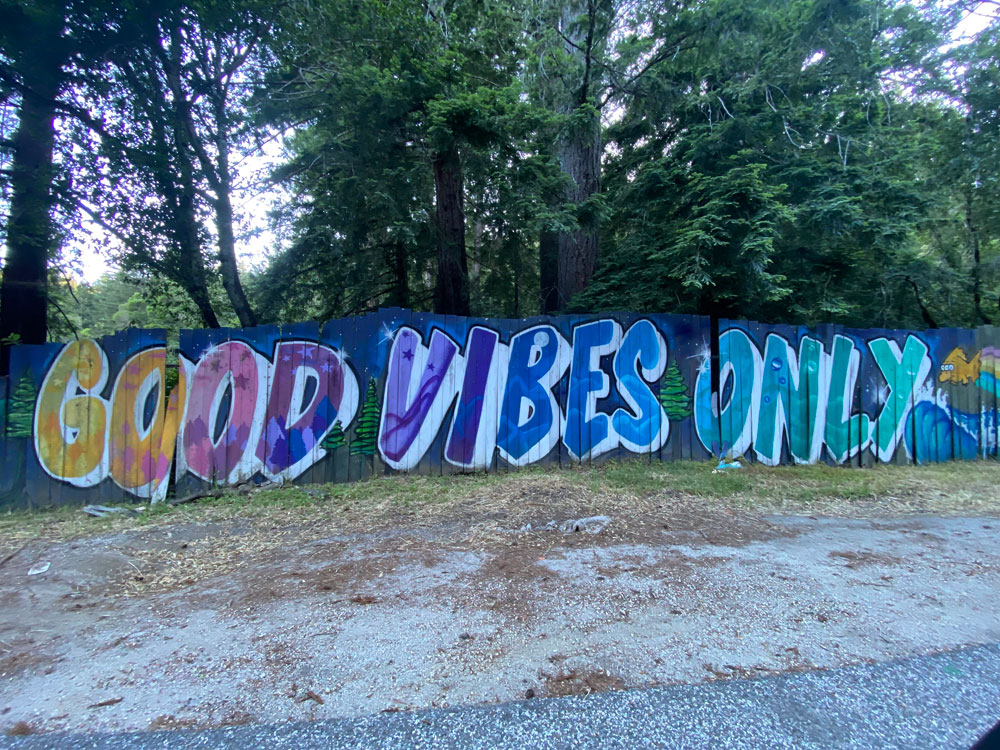
PEACE OUT This was taken near Riverside Grove in Boulder Creek. It just feels like summer in Santa Cruz. Photograph by Jason Hauck
GOOD IDEA
Santa Cruz is giving free tours of its recycling facility at 605 Dimeo Lane on Fridays, June 14-Aug. 23, at 10am and 1pm. The 90-minute tours show the recycling process, food scraps processing and household hazardous waste treatment.
Visitors will see what happens to the 30-50 tons of material that Santa Cruzans place into their blue recycle bins every day. They will also learn the importance of ‘recycling right’ and avoiding “wish-cycling.”
Registration is required. Tours are limited to 20 people. Children must be at least 8 years old, and youth ages 8 to 18 must be accompanied by an adult. Reserve your spot at www.cityofsantacruz.com/tours.
GOOD WORK
Music Production for Women and Distrokid have announced a series of four free beginner music production masterclasses in July to empower female and non-gender conforming musicians in New York, LA, Nashville and Santa Cruz.
The Santa Cruz event is 5:30-9pm Thursday, July 11 at 411 Kerr Road. Sign up at musicproductionforwomen.com.
“When you’re new to the music production space, it can often feel overwhelming to know where to start and how to start building a network,” founder Xylo Aria says. “We designed these events to be that perfect first step where artists, particularly women, can get a taste of music production, while making new friends in a safe and encouraging space.”
Electric guitars and powerful amps may have aided the transition from old-fashioned blues to intense rock ’n’ roll, but the blues as it once was is still alive and well. Reverend Peyton and his Big Damn Band have been making sure of that for nearly 20 years. Since their inception in Indiana in 2006, this three-piece country blues outfit has toured nonstop, scoring three Blues Music Award nominations and studying under many of their heroes, including T-Model Ford, Robert Belfour and David “Honeyboy” Edwards. These are front porch blues connoisseurs of our time, rare birds not to be missed. Their latest record is called Dance Songs for Hard Times. ADDIE MAHMASSANI
COUCH comes to Felton Music Hall PHOTO: Miranda-Niscuanti
COUCH
Couch provides the perfect soundtrack for walking down the sidewalk on a late afternoon in the summer. Their warm and bubbly sound inevitably causes an extra bounce in one’s step—especially once the horns kick in, bringing a jazzy, funky sound to modern pop that embodies joyful expression. Even a song about what it feels like to be ghosted leaves the listener smiling and grooving to the beat. And no one can resist dancing when Couch performs; their high energy spreads to the audience, and soon, everyone dances and bounces together. ISABELLA MARIE SANGALINE
TIGER’S TALE GRATEFUL GARCIA SUMMER SERIES KICKOFF
Jerry Garcia lovers, unite! The Santa Cruz Vets Hall is opening its mystical gardens to Deadheads this summer, hosting a monthly series with tribute band Tiger’s Tale. The band is named after Jerry’s guitar of choice later in his life (Tiger) and plays covers from the Jerry Garcia Band years. They don’t limit themselves to just Jerry songs, though; catch their covers of classic Motown, reggae and R&B hits as well. If the grooves hit right, go ahead and see them again. The series takes place one Friday a month for the rest of the summer. JESSICA IRISH
INFO: 7:30pm, Veterans Hall, 846 Front St., Santa Cruz. $11/adv, $15/door. 454-0478.
OPERA
DIE FLEDERMAUS: THE REVENGE OF THE BAT
In the spirit of brazen generosity, the Santa Cruz Opera Project brings user-friendly operatic works into the community for a few bucks. They’re determined to break down barriers and win new fans for opera. Opening on June 14 is SCOP’s spun, edited and fine-tuned version of Johann Strauss’ Die Fledermaus, starring the gorgeous voice of Diane Syrcle as Rodolfo. Be blown away by how much fun light opera can be, filled with seduction, trickery, silliness and delicious music. A glass of champagne and other goodies is included in the price of admission. Glorious music in a winery? Why not! CHRISTINA WATERS
In 1991, community leader Raymond Evans brought the hardy Juneteenth celebrations of his native Texas to his new home in Santa Cruz, and the city has never looked back. Juneteenth is a federal holiday celebrating the liberation of the last group of enslaved Black people in the United States, and has even more special local significance: Santa Cruz resident London Nelson (after whom the community center is named) was freed through this process after the Civil War. Juneteenth 2024 is jam-packed with basketball clinics, soul food, art vendors, a parade and much more, all scheduled between noon and early evening. AM
INFO: Noon, Laurel Park, 301 Center St., Santa Cruz. Free. 420-6183.
PUNK
Drain plays the Civic Auditorium PHOTO: Eli Rae
DRAIN
The boys are back in town! And this time, they’re bringing a who’s who of friends in the hardcore scene to rain utter chaos on the Civic Auditorium. That’s right, Cody Chavez, Sammy Ciaramitaro, and Tim Flegal—known as the California cursed trio Drain—are returning for their biggest hometown show to date. Last year, they played to a sold-out Catalyst main room, and with this Saturday as the final stop on their Good Good Tour (with hardcore legends Terror and H20 along with some of today’s best in the genre like Mindforce, Angel Du$t, End It and Slugger), they’re looking to pack the historic Santa Cruz Civic. Our advice: get plenty of stretching in before hitting the pit! MAT WEIR
INFO: 6pm, Civic Auditorium, 307 Church St., Santa Cruz. $50-$55. 420-5240.
PUNK
HOT LUNG & OUTPATIENT X
This Saturday, head down to Streetlight Records for a special record release party featuring Hot Lung and Outpatient X, two of the local scene’s best new bands. Billed as an outdoor daytime show at the Felix Kulpa Gallery (behind Streetlight), it’ll also feature new work from a local artist (who wishes to remain anonymous). Over the last year, these bands have gone from fledglings to finely tuned punk machines. Outpatient X’s debut EP, Deceptive Optimism, delivers fast and loud skate punk from its catchy opening chords to the final, frantic heartbreaking screams of “Wake up!” on the closing track, “Gen.” Hot Lung’s debut LP, In Spite Of, captures a ’90s alt-rock/post-hardcore sound with introspective lyrics and brooding guitar riffs. MW
Ekep Nkwelle will grace Kuumbwa PHOTO: James Asante
EKEP NKWELLE
Twenty-four-year-old Cameroonian American vocalist Ekep Nkwelle belongs to the next generation of great jazz singers. Her vocal timbre evokes the great Billie Holiday, but she’s crafted a distinctive personal style with power, control and soulfulness. The Washington, DC, native is a Howard University and Juilliard grad who has performed with the Jazz at Lincoln Center Orchestra and her own combo at major festivals as one of Wynton Marsalis’ latest discoveries. Nkwelle is working on her debut album and will perform at the San Francisco Jazz Festival the day before her first appearance at Kuumbwa. DAN EMERSON
INFO: 7pm, Kuumbwa Jazz Center, 320-2 Cedar St., Santa Cruz. $31.50/adv, $36.75/door. 427-2227.
WEDNESDAY
ROCK
3rd Street Band PHOTO: James Lynch
3RD STREET BAND
Not many singers can hit the Freddie Mercury high note and sell it, but the guys from 3rd Street Band? They’ve got it on lock. This trio of Louisiana dudes seem to be able to cover any song on a Top 40s list from the past seven decades, and they’re primed to get the crowd singing along. Their catalog stretches from Queen and Billy Joel to Montell Jordan, with some country music standards thrown in for the line-dancing crowd. Openers include Santa Cruz-based Universe, which describes their genre as “rocktronica” and shreds like the best of them. JI
I’m flying to Los Angeles with friends for the Anime Expo. I’m going to dress as a character from My Hero Academia, the Japanese manga series.
Maryia Dzenisevich, 17, Student
GIO
I’m going to Tahiti for 10 days or so. It’s a trip my dad planned with a friend from college and his family, and I’m going to live on a sailboat—a catamaran—for a weekend.
Gio Marini, 17, Student
BRANDI
I’m going to Friday Night Reggae at The Pool in Reno to see Ky-Mani Marley, Bob Marley’s son. I’m going to get in the pool and swim and listen to reggae and have drinks. That’s all I got going on.
Brandi Stirton, 54, Retired
CHIP
I just got a boat with forward-facing propellers for skiing and wakeboarding, so I’m going to go out boating. We’ll go out with our kids and make it a family affair.
Chip Hodgson, 63, Retired
MELODY
I’m going to visit Hawaii—the Big Island—where I used to live. I went last year, but before that it had been many years. Frogs are now there! It was weird. They’re invasive and very loud!
Melody Litt, 53, UCSC
CRIS
I’m going to learn to do standing backflips. From the videos I’ve seen, the first thing I have to practice is being comfortable with falling. I can do a front flip, but only on a trampoline.
An Orange County Superior Court judge ruled in favor of the University of California and ordered a temporary stop to all striking activities by the United Auto Workers (UAW) through June 27.
The ruling comes after the state labor board ruled twice in favor of the UAW 4811 which represents 48,000 post-graduate and graduate student workers in the UC system who went on strike over UCLA’s treatment of pro-Palestinian protestors. The Public Employment Relations Board (PERB) found that the UC system had in fact committed some labor violations and that the strike could continue.
“From the beginning, we have stated this strike was illegal and a violation of our contracts’ mutually agreed upon no-strike clauses,” said the UC in a statement. “We respect the advocacy and progressive action towards issues that matter to our community and our community’s right to engage in lawful free speech activities — activities that continue to occur across the system. However, UAW’s strike is unrelated to employment terms, violates the parties’ agreements, and runs contrary to established labor principles.”
The UAW said the UC’s shopping of the case to conservative Orange County was reminiscent of union-busting tactics used by Starbucks and Amazon.
“There is a sense of disappointment and defeat but also we just did a huddle and there is a sense of people being pissed off,” said Rebecca Gross of UCSC UAW. “It feels bad. It feels bad that they tried to do this evasion and it worked.”
However, this does not mean that the strike is illegal, according to Gross.
“It is just a temporary restraining order and it does not mean that our strike is illegal. Decades of labor law has shown us that unfair labor practice strikes are legal,” said Gross.
Laurence Bedford tells me that for his hiking buddy Sven Davis, “Minimalism gets to be a religion.” Laurence grins and explains that Sven cut the handle off his toothbrush to save the weight. And that as Sven reads his books, he tears out the pages that he’s read and burns them in the campfire.
“Sven uses one cup, for tequila at night, and the next morning your oatmeal smells like tequila,” Laurence says.
According to naturalist John Muir, a good way to start a hike is to “throw a loaf of bread and a pound of tea in an old sack and jump over the back fence.”
And that’s what Sven and Laurence set off to do: a camping trip in Big Sur up in Carmel Valley. They parked Sven’s old Subaru near China Camp, put on their packs and walk down the Pine Valley Trail, intending to hike four miles and set up camp in a meadow for a few days. Their hike started perfectly on a gorgeous spring day, and they were getting close to the meadow.
Laurence recounts the trip to me: “It was our alcohol-free trip, we didn’t have anything to nip on.” They did three and a half miles and were not far from their meadow destination.
The Sound of a Hike Changing
The two friends were walking under an ancient, giant tree, shooting the shit.
Laurence said, “Hey Sven, you know those pumas and cougars?”
As Laurence walked, he turned his head to look back at Sven.
“They sleep in the trees during the day. We’re always looking for them in the grass. But they could be right up there.”
The two men made eye contact to consider the imagined cougar in the tree, when they both heard a sharp crack from Laurence’s ankle. Sven said that he could feel the sound. They continued looking at each other, knowing their future had just changed.
Sven remembers, “Three and a half miles in and suddenly Lawrence’s ankle just goes pop. Like he just stepped on something weird. It literally made a noise. I said, ‘Let’s sit down for a minute. Let’s take stock on what’s going on here.’ It was kind of obvious that he hurt it, and so we hobbled over to the creek nearby.”
Laurence remembers, “Yeah, there is a moment of panic, you know, something just went crack in my ankle and I could feel it swelling. It swelled up really, really fast. When you don’t know if it was broken, when you don’t know what you’re dealing with … your mind now is racing. We’re in the fucking middle of nowhere.”
OutdoorLife.com says, “The first part of surviving an injury is immobilizing the moving parts. It’s always best to immobilize the next joint up from the injury, if possible. If an ankle seems sprained, immobilize it up to the knee.”
They didn’t know what to do. They knew they weren’t walking out that day and knew they didn’t want to get airlifted. They didn’t have cell phone reception anyway. And they also knew the old adage, “You don’t take your boot off because the swelling will ever not let you put the boot back on.”
I ask Laurence, “So what happened to your ankle?”
“My foot got caught and then snapped.”
Wilderness First Aid says, if something happens to you like that, they tell you not to take your boots off because you’ll never be able to put it back on. Your boot is supposed to contain the swelling.
Laurence explains that he was near a cold stream. “Instead, I took my boot off and stuck my foot into the cold stream. We had supplies for two, three days. I was like, ‘Hey, this is a good place.’ I could barely get my tent together. I was right next to the water, and we made a fire.”
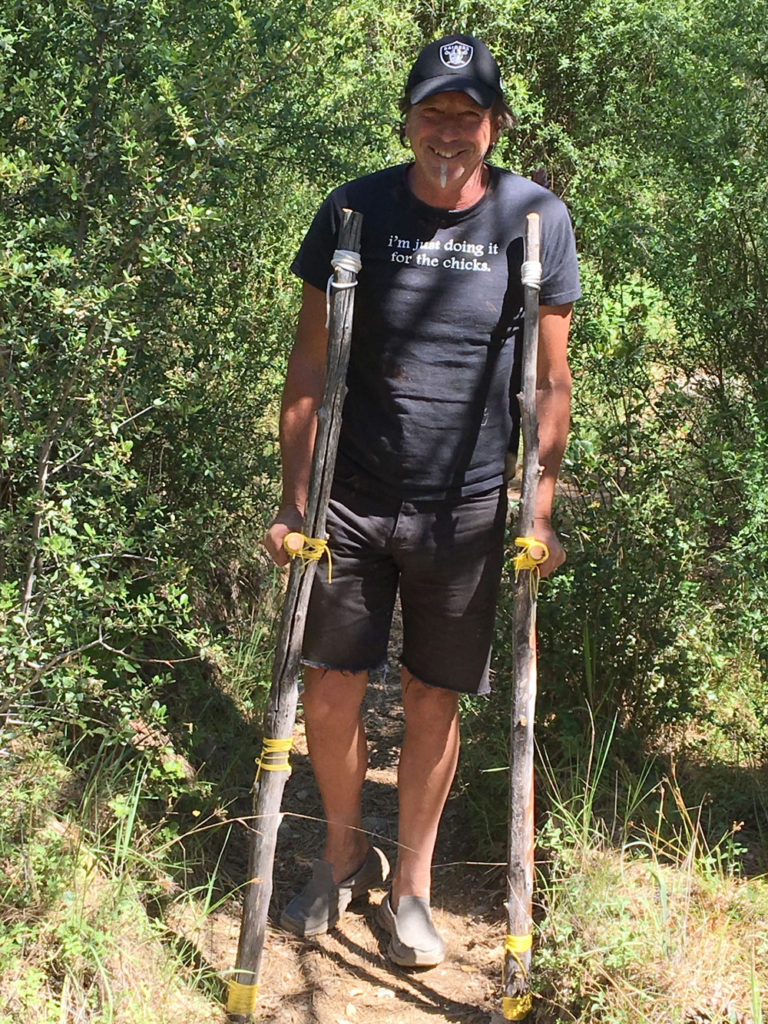
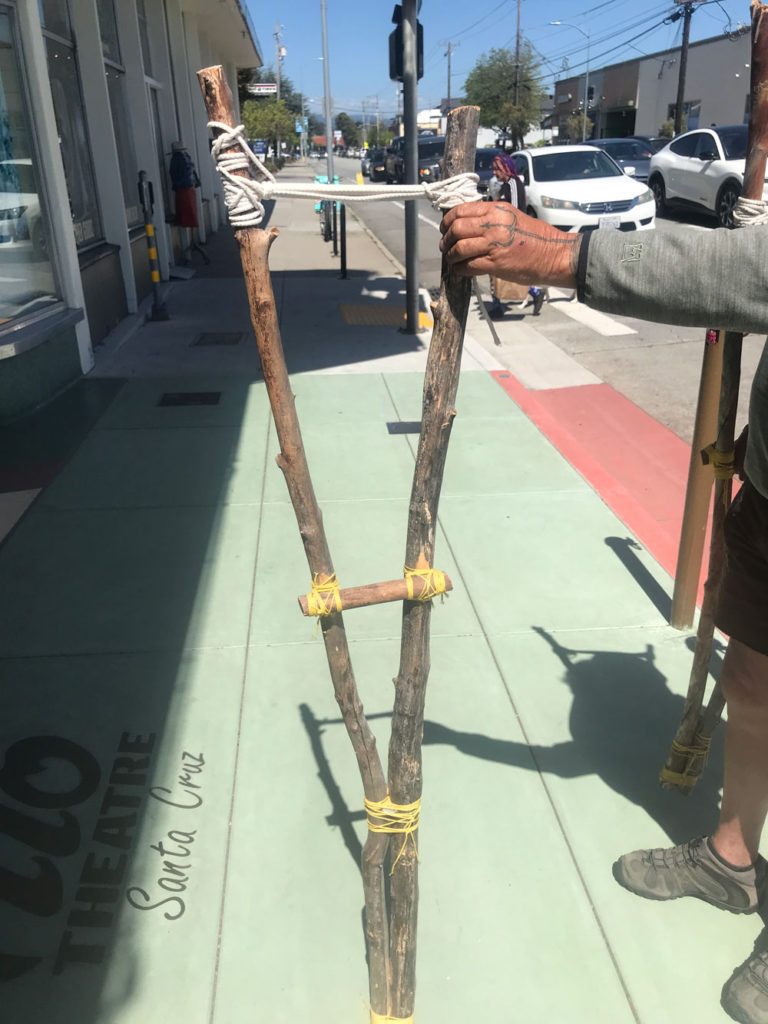
It took one full day with his foot in cold water to contain the swelling. Laurence slept in his tent on the bank with his foot in the water for 23 hours. The swelling stabilized. On the second day, Sven started making crutches, using knots he had learned to tie in the Boy Scouts. The next morning, they tested them and the crutches worked. Laurence could plant both crutches out in front of him and then swing his body forward, land on his good right foot, replant the crutches in front of him and keep swinging forward. It was faster than walking.
Crutches for a Man with Tape
Laurence tells me, “The second day Sven engineered the crutches and, you know, you always have duct tape. You always have nylon string, you know; there you have basic stuff that you always have with you.”
I interrupt Laurence’s story, “Wait a minute, wait a minute. You always have duct tape with you? You’re hiking and you have duct tape?”
“Yes! Always have duct tape.”
An Outdoor Life Survival Skill manual agrees that duct tape can help when assembling a crutch in the wild: “The fork should be heavily padded by wrapping it with clothing or another soft material. A little duct tape works well.”
Laurence had a four-inch saw on a knife, but just as Sven assembled his long sticks to start in with the little saw, a passing hiker stopped and unfolded a large crosscut saw and Sven cut his sticks in a few minutes.
The crutches worked perfectly. His left foot never touched the ground, and he developed a swinging cadence that outpaced Sven. “You just put both of them down at the same time. You swing forward and land on your one good foot. My left foot never really had to touch the ground.” Laurence was deeply impressed by Sven’s crutches. “You know, they stood up to my weight and everything. I mean, the engineering was great.”
So, they were home free, with Laurence swinging his body through his crutches, clipping along fast, and Sven goes, “Like, dude, stop! Listen! There is a rattlesnake just hanging on the trail.”
Laurence says, “The rattlesnake came out of the grass and then started coming forward. I heard the rattle but didn’t know where it was. It was coming across the path at us. I backed up and then Sven came up with a tree branch and encouraged it into the woods. We continued our journey and made it out in record time.”
Ladybug, Ladybug ... Your House Is on Fire
Laurence’s grapefruit ankle turned out to be a severe sprain and got better. He wanted to return to get his backpack and gear but was delayed by the Big Sur fires and floods of 2018.
“We had taken pictures of the locale and the tree. I had documentation of where that pack was so we could go back and get it. We had to go through two seasons of fire and flood. I didn’t end up going back up there for two years.”
“The 2018 wildfire season was the deadliest and most destructive wildfire season on record in California, with a total of over 7,500 fires burning an area of over 1,670,000 acres, the largest area of burned acreage recorded in a fire season.” (fire.ca.gov)
Laurence returned to the Pine Valley trail in 2019 to find that the big tree, his pack, and the whole forest were gone.
Laurence keeps Sven’s crutches in his office at the Rio Theatre.
It’s no secret that since the pandemic the Santa Cruz music scene has been going through a major revival. Along with the reopening of the Santa Cruz Veterans Memorial Building—aka Vets Hall, one of the only all-ages venues left in town—the 40831 hardcore scene blew up nationally in 2021 with Santa Cruz and San Jose bands like Drain, Scowl and (now defunct) Gulch leading the charge.
However, there’s another burgeoning scene that’s quickly sprouted to the surface and it’s poised to keep our city on the music map for another sound altogether.
This Friday the inaugural Santa Cruz Scene Celebration Festival (SCSC Fest) is ready to highlight 14 of those bands at the Santa Cruz Veterans Memorial Building. In addition to bands like Sluttony, Trestles, Career Woman and the Anti-Groupies, the all-day event will feature booths by local artists, vendors and others in a salute to everything Santa Cruz.
“We want this to be for the community,” says Santa Cruz Recording Studio’s Josh Dimatulac (A&R/Salsa). “After all, Santa Cruz is in the festival’s name.”
And it’s a price point hard for any live music lover to refuse.
“We’re only charging $10,” co-organizer Claire Wirt says. “And we’re not taking any money. After we pay security, the bartenders and things like that, all of the bands are splitting the door proceeds evenly.”
The event is sponsored by Santa Cruz Recording Studio, where Claire’s husband, the Grammy-nominated producer Jim Wirt, has recorded singles for all of the bands on the festival bill over the past year.
“A lot of these kids don’t really know what it means to be actually produced,” Claire explains. “They might have a few plug-ins but that’s it. So my pitch was ‘Come do a single with us and it’s yours. We don’t want a part of it.’”
The final destination for those singles will be a compilation CD released by Santa Cruz Recording Studio later this year.
“We want to keep it all Santa Cruz [bands] geographically,” Jim states.
While he might not be a household name to those outside the industry, his work is internationally known. Incubus, Something Corporate, Alien Ant Farm, Jack’s Mannequin, L.A. Guns, Something Corporate and more have all found themselves on the other side of Jim’s board. Wirt was also the man in the chair behind Hoobastank’s 2001 platinum-selling self-titled debut album.
Last year the Wirts relocated to Santa Cruz and immediately started doing what they do best: connecting with local musicians to record and promote.
But what exactly is this bubbling new scene?
“If I had to define it I’d call it West Coast Surf Punk,” Dimatulac says.
“Santa Cruz Surf Punk!” Jim cuts in with a laugh. “Anything that’s anything we can call ‘Santa Cruz Surf Punk.’”
Despite what the engineers call it, this new scene—like anything new and exciting—is hard to define.
These groups are a cornucopia of genres melding punk, garage, emo, indie, dream pop and more for a mosaic of sound. Each show can have different lineups with different styles of music, yet it all, somehow, seems to blend effortlessly. Maybe that’s because the groups themselves are a hodgepodge of local and student musicians, mostly in their early to late 20s with some as young as teens or as “old” as their early 30s, lending a wide variety of influences.
Take Perch, for example. Formed right before the pandemic, this quartet draws from the well of mid-2000s pop punk and mid-western emo for songs that are as passionate and introspective as they are catchy. They recently recorded a soon-to-be-released single with Wirt.
“Recording with Jim was awesome because he had a real punk approach,” Perch drummer Rowen Graves says.
Guitarist Pablo Robles agrees.
“He gave a lot of very artful criticisms. He wasn’t trying to fuck with our songs but instead was trying to get them to sound as best as they could be.”
Other bands in the scene seem to be on the opposite end of the music spectrum.
Sluttony—a four-piece, all-femme group—rides a previously unknown line between riot grrrl, classic rock and ’90s alternative. Last year they won the Shabang Battle of the Bands—cosponsored by local promoters, Free the Youth—earning them $1,000 and a spot on that year’s Shabang Festival in San Louis Obispo. Since then they’ve relocated to Los Angeles to grow the band’s presence when they’re not on the road or returning to play Santa Cruz shows, which they still do on a frequent basis.
Then there’s groups like Trestles.
This four-piece band rocketed from house shows and venues like Streetlight Records and the now closed Bocci’s Cellar to the Catalyst main stage, Phoenix Theater in Petaluma and Cornerstone in Berkeley. Just as their namesake is an amalgamation of steel beams and supports, Trestles builds a sound welded by art rock, indie dream pop and garage rock a la Strokes, Fontaines D.C. and Beach Fossils. Plus, they do a killer cover of David Bowie’s “Moonage Daydream” in a display of the band’s musical knowledge.
But what makes this fledgling group of new musicians the very definition of a scene is their friendship. All of the bands are constantly playing shows together around Santa Cruz and the greater Bay Area. They lift each other up and support one other’s music, building a community instead of competition. On any given weekend one can easily find acts like Trash Day, Vertiginous, N.O.S., Field Hockey, Universe, Bonesio and others playing gigs around town.
Because of this, it’s only getting bigger.
Just look online and see the thousands of fans and monthly listeners that have their eyes focused on Santa Cruz. Trestles has 13.6 thousand monthly listeners on Spotify while four-piece punk-influenced garage band Couch Dog has 17.8 thousand. Mom Cars has a staggering 58.6 thousand Instagram followers with Sluttony coming in hot with 49.9 thousand.
It’s this open-minded, inclusive mentality that drew the Wirts to get involved with the Santa Cruz Scene Celebration Festival in the first place.
“This scene isn’t so hardcore and niched,” Jim says. “There’s room for a lot of people to get involved.”
INFO: 2:30pm, Santa Cruz Veterans Memorial Building, 846 Front St., Santa Cruz, $10 door. 454-0478
The original plan was modest enough. Then minor went major, and suddenly Woodstock’s Santa Cruz (710 Front St., Santa Cruz) is ready to party like it’s 2025.
“We called it a refresh, but in this case it’s more than a refresh,” co-owner Laura Ambrose says. “We decided once we got started to redo everything.”
There was already a lot to like...