Teaching Meditation at Juvenile Hall

1

An eclectic, endearingly eager group of more than 60 people squeezes into the Louden Nelson Community Center. Throughout the crowd sit grandparents, young children, dreadlocked hippies and tattooed punks, all awaiting a talk from Noah Levine, author of Dharma Punx, Against the Stream and other Buddhist-based teachings.

Levine is in town giving a special lecture on behalf of the Mind Body Awareness Project (MBA), a nonprofit he founded here decades ago. The program teaches incarcerated and at-risk youth mindful meditation and coping skills to deal with tough issues. Entry to the talk was by donation, with all proceeds going to MBA, which re-opened a local chapter the next day, headed by Joe Clements—a fellow Dharma Punx founder and singer in longtime local punk rock band Fury 66.

The mindful skills and ideas they teach are just as important outside of the penitentiary walls, Clements says, as they are within. “They are incarcerated, but we’re all prisoners of our minds and emotions,” he says. “The revolution starts inside.”

Micah Anderson, another Dharma Punx founder, has been a practicing Muslim for 20 years, and at the Nov. 19 chat, he alludes to the pall hanging over the crowd in the aftermath of the 2016 presidential election. He suggests there’s never been a better time to take action and get involved politically or spiritually.

“In this age, especially in the last couple weeks, it seems we’re all disenfranchised,” says Anderson, who also volunteers at a Muslim nonprofit in Fremont called the Ta’Leef Collective that does work similar to MBA.

The event represented something of a coming home, too, for MBA, which is now based in the East Bay.

“The Mind Body Awareness Project is very personal to me and a part of growing up in Santa Cruz,” Levine begins his talk . “The Mind Body Awareness program came out of this local community.”

Officially founded as a nonprofit in 2000, the MBA’s origins go back to 1988, when Levine was locked up in the Santa Cruz County Juvenile Hall for a childhood of drug addiction and theft. “At that time, I was constantly blaming everyone else,” he tells the captivated audience. “No responsibility for my actions, just a constant blaming of society.”

Levine believes the type of work MBA performs is not only important to the lives of the young people they interact with, but for the future of the greater community.

“It’s important now, more than ever, to come together in service,” he tells GT. “Especially populations that have been historically underserved, such as the incarcerated.”

It was during Levine’s incarceration that his father, Stephen Levine—also a world-renowned Buddhist author and practitioner who is credited with helping bring Eastern religion to the West during the 1960s—taught Noah how to mindfully meditate over the Juvenile Hall phone.

Over time, the younger Levine realized he was a drug addict and that he needed to change his life. Once released, Levine continued his practice, and in the 1990s, he began returning to the juvenile detention center as a volunteer to teach at-risk youth the same meditation practices he had learned while he was in their predicament.

“I think it’s a lot easier for someone like me to go in and say, ‘Look, I was here, but I changed my life, and I want to introduce you to it’ in a very open and offering way,” he says.

Today, the MBA headquarters are in Oakland with classes at juvenile halls in Alameda and San Mateo and continuation schools in Oakland, Newark and Hayward. By utilizing meditation and group therapy, MBA teachers show young people their 10-module curriculum with lessons such as empathy, impulse regulation, emotional intelligence and forgiveness. According to its 2015 Annual Report, MBA served 3,659 at-risk and incarcerated youth, with 88 percent saying MBA helped them manage their emotions.

“Here we are, still doing it,” Anderson says. His friendship with Levine having spanned more than 20 years, he notes that while they still teach mindful meditation, MBA is now “less dharma-approached.” Instead, it focuses more on practices based in clinical psychology and therapy.

With Clements spearheading the local reboot, the four-week pilot program features a changing cast of teachers for the youth to work with, including the fourth Dharma Punx founder, Vinnie Ferraro.

Clements believes our world needs more programs like MBA because they give troubled teens an outlet to not only manage their problems, but also provides them with a place to be creative and create meaningful relationships—allowing for a higher enlightenment of both the individual and the society.

Clements, who spent time incarcerated as an adult, never intended to start his own chapter when he began volunteering at MBA. But he quickly realized it was the next natural step, and he’s amazed at how his meditative journey has come full circle.

“It’s a really cool feeling to be a part of this, not just for myself but for our community,” he says. “It gives me chills just thinking about it.”

How Four Groups Are FightIng Homelessness

0

Homelessness is a complex problem, which is why there are so many different ideas about how to fix it.

“Homelessness is just as diverse as we are,” explains Pajaro Valley Shelter Services (PVSS) executive director Kimberly Ferm. “Anyone can be homeless for any reason at any time. There’s no one cause for someone to become homeless.”

Fortunately, in Santa Cruz County, there are multiple organizations that provide services to help the homeless community. Four of them are part of this year’s Santa Cruz Gives holiday giving drive, in which GT and its partners are asking readers to contribute to local nonprofits at santacruzgives.org. The almost three dozen organizations participating in Santa Cruz Gives have many different goals, but PVSS, the Homeless Garden Project (HGP), the Mental Health Client Action Network (MHCAN) and the Warming Center Program are focusing this holiday season on improving the lives of homeless families and individuals in Santa Cruz County.

HGP helps give people transitional work, with the goal of getting them working full-time elsewhere, and into a more secure life. They work on an active, functioning farm, and are involved with every aspect, from tilling the soil to selling HGP’s produce and products to the public.

“It’s hard for people to move from homelessness directly into a job. The project is here to make that transition,” says Executive Director Darrie Ganzhorn. “People really need to develop their confidence. People develop a sense of community and belonging, and that helps them in their job search.”

Another factor affecting some members of the homeless community is mental illness—when untreated, with no support system, it can have catastrophic effects, and sometimes those dealing with mental health issues find themselves on the street. MHCAN is a local peer-to-peer organization that seeks to help them gain control of their lives.

Through Santa Cruz Gives, MHCAN is hoping to fund a shower room for its members. While a majority of MHCAN members do have a home, group organizers say, some individuals they work with—housed or not—have issues with daily living skills like hygiene to the point where it affects how they are perceived by others. Sometimes a lack of self-care can come from a history of child sexual abuse, negative self-image, or other issues that increase feelings of vulnerability. MHCAN wants to remodel a small room into a shower room designed to offer a safe space.

The Warming Center, meanwhile, helps the homeless with a different kind of vulnerability. On a cold night, the Warming Center will give those who have nowhere to go a place to stay, and a meal—and possibly save their life in the process.

“There are far too few shelter beds, and they don’t allow people with dogs, or large personal property, often not even bikes,” says program director and manager Brent Adams. “We’ve made a pledge to never refuse anyone. We pack people in pretty tight sometimes.”

The all-volunteer organization often gives out blankets and clothes, and sometimes will even send drivers out to pick people up on cold nights.

PVSS deals with yet another source of vulnerability and homelessness. Women and children often have no home to go to in situations when there’s divorce or an abusive spouse, and PVSS offers transitional housing. They offer an emergency 90-day program for women and children, and there are also one- and two-year programs for homeless families. PVSS isn’t just housing, it’s also a comprehensive program to develop skills for self-sufficiency.

“The programs we have, we would say is a tough love approach. It’s very structured, accountable, and client-driven. The clients set their goals with the case managers. Whatever their goals are, we work with them to make them accountable,” says Ferm.

Saving money, for instance, is required. The case manager even works with the clients by reviewing their expenditures, pay stubs and receipts to help them develop the skills to take care of themselves.

“We help them to know the importance of taking good care of property, as well as taking care of your health, yourself, and your housing and your family,” says Ferm. “Those are the core values that we have.”


Go to santacruzgives.org to give to these groups, and many others, through Dec. 31.

When Pets Eat Pot

My cat Asimov is as strong and healthy as they come. With a shiny black coat and razor-sharp claws, he resembles a miniature black panther whose paw-eye coordination is spot-on when it comes to mosquitos and flies.

So you can imagine my concern when I arrived home one evening to find the little guy barely able to sit up, wobbling from side to side with each beat of his heart. I watched him walk a slow, crooked line through the kitchen, then stop to gaze at me through half-lidded eyes. An 11-pound sack of flour in my arms when I picked him up, he was docile and purring, but glassy-eyed and sedate, and he slept in my lap as I googled his symptoms. As soon as I read that tulips and lilies—like the ones growing in my backyard—are among several plants known to be fatally poisonous to cats, I gathered his limp body into a carrier and rushed him to the Pacific Veterinary Specialists emergency room on 41st Avenue, suspecting the worst.

After a thorough examination that ruled out poisoning by lily or synthetic chemicals like rat poison—he would be vomiting and pooping everywhere, said Mark Saphir, DVM—the doctor sat back and watched Asi slink under a chair, then asked calmly: “Could he have had access to any marijuana?”

I felt what I imagine is close to a mother’s shame. It was a distinct possibility. “It doesn’t take a lot for a cat,” Saphir said. “Look at how big he is compared to you. All it would take is a few crumbs on the carpet.”
Very stoned animals are something Saphir says he sees quite a bit at the ER—though much more commonly with dogs, which are notorious for having less than picky palates.

“Take him home, put on some mellow music, and you’ll have your cat back in about 8-12 hours,” said Saphir, who assured me that no, this would not leave any lasting neurological damage.

But Asi was lucky—he ate a small morsel of plant matter, and not a highly concentrated edible product like pot butter, which can be extremely dangerous. “There is a lethal dose for dogs and cats. There is not a lethal dose for humans,” says Ken Cholden, DVM, of Santa Cruz Veterinary Hospital on Soquel Drive. That lethal dose varies from animal to animal, while the most common effects of cannabis ingestion are listlessness, loss of motor coordination and balance, depression, dilated eyes, vomiting and hypothermia. About 25 percent of animals become quite distressed, with a heightened heart rate, panting and pacing. The neurotoxic effects usually last for about 12 hours, and kick in within a half hour to two hours of ingestion.

Of cannabis’ 60 or so cannabinoids, it’s tetrahydrocannabinol (THC) that’s most toxic to animals. (Perhaps relevant to people who hike in Pogonip or other areas with high homelessness with their dogs: THC exits the human body in feces, and psychoactive effects have been reported in dogs that come across—and eat—THC-laced poo, though the likelihood of a lethal dose is not probable.)

In cases that aren’t severe, the best treatment is time, says Cholden. But if a dog has consumed a large quantity of edibles within the last hour, the doctor will often induce vomiting. If it’s been more than a couple hours, activated charcoal is administered to draw out the toxins, and in the most severe cases, an intravenous lipid therapy, to soak up fat-soluble THC.

In the rare case that an animal dies, what usually kills them is respiratory depression—where their breathing becomes so shallow that it stops and they need to be put on a ventilator—rapid or slow heart rates, and seizures, says Cholden.

The moral of this story is: Pets and pot do not mix. “It’s something that a lot of times people feel ‘well I like it, my dog should like it.’ But they don’t, they’re very different. People make the decision to adjust our consciousness, but dogs and cats don’t, they’re on a different wavelength.” That means: do not blow smoke in your pet’s face (this should go without saying), and “Keep your stash secure,” says Cholden.

But along with the legalization of marijuana, medicinal oils and capsules containing cannabidiol or CBD are seeing a rapid increase in popularity for topical use on pets (in cases of skin cancer), as well as for internal consumption. While promising, Cholden cautions that dosage is key, and he has seen psychoactive effects from topical application.

Back at home I fed Asi a second dinner and put on some Brazilian jazz, which he has always liked, and he collapsed into my lap, purring the rest of the night away. He was back to his normal self by 5 a.m.

Preview: Hari Kondabolu Comes to Catalyst

0

To many who fear a Trump presidency, what happened on election night is enough to make you curl up in the fetal position and try to wait out the next four years. Get up, says comedian Hari Kondabolu: we need to crawl out of our sustainably built underground pacifist bunkers and do our civic duty.

“I feel that people don’t understand how democracy works. I know that sounds condescending, but people seem to think that the election is what democracy is. That’s a part of democracy, but holding people accountable after the vote is cast—that’s democracy as well,” he says. “Now isn’t the time to let up. To use a sports analogy, once you miss the shot, what do you do? You just let the other side score? No! You do whatever you can to defend.”

It’s why Kondabolu is such a casually brilliant comedian: he’s funny and he’s right. His humor is sociopolitical, dark and unforgiving. Kondabolu calls out racism, sexism, homophobia, white privilege, xenophobia, and gender stereotypes, because for him, being a comedian who talks about these issues shouldn’t be “niche,” it should be commonplace—even if it makes some audiences sweat nervously in their seats. Kondabolu’s even got a feminist dick joke (!) and he’s bringing that special brand of slow-burning zing to the Catalyst on Friday, Dec. 9, to promote his latest album Mainstream American Comic with an hour of entirely new material.

Kondabolu, a former immigrants rights organizer, also co-hosts the podcast Politically Reactive with W. Kamau Bell, which landed among the top 15 podcasts in the country in its first two weeks on air. On the show, Bell and Kondabolu have interviewed the likes of Jill Stein, Rachel Maddow, Shaun King, Robert Reich, Kathleen Hanna and other think-producers of the zeitgeist.

Between the podcast, his standup and his in-the-works documentary The Problem with Apu, Kondabolu has slyly emerged as the wokest comic on the national stage and the deputy of our 2016 angst.

But he doesn’t call himself an activist. Kondabolu’s goal is to make people laugh, he says, and he has to talk about the things that matter. He eviscerates Twitter like his personal chew toy, creating trending hashtags like #BobbyJindalIsSoWhite in mockery of his least-favorite politician, vehemently defending his Jill Stein vote, and lamenting how his Bumble matches only ask for tour dates. Sometimes he’s even doing all that with pants on.

In the days and weeks after Nov. 8, Kondabolu says he’s found himself responding to almost every question with something about Trump. “Even the question ‘How are you’ has become so loaded,” he says.

People shouldn’t normalize Trump’s win or what has followed, says Kondabolu. It’s emboldened some people to a sickening degree, even shouting Trump’s name as a weird sort of justification for interrupting a show, as some of Kondabolu’s friends have experienced.

“He makes people feel that they have power, and it’s not a power to create positive change, it’s a power to destroy and not be held accountable,” he says.

On his album Mainstream American Comic, Kondabolu hits on all the politically charged topics that make him so beloved, like the immigrant experience and how it has affected those close to him: “I think about what my mom’s been through in this country, people saying things like ‘Take that dot off your head,’ or ‘Why are you wearing bedsheets out of the house,’ or ‘Why don’t you shut up and make me food?’ And this is just stuff me and my brother said growing up. Can you imagine what she dealt with out of the house from people who didn’t love her?”

It’s the kind of funny that hurts, because it’s true—immigrants, women, people of color, they’re all going to have it harder, says Kondabolu, which is why the momentum to hold Trump and the media to task needs to keep growing.

“Every day on Facebook I read about a different hate crime or something that’s happened to a friend, someone being attacked or harassed or targeted—and this is before [Trump] starts,” says Kondabolu. “If we’ve learned anything, it’s that passiveness, allowing for violence, allowing for oppression—that’s almost as evil. I don’t think that everyone who voted for Trump is racist. I do think if we see racism as a crime against humanity, they aided and abetted in that crime.”

There is a wide swath of people who will probably never change their hearts or minds on the issues that liberals hold dear, says Kondabolu, and if the children of those voters aren’t the answer, hopefully at least they’ll see after four years that Trump was full of hot air and empty promises.

For those who still grieve, Kondabolu will be there.

“I want people to know that we’re in it together, this is a safe place where for at least an hour you get some relief, some catharsis, and a feeling that you’re not alone,” he says.


Info: 7 p.m., Fri, Dec. 9. The Catalyst Club, 1011 Pacific Ave., Santa Cruz. $15-$20.  Mainstream American Comic is available on killrockstars.com/hari.

Film Preview: ‘Eagle Huntress’

0

The best girl-power stories are true. Fiction can inspire, but what better validation can there be for girls in the audience than a young woman who beats the odds in real life to excel at some traditionally male-dominated activity that she loves? Someone like Aisholpan Nurgaiv, the 13-year-old heroine of the stunningly beautiful documentary The Eagle Huntress, a daughter of Mongolian nomads who defies tradition to master the ancient art of hunting with eagles.

Directed by first-timer Otto Bell, the film was shot by Simon Niblett, with great sensitivity to the severe beauty of the vast, craggy steppes of the Kazakh region of Mongolia, and for the folkways of its people. Nomadic families move out into the grasslands with their yurts to graze their sheep during the warm weather, but band together in their village of stone bunkers when winter comes.

Aisholpan’s father is distinguished among the villagers as an eagle hunter, a skill learned from his own father. Indeed, the men in their family have been eagle hunters for 12 generations. Anyone bred into the brotherhood learns to capture his own baby eaglet from an unattended nest, bond with the bird he trains to respond to his commands, and hunt the small game the nomads need to provide fur lining for their winter clothes. At the end of seven years of service, the hunter returns his bird to the wild with a ceremony of thanks.

It’s always been a skill handed down from father to son, but Aisholpan has been fascinated by her father’s birds from a very young age. He’s taught her to feed and handle the bird, and to wear the forearm cuff on which the eagle perches. Eagle hunting is “a calling,” he says. “It has to be in your blood.” So when his daughter wants to train to be an eagle hunter, he encourages her—and the filmmakers are there every step of the way.

Her father takes Aisholpan out into the mountains where she must “earn an eagle of her own,” by scrambling down a cliff to snatch a female eaglet out of a nest. (Including some amazing up-close footage from a body cam Aisholpan is wearing.) We see her feeding and cuddling with her eagle (a juvenile, yes, but still an enormous bird), and teaching her bird to respond to her particular voice commands. Aisholpan is the youngest and the first-ever female to compete at a festival for eagle hunters from around the region. But the real test comes when she and her father take their shaggy ponies and their birds out into the mountains in deep winter to hunt for real.

It feels a little stagey that the filmmakers set up a chorus of male tribal elders to ask their opinion of a mere girl hunting with an eagle, but their responses (and especially their expressions) are priceless. In contrast to their stoicism is Aisholpan herself, sturdy, rosy-cheeked, quick to laugh, and incredibly poised, either at her chores, or in the traditional fur hat and embroidered regalia of the eagle hunters. Her mother doesn’t mind that Aisholpan “takes after her father more than me.” She tells us, “I just want my daughter to love her life.”

The details we glimpse of that life are impressive. Eagle hunters are held in such esteem, they rarely appear in public without their birds on their arms. When they ride their horses, a ceremonial post is attached to the saddle to provide a rest to hold their arms horizontal so their birds can perch. Each hunter’s rapport with his or her individual eagle is very stirring.

According to a recent interview with Aisholpan, the movie came about after Niblett heard about an eagle hunter teaching his craft to his daughter and took a series of still photographs of them. Director Bell signed on, with Niblett as cinematographer, and when they showed their footage to Star Wars franchise heroine Daisy Ridley, she begged to be involved, as both narrator and co-producer. Aisholpan’s story in this soaring film inspires that kind of devotion.


THE EAGLE HUNTRESS

**** (out of four)

With Aisholpan Nurgaiv A film by Otto Bell. A Sony Pictures Classic release. Rated G. 87 minutes. In Kazakh with English subtitles.

Preview: Pure Roots to Perform at Moe’s Alley

0

Local drummer Jeff Allgrove can hardly believe what’s happened in his life in the decade since his reggae band Pure Roots formed. Like, for instance, the time he sat at Ken Boothe’s house in Kingston, Jamaica eating the best mango he ever tasted, and munching on some really spicy red snapper.

Boothe’s name may not be as recognizable as Bob Marley’s, but to hardcore reggae fans, he is right up there with the legends. Boothe is often called “Mr. Rock Steady,” in reference to the soulful, slower-paced sub-genre between ska and reggae that dominated the Jamaican airwaves in the late ’60s. Allgrove not only broke bread with Boothe, he also got him to record vocals on a Pure Roots track that will be featured on the group’s debut album in late 2017.

“He was a really humble guy, and he welcomed me into his house very warmly,” Allgrove says. “I turned on some music I produced. He listened to the song four times in a row. By the fourth time, we started a conversation about recording some music together. It was really a blessing.”

The Pure Roots debut is a long time coming. Its influences span the gamut of Jamaican music from the ’60s and ’70s (ska, rocksteady, reggae rockers), as well as elements of American R&B. The group has been working on this album almost as long as it’s been a band. Recording sessions started in 2009, when the group lost its singer. For a while, the remaining members played live as an instrumental group, but they spent a majority of their time in the recording studio. The band recorded and re-recorded tracks a handful of times. The last time was in 2014, with Steel Pulse’s Amlak Tafari in the co-producer chair.

“We were looking for that real crisp sound. It took us a few years longer than we anticipated,” Allgrove says.

Vocal duties for the album have been filled by a variety of singers, including a who’s who of classic Jamaican music. In addition to Boothe, Junior Reid and Earl Zero (who is the group’s current live lead singer since 2011, and also a featured guest at their Moe’s Alley show on Friday) contributed to the record. There are more, Allgrove says, but he can’t announce them just yet.

How did a Santa Cruz reggae group get to work with so many legendary Jamaican artists? Well, before Allgrove brought any of them into the recording booth, he was booking them. In 2008, he founded Right Vibes Productions to get Pure Roots better gigs. In no time, he was booking other local acts, too. Then, in 2012, he connected with the Wailing Souls, a Jamaican band that dates back to 1967, and started representing them. From there, he forged connections with other international reggae acts like Horace Andy, Black Uhuru and Junior Reid.

“The Wailing Souls are an example of one of the more underappreciated reggae bands, an original harmony trio from Kingston Jamaica,” Allgrove says. “They’ve told me stories of them picking through the landfill with Bob Marley, looking for food, before they were ever playing music.”

Allgrove works hard for his clients. Last year, he took the Wailing Souls to Brazil, where they played five sold-out shows. Just a few months ago, he took them to Kenya—the first time in the band’s entire career they had performed in Africa. According to Allgrove, the band played to 6,000 people from 1:30 a.m. until 5:15 in the morning.

“Those guys are up there, so joyful, playing their music. They are genuinely happy and looking young and youthful. They had more energy than me. It’s crazy. I look up to those guys,” Allgrove says.

Getting to record and travel with these legendary Jamaican musicians has been an inspiration for Allgrove as he continues to finish up Pure Roots’ debut album, and play shows in and out of the Santa Cruz area for eager reggae fans.

“There’s a saying: ‘Who feels it knows it.’ That saying didn’t mean much to me the first time I heard it,” Allgrove says. “With all the professional musicians we’ve worked with, you’re standing there watching it—it’s pure energy. It’s really nice to know that there’s a spirit in reggae. Our message is in the music, and the music is in the message.”

Pure Roots plans to release four singles in 2017 prior to the release of its full-length album. The first, with vocalist Junior Reid, is expected to be out in April.


INFO: 9 p.m., Dec. 9, Moe’s Alley, 1535 Commercial Way, Santa Cruz. $7/adv, $10/door. 479-1854.    

Be Our Guest: Foreverland

0


One of the greatest performers of all time, Michael Jackson has no equal. But, that’s not to say that a Michael Jackson tribute can’t pack a dance floor and be loads of fun. Enter Foreverland, the Bay Area’s favorite MJ tribute band. A 14-piece ensemble featuring four lead vocalists, four horns and a six-piece rhythm section, Foreverland honors the out-of-this-world talent, showmanship and artistry of the late, great Jackson with high-energy renditions of his countless jams, which spanned eras, styles and cultures. On Dec. 30, the band performs its Night Before New Year’s Eve Thriller Ball.


INFO: 8 p.m. Friday, Dec. 30. Don Quixote’s, 6275 Hwy. 9, Felton. $25. 335-2800. WANT TO GO? Go to santacruz.com/giveaways before 11 a.m. on Friday, Dec. 23 to find out how you could win a pair of tickets to the show.

Love Your Local Band: Disiac

0

Local soul-funk outfit Disiac recently shared the stage with Santa Cruz soul ensemble the Inciters at Don Quixote’s. It shouldn’t be surprising that the two bands were a great fit, since Disiac was born out of the Inciters, in a way. Andrea “Button” Pisani sang in the Inciters for three years; she started Disiac while still in the group, but eventually decided to put all her creative energy into her own project.

“I wanted to come up with something new and fresh. I wanted to be in charge,” Pisani says. “We’re honoring these older soul, funk songs. We’re not so pigeonholed into these very specific types of songs, or very specific genres. We like making things our own.”

Certainly, the band is much smaller, and more stripped down, with influences that include soul, funk, rock, and blues. But what makes the group different from just about any other soul band on the planet is its inclusion of an electric vibraphone player instead of a keyboardist. It makes for a spacey, psychedelic sound.

As for the group’s name, it might be a little confusing at first. In fact, most people mispronounce it as “dizzy-ack,” but it’s easy to get it right once you know it’s short for “aphrodisiac.” The name, they feel, is a perfect fit for what they’re trying to do as a band.

“It’s about making people feel good, making people feel empowered and confident, because that really is a sexy thing,” Pisani says. “We try to create our own energy from this little made-up word, which nobody knows how to pronounce.”

The group’s upcoming show at Moe’s might be its last for a while. The members are anxious to get some recording done, and plan is to spend the winter recording an EP and return to the stage in 2017.


INFO: 8:30 p.m. Wednesday, Dec. 14. Moe’s Alley, 1535 Commercial Way, Santa Cruz. $5/adv, $8/door. 479-1854.

New Chef For Assembly

Tapped to become Executive Chef at the evolving Assembly restaurant, Jessica Yarr—barely into her 30s—enjoys a substantial resumé of local establishments that includes Gabriella Cafe, Theo’s, River Café and most recently Mint in Scotts Valley. Pastry has long been a specialty of the mother of three, and for the past seven months Yarr has managed the pastry chef program at The Penny Ice Creamery. Yarr says she felt an instant kinship with Assembly/Penny co-owner Kendra Baker.

“She was also a woman chef with small children, so I felt good about that,” says Yarr. “I was happy to join their team.”

Once onboard, Yarr began working with the many Penny/Assembly events. “I became Kendra’s go-to for events. I did two Outstanding in the Fields, a Live Earth Farm, and a Route One dinner,” and plenty of farmers market pop-ups, she says. “They knew I was more interested in full-service restaurant work, and they asked me to be Executive Chef at Assembly.”
Yarr is already getting the lay of the land. “It’s busy in unpredictable ways,” she says. “It’s huge, and it’s a challenge.” But, she says, she intends to give it her best, and “to see what I can bring to this role. It’s a definite step forward and up from what I’ve done in the past.”

The new chef wants to attract “a real diversity, especially some younger patrons.” Yarr acknowledges that the sheer size of the restaurant, developed by business partners Zach Davis and Kendra Baker, cuts into a sense of comfort that some patrons seek.

“We need to be targeting millennials. They work hard for their money, and they want quality foods that are good values. People who go to gastropubs, who are interested in fermented and artisan foods,” she says. Yarr believes that the Baker/Davis presence has already elevated the local food scene. “Now the restaurant is the last piece that needs to be polished,” she says.

As far as new menu design, Yarr chuckles that her job is to “compete with the burger,”  Assembly’s popular signature. “Accessible food, but food that they can’t do at home,” she explains. “I would like to work on fermented, sprouted, crafted foods. More in-house condiments. I’m not there yet. I have to wrap my brain around the beast first.”

We can’t wait to taste what Yarr can do with such an ambitious kitchen. assembly.restaurant.


Swing Shift at Soif Wine

John Locke, for years the red-haired oeno-savant at Soif, has exited the building to devote himself fulltime to Birichino, the wine brand he partners with Alex Krause. A brick and mortar tasting room is being conceived as we speak. This is both good news and bad news. The good news is that Locke gets to reinvent himself yet again, after years as the savant conspirator with Randall Grahm on the infamous newsletter and other linguistic hijinks. And, after shaping and styling the wine inventory, the wine events, and the seemingly limitless wine lore offered to Soif patrons over the past 10 years, Locke will turn his talents to developing his own stable of Birichino wines. The other good news is that “two weeks ago, we/they hired a gentleman named Brett Tebo to work with Alyssa [Twelker] on the wine programs,” he says. Locke feels that with a substantial Bay Area wine resumé Tebo “will make a great addition and a needed fresh pair of eyes. My admiration for Alyssa is immense. Few realize what a prodigy she really is. I am sure she will shine in this new arrangement,” says Locke. The bad news is that Soif regulars will lose the mercurial and impish presence of Locke’s seemingly endless wine expertise. Change happens. Stay tuned.

Pumpkin Bread from Staff of Life

0

Like many Santa Cruzans, I co-habitate with adults, and we share a lot of our food. When I brought home a fluffy loaf of house-baked pumpkin bread from Staff of Life, I felt like a capital-G, capital-R Good Roommate.

I’ll admit, we are kind of a bread-obsessed household, but even I was surprised at how quickly—and in how many ways—it disappeared. Airy, fragrant with baking spices, but not very sweet, it was delicious toasted in the morning with fried eggs, absolutely phenomenal as French toast and blew our minds as a grilled cheese sandwich with gruyere, sauteed kale and caramelized onions, in addition to the many slices that were slathered with butter and dusted with brown sugar. It’s only available through December, so grab a plump loaf and savor the end of autumn while you can.


RAMEN TUESDAYS

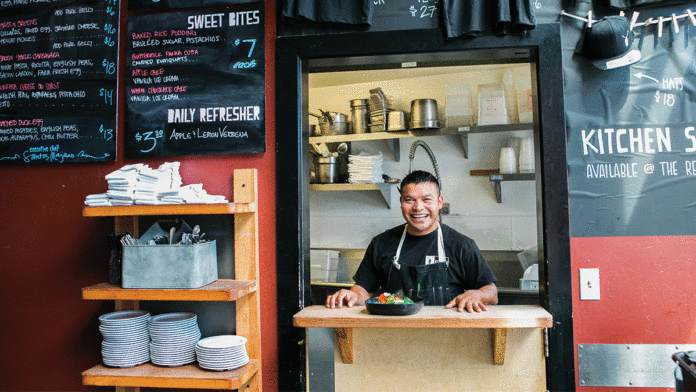
They’re back! For those of us who fell in love with the weekly ramen slurp sesh from the Kitchen at Discretion last winter, our bowls of soul have returned. Layers of dashi, bone broth, fresh noodles and fatty pork are lovingly and painstakingly crafted by ramen enthusiasts chef Santos Majano and his sous Dare Arowe every Tuesday and topped with a rainbow of house-made pickled egg, vegetables, nori and Serrano chilis. Arowe will mix it up each week with different regional styles of ramen. I guess we’ll have to try them all! kitchenatdiscretion.com.


POP-UP FOR STANDING ROCK

A pop-up fundraiser for Standing Rock (yes, they still need funds) will be held at Midtown Café from 5-9 p.m. on Friday, Dec. 16. The collaborative menu will feature red beans and rice with a variety of fixin’s by chef Jessica Yarr of Assembly, Amanda Pargh of Burn Hot Sauce and Seth Heitzenrater of Outstanding in the Field. Speakers who have spent time on the ground at Standing Rock will share their experiences, and musical entertainment will be provided by local artists Jessie Marks and Aliza Hava. All proceeds from this event will go directly to Sacred Stone camp and their medical and legal funds.

Teaching Meditation at Juvenile Hall

Mind Body Awareness Project
The Mind Body Awareness Project, which Noah Levine started in Santa Cruz, is reopening its local branch

How Four Groups Are FightIng Homelessness

Pajaro Valley Shelter Services
Santa Cruz Gives shines light on Pajaro Valley Shelter and others helping the county’s poorest

When Pets Eat Pot

pets eat pot
The dangers of letting your pets get ahold of your stash

Preview: Hari Kondabolu Comes to Catalyst

Hari Kondabolu
Comedian and ‘Politically Reactive’ co-host Hari Kondabolu is the ghost of 2016—and funny, too

Film Preview: ‘Eagle Huntress’

Eagle Huntress
Girl defies tradition in soaring documentary ‘Eagle Huntress’

Preview: Pure Roots to Perform at Moe’s Alley

Pure Roots
Santa Cruz group Pure Roots connects with some of Jamaica’s most legendary musicians

Be Our Guest: Foreverland

Foreverland
Win tickets to Foreverland on Dec. 30 at Don Quixote's

Love Your Local Band: Disiac

Disiac band
Disiac play Wednesday, Dec. 14 at Moe’s Alley

New Chef For Assembly

Jessica Yarr and the team at Assembly in Santa Cruz
Jessica Yarr becomes new executive chef at Assembly, and John Locke leaves Soif for Birichino Wines

Pumpkin Bread from Staff of Life

Staff of Life pumpkin bread
A versatile seasonal bread, plus the return of Ramen Tuesdays and a Pop-Up Fundraiser for Standing Rock
17,623FansLike
8,845FollowersFollow