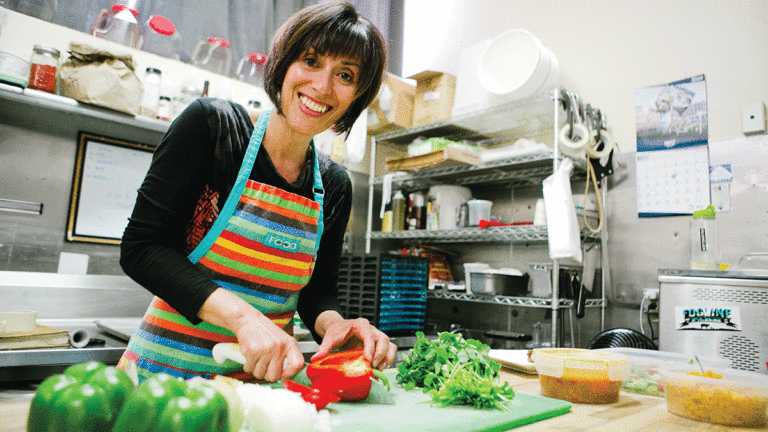
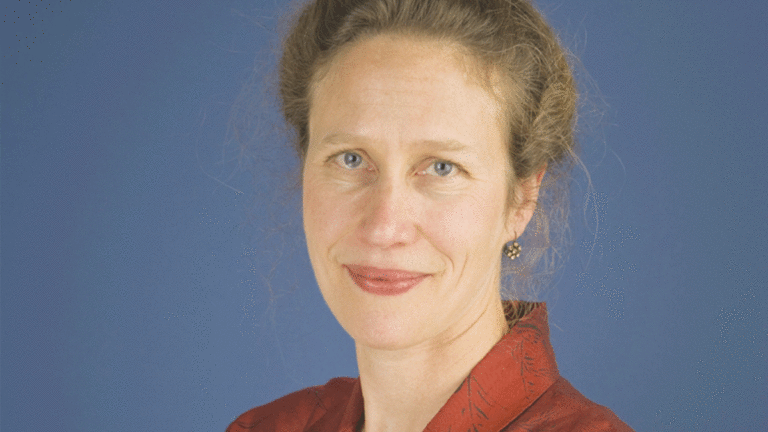
Anna Deraco really wanted to start a food truck. She had the perfect idea, too: Puerto Rican food. With no professional culinary experience—she always cooked at home—her friend encouraged her to start out doing pop-ups. Last September, La Sofrita was born.
Her Puerto Rican food pop-ups have been a huge success. Now she hopes to one day open a café. Deraco gives us the complete breakdown of La Sofrita.
Why did you start La Sofrita?
ANNA DERACO: I grew up with great Puerto Rican food. You don’t get a lot of that out here. On the East Coast, it’s all over the place. There’s a sizable Puerto Rican population in the area in Pennsylvania I grew up in. Whenever I would cook it, people would love it. Once I started doing this, what became really fun for me was seeing how many Puerto Ricans were in the Santa Cruz area. That’s been fun, having them show up and go, “Oh my gosh, I’m so excited to have this food here.”
What defines Puerto Rican food?
On the surface, it doesn’t sound terribly different. It’s rice, beans and chicken. Puerto Rican rice and beans have a distinct flavor. The rice is flavored and covered with something called achiote, which is a pebbly seed from a flower off a tree that grows in the tropics. Once you put them in some warm olive oil, it gives off this gorgeous orange color and subtle nutty flavor. It’s added more for the color. The stuff that I’ve been doing a lot is empanada. Those have been pretty popular. It’s just a flour-based dough stuffed with whatever you want to stuff it with. I do the traditional beef picadillo, which is ground beef. Puerto Rican food has lots of herbs and flavor, but it’s not spicy. It’s a lot of garlic base and cilantro and different sweet peppers, but not spicy peppers.
Why did you choose the name La Sofrita?
Sofrito is the base of about 90 percent—I’m exaggerating—of Puerto Rican dishes. It’s absolutely indispensable to Puerto Rican cooking. The base is traditional peppers that I don’t have access to here, but I substitute with sweet red and green bell peppers, onion, cilantro, tomatoes, that gets blended together into a relish. That gets fried up in olive oil and that’s what starts a lot of Puerto Rican food. It starts the rice. It starts the beans. It starts some of the fillings for the empanada. The counterpart is alcaparrado, which is a combo of roasted red bell peppers, manzanilla olives and capers. No authentic pot of Puerto Rican rice, beans, stew or empanada filling can be made without it. I wanted to call myself Sofrito, but my brother told me that the domain name was already taken. I had to be a little creative, so that became La Sofrita.
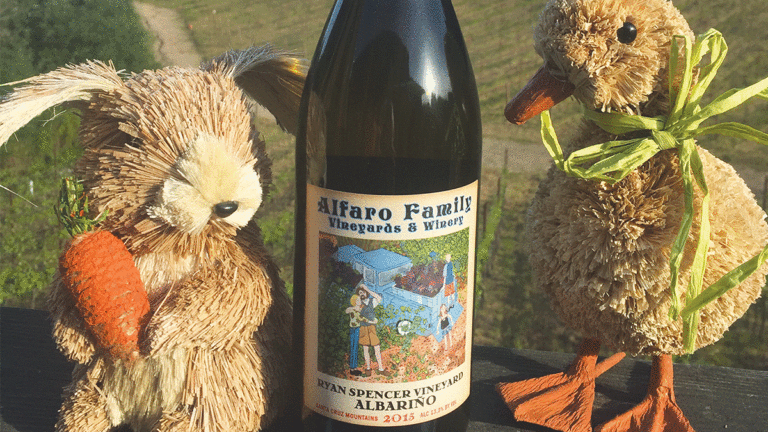
It’s hard to keep up with all of the different varietals that winemaker Richard Alfaro is producing these days. And his wines sell out so quickly. As of writing this, Richard and his wife Mary Kay Alfaro still have plenty of their estate Albarino 2015, made with grapes from the Ryan Spencer Vineyard, named after the Alfaros’ son.
A dry and zesty white wine, Richard produced 71 cases of Albarino after aging it for three months in neutral oak. Pale straw in color with a medium body, “it boasts the stone-fruit flavors of peach and apricot, but finishes with bright acidity,” the Alfaros say.
Originating in Spain and Portugal, the Albarino grape produces a highly aromatic wine that pairs well with seafood and spicy cuisines like Asian, Thai and Cajun.
Although most people don’t walk in the door after work and pour themselves a glass of Albarino, it is gaining in popularity and is becoming quite trendy, in fact. With its sturdy acidity and rather high alcohol content, it’s a versatile white to enjoy on its own as well as with food.
My husband and I were in Spain recently, staying with friends in their 100-year-old farmhouse. They cooked many a splendid dinner for us, and we all drank copious amounts of Albarino (Spanish wines are so inexpensive) – before, during and after dinner. I appreciate this varietal more than ever.
The Albarino sells for about $25 at Alfaro’s tasting room—an upbeat place to visit with an energetic vibe. You’ll have a great time, for sure.
SweetSurf Party Room is all set up to help you host a party in their new quarters—with Marianne’s and Polar Bear ice cream companies combined. “We are ready for your next birthday party, business meeting or team celebration! Let’s party!” says co-owner Mary Cody. They also do outside functions, of course. SweetSurf Catering, 1020 Ocean St., Santa Cruz, 687-9220. Visit sweetsurfcatering.com to check out their flavorful offerings.
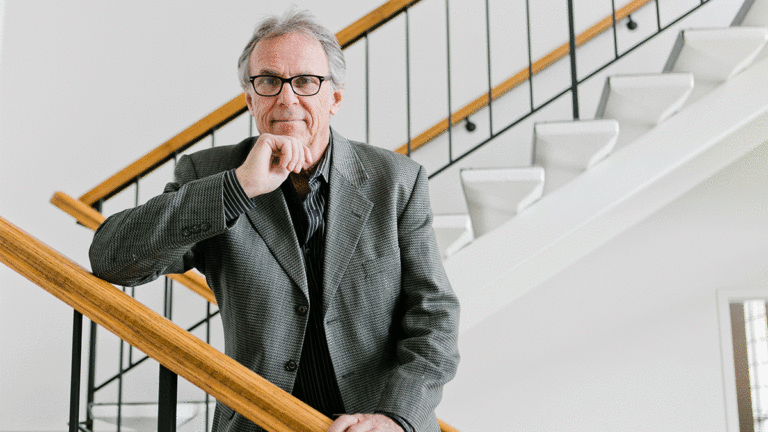
Oscar-winning documentary filmmaker Eric Thiermann lives for storytelling.His experience and imagination ignite the narratives at Impact Creative, a small production studio here in Santa Cruz that epitomizes “state of the art.” A member of the first graduating class at UCSC, company founder Thiermann feels that proximity to the university is key to Impact Creative’s future.
“I’d like to set up a funicular going straight down the hill from Science Hill to our studio,” he says.
With their pioneering work in virtual reality, companies like Seagate, Google, Hyundai, CISCO and Princess Cruises are coming to Impact Creative to help them launch ad campaigns, forgoing traditional TV spots and billboards for the opportunity to plunge their prospective consumers into an unforgettable experience.
But the company’s productions can have social applications, too, Thiermann says.
“Two people in two different parts of the world can have headsets and interact in a single virtual space,” he says. He cites Rising International, the nonprofit, founded by Carmel Jud, that has recently starting using VR technology to acquaint women in high-risk areas around the world with the women selling their handmade goods locally.
Thiermann has applied for a U.N. Impact Grant to deepen the social justice area of his work. “You gotta do something to feed your soul. All the companies are coming out with games,” Thiermann notes. “What I like to do is tell stories that connect people.”
The Studio
BRACED FOR IMPACT Members of the Impact Creative team on a shoot with the first autonomous robot to arrive at Walmart Supercenters. Left to right: Philip Lima, Kelsey Doyle, David Sieburg, Deva Blaisdell-Anderson and Donald Eldridge.
Two lively little dogs greet invited guests at the code-protected front door of Impact Creative. Once they have a sniff, the house mascots romp away to other regions of the spacious design studio. Huge enough to house studio and brainstorming areas, the first floor boasts at least two man-cave-sized lounge areas (wraparound couches, toys, what have you), a conference table that can seat the entire IC team, a central staging area for off-site shoots that also works up into a mini studio for product photography, and long counters filled with various snacks and drinks, plus water bowls for the canines. Desks and computers for programmers, producers, editors, and writers hold down a far corner—the business end of the studio, if you will. At the opposite corner is a vault protected by codes and locks, in which the house treasures are stored—cameras, drones, robotics, lithium batteries the size of toaster ovens, stabilizers, and assorted sound capture devices. Major motion pictures have been made with the exact same equipment. On one side of the studio, post-production is finessed. On the other, image and data captured. High-energy humans with laptops pace in between, mostly very young.
The first day I visit IC, a trade show booth is being finalized for its gig at a Las Vegas convention, and I’m invited to step into a fabulous virtual world. “With VR, you don’t use space and time in the usual way,” Thiermann says. “Creating experiential content requires a lot of craft.”
VR goggles cover my eyes, and I step out into space, looking at the Earth far below me. After floating for a few seconds, I turn my head and see the NASA space shuttle docking just beside me. I float inside it, and watch as it maneuvers through various intricate exercises that I can step into, or not. I can already feel the addictive pull of this sort of gorgeous illusion.
However sexy—and however rapidly evolving—the 360 VR technology needs much more content before it becomes the promotional industry standard.
“We’re not getting rid of our 2D bread and butter,” Thiermann admits, and that includes computer-animated videos, as well as shoots involving complex 360 live-action imagery.
Over 40 years, Thiermann’s group has grown and evolved. While he can’t reveal the name, he will say that “a major Hollywood film company” just contacted them about a collaboration. IC demos often get one million hits in a day.
Thiermann thinks the reason is simple: “People want engaging content.”
Raised in L.A., Thiermann learned to take photos and shoot movies as a UCSC student before getting his MFA at UCLA. “I worked around Hollywood, worked with Jonathan Demme. But I didn’t want to be an art director. I wanted to do movies,” he says. “I made short films, then applied for an AFI grant that was my ticket out of LA.”
After doing a PBS-style documentary of artists in prisons, Thiermann made The Last Epidemic, an anti-nuke film, exposing the medical consequences of nuclear war, nominated for an Oscar. “The next one, In the Nuclear Shadow—I was the shooter—did win the Oscar,” he says. “I made tons of documentaries, and we started getting lots of jobs. Once the internet came along, you could be anywhere, so you didn’t have to be in New York or L.A. The quality of life here, raising a family in a real community, has kept me here.”
“I think we have a good reputation. It’s all referrals, it’s not me,” he insists. “There are so may talented people here.” He points around the studio. “Young people who grew up with digital technology. I can still shoot really well, but they grew up with this stuff,” he says.
Thiermann and his team seem to inhale work. “Every year, we get bigger and better. All the demo videos you see at Best Buy stores all over the world—those are ours. Anything Google. We make all the videos on all those products.”
Thiermann likes doing it all. “I like shooting guerilla-style. I like building things,” he says.
Travel comes with the territory. “Every week or so we’re on location. I just got back from Standing Rock. Couldn’t get a plane, so we drove for two days in the snow to make a little documentary. We went up to the Northwest to do a really fun shoot for Hyundai. Going to Haiti next month, and then the Cameroons to document innovations that help keep young women in school.”
Why slow down? “I’d rather be working,” he says with a shrug. “It’s too much fun. And it’s all new, all the time.”
The Photographer
Philip Lima gets to play with the dazzling toys.Expensive (close to six figures) cameras—like the “Weapon,” which is made by Red and delivers megapixel images that are detailed enough to eat. The Martian, The Hobbit, and Transformers were all shot on similar Red cameras. These are stored in the code-protected vault, along with an arsenal of other digital cameras, VR hardware in its own James Bond-style case, robots, drones, etc.The man who handles all of this hardware was born and raised in Santa Cruz and has been with Eric Thiermann for 10 years—one third of his life.
LOOK HERE Judy Mo, motion graphics designer for Impact Creative, with VR goggles. PHOTO: KEANA PARKER
“I started editing video,” explains Lima, “and quickly shifted to computers and capturing images.”
He claims he still enjoys editing, but I can tell he likes image capturing the best.“Small projects begin with the directing team. They figure out the approach, and then come to me. I shoot, then they edit. I do color correction afterwards, usually with DaVinci Resolve.”
One of Lima’s most arduous VR camera shoots involved a parachute assault training exercise piece at Fort Bragg. “Since it was a VR shot, I had to be close to the camera, to monitor sound, and I had to fit in. The client in that case was VICE News, an investigative reporting group that does a very organic kind of news gathering.”
The result was a four-minute VR special that takes viewers inside a Boeing C-17 while paratroopers perform assault maneuvers. The camera and reporter had to capture everything with multiple camera arrays while staying out of the way of the military. Lima suited up in camouflage gear in order to blend in.
“Shooting a commercial with cameras, like the Reds, you have complete control,” Lima says. “All that goes away with 360 panoramas. Plus, there’s a real challenge with storytelling using 360, because it’s hard to move the viewer’s attention in the way that you can by using different lenses, different kinds of focus and light.”
So how does he guide the viewer’s eye in these wraparound panoramas? “Audio cues are helpful, and lighting. That can lead them in the desired directions.” But there are other challenges with 360. “All of the lighting equipment has to be invisible, because of the omni-direction of the views. Have to hide the lights—that’s a big challenge.”
But challenges also involve a lot of on-location fun. “We began using 360 a year and a half ago,” he says. “One of our recent clients was Princess Cruises. We all went to New York, and went on the boat as it docked. Then we did all the touristy things in New York, shooting it in 360 degrees so the viewer could get a feel for the cruise package experience. It was great.” How long does this kind of shoot take? Their Hyundai Canada commercial, he says, required three 12-hour days of shooting to produce two 30-second spots.
What’s fun, says Lima, is that “everything’s new in this field.” And the most fun involves aerial drones. “I started with drones five years ago,” he says, eyes widening. “The big thing is that you can achieve a stable image. You can put a camera wherever you want—it opens a world of possibilities beyond the obvious visual clichés.” Those ads that take you right out over the water with surfers, or soaring high above a car speeding through the desert—those are shot with a smart camera suspended from a drone.
Known for his aerial shots, Lima admits to strapping the costly Red cameras onto the bigger drones for some shots. “For those, we use both a flier and a spotter. Definitely lots of adrenaline,” he says.
The Tech Guy
Joe Goldin left the computer science program at UCSC to develop the emerging technology area at IC. Kinetic as a Tesla coil, the house technologist manages IT systems. “Making sure the internet’s running, researching server upgrades, new technology, how we can utilize it,” he says with a grin. “For a Seagate project, we had to research product mapping. Ninety percent of my research happens online.”
Barely 20 years old, Goldin grew up with gaming and computers.
“My biggest curiosity is how humans use technology,” he says. “VR is where psychology, storytelling, and technology come together.”
Which is why the pieces made by IC have such emotional power, as well as state-of-the-art graphics. Goldin’s work also involves stitching together digital images. “For the Princess Cruises piece, a 360-degree video, I started by looking at the shot list, at pre-production, how many shots would be indoors, or outdoors,” he says. “With 360, we use six cameras and a single brain that compiles all the images. After the shoot, I stitch it together on a computer.”
He often invents the required programs as he goes. After the compiled images are edited, Goldin smooths the edges so the final product is visually seamless.
Goldin surfs emerging technologies for exciting ways of displaying products, like logos mapped onto three-dimensional volumes. “With video projection mapping,” Goldin says, “we can project images onto anything—faceted objects, trees, hands. What is new is the ability to map onto the shape of an object with a single projector—saving lots of money.”
Goldin explains a simple but important distinction: everything VR is 360-degree, but not all 360-degree video is VR.
“VR is defined by the technology,” he explains. “If you are watching a 360 video on a computer, that’s not virtual reality. If you watched that same video in a VR headset, that is virtual reality. Current headset hardware has been perfected so that it won’t make you motion sick. It in essence moves with the user’s motor expectations.”
For example, my spacewalk was an animated 360 video that IC created for the hard drive company LaCie. It can be watched on a computer or tablet, but it was created with viewing on a VR headset in mind.
“A few years from now we won’t have the clunky headset, there will be a contact lens, or a chip that acts as a receiver,” says Goldin. He doesn’t believe this will all lead to a dystopic Matrix-type world.
“I still love to go outside and play,” he says.
The CEO
David Sieburg’s background in broadcast marketing for ABC, NBC and the Department of Defense positioned him to lead the product development direction of IC. He and his former wife had come out from Colorado, shopping for a future home. Santa Cruz sold itself, and a friend of Jacques Cousteau’s helped make a connection to documentary films—and that led to Eric Thiermann.
“The world is quickly transitioning into an ‘era of experience’ where the digital and physical merge,” says Sieburg. “We have a long track record in film and video production, but we are evolving into a new breed of production company.” Noting the overwhelming newness of the technology IC uses, Sieburg admits that “all of these terms—virtual and augmented reality, artificial intelligence, machine learning, big data, drones, autonomous cars—they’re all different pieces of this experiential future.”
Like Thiermann, he is attracted to social relief efforts, and has documented post-disaster efforts in places like New Orleans and the Philippines. There’s no stopping the move toward virtual and artificial intelligence, but Sieburg wants to keep his eyes on the big picture, and help influence the positive implications of technology.
What does a CEO of a video production company do? “I develop client projects,” he says. “I’ll ask about their goals—mostly by phone and email—and then build a proposal. Next come the three-phase pre-production, production and post-production. This is a group process. Half of what we do is animation, although it’s more fun to do the video projects.”
Sieburg estimates the eight-person team has “between 10 and 30 projects going at any given time, and each takes anywhere from six to 10 weeks for completion.”
People are surprised that a small studio like IC can produce such slick, high-powered work. “We blow them away with our ability. All of us, Eric, Deva, Donald, Philip—the whole team—we all edit and direct and write. We’ve mind-melded after almost eight years. We’re not the usual agency model,” says Sieburg. The team includes directors, producers like Deva Blaisdell-Anderson, Kelsey Doyle, and Toby Thiermann, plus motion designers Judy Mo and David Whitmer. “All of us, we are very hands on.”
The marketing angle is “all about eyeballs—getting people to notice and watch the content. The bigger topic,” Sieburg says, “is what are we—mankind—going to do with it? I’m not sure if it’s driving us, or if we’re driving us. We know that technology is evolving—you can’t stop it. We want to be part of the good uses. But what’s next on the horizon? There’s no portfolio yet for that. It’s the edge—that’s where it is exciting.”
A VR Glossay
VR (virtual reality) offers an immersive experience, one that simulates a three-dimensional world and places the viewer in a non-real somewhere, using a headset and motion tracking device. In VR, using a headset, you can look around a virtual space and it feels as if you’re actually there.
360 degree cinematography uses many cameras with multiple lenses to capture all angles, side to side, top to bottom. The captured imagery is then “stitched” together by computer programs to simulate a seamless encounter with a wraparound environment, seen from the viewer’s point of view. Anyone with an ounce of geek DNA can attach a 360 camera to a drone and make a fairly decent “oh wow” visual experience.
AR (augmented reality) lies somewhere in between a physical environment and a virtual one. It adds sensory data to the natural world, like maps and directions suddenly popping up along your sightlines when you need them. Think of the hologram of Obi Wan in Star Wars—thehologram of Princess Leia was a digital creation placed into a real space. Another great example of AR occurs in the film Minority Report when Tom Cruise’s character walks through the shopping mall and all of the window ads and billboards know his name and offer him his favorite product choices. This, as anyone surfing the internet knows, is already with us in the form of robots tracking our reading and purchasing choices. CHRISTINA WATERS
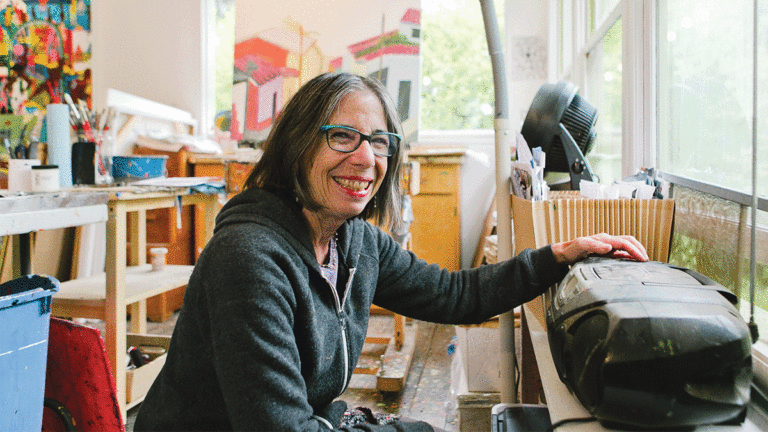
“It was always there, and always something you could count on,” retired art teacher Myra Eastman says, the sound of long-lost love lingering in her voice. “We were friends.”
Her late companion is defunct community radio station KUSP (88.9 FM).
Although she never worked at the station, Eastman—a local resident for 46 years—says community radio played an integral part in her family’s life. It was the station she turned to for the latest in local politics, or to hear new and strange music hand-curated by passionate disc jockeys. She fondly remembers raising her children with programs like “Castle Cottage,” and how it was “our only lifeline” for information after the devastating 1989 Loma Prieta Earthquake.
“It was a local jewel,” she says. “These were [voices] you knew, they were your neighbors.”
So when she read about the financial trouble the station was going through two years ago, she became involved with Media Watch and KUSP Forward. Ex-KUSP programmers and community members in those groups did what they could to keep the station afloat, attending board meetings and even attempting several times to raise enough money to acquire the station’s license. Their latest attempt was in October of last year, when they were outbid by the Educational Media Foundation—an adult contemporary Christian music conglomeration—which won the rights to the bankrupt station’s signal with a $605,000 offer. The new Bible-thumping rock station on 88.9 calls itself Aware FM.
With KUSP gone, Eastman and others from Media Watch created a new coalition called Central Coast Community Radio (CCCR), with a new goal of purchasing an entirely different license, frequency and transmitter. Through its online crowdfunding campaign, CCCR has raised $82,500 toward the purchase of 90.7 FM. The new station, not nearly as powerful as KUSP, would be able to transmit from a small tower on the UCSC campus.
Still, their $82,500 is a far cry from the $265,000 needed to purchase the new license and transmitter, and even farther from the estimated $350,000 needed to fully operate a new station for an entire year. To help them reach this goal, CCCR received a challenge grant from a community member of $50,000, should they raise an initial $150,000. Raising the rest could be an uphill climb, and a steep one at that—as the members are well aware—but they hope media coverage will help them get there. If CCCR doesn’t meet its goal, all donors will get their money back.
After fundraising and bidding for the signal are wrapped up, the license transfer must still be approved by the Federal Communications Commission before new call letters get assigned.
“Our biggest need is obtaining more contributions to close the deal,” says business attorney and CCCR Steering Committee member Ned Hearn. “By the end of the month, our goal is to have a package of funds.”
Talking Point
Charlie Lange, another committee member, agrees that KUSP’s departure stripped the community of a vital service.
“The need for a locally based, locally supported media outlet is crucial in these times we live in,” says Lange, who serves on CCCR’s Advisory Committee. “For disasters, for public commentary, for entertainment and artistic expression.”
For nearly 40 years, he helped build the station’s listenership and maintained its local focus by hosting shows like “Soul Shack.” In the early days, he would even drive around in his Volkswagen van, broadcasting live from concerts and events. Although Lange’s faith in community radio’s importance remains unwavering, he often wonders if the public realizes what it’s missing.
“In my opinion, [the verdict] is still out on whether or not people in this community want to support it,” he admits. “We’ve had strong fundraising efforts for the last few months, but we’re not even halfway to the cost of just the license.”
Worries like these led Central Coast Community Radio to create an ongoing survey on its website, asking community members what they want to hear. Since the poll launched in January, 110 people have answered, and the results show a strong desire for the old KUSP-style formatting, with 85 percent saying they want to hear local news, 78 percent in favor of local politics and 69 percent in favor of live broadcasts from events around the county. When asked what community radio means to them, comments included “community-owned and operated,” “Radio of, by and for the people,” and even “The old KUSP.”
There were suggestions about bringing back some of the old programming, like “Talk of the Bay.”
“There seems to be a growing interest [in community radio],” says ex-“Talk”host and current CCCR Steering Committee member Rachel Goodman. “Once people hear about it, they get excited. It’s just a matter of getting the word out.”
A Peabody-Award-winning journalist and current co-host of “Planet Watch” on KSCO (1080 AM), Goodman believes the survey is a positive step in the right direction from the lessons learned after KUSP’s demise, something she felt could have been avoided.
“Being nimble and responsive to your community is very important,” she says, “along with looking at other successful models from around the country.”
Undivided Antennae
One model that radio-loving locavores admire is KPCW out of Park City, Utah.
“We’re growing audience and revenue while airing more shows we produce,” says KPCW General Manager Larry Warren. “We believe this is a great time to be in non-commercial radio.”
Now in its 37th year of broadcasting, the station frequently earns award nominations from the National Association of Broadcasters (NAB). It has eight paid staffers to go with roughly 50 dedicated volunteers. Underwriting represents half of the station’s revenue, with another 25 percent coming from listener donations, and the final quarter from other funds, such as grants from the Corporation For Public Broadcasting.
“Until Trump kills it,” Warren says with disdain.
The community station is affiliated with National Public Radio, although it broadcasts only the bare minimum of the media organization’s shows.
“I stripped away most of the syndicated programs,” he states. “Why should I pay for a show that a bigger station with a stronger signal is also running?”
Along with news and entertainment designed specifically for Park City, Wasatch and Summit Counties, KPCW also broadcasts helpful and empowering programs like The Classified Show. It’s like an on-air Craigslist, where listeners can call in about anything from garage sales they’re hosting to furniture they might be looking for.
When it comes to what communities crave, Lange believes one need not look farther than KPIG, which broadcasts out of Watsonville.
“I would rather listen to a show by someone who is passionate,” he says. “People might like the music, but it’s the personality that they respond to.”
“Here’s to alcohol: the cause of—and solution to—all life’s problems,” proclaimed the animated poet Homer Simpson. His thoughts on the matter may be closer to the truth than perhaps even he realized. Alcohol certainly does have a side as dark as a shot of Fernet: it is an all-too-commonly abused drug, plays a role in many car crashes and violent crimes, and can have disastrous and fatal consequences on health. But there is also scientific evidence that consuming it moderately may enhance well-being.
The Harvard School of Public Health’s website comes eerily close to agreeing with Homer, stating, “It’s safe to say that alcohol is both a tonic and a poison. The difference lies mostly in the dose.” So exactly how much should we be drinking? Where is the line between tonic and poison?
One of the first people to look at the question from what he called a “tight, defensible scientific perspective” was Dr. Wells Shoemaker, a local physician and co-author of the book The French Paradox and Beyond, published in 1992, just after the term “French Paradox” entered our lexicon. It refers to the finding that even though French people typically ate diets rich in saturated fats from things like butter and cheese, their incidence of heart disease was surprisingly low. One proposed explanation was that the French also consumed a lot of wine. Could this resolve the seeming paradox?
The answer, according to Shoemaker, is yes. “The alcohol molecule itself has a number of salutary effects,” he says. “It raises [good] HDL cholesterol, lowers [bad] LDL cholesterol, and reduces the tendency of platelets in the blood to clump together.” Wine also offers benefits: “There are a number of antioxidant compounds in wine, mostly in the skins”—which is why red wine is healthier—“that slow damage inside blood vessels,” says Shoemaker, referring to polyphenols like anthocyanins and resveratrol.
He says the timing and manner of how wine is often imbibed is crucial, too. “Typically, wine is consumed with a meal. While fats are being metabolized, the antioxidants are getting into the blood as well, and it is often consumed slowly, in integrative settings that have a social aspect.” Even famed (and French) 19th-century chemist and biologist Louis Pasteur was a proponent of wine, saying, “Wine is the most healthful and most hygienic of beverages.” “So it’s really not a paradox at all,” continues Shoemaker. “Moderate drinking does lower the risk of heart disease and stroke.”
But what exactly constitutes “moderate drinking?” For some, that term is itself the paradox, and unfortunately nine drinks on Saturday night and none the rest of the week does not count. Shoemaker says that the definition has slowly come down over the last two decades, and now sits at about two standard (12-ounce beer/5-ounce wine/ 1.5-ounce liquor) drinks per day for men, and one standard drink per day for women.
A 2017 study published in the British Medical Journal showed a reduced risk of heart disease for moderate drinkers relative to both those who didn’t drink at all and those who drank heavily. And 2015 research at the American Society of Human Genetics used DNA markers to look at alcohol’s effect on aging, and found that moderate drinking was correlated with the healthiest aging.
But a 2016 systematic review published in the Journal of Studies on Alcohol and Drugs looked at 87 previous studies and found that they all showed a reduced mortality risk for low-volume drinkers. After adjusting for insufficiently accounted-for differences between drinkers and abstainers, the effect disappeared.
A 2016 review of previous research published in the journal Addiction concluded, “There is strong evidence that alcohol causes cancer at seven sites in the body, and probably others.” That said, according to the Centers for Disease Control and Prevention (CDC), the leading cause of death in the U.S. is still heart disease, and stroke is fifth, although cancer is second.
It is no wonder that Shoemaker calls this a “very murky field,” and stresses the importance of a case-by-case approach. He doesn’t recommend starting a drinking habit for health reasons, but says, “A physician recommending their patients not drink at all is not scientifically supportable. If you do drink moderately, it’s probably not harmful.”
It all comes back to the individual and his or her specific health issues, history, and genetic and environmental risk factors. Perhaps then the question is not, “How much should we be drinking?” but instead, “How much should I be drinking?”
Ever been called a birdbrain? According to Jennifer Ackerman, you should be so lucky.
In her wondrous new book, The Genius of Birds, she reminds us that there is more than one way to wire a clever mind. From the exacting beauty of their nests to the evidence of their empathy, navigational prowess, and ability to recognize faces, she lays out the surprisingly adaptable intelligence of birds, elevating it to its rightful place in the natural world. We talked recently about the delights and mysteries to be found in the avian brain.
How has your personal history influenced your interest in birds?
JENNIFER ACKERMAN: I started birdwatching with my dad when I was eight or nine years old. We had five girls in our family, so getting a little alone time with him was a big deal. He’d learned about birds in Boy Scout camp, so he was pretty good at identifying them by call and sight. I’ve held onto that love of birds all my life. When studies started to come out about their surprising cognitive abilities, I thought it sounded like a fascinating topic to delve into.
Birds are smarter than we give them credit for. What have we learned about the nature of their mental abilities?
The misrepresentation of the bird brain goes back to Ludwig Edinger in the 19th century. He suggested it was a primitive, reptilian structure, which turned out to be wrong, but it stymied research in the field for a very long time. Scientists finally began to sort out that birds may not have a neo-cortex like ours, but they have a structure that’s similar. Many species have brains that are large for their body size. Neurons in the brains of songbirds and corvids have a density akin to primates, but intelligence is not so much about brain size—it’s about the connections between neurons. When birds learn to vocalize, they use neural pathways similar to those we use to learn speech.
So birdsong is like language?
There are remarkable similarities between song learning in birds and speech learning in humans. Young songbirds have a period of vocalizing called subsong, which is like human baby babble. Some birds sing their songs in regional dialects and pass them down through generations. Some songbirds have speech defects. They stutter. Like humans, songbirds have a narrow window of time in which their brains are more easily wired to learn songs the way ours are more easily wired to learn language.
You write that birds having mapping minds. How does a hummingbird find his way to the same feeding ground each year?
The navigational abilities of birds so far exceed our own that they’re in a different domain. It’s believed that they use a sort of map and compass system, but it’s all cognitive. They tap into many different types of information, from sun and stars to magnetic fields, landscape features, wind, sound, smell, and more. All of it funnels into their brains and somehow guides them to their destination. Birds displaced from their natural migratory paths by hundreds or thousands of miles are able to beeline back to the right route within an hour or two.
Birds’ adaptability is often used as an explanation for their success, but many species are highly vulnerable right now. How can we help?
Birds that are adaptable are probably going to do all right, like blackbirds and sparrows. The ones that are highly specialized, particularly in mountain or tropical niches, are being squeezed out of their habitats. In terms of helping, being an ethical consumer is important, calling and writing your representatives about environmental issues can make a difference, but we can also do things in our own backyards. One of the great stories where I come from is the rise of the bluebird population. It happened because people put up bluebird boxes everywhere to protect them from predatory birds that were displacing their nesting sites. Growing native plants that birds love is another way to help, and you get the added joy of seeing them in your garden. I’ve even had an eastern screech owl roost in a tree right outside my kitchen window. That was pretty great.
Jennifer Ackerman will talk about and sign her new book at 7 p.m. on Wednesday, April 12 at Bookshop Santa Cruz, 1520 Pacific Ave., Santa Cruz, 423-0900. Free.
In the traditional son jarocho song “Señor Presidente,” a peasant laments the sad state of his neighborhood. In each verse, the narrator asks the president if the common people will ever have things as good as they are in the president’s neighborhood. Will their streets ever be as safe? Will they ever be as rich? The questions go unanswered, but after all, they are rhetorical. The answer, it is clearly implied, is no.
Las Cafeteras perform their own version of the song on their new album, Tastes Like L.A., which comes out this week. The East L.A. band is known for their love of son jarocho, but that doesn’t mean there’s no downside to carrying on the centuries-old folk tradition from the Veracruz region of Mexico. For instance, Las Cafeteras member Leah Gallegos wouldn’t mind at all if songs like “Señor Presidente” weren’t so relevant today.
“Four hundred years later, we’re still singing about the same needs,” says Gallegos by phone, as the seven-member band prepares for an album release tour that comes to the Rio Theatre in Santa Cruz on Saturday, April 15.
On Tastes Like L.A., “Señor Presidente” leads into an even more direct comment on our times, the hip-hop-driven “If I Was President,” featuring lyrics like “If I was President/I’d free all my poor black and brown kids that got caught up in three strikes/And when they get out/They gettin’ free bikes.”
Few bands can find the humor and joy in a political protest song the way Las Cafeteras does (another great line from “If I Was President”: “My first lady would be my mom/Cause she’d slap me at the first thought/Of drone strikes and dropping bombs”). Gallegos doesn’t even see it as political, really, singing about the human experience.
“I think we sing about very basic human needs,” she says. “A lot of times that gets named ‘political’ or ‘radical,’ and I think that’s a little off.”
Perhaps the difference is that, as most of the band members come from immigrant families, the issues people have been most alarmed about since Trump took office are ones they’ve had to be worried about their whole lives.
“It’s become a little more loud, it’s a little more in everyone’s face,” says Gallegos. “But it’s not that new to us.”
Neither is the internal turmoil they had to deal with in 2015, when Annette Torres left the band; Torres released a statement claiming the members of Las Cafeteras weren’t living up to their stated feminist and democratic values, saying the women in the band were being pushed around by the men. The other band members denied most of her claims, and Gallegos took issue with anyone speaking for her. Any band that finds success—as Las Cafeteras has since the release of its popular last album, 2012’s It’s Time—is going to have tension, she says, but the story she saw represented by Torres and much of the media coverage was not her experience at all. Because Torres is the aunt of two of the band members, brothers David and Hector Flores, the break-up was that much harder.
“We’re still broken-hearted about it,” says Gallegos. “But I think internally it sort of allowed us to grow stronger. It really tested our caring for one another, because we lost a family member. We lost a friend.”
Weirdly, the conflict also pushed them to complete their long-overdue follow-up to It’s Time, which kept getting pushed back year after year as they continued to tour.
“It kind of put us in a place where we wanted to create, and be in the studio making music,” she says. “It was sort of our medicine.”
The finished product represents a lot of musical growth by the band, which has created a sonic stew on Tastes Like L.A. that goes well beyond their origins in traditional sounds and songs.
“We have a lot more originals. We’ve kind of strayed away from son jarocho,” says Gallegos. “We’re starting to experiment with more instruments and more sounds.”
INFO: 7:30 p.m., Saturday, April 15, Rio Theatre, 1205 Soquel Ave., Santa Cruz. $25. 423-8209.
We have never had a bad time at the little arcade party that is the El Palomar Taco Bar. Four TVs all tuned to sports, spacious tiled floors, a team of can-do women running the food show (wearing lots of bright pink), a full bar of tequilas, and delicious freshly-made Mexican classics.
Of course we love this place—and so, it appears, does everybody else. Families, children, babies, grandpas, surfers, students, tourists, rock stars, local politicos, everybody ends up hanging out. We checked out the lunch specials as we stood in line to place our order. Great offerings at great prices. But we had our favorite orders already in mind. For me, a ginormous prawn quesadilla ($8), plus a succulent guacamole taco ($3.50). For Jack, his all-time favoritesnapper taco($4) plus rice and beans ($3). And a large diet Coke ($2.25). Diet Coke goes brilliantly with the bright flavors of pico de gallo, cilantro, and creamy guacamole. Besides, Jack doesn’t get anything close to a Coke at home, so he indulges when at El Palomar. So we pay and pick up our bowls of chips and salsa, grab a table and wait for our number.
It’s important to grab a table fast anytime close to noon. This place fills up in nanoseconds. Chips: warm, light, crisp and salty. Perfecto. Salsa: well-balanced, spicy, complex, but not lip-incineratingly hot. Like everything at El Palomar, these foods are cooked to order, so while it’s quick, it’s by no means fast food. The scene is so vivacious that waiting is also part of the fun. A plump baby spreads one of those supernatural smiles all over the place. A well-behaved pug poses beneath his owner’s chair. Buffed men kick a soccer ball across an emerald field on one of the screens. First comes my guacamole taco, a layer of citrusy mashed avocado, cilantro, and lettuce on a pillow of world-class refritos and a soft corn tortilla. I never knew that guacamole could hold its own as the key taco element. It can. Next came my beautiful quesadilla, melting with cheese, a thin frosting of refritos, and lots of hot prawns. Pre-scored into accessible strips, the quesadilla was deluxe, and so were its partners—sour cream, guacamole, and a fat scoop of, you guessed it, pico de gallo (I love pico de gallo). Finally came the snapper taco, sauteed chunks of fish filet tossed with beans, cilantro and lettuce, and tucked into a tender taco. Next to the taco was a broad band of seasoned rice, and next to that a dinner-sized portion of pinto beans. Oh. God. So. Good. For $22 we had enough for a substantial side dish. In and out in 40 minutes. El Palomar Taco Bar—siempre! Downtown Santa Cruz, in the arcade connecting Pacific Avenue and Front Street.
A Vermouth Worth Drinking
That’s Carpano “Antica Formula” Sweet Vermouth. Elegant, full-bodied, and delicious, this blood-red Italian sweet vermouth is made from several varieties of grapes plus botanicals such as vanilla, saffron, wormwood (the central ingredient in absinthe), and bitter orange. Such complexity (a secret formula since the late 18th century) yields an equally complex libation. I consider this beautiful beverage the sweet sister of my favorite bitters, Fernet Branca. We were given this spectacular vermouth as a New Year’s gift—thanks to the impeccable palates of Lin and Dee. It is definitely the finest sweet vermouth I’ve ever encountered. Obviously, it would make a sensational Manhattan, but we enjoyed it neat, room temp. Does anyone know if it’s available here in Santa Cruz? If so, let me know where!
It is Easter Week, also called Passion Week. The story of Jesus the Christ, an Avatar from the blue-white star Sirius, who was judged, crucified, died and then resurrected from the tomb. The narrative focuses upon death. With one day set aside for resurrection. The new narrative for humanity concerning the Christ (Piscean and Aquarian World Teacher) in this biblical story, concerns the Resurrection.
What happened this Passion Week a long time ago? And what is occurring now? From Monday through Wednesday, Christ taught his disciples hidden esoteric teachings, preparing them for His death. On Holy Thursday, at the Last Supper (Passover), Christ anchored the new Piscean religion and the priesthood. On Good Friday, the Christ at his crucifixion, “rent’ (tore/broke) the veils” that separated humanity from returning to the Father.
On Holy Saturday, the Christ entered deep into the Earth and welcomed the Souls waiting for release and lifted them into heaven. On Sunday, Resurrection Day, the Christ, rolling the rock back, demonstrated to humanity the fact that there is no death. There is only liberation from captivity in matter. And a Great Adventure in death, ahead.
Christ’s three-year mission on Earth, culminating in the Easter/Resurrection festival, was a labor done for all of humanity. He closed one great cycle (Aries) and initiated the new cycle of Pisces (sign of the Savior). In the Aquarian Age, the esoteric (hidden) teachings focus upon the fact of the resurrected and liberated humanity, released from the Cosmic Crucifix. Now we are preparing for Christ’s Reappearance as the Aquarian teacher. Everyone will recognize Him this time. Christ will return as the Water Carrier, meeting the needs of the thirsty nations of the world—thirsty for truth, right human relations and loving understanding. We prepare for this. We pray for our world—thirsty and in crisis.
ARIES: You’re here, there and everywhere. In and out, up and down. The energies are dynamic yet contemplative, fiery yet watery, leading to excessive activities and times of melancholy. Attempt to focus within the heart. This allows all new ideas, not yet to be acted upon, to filter through the question “Is this for the Goodwill of everyone?” The answer allows you to know the best course of action through tumultuous times.
TAURUS: You’re often in serious contemplation or study, attempting to sort out details, feelings, instincts, and intuitions. The main key is truth. You may not know immediately what you feel. However, you must still express to others when the timing isn’t right, when the path isn’t clear, when the past hasn’t caught up to the present/future. You know that moving forward without right timing is foolish. So many retrogrades these days!
GEMINI: Do not be discouraged. Love’s hiding so you can assess your wants, needs, and aspirations first. Pleasure might also be hidden, delayed until just the right time to come out and play. Be very aware of the Easter festival. Since love pours down on all of humanity during the festival, and since you’re Ray 2 (Love/Wisdom), you’re in the direct pathway to receive. Allow nothing to interrupt your meditations.
CANCER: Anything unresolved with intimates and relationships (even those who have died) will reappear through feelings, thoughts, emotions and memories. Attempt to reconnect with grace and equanimity, remembering “Love underlies all events and happenings.” Life creates tests, losses, sadnesses and meaningful encounters, so that we are strengthened. Contemplate on all ideas and dreams being impressed upon your mind. They are messages.
LEO: It’s as if you need a ship to navigate the tides going in and out of your life. See yourself at the seashore, building a fire close to the water’s edge. Then contemplate both elements—fire and water. When they join, a new reality, new direction and a new awareness of life occur. You need these. The challenge will be maintaining an inner steady course when emotions become overwhelming. You can do this. Talk with those who love you. The animal and plant kingdoms listen well.
VIRGO: You’ll be practical as well as creative with money and finances, day-to-day events, plans, connections and agendas. Even if you feel like an inner explosion might occur, focus on how to bring balance and harmony, caution and care into all situations. The week is paradoxical with polarized realities everywhere. Stand in the middle where the light is. That will be your adventure.
LIBRA: You continue to assess what you’re able to provide to others, especially those close to you. You also review exactly what you need. Sometimes realizations can be difficult especially for Librans who want to have harmony above conflict, ease above constant change. You want more depth, meaning, closeness and yet also freedom. Sometimes a dilemma. Maintain silence this week, listening only to the heart of nature. You will forgive and then love more.
SCORPIO: Find ways to express yourself, not necessarily through words but through exercise, yoga, tai chi, walking, running, cooking, music, boating, etc. However you express yourself, movement is what is important for it will sustain and stabilize highly emotional trigger points. Daily life stresses make you feel like escape is necessary. Yes, do escape. You know how to do this. Ohm.
SAGITTARIUS: Use your mind and spiritual will to focus on health and well-being. Think prevention. Then attempt to enjoy yourself. Both are important. You have a real sense of confidence in your intelligent and good planning. When you’re truly mindful, your communication infects others with laughter, inspiration and enthusiasm. You bring a “resurrection” to people. An upliftment. Ponder these things during the Easter festival. Attend church and pray.
CAPRICORN: As you tend to needed domestic duties and disciplines, a small voice, becoming louder and stronger, calls for a change and a bit more freedom. Be caring when communicating with family. You could feel impatient, saying things you later regret. You may work harder and longer to the point that exhaustion follows. Don’t allow that to occur. In all ways, you are recognized, needed, creative and very valuable.
AQUARIUS: Maintain strict limits and agendas so time and money are not wasted. Discipline allows the intuition to emerge. When we have no discipline, intuition has nothing to focus upon. Should you need anything, realize your communication abilities are excellent. Ask and it will be given. Give and more will be asked of you. Both must occur. Think on all the love and goodness your life has provided. This goodness rules your life.
PISCES: What you communicate will affect many people. Tell the truth about your experiences. Let people know both your inner and outer realities. No matter what is occurring in your life, move toward it with grace and love and willingness. Great good will come of it. Remember this when the road becomes rocky. (Only for a small amount of time). Read Psalm 91. Write daily in your gratitude journal.
ARIES (March 21-April 19): Before visiting Sicily for the first time, American poet Billy Collins learned to speak Italian. In his poem “By a Swimming Pool Outside Siracusa,” he describes how the new language is changing his perspective. If he were thinking in English, he might say that the gin he’s drinking while sitting alone in the evening light “has softened my mood.” But the newly Italianized part of his mind would prefer to say that the gin “has allowed my thoughts to traverse my brain with greater gentleness” and “has extended permission to my mind to feel a friendship with the vast sky.” Your assignment in the coming week, Aries, is to Italianize your view of the world. Infuse your thoughts with expansive lyricism and voluptuous relaxation. If you’re Italian, celebrate and amplify your Italianness.
TAURUS (April 20-May 20): It’s closing time. You have finished toiling in the shadow of an old sacred cow. You’ve climaxed your relationship with ill-fitting ideas that you borrowed from mediocre and inappropriate teachers once upon a time. And you can finally give up your quest for a supposed Holy Grail that never actually existed in the first place. It’s time to move on to the next chapter of your life story, Taurus! You have been authorized to graduate from any influence, attachment, and attraction that wouldn’t serve your greater good in the future. Does this mean you’ll soon be ready to embrace more freedom than you have in years? I’m betting on it.
GEMINI (May 21-June 20): The heaviest butterfly on the planet is the female Queen Victoria’s birdwing. It tips the scales at two grams. The female Queen Alexandra’s birdwing is the butterfly with the longest wingspan: more than 12 inches. These two creatures remind me of you these days. Like them, you’re freakishly beautiful. You’re a marvelous and somewhat vertiginous spectacle. The tasks you’re working on are graceful and elegant, yet also big and weighty. Because of your intensity, you may not look flight-worthy, but you’re actually quite aerodynamic. In fact, your sorties are dazzling and influential. Though your acrobatic zigzags seem improbable, they’re effective.
CANCER (June 21-July 22): Picasso had mixed feelings about his fellow painter Marc Chagall, who was born under the sign of Cancer. “I’m not crazy about his roosters and donkeys and flying violinists, and all the folklore,” Picasso said, referring to the subject matter of Chagall’s compositions. But he also felt that Chagall was one of the only painters “who understands what color really is,” adding, “There’s never been anybody since Renoir who has the feeling for light that Chagall has.” I suspect that in the coming weeks, you will be the recipient of mixed messages like these. Praise and disapproval may come your way. Recognition and neglect. Kudos and apathy. Please don’t dwell on the criticism and downplay the applause. In fact, do the reverse!
LEO (July 23-Aug. 22): “Go Tell it on the Mountain” is the title of an old gospel song, and now it’s the metaphorical theme of your horoscope. I advise you to climb a tall peak—even if it’s just a magic mountain in your imagination—and deliver the spicy monologue that has been marinating within you. It would be great if you could gather a sympathetic audience for your revelations, but that’s not mandatory to achieve the necessary catharsis. You simply need to be gazing at the big picture as you declare your big, ripe truths.
VIRGO (Aug. 23-Sept. 22): If you were a snake, it would be a fine time to molt your skin. If you were a river, it would be a perfect moment to overflow your banks in a spring flood. If you were an office worker, it would be an excellent phase to trade in your claustrophobic cubicle for a spacious new niche. In other words, Virgo, you’re primed to outgrow at least one of your containers. The boundaries you knew you would have to transgress some day are finally ready to be transgressed. Even now, your attention span is expanding and your imagination is stretching.
LIBRA (Sept. 23-Oct. 22): For more than a century, the Ringsaker Lutheran Church in Buxton, North Dakota hosted rites of passage, including 362 baptisms, 50 marriages, and 97 funerals. It closed in 2002, a victim of the area’s shrinking population. I invite you to consider the possibility that this can serve as a useful metaphor for you, Libra. Is there a place that has been a sanctuary for you, but has begun to lose its magic? Is there a traditional power spot from which the power has been ebbing? Has a holy refuge evolved into a mundane hang-out? If so, mourn for a while, then go in search of a vibrant replacement.
SCORPIO (Oct. 23-Nov. 21): Most people throw away lemon rinds, walnut shells, and pomegranate skins. But some resourceful types find uses for these apparent wastes. Lemon rind can serve as a deodorizer, cleaner, and skin tonic, as well as a zesty ingredient in recipes. Ground-up walnut shells work well in facial scrubs and pet bedding. When made into a powder, pomegranate peels have a variety of applications for skin care. I suggest you look for metaphorically similar things, Scorpio. You’re typically inclined to dismiss the surfaces and discard the packaging and ignore the outer layers, but I urge you to consider the possibility that right now they may have value.
SAGITTARIUS (Nov. 22-Dec. 21): You’re growing too fast, but that’s fine as long as you don’t make people around you feel like they’re moving too slowly. You know too much, but that won’t be a problem as long as you don’t act snooty. And you’re almost too attractive for your own good, but that won’t hurt you as long as you overflow with spontaneous generosity. What I’m trying to convey, Sagittarius, is that your excesses are likely to be more beautiful than chaotic, more fertile than confusing. And that should provide you with plenty of slack when dealing with cautious folks who are a bit rattled by your lust for life.
CAPRICORN (Dec. 22-Jan. 19): Until recently, scientists believed the number of trees on the planet was about 400 billion. But research published in the journal Nature says that’s wrong. There are actually three trillion trees on Earth—almost eight times more than was previously thought. In a similar way, I suspect you have also underestimated certain resources that are personally available to you, Capricorn. Now is a good time to correct your undervaluation. Summon the audacity to recognize the potential abundance you have at your disposal. Then make plans to tap into it with a greater sense of purpose.
AQUARIUS (Jan. 20-Feb. 18): The poet John Keats identified a quality he called “negative capability.” He defined it as the power to calmly accept “uncertainties, mysteries, and doubts without any irritable reaching after fact and reason.” I would extend the meaning to include three other things not to be irritably reached for: artificial clarity, premature resolution, and simplistic answers. Now is an excellent time to learn more about this fine art, Aquarius.
PISCES (Feb. 19-March 20): Are you ready for a riddle that’s more enjoyable than the kind you’re used to? I’m not sure if you are. You may be too jaded to embrace this unusual gift. You could assume it’s another one of the crazy-making cosmic jokes that have sometimes tormented you in the past. But I hope that doesn’t happen. I hope you’ll welcome the riddle in the liberating spirit in which it’s offered. If you do, you’ll be pleasantly surprised as it teases you in ways you didn’t know you wanted to be teased. You’ll feel a delightful itch or a soothing burn in your secret self, like a funny-bone feeling that titillates your immortal soul. P.S.: To take full advantage of the blessed riddle, you may have to expand your understanding of what’s good for you.
Test this hypothesis: The answer to a pressing question will come within 72 hours after you do a ritual in which you ask for clarity.