
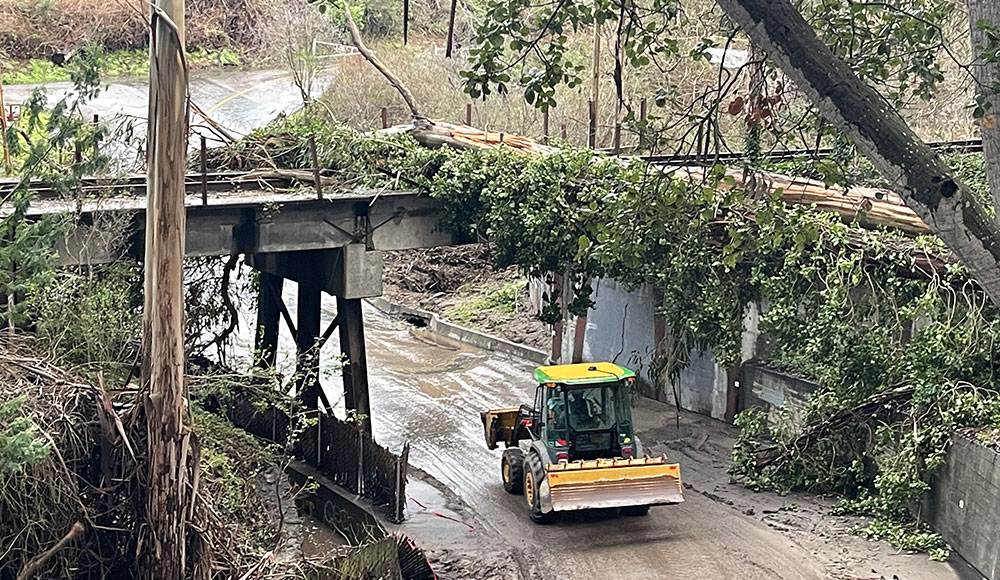
The Santa Cruz County Regional Transportation Commission (RTC) on Thursday approved a plan to develop an interim bicycle and pedestrian trail on segments 9–11 of the Santa Cruz Branch Rail Line from San Lorenzo River in Santa Cruz to State Park Drive in Aptos.
Thursday’s 7-5 vote—which came after a six-hour meeting—means that a temporary trail will be built on top of the existing tracks, as opposed to the “ultimate” design of a trail running parallel to the existing rail line.
Segment 8, located along Beach Street in Santa Cruz, will continue to be developed in the ultimate trail configuration.
The decision fell short of trail-only advocates’ hopes for so-called rail banking, which would have meant removal of the tracks to be ostensibly replaced when funding materializes.
The plan was a combined effort of commissioners Fred Keeley—Santa Cruz’s mayor—and Manu Koenig, who holds the First District seat on the Santa Cruz County Board of Supervisors.
This significant change in direction—County residents in 2022 soundly rejected Measure D that would have required the county to focus on a trial-only model—came after the RTC’s acceptance of the Zero-Emission Passenger Rail and Trail (ZEPRT) Project Concept Report in October, which identified significant capital and operating costs of more than $4.5 billion for future rail service, envisioned as a long-term project for our region.
Those costs have been a significant sticking point in the controversial issue that has divided the county.
Supporters of the rail-trail envision a future of a cross-county passenger rail system that could connect to the Bay Area rail lines and points beyond, as an adjacent trail would allow for walkers and bikers.
But opponents to the Coastal Rail Trail plan point to the astronomical $4.5 billion price tag, which includes replacing rails and several bridges, including the Capitola trestle.
The RTC has also been criticized for paying nearly $575,000 to Raleigh, N.C.-based engineering, planning, and design consulting firm Kimley-Horn and Associates from 2017-2019, and another $640,000 to architecture, engineering, and environmental and construction services to Nebraska-based consultant HDR Engineering, Inc. in 2020-21.
In addition, the RTC has shelled out more than $960,000 in labor costs from 2023-26.
The move away from a rail-trail model was necessary, RTC staff says, to reduce project costs and save grant funding for the Coastal Rail Trail, which otherwise would be eliminated or substantially reduced.
This includes a $96 million state grant that could be rescinded if the state doesn’t begin segments 8–11, from Santa Cruz to State Park Drive in Aptos, by June 2027.
RTC Staff says that estimated construction costs have increased significantly from the original estimate of $500 million, and the previously planned ultimate plan for Segments 9-11 cannot be delivered within existing funding, timelines, and grant requirements.
“Grant funds come with strict requirements and timelines, and failure to advance a buildable project within those timelines could result in the loss of significant public funds,” said RTC Executive Director Sarah Christensen. “The Interim Trail configuration ensures that construction can begin on time, opening the public corridor for near-term active transportation use, delivering grant benefits of enhancing safety, access, and mobility, while maintaining the possibility of future passenger rail service.”
At Thursday’s meeting, the Commission directed staff to continue seeking full funding for the ZEPRT project’s next step, which would be completion of preliminary engineering and environmental review.
The Commission directed staff to return within two months with a proposal to allow the construction of the Interim Trail without the need for adverse abandonment of the freight easement or railbanking.
But the decision does not mean the RTC has abandoned plans for a rail-trail.
The commission also approved a resolution of support for future passenger rail and continued partnership with the Caltrans Division of Rail on Corridor Identification and Development, which aligns with the 2024 State Rail Plan.
“The Interim Trail is designed so that the corridor remains preserved for potential future passenger rail service, consistent with the State Rail Plan and ongoing participation in the federal Corridor Identification and Development (Corridor ID) program,” Christensen said. “This step would also preserve existing freight for the customers being served along the branch line’s southernmost three miles in Watsonville.”
In addition, staff was told to prepare the final design and actions to implement the Interim Trail on Coastal Rail Trail Projects as expeditiously as possible, and additionally requested that staff investigate a design alternative that does not require the removal of the tracks.
Staff will also look into retrofitting the Capitola Trestle for bicycle and pedestrian use either as part of the project already under development or as a separate future project.
For information, visit sccrtc.org.