
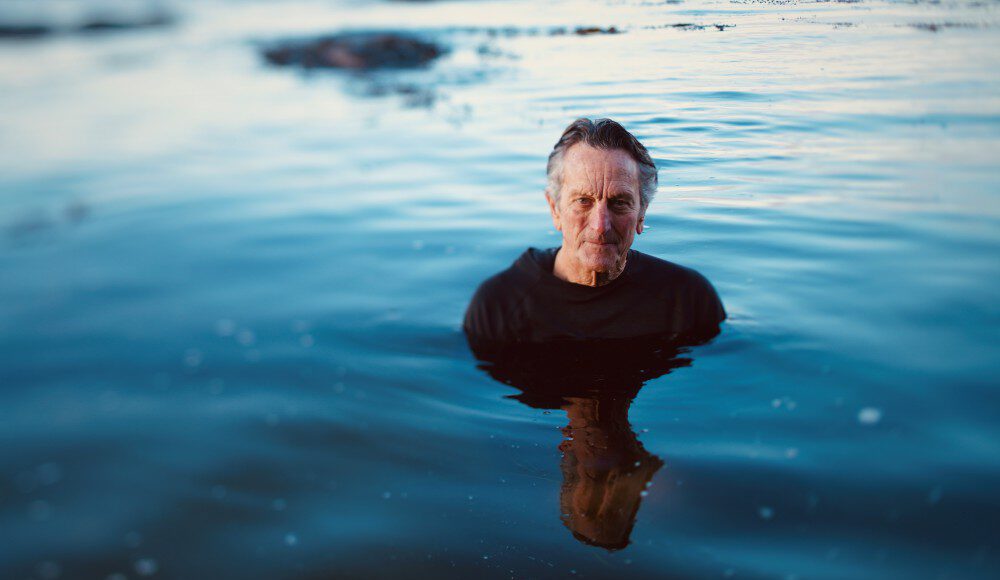
There he is up ahead of me, lanky sentinel of the waves, in a black tee and jeans instead of a wetsuit, padding agilely in flip-flops up steep trails hemmed by wild grass and blackberry and encroaching poison oak. Steve Hawk is guiding me to a geological phenomenon featured prominently in his debut novel, Nearshore, which he’ll be reading from at Bookshop Santa Cruz Aug. 19, and he’s been eager to show me its beauty.
Place is important to Hawk. Where some authors might print a prologue, he included a surfer’s map from the Golden Gate to Davenport Landing. We’ve traced that today, Sunday-driving on a Tuesday along Highway 1.
Hawk introduced his skate pioneer brother Tony to surfing, and was the editor of Surfer magazine and surfline.com. Every time we come to a seascape lookout, he assesses what, or more how, the waves are doing, if they’re quality. Today, they frequently aren’t, which may reflect the precision of his writing: shiny, fleet-footed sentences, and geeky deep dives unveiling history and scientific know-how the way a chef unrolls their knife bag.
“Tide’s a little too high,” he says at Montara State Beach. “See how they’re missing the offshore sandbar, then sort of fading and breaking out on the sand?”
Hawk has a whispery baritone that compels you to lean in. Speaking softly and carrying a big stick, he prefers a 7’4” Trimcraft by Ryan Lovelace, or his shortboard 6’8” Neptune by Shawn Rhodes. Both use 2+1 setups, with an old-school large center fin and two smaller “side-bites.”
Asked if he was stoked or spooked by the New Zealand-powered South swell in June, he regrets his back was tweaked and so couldn’t get out there. In Half Moon Bay it was “about as good as anyone’s ever seen it.”
Our guide in Nearshore is Jamie Palmer, a seen-it-all California State Parks lifeguard and peace officer who isn’t slo-mo running in red trunks because he’s usually already too late to save anyone. He can’t perform mouth-to-mouth because there is no mouth — the fish ate it away. As the closest emergency medical authority on the coastline, he attends to drowning victims, giving him a military vet’s nightmares.
One day, Palmer’s best friend Alexander “Boneyard” Bonnard ends up one of those grisly cases, drawing him into a conspiracy with an enigmatic billionaire and an army of white nationalist doomsdayers, using homegrown nuclear weapons as a cudgel in the culture war.
Hawk admits Palmer is “vicarious fiction.” In terms of board skill, he’s “way gnarlier than me. The surfer I wish I was.”
Palmer’s also gnarly by trade: California State Parks is one of the few agencies training its lifeguards to carry firearms, making Palmer a cop-who’s-also-a-lifeguard, like the noir detectives of old. But our hard-boiled gumshoe, unlike Marlowe or Spade, is happy to delegate, even when it comes to the narrative itself — we don’t stay solely in Palmer’s POV. Almost every character gets their chapter.
“Gun on my hip like some Texas sheriff” is a line that tips its Stetson to Hawk’s main inspiration for Nearshore: McCarthy’s No Country for Old Men. Specifically, the italicized incursions by Sheriff Ed Tom Bell. The third-person omniscient for the tense action gets ventilated by Bell’s brief “as-told-to” monologues, in what Hawk calls his “thick, lovely West Texas patois.” Hawk thought this format could open the “lockbox” of his main character of few words.
Hawk doesn’t have that problem. Watching him interact, I think he might be the secret Mayor of Half Moon Bay – not from the way he carries himself, but from the way he animates people: the park ranger manning a gate; the surly woman standing sentry for a beach lot; the surfers shedding their wetsuit skins on the back bumpers of their cars; Brian Overfelt, elated that the Old Princeton Landing Public House & Grill he owns with his brother is the site for a post-paddle out memorial feast in the novel. “Bottom of page 71, baby!”
Weeks from his 71st birthday, Hawk doesn’t feel the cold any more than he used to, but these days he rarely surfs long enough to get cold. The first time he stood up on a board was five years old at Mission Beach, San Diego, where he was raised. While I was learning to surf in 1998, he was at Surfer, and he rattles off Santa Cruz surfers he would’ve covered at that time.
“Rodent. SkinDog. Flea. Ratboy. Condor. All the vermin,” he says, laughing.
Perched like Palmer and Boneyard at Kelly Avenue, “ground zero for surfers in winter,” he and his best friend Kevin could spot those who were going to get into trouble. “Almost every surfer around here has had reason to pull someone out of the water,” says Hawk.
He credits writer and “dear friend” Kem Nunn for doing that for him, tapping him for a writers’ room gig on HBO’s John from Cincinnati TV show that “changed my life.” Hawk learned under gifted small-screen scribe David Milch, known for the critically lauded Deadwood and NYPD Blue, and whom he came to call a mentor.
Nunn originated the “surf noir” genre with his novel Tapping the Source, followed by ones Hawk reveres more, Dogs of Winter and Tijuana Straits. Hawk seems ambivalent about having the label applied to Nearshore. He sees copycats misunderstanding the tenets, oversimplifying it to “pairing the lovely pastoral aspect of surfing with shocking, grotesque violence.” Well-regarded mystery novelist Don Winslow attempted it in his Boone Daniels series but committed the ultimate sin: “Surfing was peripheral.”
In Nearshore, for which Nunn gave “invaluable notes,” it’s at the very core. Knowledge of secret surf spots becomes a pivotal plot point. A love interest is compared to former surf champion “Rell [Kapolioka’ehukai] Sunn in her prime.”
Those notes included centering the relationship between Palmer and Boneyard’s adopted son, Luca, so that Palmer’s daredevil nature is in tension with his desire to protect him. There’s a steady drumbeat in the novel: “Palmer keeps his promises.” That’s a promise that appeals to Hawk, who adopted a son, Cameron (32), with his wife Pamm, with whom he also has a biological son, Wilson (34).
Hawk lived 1,500 to 3,000 words at a time, intimidated by novels’ size until landing a longform journalism gig in the ’80s with the Orange County Register. He profiled “Paul,” a high schooler with Down syndrome in a district program helping people like him get mainstream jobs to deisolate them. Hawk followed Paul for six to eight months around his other assignments: at school; the first day he trained at Carl’s Jr.; when the clerk counted out the cash for him from his first $27 paycheck; when he proudly walked into class in his uniform and everyone high-fived him, that star on his chest like a sheriff’s.
At Half Moon Bay Airport, Hawk indicates where a hangar featured in the novel’s climax is now a concrete slab. I see a writer disappointed that the reality they took pains to capture no longer matches their fiction. Verisimilitude matters to him, so to “inoculate himself against critiques from experts,” he prepared for Nearshore two ways: by doing ride-alongs with state lifeguards who cover from Devil’s Slide to Santa Cruz, so that when Palmer checks his lanyard or clicks his headset, it’s correct; and by speaking with authorities on nuclear technology.
It’s at Martin’s Beach where we talk nuclear turkey, fitting because we’re the only souls there, and together with a row of boarded up beach shacks gives the unshakeable feeling we’re wandering across some fallout-forsaken, if gorgeous, expanse. It’s the “sharkiest” beach in Hawk’s opinion, and it’s not the giant fin-shaped rock rising from the water, or that he’s ever seen one while surfing there.
“You just feel like you’re in the food chain,” he says as we pass an old hamburger stand.
Sure enough, out past the shacks we find a couch cushion-sized chunk of blubber from some poor pinniped or cetacean. The sun had roasted it golden and almost scentless, spilling off the rocks like molten marshmallow. From there we turn to the subject of yellowcake.
A 90-minute Zoom call with science historian Alex Wellerstein “changed everything.” Hawk had assumed the hard part about making a nuclear bomb was its construction, but Wellerstein insisted that’s just high-level fabrication — “the hard part is purifying the uranium or acquiring the plutonium so that you have fissile material that will chain-react.”
Wellerstein had created NUKEMAP, a nuclear impact simulator website with an astonishing level of detail. Hawk could place his marker on the map, select airburst or surface detonation, set the warhead yield manually or with presets such as “North Korean weapon tested in 2006,” and it would give him everything from the fireball radius to the fatality estimate.
The site brags: “401.1 million detonations and counting!”
Gumshoe Palmer brings his dame to a cave at Bean Hollow full of tafoni, a “vast alien web of honeycombed rocks,” but it’s high tide so Hawk improvises an alternative, bringing us to a stonelace formation against a cliff face. It’s as breathtaking as he and Palmer promised, like I’m trekking in the ruins of some titan’s brain.
“I can’t write an outline,” Hawk says. “I have to find it as I go.”
You can go and experience Steve Hawk’s fiction at 7 p.m. on Aug. 19 at Bookshop Santa Cruz, 1520 Pacific Avenue, Santa Cruz. Admission is free, but RSVP at bookshopsantacruz.com/steve-hawk. The event is co-sponsored by the Save The Waves Coalition.