

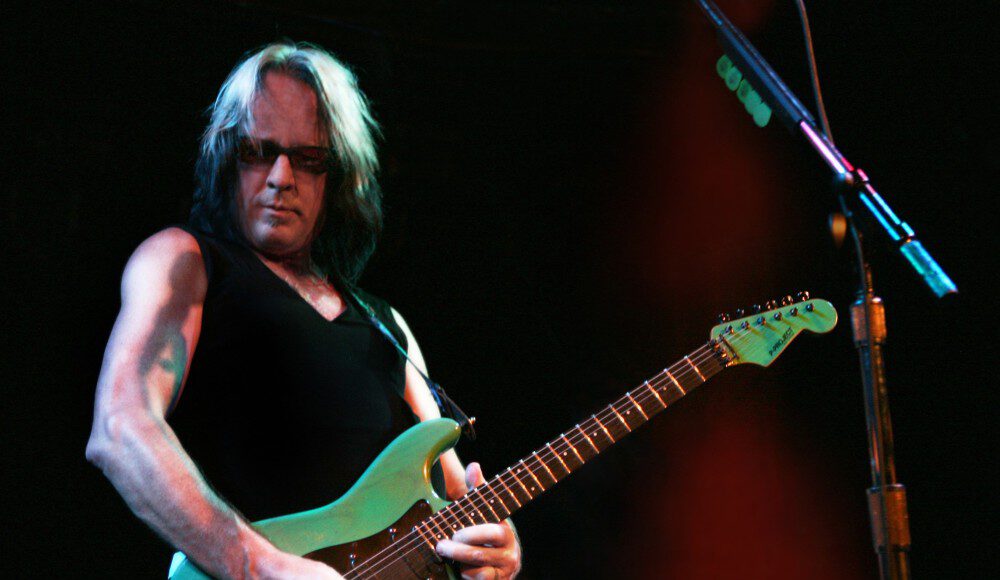
Todd Rundgren found me in Trader Joe’s. His early hit, “We Gotta Get You a Woman” was playing—one of those Trader Joe songs that I knew before I remembered why.
A mythical figure in rock for more than half a century, Rundgren’s hits as a singer, songwriter and producer could furnish several musicians with respectable careers, but that afternoon he was simply a familiar voice amid the frozen foods, bringing back a little of my younger life.
That one song brought others to mind — “Hello It’s Me,” “I Saw the Light,” “Can We Still Be Friends.” I wondered how many younger shoppers knew those songs, too, without knowing the voice belonged to Todd Rundgren.
For me, they came with half a century of memories attached. For someone else, perhaps, they were simply good songs still finding their way into a life—or familiar echoes of a time they could only imagine.
Could a song from my youth become a touchstone for theirs, something they’d hear 50 years from now and suddenly remember who they were?
Rundgren’s return to Santa Cruz on October 22 offers both generations a chance to encounter an artist still finding new ways to play familiar music. With a musical reach that stretches from soulful pop to progressive rock and stranger places beyond, he gives longtime fans and curious newcomers plenty to love—and plenty to discover.
Ahead of his Rio Theatre appearance, we talked about singing, songwriting and the restless curiosity behind his music. His answers were candid, funny and thoughtful, with insights that reach well beyond the recording studio. First, though, I had a rock ‘n’ roll rumor to run past him.

This interview has been edited for length and clarity.
John Koenig: I heard this story—is it really true? Do you remember a show at CBGB in the ’80s where you pulled out some scissors and cut off your hair? Did that happen?
Todd Rundgren: No, the New York scene acts that I knew about, like the Dolls and Patti Smith, were playing there, but I never played CBGB. I have shaved off a beard in front of an audience, but cut my hair? No, that’s too precious to me. If there’s one thing I’m vain about, it’s what little hair I have!
John: Is there something in this show that you’re really excited for audiences to experience?
Todd: The thing that pleased the audience even more than I expected was the acoustic part of the show, and I understand why. I mean, it’s quieter for a change! I think that’s partly the point of it: you don’t have all of that racket. The drums can cover up a lot because they’re a big sound—low frequency, high frequency.
And we get to do a lot of fan favorites in a different way. I enjoy doing things differently than they were originally done if there’s a way to change things up a little.
I haven’t done an acoustic set in a while, because playing with the band frees me up not to play the guitar. For an acoustic show, I have to accompany myself the whole time, but I think people enjoy hearing it.
John: I’m surprised to learn that originally you didn’t consider yourself a singer.
Todd: Most people decide to be a singer at a young age. But I was not confident enough for that. I could sing, I could keep a tune, but I didn’t consider myself qualified to front a band.
After Nazz broke up, I realized that if I was going to write material that was personal, about my thoughts and feelings, I had to learn how to deliver that.
I could do that in the studio, with time to take a big breath, hit the high notes and punch them in. But when you do a performance, you’re singing constantly. I couldn’t get through 15 or 20 minutes of a live show. I didn’t have the stamina. That took a while to develop.
I enjoy the singing now, whereas before I dreaded going onstage and having to sing for 40 minutes, which I could barely get through.
John: When did you realize you had your own unique voice, distinct from your influences?
Todd: Almost all artists are a product of their influences. It’s your limitations that keep you from sounding exactly like somebody else. So that’s kind of a good thing: working within those limitations while aspiring to the style or delivery another singer might have, or wishing you had the same pipes.
I’ve always wished I had the range of Stevie Wonder, but I will never have that. I learned other things from Stevie, like how to breathe. I tend to sing in a higher range, and that’s the influence of R&B—the urgency in the singing—it’s got to sound like you’re really putting yourself into it.
That comes from the blues and African music, field hollers, and, to a certain extent, grand opera, because traditionally they had no amplification. The voice is strange sounding in a way because it’s got to reach the nether parts of an opera house. At the same time, it’s that full commitment that puts the drama in opera, that makes the story more believable. The singers aren’t just singing loud; they’re singing with a degree of emotion as well.
John: Having written songs in different styles, when you get an inspiration, do you think, “This is an R&B song,” or, “This would be great for Utopia”? How do the inspirations present themselves?
Todd: I don’t think of genres, like, I need this or that kind of song. The bigger challenge is not to have it all sound the same—with lyrics about the same thing and similar structures and changes.
You naturally want to play with any of the styles you’re comfortable with. Then there’s always the challenge of trying to absorb or cultivate new influences you haven’t really taken advantage of.
John: I wondered, are you receptive to outside influences, or do you try to screen them out?
Todd: No, I have a natural filter in terms of what I want to hear and what I don’t. It doesn’t necessarily reflect what the popular meme is. I grew up in the ’60s, and what was happening then—principally the Beatles—is a seminal influence.
But I was thinking the other day how the music of the ’90s was, to me, the last big adventure, when people were experimenting with different combinations of styles. We tend to think of it as the age when grunge supposedly was ascendant, but that opened things up to a whole lot of other weird and interesting experiments.
Oddly enough, the most prevalent survivor of that whole thing is Green Day, and they were just imitating music of the ’70s. It’s weird that that survived.
It becomes more difficult as time goes on to find new influences. It’s especially difficult nowadays if you follow what’s popular. If Saturday Night Live is any indication of that, I have no interest in what’s popular nowadays. So I have to find more obscure stuff, I suppose, to be influenced by.
Every once in a while, a record sounds new and original, and I’ll wonder why and probably try to find some influence in that. That Bon Iver record where it was all about different cities had such a different sound, interesting combinations of instruments and approaches. The singing was an interesting style. I listened to that record a lot and probably absorbed some part of it.
John: Your songs have been covered by so many artists. Do you have a favorite?
Todd: I think the most ironic one is the Isley Brothers’ version of “Hello, It’s Me.” It was definitely not like one of those burning funk numbers they usually gravitated toward. The arrangement was way beyond anything I would have done, like a Disneyland soundtrack or something. A generation of people thought that was the original version, and I was just a copycat.
John: Do you ever call artists you’ve never worked with and say, “Hey, let’s get together and do something”?
Todd: I have done that on my recent records. Space Force and White Knight were both collaborative records where I invited other artists to participate.
The internet and file sharing make that possible. Living on Kauai, it would have been prohibitive, me just calling someone and saying, “Come on over, and we’ll mess around in the studio.”
John: But you got Daryl Hall to Kauai to perform “The Last Ride” with you. The YouTube video is so good.
Todd: That was fortuitous. They were on the way back from Japan and thought, “Why don’t we stop here?” It turned out to be quite memorable.
John: Do you have rituals or habits that get you into a creative space?
Todd: I depend on my subconscious to give me ideas, so the most important thing is to get some solitude and cut off any interruptions to set that loose. When I had a house full of kids and potential interruptions, I rented a little cottage with quiet enough to get the process started. Now it’s a little easier, if I can detach from the other things that concern me during the day. In a way, that’s as difficult as finding proper solitude.
Todd Rundgren performs Thursday, Oct. 22, 2026, at 8pm at the Rio Theatre, 1205 Soquel Ave., Santa Cruz. Doors open at 7pm. Tickets: $62 general admission, $82 Gold Circle; pulseproductions.net.
A Young Person’s Guide to Todd Rundgren
Know the name but not the music? Here are eight doors into Todd Rundgren’s world. Headphones encouraged; youth optional.
- I Saw the Light — Start here. Three minutes of sparkling pop, with a melody that seems to have been waiting for you to discover it.
- Hello It’s Me — You may know this one without knowing you know it. Warm keyboards, an unmistakable voice and the complicated business of letting someone go.
- Can We Still Be Friends — A breakup question almost everyone eventually asks, wrapped in a tune almost unfairly lovely.
- A Dream Goes on Forever — A small, shimmering heartbreaker. For anyone who has kept a dream alive long after reality stopped cooperating.
- Just One Victory — An anthem for getting back up. Listen as its layers of voices turn private discouragement into communal resolve.
- The Want of a Nail — Rundgren and soul great Bobby Womack raise the roof. If you’ve filed Todd under “gentle singer-songwriter,” this should rearrange the cabinet.
- The Ikon — Utopia — Ready to leave the three-minute pop song behind? This half-hour prog expedition hurtles through shifting rhythms, towering keyboards and guitar fireworks. Genesis and Yes fans: make yourselves at home. (Final track on the linked album.)
- The Last Ride — with Daryl Hall — A slow-burning beauty, with soulful vocals and a guitar part that has plenty to say of its own. This performance with Daryl Hall lets you watch two extraordinary singers savor the same song.