

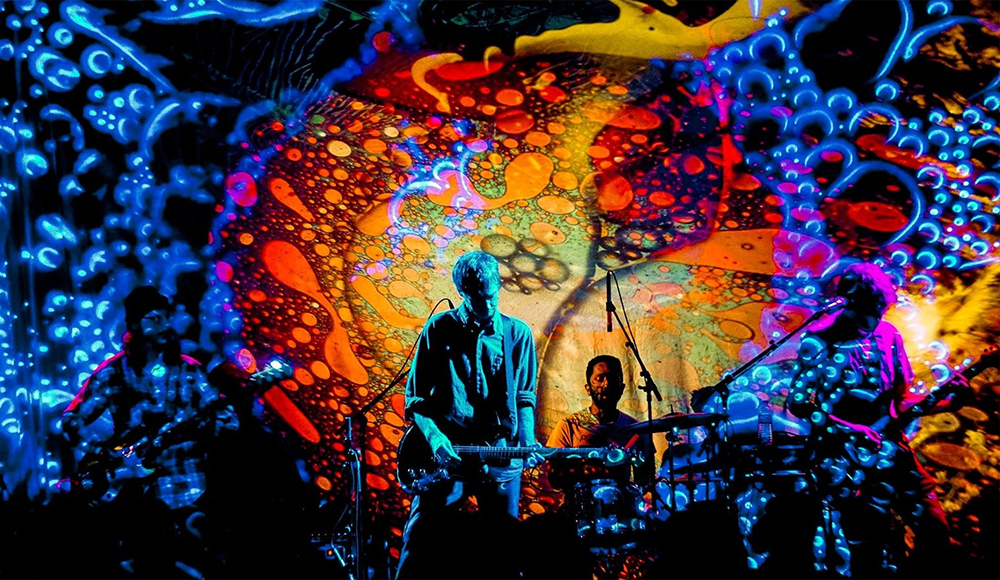
Founded more than 20 years ago in San Francisco, LSD and the Search for God have cultivated a following organically, almost by accident, in fact. They’ve carefully curated their engaging psychedelic-meets-shoegaze sound through live performances and a remarkably slim volume of releases. The group kicks off an eight-city tour with a show at The Catalyst on January 15.
When Andy Liszt launched LSD and the Search for God with fellow guitarist Chris Fifield, the band’s vision was straightforward, he says: “Let’s put these songs together and do this.” As quickly as their second gathering, things clicked.”Something special was happening,” Liszt says. “It felt really magical, and it was really fun to play.”
Inspired both by the swirling psychedelia of late ‘60s rock and by that style’s distant relative of ‘90s shoegaze, the group developed a set of original material and began playing in and around the Bay Area. The band’s lineup would remain fluid for many years, with members coming and going; some 17 musicians have counted themselves as members at one time or another.
Some have even left and returned. “There was a short time when Chris was not doing shows,” Liszt says, but at present both guitarists and ethereal vocalist Scarlet Levinson form the core of the group. “We’ve had wonderful band members who are great musicians,” he says, “but the band right now is as on-point as any [lineup] we’ve ever had.”
Shoegaze – the melodic yet droning, wall-of-sound rock style characterized by heavy distortion, extreme volume and vocals that melt into the mix – enjoyed its heyday in the first half of the 1990s, primarily in the UK with bands like My Bloody Valentine and Slowdive. The style fell out of favor as grunge became popular. Some of its leading lights broke up, lost their record deals or changed their musical approach to explore other horizons. But the story wasn’t over.
Liszt observes that shoegaze has once again taken hold with a younger set of fans over the last four or five years. “I think Covid, TikTok and Reddit played a big role in that,” he says. “Think about it: being an 18-year-old, all you want to do is not be around your parents. You want to be with your friends, see new [live] music, try new things. And all of a sudden, the whole world is shut down, and where are you? At home with your parents. There’s no music to go to. Your graduations are canceled. You can’t go on dates.”
Faced with limited options, many turned to their computers and the Internet. “They found their own way of creating meaning in their lives,” Liszt says. “They went deep, and [shoegaze] really seemed to speak to a lot of them.”
But the original wave of bands in the style had long since come and gone. Their back catalogs were certainly available for listening, but when it came to current shoegaze bands, LSD and the Search for God was one that stood out. By that point the group had been together for many years, and had already released both of its records, a self-titled 2007 EP and 2016’s Heaven is a Place.
When it was safe to gather en masse again, LSD and the Search for God – which had been forced to cancel a European tour twice because of the pandemic – returned to the live scene. “But even at the beginning,” Liszt says, “people were expressing how interested they were in the band, how much our music meant to them and how it spoke to them.” He says that that level of intensity among fans hasn’t changed over the years. “What has changed,” he says, “is its scale. And we’re thrilled about that.”
Liszt marvels at resurgent appeal of shoegaze, emphasizing that it’s a movement larger than his group’s fanbase. He cites the example of Panchiko, a like-minded band from Nottingham, England that caught on via chatter on Reddit. “They had pressed up something like 20 CDs, got one song on a compilation, and that was it.,” he explains. Fans online somehow discovered the album, and it blew up. “Suddenly they were playing a 300 capacity venue, then a 500 cap.” By the time Panchiko shared a bill with Liszt’s band at the Warfield in 2023, they could fill a 2000-capacity venue.
Andy Liszt concedes that the kind of music his band makes can be an acquired taste. “We’re not trying to be McDonald’s,” he says. “For someone who hasn’t been introduced to this style of music, it’s new; it doesn’t make sense in someone’s schema right away. There are layers to it that unfold and become available [to the listener] ovAer time.” Liszt also believes there’s plenty left to say within his chosen musical idiom. “It’s interesting to see what other influences have been brought into a genre that’s 50 years old,” he says. “And it will continue.”
LSD and the Search for God with 60 Juno, The Catalyst,Thursday, Jan. 15, 9pm
$37.31