

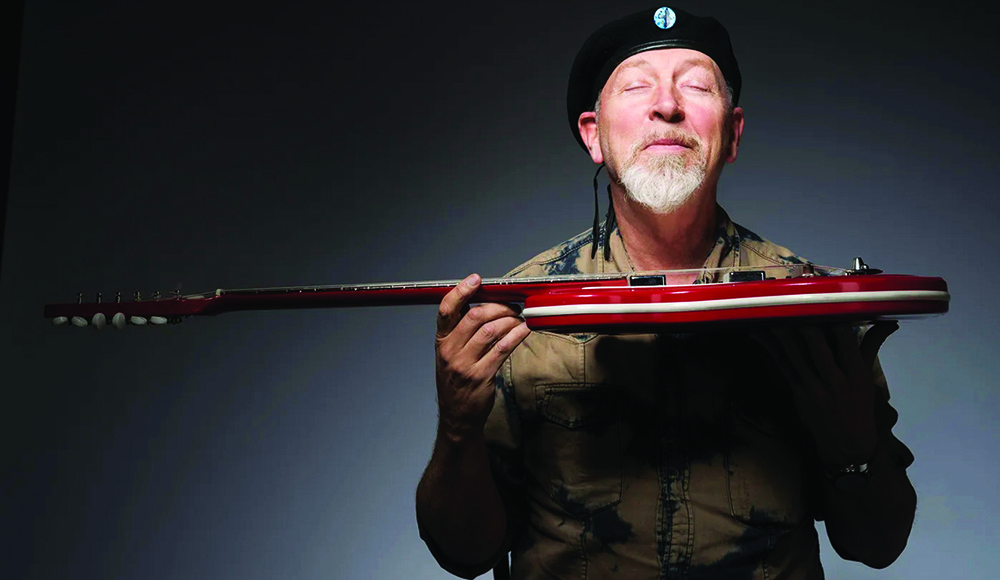
Some musical artists are studio rats. Decades apart, the Beatles and XTC quit touring mid-career, cloistering themselves away in the studio and arguably creating their best work. Other artists abandoned studio work altogether, focusing solely on live performance: the Moody Blues, Eagles, Guns N’ Roses and Fleetwood Mac are some of the most well-known examples.
Richard Thompson stands apart from both extremes, focusing on records and live concerts. The British guitarist extraordinaire came to prominence as a founding member of Fairport Convention in 1967; after leaving that group, he embarked on a creatively fruitful and prolific career as a solo and collaborative artist. Ship to Shore, his latest release, is solo album No. 47, and that’s a rough estimate. Richard Thompson comes to the Rio Theatre on April 5.
Not only does Thompson release new music with alacrity, but he tours frequently as well. And he believes there’s a strong relationship between studio and live work. Everything he records in the studio is designed to be performed live, he says. Thompson chuckles and explains that he doesn’t have “the Sgt. Pepper mindset” in which the songs can be decorated with all manner of instrumentation, free from the worry of how a complex arrangement can be put across onstage.
Yet Thompson doesn’t limit himself while recording; if he has a good arrangement idea that simply can’t be reproduced live, he’ll do what works. He provides an example from upcoming album No. 48, set for release in September.
“We have a four-piece, Salvation Army [sort of] horn section,” he says. “Now, I’ll never be able to afford to have those guys along on the road, as much fun as it would be.” His solution? “We’ll paper over the cracks,” he says with a smile. “I don’t think you’ll miss it.” And he doesn’t skimp on getting things right in a concert setting. “Live performance is my main focus,” he says.
When it comes to studio work, Richard Thompson is decidedly old-school. While asking about his recording methods, I make the mistake of referring to past methods when studios used magnetic tape rather than computers; Thompson stops me cold. “Isn’t there tape?” he retorts. “I’ve never done a record not using multi-track tape.”
Of course, digital technology figures into the final stages of record-making. “It all ends up digital anyway,” Thompson concedes. “You end up with a CD.” But he values the warmth of analog recording methods using vintage equipment. “People will drop by the studio and ask, ‘What’s that smell? I recognize it.’” It’s the distinctive scent of warm magnetic tape running through the machine. “My god,” one of Thompson’s studio visitors once replied. “I haven’t smelt that for 20, 30, 40 years!”
Thompson admits that his approach isn’t the prevailing one in 2026. But he knows what he likes, and the results of his creative choices speak for themselves. “I have a hard time listening to electronic music, or to music that uses a lot of samples,” he says. “I just find the texture really irritating.” Even though technology has advanced to introduce a bit of variance, for Thompson, sample-based sounds are too stiff and lifeless.
“You get someone playing a bass drum live as you’re recording,” he explains. “It’s different every time they hit the drum: different intensity, different overtones, different undertones.” Those variations are what makes the music breathe. Samples, in contrast, become very narrow in the digital recording process, he says. “Call me an old fuddy-duddy, thank you very much indeed. But I just like the sound of musicians playing music.”
What some artists might consider a sonic bug is a feature for Thompson. “Sometimes, you really want two people singing on the same mic, because you get that intermodular distortion, that Everly Brothers kind of thing happening,” he says. “Recording in the same room at the same time [results in] instruments spilling down over other microphones. I love all that, and we aim for that when we’re recording.”
Thompson’s prolific nature has yielded work of a consistently high standard; it’s rare for one of his albums to earn less than a four-star rating from outlets like allmusic.com. And his backlog of material is so deep that when a well-received collection of previously-unreleased material, RT: The Life and Music of Richard Thompson was released in 2006, the music filled five compact discs.
“At some points,” he says, “I think, ‘Well, I’m not really motivated to write right now.’” But many other times, when he sits down to write, “the stuff just comes. It just… appears.” Thompson recalls that when he came out of COVID-forced isolation, he had amassed three albums’ worth of new music. “A lot of it, I haven’t even recorded yet,” he says.
And while Thompson is a gifted composer, improvisation is a major part of his creative process as well. “I try to write songs that may have room for me to improvise within them,” he says. “Songs that will show off whatever I can do: the voice, the guitar.” So while constructing a good song is paramount, Thompson says that “as a songwriter, I do try to favor my strengths.”
Over the years, many of Thompson’s concert tours have been built on a theme. One of the most celebrated was his early 2000s run of dates celebrating “1000 Years of Popular Music.” Asked if this current tour has a theme beyond supporting Ship to Shore – or perhaps the upcoming new album – he grins broadly and says, “If there isn’t one, I’ll pretend there is.”
Richard Thompson with Zara Phillips, Rio Theatre, 1205 Soquel Ave, Santa Cruz Sunday, April 5, 8pm Tickets: $35, general admission/$48 gold circle