On a warm July evening, I found myself seated at a brew pub picnic table as two-time Guinness World Record holder Shawn Dollar took the makeshift stage to share a heart-wrenching story. Known worldwide for his achievements in big-wave surfing, Dollar described the life-changing injury that brought his career, and life as he knew it, to a sudden halt.
In 2017, during a solo trip to Big Sur, a routine cliff dive nearly turned tragic, sending him headfirst into an underwater rock. Somehow, Dollar pulled himself from the surf and made his way to the emergency room on his own. There, he learned he had broken his neck in four places.
Dollar was competing with beer, pizza and friendly conversation that evening, but as he described emerging from the accident with a life he barely recognized, the audience grew quiet. An elite athlete accustomed to pushing his physical limits was suddenly struggling with pain, cognitive issues and the loss of the identity that had defined him.
Fortunately, the tale has a happy ending. Dollar’s arduous healing process included a visit to the Amen Clinic in San Francisco, where Dr. Amen conducted a brain scan and offered a treatment plan to address an otherwise bleak diagnosis.
By this time I was on the edge of my seat. Dollar credited hyperbaric oxygen therapy (HBOT) with much of his recovery. I recently reached out to Dollar, now fully recovered and a staunch HBOT advocate.
HBOT involves breathing nearly pure oxygen inside a chamber pressurized above normal atmospheric pressure. Under these conditions, the lungs take in significantly more oxygen, increasing the amount carried through the bloodstream and delivered throughout the body.
“The first time I did HBOT I felt a huge improvement,” Dollar states on his website. “I could think more clearly, I was faster mentally and just felt better overall.” His history of heavy wipeouts and accumulated “minor” concussions ultimately led him to undergo more than 80 treatments.
HBOT has strong evidence for a fairly specific group of medical conditions. But as the technology moves from hospitals into wellness centers, it’s increasingly promoted for longevity, neurological conditions and general health, areas where evidence is still emerging. Yet local centers offering the technology have compelling stories to tell.
At Santa Cruz CORE, founder Jaimi Jansen says clients range from young children to seniors. “We had one patient who was going blind, and HBOT helped her eyes heal and saved her sight,” Jansen says. She has also seen clients use it to support wound healing after injuries and radiation treatment for cancer.
Beyond those applications, Jansen says clients seek HBOT for traumatic brain injuries, Lyme disease, athletic recovery and general wellness. CORE’s stem-cell patients also use the chamber prior to harvesting in hopes of improving stem-cell yield.
“It’s a simple thing to do,” she says, “to optimize your health or heal from an injury.”
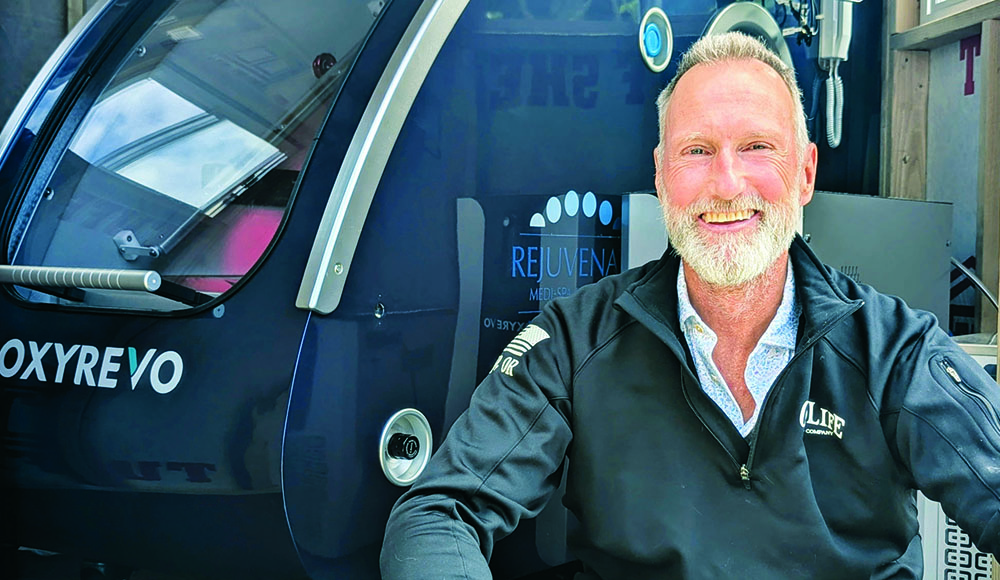
Dr. Jay Pennock, founder of Capitola-based Rejuvenate Medi-Spa and Wellness Center, is equally enthusiastic. He recalls a patient who arrived shortly before a long-awaited trip to Bora Bora following extensive cosmetic surgery. Several wounds had failed to close, leaving her worried she wouldn’t be able to swim.
Pennock suggested daily hyperbaric treatments for the eight days before her departure. “Every one of her wounds closed to the surgeon’s satisfaction,” he says, allowing her to get into the water on vacation.
Pennock explains that HBOT increases the oxygen dissolved in the blood beyond what red blood cells normally carry, which can be useful in swollen or damaged tissue where circulation is compromised. Increased pressure helps reduce swelling, while oxygen dissolved in plasma can reach areas where red blood cells may have difficulty circulating.
“You decrease swelling and increase oxygen delivery,” says Pennock, who recommends HBOT before and after certain surgical procedures to support healing.
Not every hyperbaric treatment is the same. Pennock says the therapeutic “dose” depends on time in the chamber, oxygen concentration and atmospheric pressure. He’s also interested in HBOT’s potential role in regenerative medicine, sometimes combining it with peptides and stem-cell therapies to support the body’s natural repair processes.
“It works through the body’s natural processes,” he says.
What HBOT Is Proven to Help
While increasingly marketed for wellness and longevity, HBOT has long been used in conventional medicine. The FDA and Undersea and Hyperbaric Medical Society recognize its use for specific conditions, including decompression sickness—the “bends” experienced by divers—certain nonhealing wounds, radiation-related tissue damage, compromised skin grafts and flaps, and some severe crush injuries where blood flow and oxygen delivery have been impaired.
The key word is adjunctive. HBOT isn’t intended to replace conventional medical care. Instead, it works alongside treatments such as surgery, antibiotics and wound care, helping oxygen reach damaged or oxygen-deprived tissue and supporting healing.
For Dollar, there’s little question where he lands on the help-or-hype debate. After an injury that left him facing an uncertain future, he happily credits HBOT as an important part of finding his way back.
Learn more about: Shawn Dollar at ShawnDollar.com
Santa Cruz Core Fitness and Rehab, SantaCruzCore.com
Rejuvenate Medi-Spa & Wellness rejuvenatemedi-spa.com
Elizabeth Borelli a wellness writer, author and Mediterranean Lifestyle for Longevity expert. Learn more about her work, local events and access free recipes at ElizabethBorelli.com