
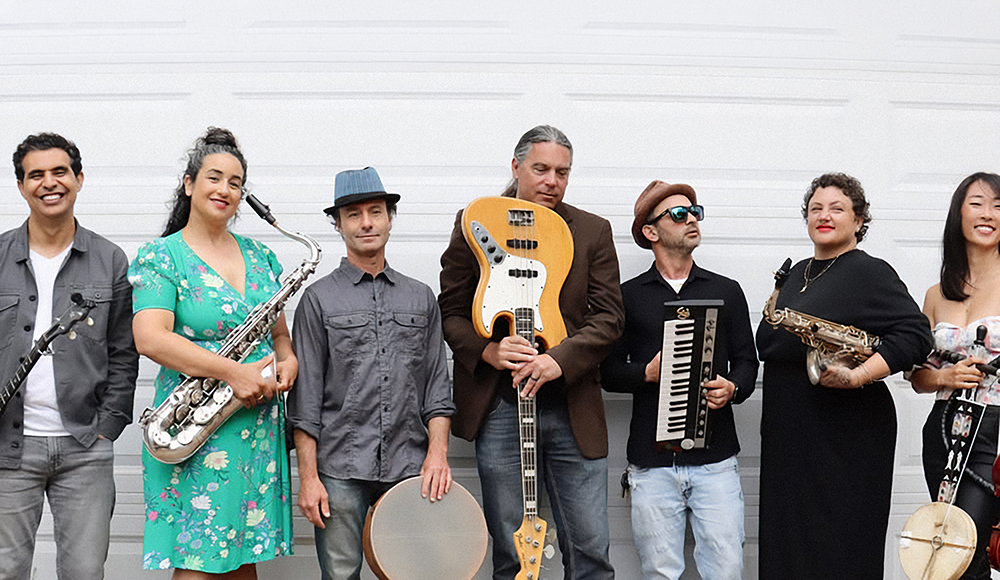
UC Santa Cruz’s Center for the Middle East and North Africa (CMENA) hopes its free concert at Woodhouse Blending & Brewing Friday can showcase a part of the world that doesn’t get enough attention and help save languages at the university.
This upcoming concert is an evening with Santa Cruz artists AZA, who fuse North African musical traditions such as Ahwash, Rwais, and Gnawa with contemporary global influences.
Lead singer and banjoist of AZA Fattah Abbou, a dual American and Moroccan citizen for 20 years, performs in his native Tamazight dialect, and uses it to describe what it’s like touring in these fraught times.
“Tsemmum,” he says.
“Sour” in English, here it means closer to disequilibrium. Abbou says people worldwide had operated on a belief in “classical politics,” that leaders could be relied upon to act with “sobriety and decorum.” He fears the American shift toward treating essentials like education and healthcare as “commodities.”
“If you’re educated and healthy, then you can innovate,” he says. “You can move a nation forward.”
Professor Muriam Haleh Davis, the director of CMENA, hopes the show will help bolster support for the interdisciplinary center.
“The countries that used to be colonized by France – Morocco, Tunisia, and Algeria – are often, for somewhat problematic reasons, studied as a unit,” she says.
“In the Anglophone academies or in the U.S. and UK, when people do the Middle East, they focus on Egypt, Palestine, Iraq,” she says. ‘“All areas strategically important for the U.S. during the Cold War.”
Instead, Davis was “delighted” by the holistic possibilities in UCSC combining them.
“It’s really rare to have this cluster of colleagues with similar interests who work on the Middle East and on the Maghreb,” she says, meaning western and central North Africa.
The humanities are “under siege,” said historian Helena Rosenblatt on The Ezra Klein Show.
“Given that federal funding for Middle East studies has been completely cut off, it’s a pretty delicate time to keep the center running,” says Davis, in her second year fronting the program, which started in 2019.
Davis is grateful to Woodhouse for hosting the event for free.
Two recent CMENA teamups with the Film and Digital Media Department, screenings with panel discussions, were so popular that they filled their hundred-person cap and turned an unknown number away.
The first examined the ramifications of surf tourism on Morocco and gentrification in surfing at large, with input by Moroccan activist Soufiane Belmkaddem of Black Surf Santa Cruz.
The second concerned revolutionary thinker Frantz Fanon, born on the French colony of Martinique and serving in the Algerian Liberation Front, whose written works inspired Oakland’s Black Panther Party.
“When I was in graduate school,” Davis says, “I decided I wanted to study somebody else’s colonial past. Working on my own was, I felt, too close to home.”
Her mother came from Northern India, and her family now lives in Pakistan, so Davis’s mother tongue was Urdu. But she’s fiercely protective of other mother tongues. She watched Farsi be cut last year at UCSC. Arabic is conceivably next.
“For many students from the region, having either Arabic or Farsi has been really meaningful given their feelings of isolation and grief, especially after October 7th, and now the war in Iran,” Davis says.
If those cuts feel ideological, the German language classes had the same fate. What was pandemic became perennial, with the University of California system joining schools across the country embracing online education as a cost-saving measure. Languages are bearing that shift.
Launched in fall 2025 by UC humanities deans, the Global Language Network initiative consolidates language instruction online for UC students to take remote courses via any UC campus on “less-taught languages” before it expands to include all. According to their website, this will facilitate “global citizenship, deeper cultural understanding, and academic pathways that might otherwise remain out of reach.”
The rollout has so far been glitchy, with low enrollments and missing courses needed to ensure continuity of instruction. At least one professor received a Notice of Dismissal before their language was officially cut.
Davis’ faculty group is wary that moving language learning online is not being decided on a case-by-case basis, and assumes all languages can be learned the same way.
“If anybody’s ever tried to learn Arabic online, it’s a disaster,” Davis says.
The right-to-left script is notoriously difficult. But mastering pronunciation is an awkward stage, she argues, especially one with complex guttural sounds, and requires an instructor’s warm hand.
Glowing student testimonials for Arabic professor Abdelkader Berrahmoun make clear that’s the kind of safe environment he fosters, impossible in the micro-delayed void of Zoom.
Like the Sciences, “language just needs a small group of people in a room together to build camaraderie,” Davis says. “Certain flagship campuses like Berkeley and UCLA will continue to have in-person instruction.”
Her faculty group has drafted a request in the Academic Senate to devise a funding model that protects languages at UCSC. The faculty union has issued a letter expressing discontent with the cuts and with the subsequent increased workload and undermined shared governance.
At this rate, Davis says, “there’s a possibility that Hebrew, funded by a variety of endowments, will be the only language taught at UCSC for Middle Eastern studies next year.”
Lydia Barrett, a South Carolinian sixth-year PhD candidate in Cross-Cultural Musicology, says this would be “an enormous disservice to the course of study.”
“At the center we support folks interested in a Middle Eastern North African minor,” she says. She sees language as an essential ingredient to education, when “learning about a place” alchemizes into “becoming part of a place.”
Davis says there are plenty of themes connecting the region CMENA covers to California and Santa Cruz, even if it can feel like “this very far away, random, and irrelevant place.”
Abbou says the kinship gets uncanny.
He’s always seen Essaouira, near where he grew up, as a “sister city” to Santa Cruz for its surfers, music, art, and “progressive vibe.” But where he interviewed from, Agadir, just three hours down the coast, had a different name after Portuguese colonization in the 1500’s.
“They called it Santa Cruz.”
CMENA Presents: AZA is at 7:30pm on May 15 at Woodhouse Blending & Brewing, 119 Madrone St., Santa Cruz. Admission is free. More info can be found at woodhousebrews.com/events/.