

New laws are about to change your yard and garden.
Called Zone Zero, it’s Ground Zero when it comes to fire safety. The most vulnerable area for a building to catch on fire is the first five feet out from the foundation all around a structure, especially under the eaves. Many homeowners in high-hazard, fire-vulnerable areas know this intuitively.
It’s taken almost six years for the government to reach consensus.
On Aug. 19, the California Board of Forestry and Fire Protection approved the final draft of Zone Zero regulations. As of this issue’s publication, however, the package was still awaiting review by the Office of Administrative Law and had not yet taken effect statewide. Once effective, the rules will apply in designated high fire hazard areas. New construction will be subject first, while existing homes will phase in requirements over several years, with timelines varying by state or local responsibility area. (To find out the level of fire risk where you live, visit CAL FIRE’s Fire Hazard Severity Zones page at osfm.fire.ca.gov.) Homeowners may also encounter similar mitigation requirements from insurers, including in lower-risk areas.
If you recall, 2020 was a banner year for fire in California – the August Complex Fire was the largest in the state’s history, burning over 1 million acres across seven Northern California counties. It was ignited by dry lightning on August 16, the same day as the local CZU fire, which burned 86,509 acres, including many homes in Bonny Doon. Everybody wanted to leave town to get away from the polluted air, but there was nowhere to go: California was burning.
It was a “meet your maker” moment, and on Sept. 29, 2020, Gov. Gavin Newsom signed Assembly Bill 3074, the Wildfire Defensible Space Law, which mandated the creation of an ember-resistant zone within five feet of buildings in high fire risk areas. Then, in January 2025, after the apocalyptic Palisades and Eaton fires, he issued Executive Order N-18-25, which directed the California Board of Forestry and Fire Protection to hurry it up – to expedite the formal rulemaking process for Zone Zero regulations.
Meanwhile, President Donald Trump averred that we were not raking the forests enough, and that climate change is a hoax. He also withdrew fire relief funds.
Nonetheless, these regulations, which are science-driven and were accepted after much public input, can be applied to homes in all zones, even near the beach or town centers. Their application just improves the odds if there is a fire—or a firestorm. We can all help ourselves reduce our fire risk by maintaining defensible space.
In California, there are more than 5 million homes in the Wildland Urban Interface or WUI, which is home to about 14 million people. That’s over a quarter of the population. A high fire hazard zone, the WUI is the area where human communities meet natural habitats. As more and more people live in the WUI, fire risk grows.
DEFINITIONS
Defensible space is a buffer zone created by clearing or thinning trees, shrubs, and other combustible materials around a home or structure to slow or stop the spread of a wildfire. It can slow fire, acting as a barrier against direct flames and intense radiant heat. It can block embers from igniting items close to the house, and it gives firefighters a safe workspace to defend your property.
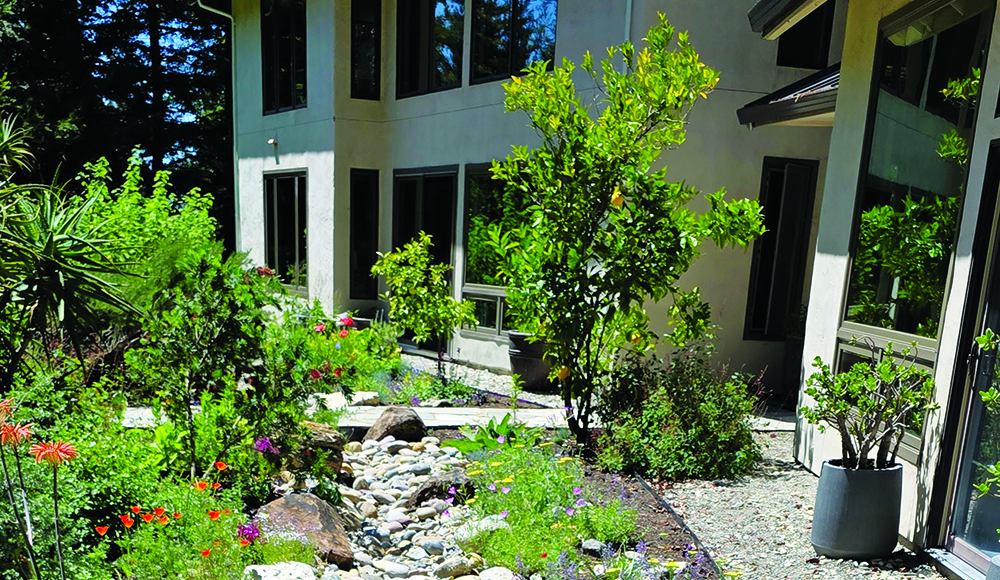
Zone 0 is 0–5 feet from the house, and it’s your “Ember-Resistant” Zone. This is the most controlled area, designed to prevent wind-blown embers from landing near a house and igniting it. Many people opt for a simple gravel skirt around the house. They can use pea gravel or many other types of decorative gravel or cobble. You can also step it up design-wise by turning this skirt into a proper path or patio. Other materials to consider are decomposed granite, flagstone, brick, pavers, and cement.
The adopted draft allows limited low-growing vegetation in parts of Zone 0 outside required vegetation-free buffers at walls, eaves, windows, doors, vents and attached decks. Rock gardens with low-growing plants can work well in permitted areas. Trees may also be allowed with required clearances.
Firewood, lumber – including structures like fences, arbors, pergolas and the like– must be moved out of Zone 0. Wood fences are okay, just not right next to the house, where you might have something like a decorative metal panel or a rock wall.
Zone 1 is the area that is 5–30 feet out from the house. This zone acts as a buffer to prevent flames from reaching the house. This area should be well maintained. Remove all dead plants, grass, and weeds. Keep trees and shrubs well-pruned, and most importantly, remove deadwood and fire ladders. Plants should be well-spaced, healthy, and properly irrigated to prevent fire from jumping easily from plant to plant. Additionally, strolling paths or patios act like fire breaks.
In Zone 2, which is 30–100 feet from the house, you want to reduce the fuel load. This zone helps create a buffer that reduces fire intensity before it reaches a structure. Lawns should be cut down to 4 inches. Take out dead wood, plants and weeds. There should be some horizontal space between shrubs and trees to prevent continuous fuel blankets. Reduce fuel ladders by pruning some lower branches off trees. Ensure outbuildings and propane tanks have 10 feet of clearance with no flammable vegetation nearby.
CAL FIRE’s Aviation Program operates the world’s largest aerial firefighting fleet, serving as a cornerstone of California’s all-hazards emergency response system. With over 70 planes and helicopters strategically positioned across one air tanker base, 13 air attack bases, and 11 helitack bases, CAL FIRE can reach the most remote fires in approximately 20 minutes. This rapid response drives their core objective of keeping 95% of all fires at 10 acres or less.
To learn more about the new regulations, visit CAL FIRE at ca.fire.gov and the Board of Forestry and Fire Protection at bof.ca.fire.gov









hy