

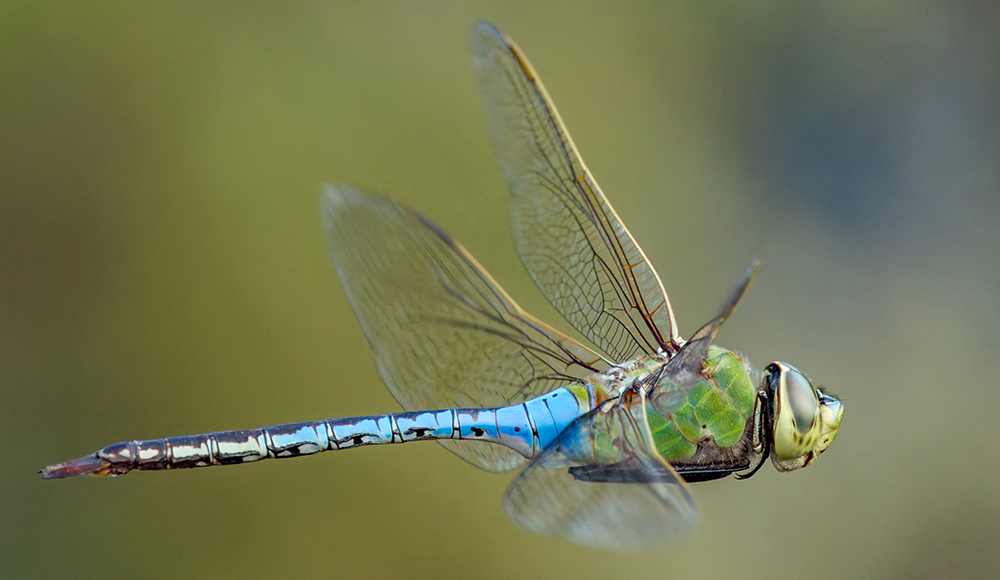
In Chinese folk meteorology, swarms of dragonflies flying low over ponds, lagoons, and fields are a sign that rain is coming.
This summer, Santa Cruz County skies have come alive with unusually dense populations of these brightly colored hunters. Large, dazzling congregations can be found near rivers, lakes and lagoons. They whir and dart, hover and dive, glinting in the warm sunlight like living jewelry.
Another natural sign of an impending, wet “Super El Niño” winter? That remains to be seen, but our local dragonflies are putting on a wildly entertaining and artful aerial show as they gorge themselves on mosquitoes, flies, and midges.
Some of the most efficient predators in the animal kingdom, basic dragonfly morphology has changed little over the last 300 million years. Like another local carnivore, the Great White Shark, evolution hit upon a winning combination of instinct, skill, and biomechanics early with the dragonfly and didn’t tinker much.
They’ve become smaller due to less oxygen in the planet’s atmosphere, according to a 2012 UC Santa Cruz study of their prehistoric ancestors, and the arrangement of veins in their wings has become more complex, but otherwise, dragonflies haven’t changed much since the Carboniferous period, a time roughly 50 to 100 million years before dinosaurs.
Like the white shark, dragonflies are beautiful, fast, killing machines that can travel up to 35 mph. Kathy Biggs, author of Common Dragonflies of California, has been fascinated with these winged hunters since 1996 and marvels at their skill.
“They don’t chase their prey, they intersect it,” she explains. “Dragonflies predict where the prey will be, fly there and catch it mid-air. It’s a remarkably complex strategy and really a joy to watch once you’re aware of it.”
And they rarely miss. A 2023 UC Davis study on aerial prey interception found dragonflies achieve an in-flight hunting success rate of up to 95 percent. As a result, they gobble somewhere between 30 and 100 mosquitoes, flies, and midges per day.
“As natural pest control agents, they’re exceptional,” says Biggs.
So why is Santa Cruz County, the San Francisco Bay Area, and Northern California in general seeing so many more dragonflies this summer?
“I think the wet winter and spring rains created unusually good conditions for local dragonfly breeding,” says Biggs.
Dragonflies typically emerge as flying adults during the warmer months, after spending most of their life cycle as aquatic nymphs. Once they emerge from the water, they congregate near or over water, hunting for food, mating and laying eggs during the late summer.
No fewer than 28 species of dragonflies can be found in Santa Cruz County, according to iNaturalist, a free app that allows citizen scientists to identify plants and animals and record their observations, but some of the most common, like the green darner, are just passing through.
In fact, some local migratory species, like the variegated meadowhawk, are in the midst of epic, multi-generational journeys from Canada to points as far south as Central America, according to Biggs.
“We still have a lot to learn about these West Coast migration patterns. Dragonfly science on the East Coast and over in Europe is a lot more advanced than ours,” she says. “I suspect this is because they’re beneficial insects. We tend to fund research on insects that can harm us or our crops.”
So what are the best places for dragonfly spotting in Santa Cruz County? According to iNaturalist, the densest congregations of dragonflies can be found near water. Namely, the San Lorenzo River, Quail Hollow County Park, the north coast’s lagoons and estuaries, Pinto Lake, and the Watsonville sloughs.
It’s important to remember that dragonflies are ectothermic, which means they’re not very active unless temperatures are at least 63 degrees Fahrenheit, Biggs says. As a result, you’ll have more luck spotting dragonflies in the afternoon after the marine layer lifts and warmer air moves into the area.
While waterways are hotspots for dragonflies, they can be found just about anywhere right now, including your garden.
“If you want to make your garden more dragonfly-friendly,” Biggs says, “avoid using pesticides because they kill dragonflies and their food, create sunny perches, and consider installing a fishless pond with emergent vegetation for them to breed in.”
Time will tell if this summer’s large dragonfly swarms portend more rain than usual, but their presence is always a good omen when it comes to natural beauty and fewer mosquitoes.









This is an excellent article. Well done! One small correction. Green darner dragonflies will breed in Santa Cruz county. They aren’t just passing through both things are happening
I’ve seen huge amounts of dragonflies over the grasses at Wilder Ranch.