

Twenty years ago, when Kirby Scudder and Chip (yes, one name only) created First Friday, they were not thinking outside the box, they didn’t have a box. They built the whole thing out of sand, held together by dreams.
They changed everything for Santa Cruz artists and the community that loves to gather around art. They created a monthly art tour that is a platform for artists to show and sell their work; businesses, galleries, and art spaces would host an artist, and create a show on the first Friday evening of every month. On June 7, this New Atlantis vision for Santa Cruz will be celebrated at the Radius Gallery in the Tannery Art Center.
Come together, right now…

Santa Cruz has a huge community of artists, and an even larger community of families who gather around art. Co-founder Kirby Scudder had a light-bulb moment when he was creating First Friday; he realized that it’s a social event. He started doing walking tours downtown, and every month more people would come. The group of people following him from venue to venue grew and grew, and then he did the Cow Bus in 2007, where he would drive art parties around town.
Santa Cruz humorist Sven Davis describes Kirby and Chip’s approach: “They used the spaghetti-on-the-wall technique. See what sticks. They had so many crazy ideas and one-third of them worked out and that was fine; it was rough and tumble all the way. Downtown was still a wreck from the earthquake and anything interesting was a good thing. There were a lot of empty storefronts, and they took advantage of that.”
What stuck on the wall?
Kirby would do these big projects, like a giant, cardboard reproduction of downtown, in a space that is now the University Town Center Building.
Kirby is a renowned large installation artist; his Blue Maquette was 32 feet long, a one-hundredth scale model of downtown Santa Cruz. He crafted this showpiece in one month and slept beside it on a cot.

“These damn upstarts”
“Those who were seen dancing were thought to be insane by those who could not hear the music.” —Friedrich Nietzsche
Before First Friday, the old Museum of Natural History and Art (MAH, pre-Nina Simon) and a couple of galleries at the University ruled the roost. They decided who got to be shown and who didn’t.
“Some of the established art community pushed back against First Friday,” says Davis. “It was getting a lot of press, a lot of attention, and a lot of the art wasn’t their stuffy art establishment fair. It was scrappy folks just doing lots of different things around town. People were going into stores, and it was helping to pull downtown together. The gallery-museum crowd thought it was just getting too boisterous. For years the art establishment had a lock on any talk about art, but First Friday made it much more free form.
“Some long term established art venues pushed back because they thought, ‘If I open my doors on the day everybody else does, we all lose part of our audience.’ It turns out that more is more, for everyone. First Friday is democratic.
“The establishment wasn’t interested in participating in First Friday because it was this upstart thing that they didn’t have any control over, and they didn’t want to be affiliated with something that they felt wasn’t curated properly. First Friday was saying, ‘We got a bunch of empty space, why not put art in there?’ Kirby and Chip had a TV show called ‘So What?’ and they would invite whoever. It was really to help revive downtown Santa Cruz. Bars and restaurants would have a good night on First Friday.”
Is First Friday still like that today?
“Like anything 20 years old, it has gotten more established, structured, mellow,” Sven adds. “But anybody can do it. If I’m a starving artist on the street and I want to put something in a restaurant and the restaurant is OK with it and we want to sign up for First Friday, you don’t get turned away.”
Chip tells me that it started with Mayor Emily Reilly asking them the question, “In a town packed with artists, why can’t we have art all over town?”
Chip answers: “Emily’s question made us think about what a gallery is, who it serves and how. We started thinking about art institutions differently in terms of access and economy, and it may have been threatening to some people. We knew that a vibrant gallery scene in a place like Santa Cruz needs a robust arts scene. We didn’t create either, we just helped reveal what already was. So many, many people came forward to make this happen, but our first anchor was Joe and Debbie Quigg, who loaned out their buildings (five places) to us to get started.”
I first met Kirby and Chip in 2004 when they opened the Question Mark Gallery. They had talked the owner of an unused commercial property on Cathcart Street into letting them put art in the empty store. They called it Kart (sounds like Kmart). The only constant theme for the show was that the 1,000 pieces were for sale at $19.99 or less. Artists who had dreamed for years of showing their work were now showing it. First Friday brought democracy to the Santa Cruz art scene.
Kirby says, “Good Times Weekly played a crucial role in getting First Friday going. Editor Greg Archer and publisher Ron Slack gave us a free insert that listed all the venues. It was a game changer.”
The First Friday Calendar is still published in Good Times Weekly every month.
“…they all said the same thing, ‘You’re crazy.’”
Kirby remembers their first gallery opening. “Chip and I got invited by the City to host this first gallery; they had enough money to pay rent for three months.
“It was always going to be a temporary thing, and all these artists were stoked to be shown. But then the three months was over and the artists freaked out, so Chip and I agreed to go out and start other galleries.
“And eventually we had like six downtown, and then the Tannery. Chip wanted to do First Thursdays because at that time the museum was doing a First Thursday, which was their free event to the public.
“But it was a disaster because what would happen is all the homeless would go there to eat the free food and the Museum hated it. We wanted to get an audience from over the hill but knew they’re not going to come here on Thursday night.
“They would come to spend the weekend, so we started the First Friday thing. Chip and I just went around, literally all day long, going to every venue. Like every idea we ever had, they all said the same thing, ‘You’re bat-shit crazy.’ And then by month three, it started to take off.”
New blood at the helm as new venues come aboard.

In 2020, Bree Karpavage (kar-PA-vage) became director and backbone of First Friday after the founders, Kirby, Chip and his wife Abra, handed her the marketing platform. They chose Bree to energize First Friday for her artistic knowledge, curation skills and her social media knowledge.
You want the person running the show to be comfortable in their administrative role and Bree exudes an easy-going confidence that grounds her excitement for art. I meet Bree in front of Minnow Arts at 204 Locust St.
“First Friday was intended to be all about emerging artists,” she says. “Artists who don’t necessarily have the connections with the traditional galleries, they don’t know how to get their art out there, and First Friday is a springboard for them.
“But over 20 years it has become a place for any artist of any level to show their work. A lot of well-known artists are Santa Cruz based; they live and work here but they haven’t necessarily shown here, and now because of First Friday, they’re starting to show in Santa Cruz.
“Andrea Borsuk is a well-known painter whose work explores notions of journey, time and destiny. Glen Carter is very popular. And then, there’s Jody Alexander here tonight at Minnow Arts.”
Covid was almost as big a villain as the early skeptics.
“We’ve got 43 events in May,” says Bree. “The R. Blitzer Gallery has just opened back up with First Friday, four years after Covid hit. Visual Endeavors is back, they haven’t shown since 2019.
“And we’re seeing a lot of new venues pop in hair salons, wineries, Next Space and Satellite Workspaces. Ferrari Florist is hosting First Fridays. Adorn Apothecary is going to be hosting the first time in June.
“It’s stronger than ever and won the Good Times Platinum Award for art exhibits. Our website gets over 20,000 hits a month, and thousands show up on our Friday. It’s growing to the East Side; Capitola Village has started with First Friday. It’s spreading around the county. For the 20th Anniversary, the opening will be First Friday June 7from 5 to 9 pm, in the Radius Gallery at the Tannery. Kirby and Chip will be there.”
As I wait for Minnow Arts to open for Jody Alexander’s show, I talk with an artist named Genevieve who hopes to show her work someday through First Friday.
“Why do you want to show your art?”
Genevieve says, “Because it’s part of the process to show your art to others.”
Bree agrees. Bree does collage using magazine cuts and she feels showing her art is essential, “It’s a level of completion. Once you make something, it’s not complete until you share it, and someone else can be a witness to it. When you witness an artist’s work, you are witnessing the artist.”
A Deep Dive with Jody Alexander

We walk into Minnow Arts at 5pm and the walls are covered with photographs of water, transferred to linen, with scientific data all over them.
I meet Jody Alexander; she looks like she could have swum here from Monterey.
“Why water?”
“When I was younger, I was a competitive swimmer, a butterflier,” she says. “I swam at UCLA, qualified for the Olympic trials, swam on the US Nationals Team. During the pandemic when the pools closed, I realized how important swimming is to me, I started open water swimming. I even bought a house up in the foothills so I could swim more easily in lakes. I started wondering why this is so important to me. Is there something wrong with me? What is it about the water? And that’s what this show is.”
Water is H2O
Oxygen one
But there is also a third thing
That makes it water and nobody knows what that is
“So, in this show, I’m trying to figure out what that is. The magic of water. And the third thing is different for everybody. I discovered the third thing for me is color and most of these photos were taken underwater.”
We look at a patchwork of water photos. “Those are the colors of the 11 lakes I swam in last summer. I collect data about the water, temperature, color, elevation, location coordinates. It’s kind of a tongue in cheek quasi-science study. It’s personal, I did not like this dark green water in one lake.”
What does it mean that First Friday is promoting your event?
“Oh, it’s amazing. It’s a way to get everybody out at the same time, celebrating whatever art is going on in the county. I’ve been going to First Friday since the very beginning.”
I ask the owner of Minnow Arts, Christie Jarvis, why she joined First Friday.
“We’ve been connected for two years, and we’ve gone from very few attending to hundreds a night. We have ongoing sonic happenings. First Friday has elevated our eagerness to keep going, to keep putting up shows, because it really brought people in. We like to present artists who have never had a show before.”
Does it cost a venue money to join First Friday?
“It does, fifty bucks a month,” says Bree. “For that, they get great social marketing, and they get in the Good Times in their monthly First Friday Calendar. We’ve upped our game with social media, to create a circle of support; artists, galleries, administrators, we’re all in this together.”
I drive to the Radius Gallery, located in the historic Tannery Art Center, 1050 River St., and gallery director Ann Hazels tells me, “It is inclusive, it is open to all, and I think that’s where curation is such an important part. Who is the right artist to show at the right spot? Here at the Radius Gallery, I can bring in artists who present a more experiential show.”
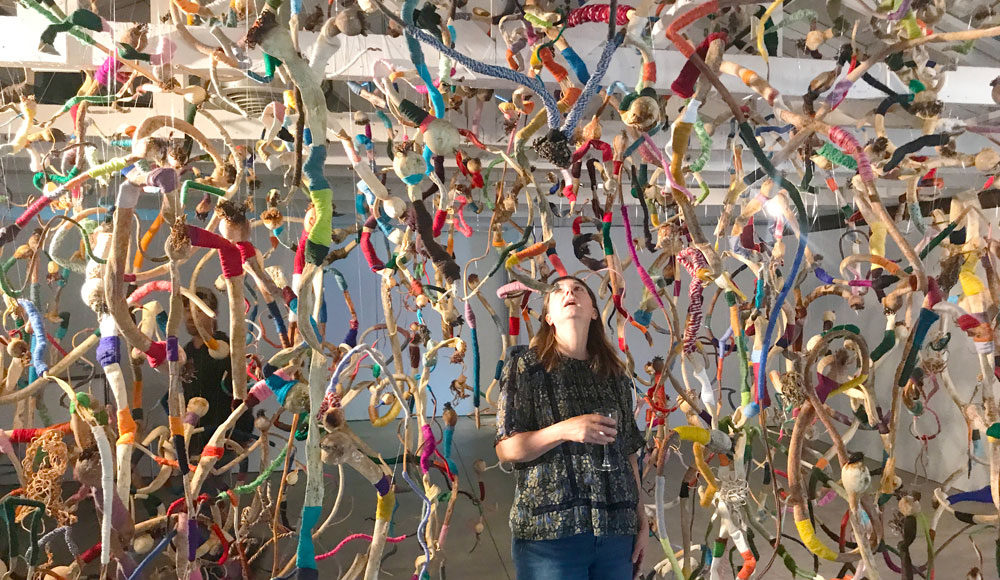
Ann turns to the massive kelp forest hanging from the ceiling. “Now we are showing Kalie Granier’s “Lungs of the Sea Forest”, and you can walk into the middle of it and sense the feeling of swimming in a kelp forest. It makes you think more deeply, how you move through the world and honor what is being disturbed in the world. You get the feeling of belonging to it.”
Over the last three years Kalie Granier has gathered kelp from the beaches of Santa Cruz and Monterey and has created her installation with hundreds of pieces of kelp that you can stand inside of.
“I did this specific installation last summer in Buenos Aires and here at the Radius Gallery, I can present it in a way that people can completely get immersed in the kelp,” says Kalie. “This is a collection of more than three years of harvesting of kelp from the beaches. It is difficult to find a piece of kelp that is dry on the sand, and not damaged. I use recycled yarn to wrap their weakest points, to take care of them.”
Why kelp?
“This installation is about our interdependence with the sea. Kelp is a fundamental species for us and today, 90% of our kelp in California is lost or damaged. I want to present an ecological message in a positive way.”
It’s everywhere now.
Twenty years ago, there was no such thing as First Friday, anywhere. But now, First Friday is in San Jose, San Francisco, and all over California.
Kirby says, “In 2004, we were broke and thrilled to put six venues together. Now it’s up to 43 and is spreading across the country. There will be a hundred someday. For a town like this that had two galleries, to me, that is success.”






Make $170 per hour. its very hard to find jobs nowadays. In this vee11 situation, you have access to a wealth of resources to help you with your working abilities. Be motivated to promote Thousands of works such as copy paste things through job boards and career nc-02 websites on internet
Just Take A Look At This>>>>>>>>>>>>>>> https://report2cash1.blogspot.com/
wow amazing that this site published a SPAM reply…
My response is genuine:
appreciating the mention of Scudder’s Cow Bus and am wondering where he is today??