

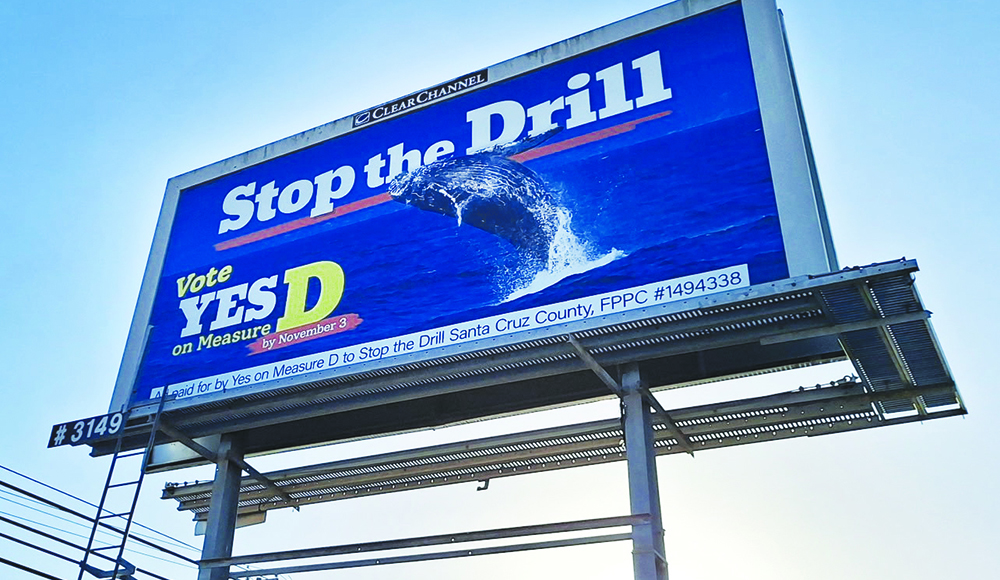
On Nov. 3, Santa Cruz County voters will decide whether to prohibit new onshore facilities supporting offshore oil, gas, and seabed mining operations unless approved by a popular vote.
Measure D updates a 1986 county law that established similar protections against offshore oil infrastructure.
The proposal requires a simple majority to pass. If approved, it would mandate voter consent for zoning and land-use changes needed to construct assets associated with seabed extraction such as pipelines, processing plants, storage yards, or waste disposal sites. It also exempts existing facilities, power plants, and gas stations from new regulations.
The original local law, Measure A, was passed four decades ago with overwhelming community support. While it did not explicitly ban offshore energy projects, it blocked supporting land infrastructure without voter permission. As a result, no onshore facilities supporting offshore drilling have been built in Santa Cruz County since its enactment.
“Measure D basically adds a seabed mining provision to Measure A,” says longtime community activist and current Monterey Bay Sanctuary Fund secretary Dan Haifley. “Measure D provides us with leverage. It gives us the ability to decide what happens.”
Federal protections under the National Marine Sanctuaries Act, established in 1992, further shielded offshore waters extending nearly 30 miles from the coastline.
However, local leaders say new federal initiatives have renewed concerns over commercial exploitation along the Central Coast. Haifley warns that seabed mining is imminent in the U.S. and its territories.
“Lease sales for seabed mining are already scheduled—Nov. 19 for an area on the boundary of the National Marine Sanctuary of American Samoa, Dec. 16 for the Mariana Islands, and, early next year, Virginia and Alaska,” he says. “This is happening now.”
Seabed mining was not an active industry when Measure A passed in 1986. Environmental advocates emphasize that mining ocean sediments for metals such as manganese, nickel, cobalt, and rare-earth elements poses unprecedented ecological risks to deep-sea habitats, local agriculture, and coastal air quality.
Specific risks include seafloor habitat destruction; irreversible biodiversity loss; massive sediment plumes, which can smother filter-feeding animals, block visual communication, and starve mid-water species; noise and light pollution; disruption of carbon sinks, which could potentially worsen climate change; and chemical and metal toxicity.
“People associate offshore mining with fixed platforms. Seabed mining is different. It’s mobile. They’re using ROVs guided by AI to search for minerals,” says Haifley. “We have very little idea what its long-term impacts are.”
Despite these concerns, federal agencies have taken steps to streamline environmental reviews and accelerate commercial access to minerals located on the seafloor, arguing that the U.S. needs to find its own sources of these metals, which are essential ingredients in everything from wind turbines and electric vehicles to cell phones, medical technologies, and military infrastructure.
Executive Order 14285, signed on April 24, 2025, reads, in part: “Vast offshore seabed areas hold critical minerals and energy resources. These resources are key to strengthening our economy, securing our energy future, and reducing dependence on foreign suppliers for critical minerals.
In addition to accelerating the seabed mining industry in U.S. waters, the Trump administration wants to lease federally controlled undersea lands for oil and gas development as early as next year off California, Alaska and in the Gulf of Mexico.
“Voters in Santa Cruz County have little control over what happens 200 or 300 miles offshore, but Measure D will give us control over what happens on our land,” says Haifley.
Historically, Santa Cruz served as an anchor for a broader coastal campaign known as the Blue Wall, in which 27 California coastal communities enacted local ordinances requiring voter approval for onshore energy facilities. Supporters hope Measure D will inspire adjacent jurisdictions to enact similar protections against deep-sea mining.
There is no organized local opposition filed against the measure on the ballot, and local election officials expect strong turnout when voters cast their ballots on Nov. 3.