Every fall, I go up to UCSC to speak to Rob Irion’s Science Communication students, and one of the things we talk about is the question they’re going to be answering from GT readers. Rob has built one of the most prestigious science-writing programs in the country at UCSC, so when I invite readers to send in their questions on whatever our theme is for the year, I know that when the answers come out in our first issue of the next year, they’re going to be meticulously researched, excellently sourced and skillfully written by these students.
But there was something that added an extra sense of urgency and importance to the process this year. I’m always interested in the questions, and what the answers will be, but this year when Rob and I selected the best submissions to have students choose from, I realized that I really wanted to know the answers myself, and couldn’t wait to read the students’ final responses.
That’s because, I think, the wildfires last summer left us all with so many unanswered questions as we tried to wrap our heads around the chaos. Even as I reported on it myself, and oversaw months of reporting on it by our team, I had many of the same questions that you wrote in with—bigger questions about what the CZU Lightning Complex fire is going to mean for the future of our ecosystem, and our way of life. That’s why Rob’s class is so important—these skilled science writers, under his guidance, delivered answers that break down very technical issues in a relatable way. I learned a lot, and I think you will, too. A huge thank you to all of the SciCom students, and of course most of all to Rob.
In other news, our Santa Cruz Gives campaign is over, and the results smashed all of our expectations. We’re still counting up some of the last donations, but we’ll have the exact totals and all the details in next week’s issue.
Also, voting for the Best of Santa Cruz County awards is in full swing. Don’t let your local favorites be left out! Go to goodtimes.sc and fill out an online ballot today!
You forgot Scotts Valley High School adapting their 15-year-running haunted house to a family-friendly drive through event! They raised over $20,000 for the Leukemia and Lymphoma Society and remotely involved over 150 students, allowing them to earn community service hours needed to graduate.
— Jamie Lafollette
Thank you for the wonderful article reflecting on what has been a year we would love to forget. And thank you for mentioning Santa Cruz Works. An important correction: our Ride Out the Wave campaign delivered hundreds of thousands to local businesses, not tens of thousands.
DNA, your vision and dedication to comedy, your business, and Santa Cruz are seen and appreciated. Thank you for pouring your passion into our community. It sucks that the Lab is closing but I’m so glad to read you plan to return. Peace.
I remember a Snail Show at San Jose State in ’70 – ’71 during a planting of a Ford Pinto!
— Carl Klem
I saw Snail for the first time at The Catalyst the year I turned 21, in 1976, and I was hooked! After that, my friends and I would dress to the “9’s” and attend every place we knew they were playing at. I always loved to get right up front, not to be seen, but to see and feel them playing. And I couldn’t help but to move. I love to dance to their music!
A friend of mine who still lives in Santa Cruz knows Kenny and Bob from a little place in Corralitos and was able to get me their latest CD “Snail NOW”. I have listened to it over and over when I’m driving and absolutely love their new direction! (I was raised listening to folk & classical from my dad, and jazz & blues from my mom.) We’re older now and I know my tastes in music have widened, and I see so has Snail’s. I will always love to hear what I refer to as my “Home boys”, after living in the area for 35 years. I truly hope this new year will allow us all to come out of hiding and get to see them live again! This time, I’ll be there.
— Pam Custer
PHOTO CONTEST WINNER
Art capturing art capturing reality on West Cliff Drive. Could be a glitch in the Matrix. Photograph by Linda Weyers.
Submit to ph****@*******es.sc. Include information (location, etc.) and your name. Photos may be cropped. Preferably, photos should be 4 inches by 4 inches and minimum 250dpi.
GOOD IDEA
BIG PICTURE
The Santa Cruz Museum of Natural History’s community-sourced virtual photography exhibit, “2020 Vision,” opened online on Jan. 2, featuring nearly 100 images taken in Santa Cruz County during the year 2020 by 62 Santa Cruz County residents. Long hours spent indoors changed the way people viewed the outdoor world. For information on “2020 Vision” and how to view the exhibit, visit santacruzmuseum.org/2020-vision.
Here at GT, reporters were working nonstop to get out the most current news about the fire, and the need for it was clear—on Aug. 21, less than one week into the fire, our website had more visitors than at any other day in its history, and our fire live blog was the most read feature on the site.
But it was a certain kind of information Santa Cruz County residents needed then. What areas are being evacuated? What percentage is contained? The very immediate questions that for many locals were literally life-or-death issues.
Months later, we all have different questions that never got answered. Bigger questions about wildfires and how the effects of this one will be felt going forward. We invited readers to send in those questions so our friends at the UCSC Science Communication program could answer them. Each of the graduate students in the program chose one to research and write about. We’re grateful to all of them for their hard work, and to their instructor Rob Irion for making their involvement possible. Now, here are your questions, and their answers.
— Editor
What in God’s name causes dry lightning? The lightning strikes that started the CZU fire seemed unnatural and otherworldly. Is it possible that weather engineering was involved? Climate change?
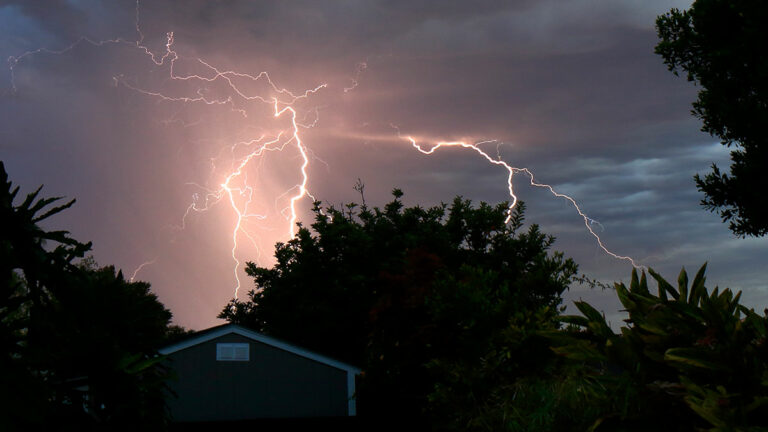
Our August dry lightning storms were spectacular and rare, but not unnatural. Rather, a tendril of moist air from a tropical storm off the coast of Mexico created perfect conditions for the mesmerizing sky show that lit the CZU complex and at least 500 other fires across the state.
The term “dry lightning” is misleading. In such storms, thunderclouds make lightning the same way they always do. The difference is that rain falling from these clouds evaporates before it reaches the ground. Because of this, dry lightning is infamous for its potential to light wildfires.
But that doesn’t happen often here. The Bay Area sees lightning on average just 1.5 days each year. Thunderclouds need a ton of warm, wet air to form—think late afternoon storms in humid Florida. The Pacific Ocean, with its chilly waters just offshore, acts like a wet blanket that smothers massive clouds before they can build up.
But in August, “it was a matter of everything lining up for a disaster,” says veteran Bay Area meteorologist Jan Null. High winds swept a steamy plume of air from tropical storm Fausto northward toward the Central Coast. Thunderclouds billowed when this moist blanket hit high temperatures from our summer heat wave. That same dry air shielded the ground from rainfall as many of us watched the storm break overhead. In the Bay Area alone, 1,026 lightning bolts met parched earth.
Meteorologists hesitate to link any one event to climate change, although models do predict that storms like Fausto will grow more intense. Lightning storms may also become more frequent as the planet heats up.
Scientists can’t say how these changes will impact the Bay Area specifically. But regarding the August storms, Null is clear on one thing: “The whole concept of ‘weather engineering’ is from the realm of science fiction and conspiracy theories, with no basis in fact.”
— Freda Kreier
Embers can smolder inside of trees for weeks before combusting. PHOTO: OREGON DEPARTMENT OF TRANSPORTATION
Is it true that some fires can smolder as embers inside of trees for days before combusting? If so, how does this happen?
Embers from a distant fire can settle in living trees and burn without a visible flame—smolder—for weeks. Lightning strikes can also spark smoldering, creating a delay so wildfires break out days after a thunderstorm has passed.
All fires need three things: an ignition source, fuel, and oxygen. If these elements are present, but in the wrong amounts for a full-fledged flame, a fire can smolder instead. Often, oxygen is limited or the fuel source might contain a lot of moisture, like a young living branch, says environmental scientist Will Russell at San José State University, who studies how forests recover from wildfires.
Smoldering above ground can happen in trees if there’s a buildup of partially decomposed leaves—called “duff”—nestled in the branches or a hollow. But usually there’s enough oxygen that such fires will either ignite or blow out. It’s much more common for a fire to smolder underground in root systems for weeks or even months, allowing it to spread long distances undetected.
Although smoldering is a slower and cooler type of burn than flaming, it still damages forests and releases greenhouse gasses into the atmosphere. Smoldering trees also can ignite into flames under the right conditions.
To understand how this happens, Russell says, imagine sitting around a campfire. “We’re trying to roast our marshmallows, and the fire is not really going. So what do we do?” he says. “Everyone starts blowing on it.” In the same way, hot dry winds can give smoldering fires the rush of oxygen they need to ignite.
For homeowners who live in wooded areas at high risk of fire, Russell recommends keeping an eye out for smoking stumps or roots—especially ones that appear to be caving in—and to water them thoroughly. If you notice smoldering higher up in a tree near your property, he says, call the fire department and leave immediately.
—Stephanie Melchor
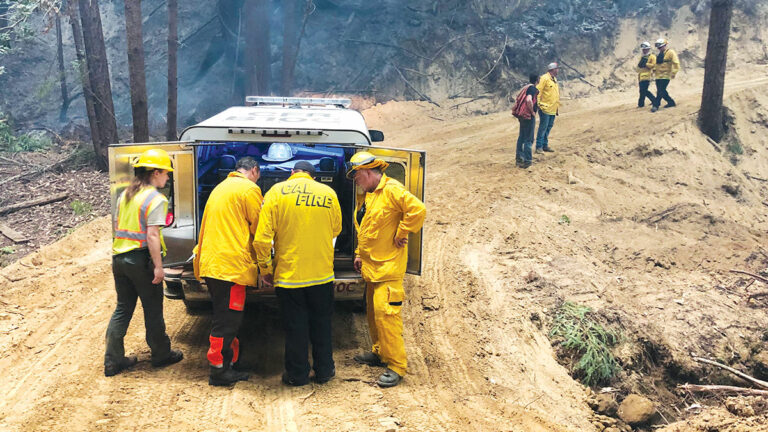
Fire crew members on Old Haul Road, which was used as a control line during the CZU Lightning Complex fire. Control lines often incorporate roads and trails because they offer firefighters accessibility. PHOTO: COURTESY OF SAN MATEO COUNTY PARKS DEPARTMENT
How do firefighters decide the best places to take a stand against anexpanding wildfire?
“Control lines,” the trenches in the war against a wildfire, are where firefighters battle to halt encroaching burns. Crews construct them by clearing vegetation and digging up soil. They may also commandeer preexisting firebreaks, like rock outcrops or roads. Dozens of factors affect where firefighters set control lines, but topography is critical.
“Our preferred method is to go direct on all fires,” says Cal Fire Santa Cruz/San Mateo Unit Chief Ian Larkin. But if confronting the blaze directly is too risky, fire crews harness the landscape—in particular, ridgelines.
Wildfires race up slopes as they dry fuels ahead of them, but flames travel slower downhill. Firefighters exploit this by positioning control lines just below the tops of ridgelines. There, they combat flames that come over the ridge.
But ridgelines don’t always hold. When the CZU fire swept past the ridge above Boulder Creek, firefighters took advantage of roadways and the Fall Creek Truck Trail, slashing new control lines to link the features—or as Larkin calls it, “connecting the dots.”
Existing roads and trails help firefighters act quickly, but often the initial attacks take much more time. On the fire’s first day, Aug. 16, crews had to cut up to 1,000 feet through woods just to reach the flames—while awaiting reinforcements in a state stressed by multiple summer blazes.
As the blaze threatened the western edge of Santa Cruz, Cal Fire used grassy areas in Wilder Ranch State Park to bulldoze 8-foot-deep control lines from Empire Grade down to Highway 1. Meanwhile, in the rugged mountain forests, chainsaw-wielding firefighters labored step-by-step in the smoky air to carve out their lines.
Fickle winds can dramatically accelerate a fire, so firefighters must be ready to adapt. Sometimes, control lines don’t cut it. When winds spurred the fire near Boulder Creek on Aug. 18 and 19, fire crews resorted to “life preservation,” says Larkin: “We had so few resources that we couldn’t do anything but get as many people out of the way as possible.”
—Nikk Ogasa
What are the chemical effects of fire residue on lakes, rivers, and the ocean?Did the ash acidify our water supply?
When we extinguish forest fires on land, the problems are just beginning in water. Ashes and burnt debris that fall from the sky or wash into streams and rivers can add toxins, heavy metals, and damaging levels of nutrients to aquatic ecosystems. And yes, ash acidifies our water supply—but it can be treated.
Fire has shaped California’s landscape for millions of years. But today’s fires are increasingly severe and happening near urban areas. The worst ones incinerate houses, cars, and industrial buildings, spewing manufactured chemicals into the air. What’s more, forests absorb industrial pollutants from nearby cities that can vaporize when fires burn through. As a result, we see elevated levels of heavy metals like mercury, aluminum, iron, lead, and arsenic in nearby bodies of water after big fires.
Burned trees, plants, and dirt create other problems. “Nitrogen, phosphorus, and carbon are the basic building blocks of biology,” says forest hydrologist Kevin Bladon of Oregon State University, who studies wildfire impacts on freshwater ecosystems. Charred soil flowing into ponds and rivers throws the levels of those nutrients off balance, he says—creating massive “fertilizer dumps” that can cause algae blooms. Those blooms deplete oxygen and choke out other living things. Seawater chemistry near the shore may also change when “black carbon”—made when fossil fuels and organic matter burn only partway—washes into the ocean. However, scientists don’t have much data on this.
Impacts on our drinking water supply are unavoidable, but fade over time. “Ash and dissolved organic carbon will acidify the water,” Bladon says. Although it can get costly, treatment plants are set up to clarify such tainted water. Depending on the cause and degree of contamination, plant managers will add chemicals or use different types of filters. The Santa Cruz Water Department recently switched to carbon filters, for example, to extract organic sediments and lingering odors from the water.
Technicians constantly monitor water sources for such fluctuations in quality and adapt their treatments as needed, says Chris Coburn, deputy director of the city of Santa Cruz Water Department.
—Emily Harwitz
According to a UC study from 2017, the leafy greens from the Homeless Garden Project farm won’t be affected by the smoke and ash from the CZU fire. PHOTO: ALLISON GASPARINI
What is the likely impact of ash from burned homes, cars, plasma screens, etc. on our organic gardens, specifically the fruit and veggies we consume? Should we be concerned about toxicity?
If your garden is in a directly burned area, the California Department of Public Health recommends not eating the produce. But outside of the burn zone, your post-wildfire fruits and veggies are almost certainly not toxic.
When a fire burns homes and cars, the resulting ashes are considered more toxic than those from forests. Ashes from structures and technological products can contain dangerous contaminants, such as lead and other heavy metals.
After the Tubbs fire burned through urban areas in Sonoma County in October 2017, the University of California Cooperative Extension received an influx of questions about local produce safety. “We started asking around, and there really was very little research—a void in information around the effects of urban wildfire on produce safety,” says food systems advisor Julia Van Soelen Kim.
The group gathered a research team and conducted tests on more than 200 samples of leafy greens from over 25 sites near the fire zone. Analyses revealed no evidence of heavy metals, and at all but one site, no detectable levels of other dangerous chemicals such as dioxins and furans, which can lurk where garbage and wood burn.
Despite these “good news findings,” Van Soelen Kim acknowledges there could be chemicals outside the lab’s detection capabilities. She advocates for further scientific research on toxicity at more sites close to major fires.
Despite the low risks of consuming fire-related toxins along with your greens, you still should take protective measures to avoid inhaling ash while gardening. If the air is smoky, wear an N95 mask when you go out to harvest. Be careful not to kick up ash in your garden, especially with a leaf blower, and use drip irrigation to prevent ash from splashing onto plants.
Finally, wash your hands before and after harvesting—and of course, clean your produce before cooking with it.
“First and foremost is protecting your lungs,” Van Soelen Kim says. “Ingesting ash is a very low concern.”
—Allison Gasparini
How many animals died in the fires, and will we see more wildlife coming into populated areas as a result?
We may never know how many of our furry and feathered friends perished in the fires. Estimating this would be a huge undertaking, says wildlife biologist Terris Kasteen of the California Department of Fish and Wildlife.
“We don’t have baseline numbers of what was there to begin with to make a comparison of what’s there now,” Kasteen says.
Our local wildlife ranges from the tiny tick to the mighty mountain lion. Fires have radically different impacts on each group. For example, insects feast on burned vegetation and thrive after fires. Rodents can survive fast-moving fires in their burrows, but lingering flames might suffocate them.
Birds and large mammals, on the other hand, need to leave. Their survival hangs on what lies outside the burn zone. Animals usually can avoid fires and then recolonize their habitats afterward. Researchers with the Santa Cruz Puma Project saw this in action: All three mountain lions with tracking collars near the CZU fire zone moved safely out of the way.
But some escape routes for wildlife are vanishing as the state’s population spreads out and develops more land. “As a result, some organisms like birds and deer have fewer places to find refuge,” says fire ecologist Jon Keeley of the U.S. Geological Survey, stationed in Sequoia National Park.
This habitat fragmentation will “almost inevitably” drive wildlife into populated areas, Keeley says: “Any place I’ve seen big fires juxtaposed with developed areas, the urban environment ends up seeing a lot more wildlife in their backyard.”
Managing forests more wisely and reducing human-caused ignitions, such as power-line failures, are essential to tamp down wildfires, researchers agree. But they also urge us to put animal risks into perspective. A lot of our plants and animals have coexisted with fire for many years,” says Richie King, a field technician with the Santa Cruz Puma Project. “These forests will come back.”
—Isabella Backman
The effects of smoke and ash on our ocean and rivers—and especially our drinking supply—are complex. PHOTO: CAL FIRE
How much damage can you really do to your lungs by exercising on a daythat the air quality has been deemed “unhealthy” due to smoke from wildfires? Is wildfire smoke worse for your lungs than the smog in L.A., which contributes to around 150 “unhealthy” air days per year?
We’ve been cooped up at home in a pandemic. Our state is smoldering from its worst fire season. We’re stressed, and that daily jog or bike ride keeps us sane. But huffing and puffing by exercising in smoky air threatens your lungs, even if you feel fine at the time.
“When you exercise, your muscles need more oxygen, so you breathe more,” says pulmonologist John Balmes of UC San Francisco, physician member of the California Air Resources Board. Breathing heavily draws in more of the microscopic particles that swirl within wildfire smoke, inflaming delicate lung tissue.
The most harmful airborne particles, denoted as PM2.5, are less than 2.5 micrometers wide—nearly 50 times smaller than a grain of sand. Such minuscule smoke particles can burrow deep into your lung’s air sacs, where they wreak havoc on immune cells.
You’re also likely to breathe through your mouth rather than your nose when exercising, Balmes says. Mucus membranes in your nose filter out pollutants by trapping them like flypaper, a function the mouth can’t match. You would need a tight-fitting N95 or P100 respirator mask to block these tiny particles, not just a loose cloth mask.
Ultimately, your risk depends on your health status and how smoky the air is. Experts discourage outdoor activity when the Air Quality Index (AQI) is in the purple range. “That’s hazardous even to healthy people,” Balmes says. People who are elderly, pregnant, or have heart or lung diseases should be cautious when it’s orange or red. Even brief smoke exposure can trigger asthma if it’s in your family history and you have allergies.
As for L.A.’s smog, its main ingredient—ozone—also inflames airways and reduces lung function. But it’s hard to compare the risks of ozone and smoke. Balmes notes that conducting a controlled health study near a wildfire is no easy task.
If you smell smoke or see haze in the air, check your local AQI at airnow.gov or purpleair.com.
—Tess Joosse
A redwood seedling on the forest floor at Pogonip. PHOTO: CYPRESS HANSEN
How have forests adapted over time to survive wildfires? Will the forests burned in the CZU fire now be more vulnerable to new fires as they regrow?
Forests in Santa Cruz County, particularly our iconic redwoods and mixed evergreen forests, survive wildfires with protections that have evolved for millions of years. Heat, flames, and even smoke prompt responses in trees and plants in neighboring habitats that help them recover quickly—although droughts can make fire damage more severe.
Fire defense often relies on the ability of a species to resist disease, so when fire strikes, it’s healthy and ready. Redwoods are tough because of “compounds in the wood that make it really resistant to insects, pathogens and burning,” says Michael Loik, an environmental scientist at UCSC.
Many adaptations kick in after trees have burned or even succumbed to the flames. To reproduce, some evergreens depend on fire, such as the knobcone pine. Its pinecones only spew their seeds when scorched by heat.
Similarly, redwoods depend on wildfires to procreate successfully. Flames remove dead leaves around the base of the tree, “which are full of pathogens that kill the seedlings,” says ecologist Gregory Gilbert at UCSC. This cleansing-by-fire leads to “seeds germinating to produce healthy redwood seedlings,” he says.
Some species, such as fire poppies in coastal chaparral habitats, store their seeds in pods underground that lay dormant for years. They only germinate when fires singe the soil. Other forest plants, such as poison oak, survive wildfires by having an extensive root system that keeps them alive.
But are burned forests more vulnerable to new fires? It’s complicated. There isn’t a simple yes or no answer, Gilbert and Loik agree. It depends on the extent and severity of the flames, as well as which plants burned. According to Loik, the most important factors in a wildfire’s severity are “large-scale winds, upslope winds, topography, temperature, humidity and fuel load.”
Fuel supply is key: Managing a forest’s underbrush and clearing clutter with controlled burns can keep the next wildfires from getting out of hand. Reducing the explosive intensity of fires is our best tool in helping forests recover quickly.
—Carolina Cuellar
Why have the fires increased the danger of landslides and mudslides, and can anything be done to help prevent or minimize them?
Imagine trying to hike downhill through a dense thicket of brambles. Now, think of bounding down a clear trail on an open hillside. In the same way, rainwater runs freely down terrain scorched by fire as it erodes the freshly exposed soil. On the charred forest slopes, a wet winter season poses a great risk to residents of the Santa Cruz Mountains.
California is no stranger to landslides. In 1982, the deadliest storm in our county’s history collapsed 1,000 feet of hillside in Love Creek Heights, burying homes and killing 10 people. And after the Thomas fire in late 2017, heavy rains triggered a massive slide in Montecito that destroyed 400 buildings, killing 23.
Although current trends point to a drier-than-usual winter here, a half-inch of rainfall within 30 minutes could trigger debris flows—the most common type of landslide in the wake of wildfires.
Debris flows are “fast-moving slurries of sand, cobbles, boulders and water,” says Jeff Prancevic, a landslide expert at the U.S. Geological Survey in Menlo Park. Picture a flash flood of rocky cement moving up to 30 miles an hour.
Ashen slopes within the CZU burn zone no longer have an understory of ferns, tanbark oaks and berry bushes to trap and hold water and soil. Free of obstacles, rain will schlepp dirt and pebbles into gullies. If the soupy mixture picks up speed, it will sweep up boulders and branches, barreling downhill until it spreads onto flat ground.
Debris flows follow the path of least resistance, making streambeds prime targets. “Be aware of those places,” warns Prancevic. “If your house is near them, don’t be there when it rains.”
Trying to deflect a debris flow with barriers just creates more projectiles, says Santa Cruz County spokesman Jason Hoppin. Instead, he stresses having a plan to leave safely. The county has geared up to provide ample warning, Hoppin says: “Evacuations are based on weather, and we’re pretty good at predicting weather.”
Text SCR911 to 99411 to receive alerts and visit community.zonehaven.com to learn about your evacuation zone.
This past March, in the early days of the Covid-19 pandemic, Santa Cruz County started hiring dozens of temporary disaster service workers to ease the burden of a health crisis unprecedented in the modern era.
These workers filled important roles, like staffing local shelters. They cared for the immunocompromised, the homeless, and the mentally ill.
Ten months later, many of these workers are still working for the county, but some are getting laid off for procedural reasons. The disaster workers themselves, people like R.C. Padilla, worry that the changes could be hard on the county’s most vulnerable residents.
“I know it’s hard for them, because they get adapted to you and you get adapted to them,” says Padilla, who’s worked as a temporary disaster worker since August.
When the county hired emergency workers like Padilla, no one had any idea how long the pandemic would last. But under California law, these workers aren’t allowed to work more than 999 hours in total in one fiscal year, which runs from July through June.
Padilla says she’ll likely reach her 999-hour limit in March, meaning that she expects to get a termination notice by then. The county has already started handing out termination notices to many of her coworkers.
These emergency workers, some of whom bring years of experience, have spent months getting to know their systems and the clients they serve. Without their expertise on the front lines, some aspects of county programs could be starting over from scratch.
Padilla, who has a background in mental health care and criminal justice, says she and her coworkers know how to de-escalate potentially violent situations and build a rapport with those they help.
“They trust us,” she says.
Helen, a client of the county’s emergency programs, has been living at a quarantine motel for the medically vulnerable for five months. She’s elderly and in a wheelchair. Helen, who asked to have her last name withheld, says it is frustrating to get paired up with a new employee after developing a relationship with someone.
“They don’t have the experience of dealing with elderly, mentally ill people. It doesn’t make sense,” she explains. “As long as these shelters are open they should have the same staff. I’ve got to feel safe.”
There have been some shifts in which workers the county is able to hire. In March 2020, Gov. Gavin Newsom signed an executive order that would allow counties to bring back retired employees.
Then, the Santa Cruz County Board of Supervisors sent Newsom a letter on May 29, asking him to take action and allow the county to do the same thing for temporary workers, but to no avail. Newsom’s office did not respond to emails from GT seeking comment.
County Supervisor Ryan Coonerty says the board has made a “bunch of attempts” to create more flexibility. “What we’ve heard back from the administration is that they are not changing the policy,” he says.
So instead, the county has opted to pursue another route.
Coonerty explains that the county has tried to keep as many existing positions in place as possible. In a Dec. 8 board meeting, the supervisors approved an item creating 45 new temporary full-time positions. The intention is to officially hire the county’s temporary employees.
Local emergency workers say it’s better than nothing, but the number is still shy of the 100-plus emergency workers currently working for the county.
Coonerty says he respects how much the emergency workers have stepped up in this time of need.
“It’s an incredibly important job these folks are doing in a pandemic,” he says. “We will continue trying to find every possible way to keep people working.”
At the same time, Santa Cruz County spokesperson Jason Hoppin says local funds are already stretched thin, with county employees on furlough. Even Health Officer Dr. Gail Newel, for example, took a 10% furlough.
“We have to be careful with funding because of the precarious financial position the county is in right now,” explains Hoppin. “And the message it sends to the rest of the staff if we go on a hiring spree while telling everybody, ‘We’re cutting your pay.”
He adds that the coronavirus relief doesn’t provide aid for local governments, despite the enormous pressure counties are under to manage both the pandemic and the resulting budget shortfalls.
Meanwhile, Dan*, a temporary county worker with a background in corrections and mental health, has already hit his 999-hour limit. He met the threshold Jan. 1, bringing his time in the role to an end.
The job turnover, he says, prompted some of his clients to have meltdowns, adding further stress to already tense situations. Dan tells GT that, like with anything, the emergency jobs are not for everyone. However, for the employees who do it well, it’s more than just a paycheck.
“During the beginning of the crisis, we would have families come in with kids and some of us would buy toys and stuff for them, out of pocket,” he says. “It’s not a part of the description, but we do it because we love our job.”
* Name has been changed to protect source’s identity, so they could speak candidly.
ARIES (March 21-April 19): The pandemic has made it challenging to nurture our communities. In order to make new connections and keep our existing connections vibrant, we’ve had to be extra resourceful. I hope you will make this work one of your holy quests in 2021, Aries. In my astrological opinion, you should be ingenious and tireless as you nurture your web of allies. Your assignment during our ongoing crisis is to lead the way as you show us all how to ply the art of high-minded networking.
TAURUS (April 20-May 20): Taurus actor George Clooney is worth $500 million. Yet his dazzling opulence is puny compared to that of Taurus entrepreneur Mark Zuckerberg, whose fortune exceeds $100 billion. It’s my duty to inform you that you will probably never achieve either man’s levels of wealth. Yet I do hold out hope that in the next 12 months you will launch plans that ultimately enable you to have all the money you need. 2021 will be a favorable time to formulate and set in motion a dynamic master plan for financial stability.
GEMINI (May 21-June 20): One of your main themes for the next 12 months comes from Leonardo da Vinci. He wrote, “To develop a complete mind: Study the science of art. Study the art of science. Learn how to see. Realize that everything connects to everything else.” If you use da Vinci’s instructions as a seed for your meditations, you’ll stir up further inspirations about how to make 2021 a history-making epoch in the evolution of your education. I hope you will treasure the value of “learning how to see” and “realizing how everything connects to everything else.” They should be at the root of your intention to learn as much as you can.
CANCER (June 21-July 22): An extensive study by psychiatric researchers suggests that well more than half of us experienced a potentially disabling trauma in childhood. You’re in the minority if you didn’t! That’s the bad news. The good news is that 2021 will be a time when you Cancerians will have more power than ever before to heal at least some of the wounds from your old traumas. You will also attract extra luck and help to accomplish these subtle miracles. To get the process started, make a list of three practical actions you can take to instigate your vigorous healing.
LEO (July 23-Aug. 22): Leo author Isabel Allende says, “We are in the world to search for love, find it and lose it, again and again. With each love, we are born anew, and with each love that ends we collect a new wound. I am covered with proud scars.” I appreciate Allende’s point of view, and understand that it’s useful, even inspirational, for many people. But my path has been different. As a young man, I enjoyed my endless quest for sex and romance. It was thrilling to keep leaping from affair to affair. But as I eventually discovered, that habit made me stupid and superficial about love. It prevented me from having to do the hard psychological work necessary to continually reinvent intimacy—and become eligible for deeper, more interesting versions of love. I bring this to your attention, Leo, because I think 2021 could be your time for a personal rebirth that will be made possible by deep, interesting versions of love.
VIRGO (Aug. 23-Sept. 22): Occultist Israel Regardie (1907–1985) was an accomplished author and influencer. To what did he attribute his success? I’ll let him speak for himself: “Nothing in the world can take the place of persistence. Talent will not; nothing is more common than unsuccessful people with talent. Genius will not; unrewarded genius is almost a proverb. Education will not; the world is full of educated derelicts. Persistence and determination alone are omnipotent.” I hope you will write out this quote and tape it to your bathroom mirror for the duration of 2021, Virgo.
LIBRA (Sept. 23-Oct. 22): The Kabbalistic Tree of Life is a mystical symbol of the hidden structure of creation. At its heart, in the most pivotal position, is the principle of beauty. This suggests that the wise teachers who gave us the tree did not regard beauty as merely a luxury to be sought only when all practical business is taken care of. Nor is it a peripheral concern for those who pursue a spiritual path. Rather, beauty is essential for our health and intelligence. In accordance with astrological omens, I invite you to take a cue from the Tree of Life. During the next 12 months, give special attention to people and things and experiences and thoughts and feelings that are beautiful to you. Meditate on how to nurture them and learn from them and draw inspiration from them.
SCORPIO (Oct. 23-Nov. 21): According to motivational speaker Les Brown, the problem for many people is not that “they aim too high and miss,” but that “they aim too low and hit.” I’m conveying this to you just in time for the Reach Higher Phase of your long-term astrological cycle. According to my analysis, you’ll generate good fortune for yourself if you refine and expand your personal goals. Here’s a key detail: Don’t borrow anyone else’s standards of success. Home in on your own unique soul’s code, and give it fuller, deeper, wilder expression.
SAGITTARIUS (Nov. 22-Dec. 21): One of my primary pleasures in reading books is to discover thoughts and feelings I have never before encountered. That’s exciting! But it’s hard to force myself to keep plowing through an author’s prose if it’s full of stuff that I already know about from my own life or from books, movies and other art. Russian author Fyodor Dostoevsky’s novels fit the latter description. I realize that many people love his fiction, but for me it is monumentally obvious and boring. What about you, Sagittarius? Where do you go to be exposed to thrilling new ways of looking at the world? Judging from the astrological omens, I conclude that this quest will be especially fun and crucial for you in the coming months.
CAPRICORN (Dec. 22-Jan. 19): “I only want people around me who can do the impossible,” said Capricorn businesswoman Elizabeth Arden. In that spirit, and in accordance with your astrological potentials, I hereby authorize you to pursue two “impossible” goals in 2021. The first comes to you courtesy of fashion writer Diana Vreeland, who wrote, “There’s only one thing in life, and that’s the continual renewal of inspiration.” Your second “impossible” goal is from actor Juliette Binoche, who said, “My only ambition is to be true every moment I am living.”
AQUARIUS (Jan. 20-Feb. 18): Your past is becoming increasingly irrelevant, while your future is still a bit amorphous. To help clarify the possibilities that you could harvest in 2021, I suggest you suspend your theories about what your life is about. Empty yourself out as much as you can. Pledge to reevaluate everything you think you know about your purpose. Once you’ve accomplished that, meditate on the following questions: 1. What experiences do you truly need and passionately long for—not the experiences you needed and longed for in the past, but rather those that are most vivid and moving right now. 2. What are the differences between your fearful fantasies and your accurate intuitions? How can you cultivate the latter and downplay the former? 3. What are your nightly dreams and semi-conscious fantasies telling you about how to create the most interesting version of the future?
PISCES (Feb. 19-March 20): Author Gunter Grass wrote, “Writers know that sometimes things are there in the drawer for decades before they finally come out and we are capable of writing about them.” I would universalize his thought in this way: Most of us know that possibly useful ideas and dreams are in the drawer for years before they finally come out and we know how to use them. I believe this will be an ongoing experience for you in 2021, Pisces.
Homework: What’s the biggest and best lucky break you’d love to attract in 2021? freewillastrology.com.
It was one of many times that week when I thought the networks might call the 2020 election for Biden-Harris any minute, and I didn’t want to miss a thing.
I’d carried the girls’ little blonde-wood table and chairs into my work room, computer in the background tuned to election coverage as we sat down to dinner. We don’t have a TV. For most of their lives, Coco and Anaïs had never seen us watching cable news on a computer. Oct. 20 had been the first exception.
Coco, six, came in at one point during the first Biden-Trump debate and sat on the sofa next to my computer. She gave the screen a few minutes of blank-faced scrutiny, more confused the longer she watched, then her face collapsed into a scowl. “I don’t like this!” she wailed. “Why are they so mad?”
I lay in bed with her that night for an hour before she had fully calmed down and could sleep. Now, two days after the election, the girls and I were discussing food preference. Or were we?
“I hate parsnip!” Coco, never halfway on anything, insisted.
Our conversation took a few twists and turns from there. Soon she was asking, “What is ‘hate,’ Daddy?”
It was a rhetorical question. Or a philosophical one. Coco knew what the word meant. She wanted to hear me expand on the idea, which I did, giving her a somewhat sanitized answer about hate meaning really not liking something a lot. A light went on in her eyes.
“Do you hate Trump?” she asked me suddenly.
I stared back at her. Did I hate Donald Trump? I had to give my daughter an honest answer.
“No, Coco,” I said. “I don’t hate Trump.”
At times, yes, I wondered. I hated, really hated, so much of what he said and did since he came down that escalator at Trump Tower. I once stood near Donald Trump on a short elevator ride at old Yankee Stadium in the late 1990s and saw him then, as I see him now, as a shell of bluster and bluff with sharp enough edges to try to prevent you from looking within to the hollow, pain-filled center. I don’t hate the man. But I hate that his con, running for president as a publicity stunt, led to four of the worst years in the history of our country. I hate what his utter cynicism and naked racism did to bring out the worst in so many. I hate how his manipulation, shamelessness and craven bad faith challenged us to be better and do better, and so often, these terrible four years, we collectively came up short. As John Lewis once told me, removing Trump from office will be a “down payment” on our future, not more. Will Rayman, a 23-year-old who regrets not having voted for Hillary Clinton in 2016, writes from Estonia, where he’s a professional basketball player:
“The Biden-Harris victory is a step in the right direction, but in no way is it the end-all-be-all.”
I think each of us has to look within and challenge ourselves to do better, be better, if we are truly going to move forward and find ways to connect with other Americans who might disagree on much but can agree on our common humanity. I hope the perspectives that follow can help kick-start that reckoning, a reckoning not only with the depths of depravity and corruption the Trump years unleashed and exposed, but also a reckoning with ourselves.
On the Friday morning after the election, Coco stirred early and came into my work room, where I’d been in the chair since 5am. I had a lot of work to do, reaching out to people about this collection, but I welcomed her into my lap. She was happy, there in the chair with Dad. A few moments later came the news: Biden had moved into a lead against Trump in Pennsylvania. Our long, national nightmare was almost over. I smiled, and Coco smiled with me. It was a moment I’ll never forget, and one I’ll never stop working to honor, hoping that with imagination and courage and care, we can learn from the many mistakes of recent years and play our part, with Joe, in being a bridge to the future.
Now What?: Essays on Life After Trump started as an idea of my wife, Sarah Ringler, co-director of the small writers retreat center we run in Northern California. She suggested we put out a collection of essays through our Wellstone Books imprint on life in the pandemic, personal essays capturing what one typical day was like. Great idea. I wish we could have done it.
Instead, we’re publishing this quick-turnaround attempt to capture this unforgettable juncture, the week the American people voted out Donald Trump. Our working title going in was The Morning After, echoing a song some of you will remember from long ago, and many of the essays explore that feeling of arriving, finally, at the morning after, even if it was clear even then that the transition through to January was going to be weird and dangerous.
The essays convey how so many of us felt as the end of the Trump presidency neared, what we thought, what we saw and what we did.
The hope is that in putting out these glimpses so quickly, giving them an immediacy unusual in book publishing, we can help in the mourning for all that has been lost, help in the healing (of ourselves and of our country), and help in the pained effort, like moving limbs that have gone numb from inactivity, to give new life to our democracy. We stared into the abyss, tottered on the edge, and a record-setting surge of voting and activism delivered us from the very real threat of plunging into autocracy. We have to celebrate that deliverance and remember it, like Luke blowing up the Death Star. We also have to keep searching for answers.
Excerpted from the introduction to the new collection ‘Now What?: Essays on Life After Trump.’ Reprinted with permission.Bookshop Santa Cruz will present the virtual event ‘An Evening with the Editor and Contributors of ‘Now What?: Essays on Life After Trump’ on Monday, Jan. 11, at 6pm. Guests will include Stephen Mack Jones, Mark Ulriksen, Angela Wright Shannon, and Steve Kettmann. The event is free. Visit bookshopsantacruz.com to register.
Never has a New Year been so eagerly awaited as this one!
Fingers crossed and hope we all stay disciplined enough to get through the winter intact. Between Zoom meets and fuming about all the things I can’t do during shutdowns, I consider the well-stocked kitchen. What are my go-to items for quick dinners, for transforming carryout leftovers into some new dish, or for just getting fed? Here are the essentials.
Condiments: Sriracha, Tapatio, Cholula, hot mango chutney, chipotle salsa, mayo, relish, catsup, mustard, tamari. These can turn any sow’s ear into a righteous silk purse.
Foundations: Chicken stock, almond milk, canned tomatoes, peanut butter, dried pasta, jars of pasta sauce. Red wine and plenty of it!
Key ingredients: Beans, canned and dried (cannellini, black, and pinto). Tuna, lots and lots of tuna. Rice: We like Lundberg Organic short-grain brown rice. Tea: black—especially Assam, English breakfast, and Lady Grey. And herbal—must include nettle leaf, Tulsi green, and ginger chamomile. Second tier would include sardines and salmon. Polenta. Even if the power goes out you can splash some hot sauce on tuna and cannellini beans and call it dinner. Pit-bull proteins such as tuna and beans can sustain life.
The little extras make you feel human. Flat pretzels, multigrain crackers, sea salt flakes, bar mix, instant oatmeal, Chocolove almonds and sea salt chocolate bars. Tubs of biscotti to consume with tea.
Refrigerator: Eggs for breakfast and dinner omelets, and hard-boiled for quickie lunches. Yogurt, hummus, dolmas, milk, butter, and a variety of cheeses. Cheeses in our house usually include a Blue Agur, Taleggio, young Mahon, a Basque sheep cheese such as Ossau-Iraty, smoked cheddar, and a ripe Brie or Camembert.
In the door we stock Gruner Veltliner, Gerolsteiner water, and emergency splits of Veuve Clicquot. We keep whatever fruit is in season out on the counter: pears, and currently Satsuma mandarins. Always Honeycrisp apples in the refrigerator.
Freezer: Venus Gin No.1 is a permanent resident, as well as a tin with the dwindling remains of Christmas cookies, mine and Lisa’s. Niman Ranch organic Italian sausages—another item that turns quickly into a nice dinner along with pasta or creamy polenta. Plastic containers of my bean and ham hock stew, and homemade chile verde. Wagyu beef patties. Green beans from the farmers market, pastured pork chops, chicken thighs, English muffins, sliced sourdough from Companion, and gluten-free cinnamon raisin bread from Canyon Bakehouse.
With the above, a comforting dinner is always within reach. But since we’re fortunate to be able to afford takeout meals, we like to make sure our favorite local restaurants know we love what they do. We get a carryout meal once a week or so. Comforting dinners involving kale salads and roast meats, or pizza and fresh salads. Seafood specialties or a pasta dish with some complex meat sauce. All of these carryout meals can turn into a second day dinner with a few tweaks. We rarely order a one-night stand as far as restaurant takeout.
So far, so good (fingers crossed). Keep afloat and stay upbeat. Pamper yourselves as much as you can with the foods you love, with takeaway dishes from the restaurants you love. If ice cream is your guilty pleasure, have at it! Give thanks for how lucky you are to be able to eat well and that you live in a community that has a Shoppers Corner. Write another check to Second Harvest Food Bank!
Spring is coming, at least that’s what my daffodils say. Welcome 2021!
Every January, the new year brings with it dozens of new laws that impact day-to-day life in many different ways.
Here are a few we find notable, from criminal justice reform to animal welfare and workplace rules:
From inmate to firefighter
During the massive series of fires that scorched much of California this summer, hundreds of state prison inmates helped battle the blazes. But for most, their criminal records prevented them from becoming full-fledged firefighters.
Not anymore under Assembly Bill 2147, which will allow certain inmates who work in prison fire camps to have their records expunged when they are released.
Covid-19 reports
Under Assembly Bill 685, starting on Jan. 1 employers will be required to inform employees of potential exposure to Covid-19 within a day of the exposure occurring. This notification must happen in writing, and must also inform the employees of their benefits and rights.
In addition, employers would have 48 hours to notify the public of workplace outbreaks.
Penalties for using phone while driving
Using a cell phone in a handheld manner while driving is currently punishable by a fine. But because of Assembly Bill 47, as of July 1 violating the hands-free law a second time within 36 months of a prior conviction for the same offense will result in a point being added to a driver’s record.
This applies to the violations of talking or texting while driving (except for hands-free use) and to any use of these devices while driving.
Family leave for small businesses
When the new year rolls around, small businesses that employ five or more people will be required to give family leave to care for a spouse, child, grandparents, grandchildren, siblings or a registered domestic partner under Senate Bill 1383.
A more diverse workplace
Publicly traded companies, which are already required to have at least one woman on their boards, will by the end of 2021 be required to also have one board member from an “under-represented” group under Assembly Bill 979.
This includes people from the LGBTQ community, as well as people who are Black, Latinx, Pacific Islander, Native American, Native Hawaiian or Alaska Native.
Closing the gender gap
The history of gender equality in the U.S. has been unequal, long dominated by men, and underscored by a system that pays women less for doing equal work as their male colleagues.
Much is changing, and Senate Bill 973 takes one step further by requiring companies with 100 or more employees to report annually their employee pay data to the California Department of Fair Employment and Housing.
Increased minimum wage
Senate Bill 3 passed the California Legislature in 2016. That law provides incremental increases every year to the state’s minimum wage. This year, that number goes up to $14 per hour.
Reparations for slavery
By June 2021, a nine-person task force will convene to come up with proposals for providing reparations to the descendants of slaves under Assembly Bill 3121.
The task force will, among other things, study the issue as it relates to California and recommend what the compensation will be, who is eligible and how it will be given out.
Smokers, keep your butts off the beach!
California state law already widely prohibits smoking within 25 feet of a playground and other places where children play. Violators face a $250 fine.
Senate Bill 8 now prohibits smoking on state beaches and state parks, with violators facing a $25 infraction.
According to the World Health Organization, smokers toss an estimated 1.5 million pounds of cigarette butts onto the ground per year. The butts are harmful to the environment and to wildlife.
Easing penalties on sex workers
In the past, sex workers have been afraid to report crimes such as sexual assault, because they were worried they could be arrested. Senate Bill 233 prohibits misdemeanor arrests for certain sex work crimes. The law also prohibits possession of condoms from being used as evidence of sex work crimes.
There goes the circus
Senate Bill 313 prohibits animals—except, for some reason, dogs, cats and horses—from being used for performances in circuses. Advocates say the law will help end cruelty to animals.
Jury service restored to felons
Previously, people convicted of felonies were prohibited from serving on juries. Senate Bill 310 will restore that right to most of them, except for those on post-release supervision, and felony sex offenders.
Youth justice reform
Starting in July, Senate Bill 328 will stop all transfers of young people to the state’s youth prisons. Instead, they will be held in local facilities closer to their families and in their communities. Advocates say the law will reform the state’s troubled youth justice system.
Breakthrough
It is a crime to leave a child alone in a locked car. But until now, good samaritans who broke into cars to rescue children faced possible criminal penalties.
Assembly Bill 2717 exempts those bystanders from liabilities, as long as they called 911, and believed that the child was in danger of “suffering, disability, or death.”
Banning chokeholds
On May 25, Minneapolis police officers placed George Floyd in a carotid artery chokehold. Floyd died as a result of the hold, prompting calls nationwide for police reform. Assembly Bill 1196 bans those holds.
Sleep a little longer
In what will come as welcome news for students, Senate Bill 328 will, by July 1, require high schools to start no earlier than 8am, and middle schools no earlier than 8:30am.
Hurry housing
Senate Bill 330 cuts the time it takes to obtain building permits for new housing construction. Supporters say it will help the housing crisis in California, which ranks 49th in the nation for the number of housing units per capita.
Along those same lines, Senate Bill 450 exempts from the California Environmental Quality Act projects to convert hotels, apartment buildings and other residential structures into supportive or transitional housing.
Improving school safety
Senate Bill 541 will require all K-12 schools to conduct at least one lockdown drill per year, and to make them age-appropriate.
A pet project
When dogs and cats get lost, they now have a way home. That’s thanks to Senate Bill 573, which requires all animals adopted or released from animal shelters to be microchipped. Placed under the skin of the back between the shoulder blades of animals, the chip can be scanned by animal control officers. The information allows the officers to find the pets’ owners.
Move over, slow down
Assembly Bill 2285 extends the provisions of the “Move Over, Slow Down” law currently in place on freeways to also apply to local streets and roads. Drivers approaching a stationary emergency vehicle displaying emergency lights–including tow trucks and Caltrans vehicles–must now move to another lane when possible, or slow to a reasonable speed on all highways, not just freeways. The law is effective Jan. 1.
Reporter/Photographer Tarmo Hannula contributed to this story.
As California continues to ride its worst wave of the COVID-19 pandemic, public health officials have more unsettling news: Six cases of a worrisome, potentially more infectious new coronavirus variant have been detected in California.
The new strain, first detected in the United Kingdom, also has been seen in Colorado and Florida and 33 other countries.
Last week, San Diego County reported it had identified the new variant, called B.1.1.7, in a 30-year-old man with no travel history. Gov. Gavin Newsom announced the discovery in a livestreamed event with Dr. Anthony Fauci, a leading national voice in the pandemic. Over the weekend, San Diego county health officials reported three additional cases.
Fauci said this news was expected, since international travel is ongoing and viruses generally mutate. “RNA viruses, they make a living out of mutating,” he said. “The more you replicate the more you mutate.”
However, the lack of travel history in the San Diego case is an indicator that the new form of the virus is circulating among the community, health officials there said. By today, the number of cases with the new variant had grown to six – four in San Diego, with one hospitalized, and two in San Bernardino, the governor announced.
“What’s really important is that detecting this lineage here doesn’t really change what we need to do other than we need to do it better,” Dr. Kristian Andersen, an infectious disease and genomics expert at Scripps Research in San Diego, said in a news conference. That includes wearing masks and maintaining social distance.
Here’s what Californians need to know about the new coronavirus strain.
How was it discovered?
The new virus variant was first reported by England’s public health agency following a surge of cases in the southeastern part of the country. The first two samples were discovered in Kent and in London in September.
While mutations in viruses are common, this particular strain stood out because it carries more genetic changes than is typical, according to researchers.
What’s the concern with this coronavirus variant?
Public health officials say the new strain seems to be more easily transmitted than the standard form of the virus. This means people who are exposed are more likely to become infected.
Dr. Mark Ghaly, California’s health secretary, explained it like this in a recent news conference: “For COVID to enter a human cell, it needs to bind to a receptor, a sort of front door on a human cell,” he said. “And the new, mutated COVID virus seems to bind a little tighter, a little more easily and enter the cell of the human body easier than our current COVID virus.”
It remains unclear how this mutant form of the virus has contributed to the current surge in California. Officials have said its prevalence here is still likely low. On Dec. 21, Ghaly said that California had been checking thousands of specimens daily over the last month, looking for mutations.
“We’re concerned because of the unknowns,” Ghaly said. “We’re concerned that we aren’t sure how this impacts the broadscale efforts to contain and mitigate the virus as it exists now.”
What is California doing in response?
The California Department of Public Health said health care providers are collecting specimens for genetic sequencing, and the state is analyzing samples suspected of being variant strains.
“As variants and mutations are found, that information is used to inform public health decisions and critical information is shared with the public,” the department said in an email.
Two variants that share some mutations with the UK variant also have been reported in South Africa and Nigeria, according to the U.S. Centers for Disease Control and Prevention.
“We know there’s more. We don’t know how many,” said Andersen, the infectious disease expert in San Diego. “Its prevalence for now is relatively low.”
Will it make me more sick?
Right now, there’s no evidence that this new COVID variant has a higher fatality rate or causes more severe illness than the currently predominant strain, according to the CDC. A recent UK government study compared patients infected with the new variant to those with the predominant strain and found no statistically significant differences in severity of illness, deaths or reinfection. Scientists around the world are still studying the UK variant, however, and more answers may come soon.
Will currently authorized vaccines protect against this new strain?
Scientists believe they will. Fauci told Newsom last week that the variant “doesn’t seem to evade the protection that’s afforded by the antibodies that are induced by vaccines.” But scientists are testing the variant against the currently authorized vaccines made by Pfizer and Moderna.
The CEO of AstraZeneca, which is developing another COVID-19 vaccine candidate, told the London Times that the company’s scientists believe the vaccine will protect against the new variant. But some scientists believe it’s possible that the UK variant, or future variants, may prove tougher for vaccines to overcome.
CalMatters.org is anonprofit, nonpartisan media venture explaining California policies and politics.
The city of Watsonville is cracking down on unpermitted food trucks and weighing whether to rework its rules regarding the mobile food vendors in the coming year.
The city manager’s office has received numerous complaints about food trucks from several brick-and-mortar restaurant owners over the last month, according to Community Development Department Director Suzi Merriam.
“What the big complaint is, is that these are competing with the brick-and-mortar restaurants in town,” she says. “[They say that] it’s not fair that food trucks are not paying rent, they’re not paying property taxes, that they’re not contributing to the local economy.”
And some, Merriam says, do not hold the necessary permits and licenses needed to operate within city limits.
Mobile food vendors require a permit from the police department and a business license from the city of Watsonville. They also need to pass an inspection from the county’s environmental health and fire departments.
Over the course of three recent weekends, code enforcement officers found at least seven food trucks operating within Watsonville city without one or more of the needed permits, Merriam says.
Code enforcement officers did not hand out any citations during their first sweeps, Merriam says. Instead, they gave those trucks a warning, and explained the application process.
Merriam says only two had obtained the necessary permits and another two had picked up the application packet from the city. Most, she says, have been understanding of the requirements.
“If they do not have all of these approvals, they need to leave Watsonville until they obtain them,” Merriam says.
But even if those trucks in question obtain the proper permits, Merriam says the issue might not go away anytime soon.
“It’s very cyclical,” she says. “It’s definitely something that keeps coming back around.”
SETTING THE TABLE
Concerns about food trucks undercutting brick-and-mortar locations are not novel issues in Watsonville or in other cities
Just as in Watsonville, food truck operators in the city of Santa Cruz must seek permission from the Santa Cruz Police Department and apply for a business license before getting clearance from the county health department and the fire department to open up. Vendors also must follow certain rules.
For instance, they can’t stop for more than four hours per stop. In residential zones, they can’t stop for more than 15 minutes. Additionally, there are 17 streets that vendors must stay away from, including West Cliff Drive, Pacific Avenue and Harvey West Boulevard.
But rules alone haven’t prevented a sense of frustration. A June executive order from City Manager Martín Bernal further restricted where vendors could set up, due to social distancing protocols in line with the Covid-19 pandemic. Some activists responded in outrage, calling the rules classist, but Santa Cruz stood its ground. After that, tensions ran high in August, when a Santa Cruz restaurant owner flipped an unpermitted food cart and allegedly pushed the cart owner to the ground. Although many came to the defense of the cart owner, she did not have the necessary permits to continue selling hot dogs in Santa Cruz.
In the city of Watsonville, leaders tried to leverage the burgeoning industry in 2012 by starting a weekly food truck gathering downtown. But business owners expressed concern that they would eat into their already thin profits, increase litter and create a negative image for the city.
Watsonville City Council last updated its rules around mobile food vendors in 2008, establishing when and where and vendors could set up and what permits they needed.
In 2015, the council tried to update those regulations, but those efforts were cooked before they began. Dozens of food vendors, worried that their livelihood would be chopped, showed up to the council chambers to push back on a rumored food truck ban. Instead, the council directed city staff to educate the vendors about the needed permits and to help streamline the permitting process.
It was then that the city also found a loophole in the wording of its traveling merchant rules. According to the municipal code, mobile food vendors can only operate in residential areas and they can only stay in one location for no more than five minutes. But an exemption in the rules for soliciting at businesses undermines those restrictions.
That rule reads: “It shall be unlawful to solicit directly to patrons at a fixed place of business without the authorization of the business owner/operator.”
“So that kind of throws everything else out the window,” Merriam says. “This one sentence essentially allows them—as long as the property owner or business owner, in writing, allows them to be there—to just sit there all day.”
City Manager Matt Huffaker says in an email that it is too soon to say when possible changes could come before the City Council. He does, however, say Watsonville will soon begin reviewing what other cities have done to police food trucks. Some have capped the time food trucks can stay in one location. Others have restricted them from setting up in locations with a high number of brick-and-mortar locations.
“Those are possibilities,” he says.
LEVELING THE FIELD
The pandemic has thrown restaurants into flux, as indoor and outdoor dining has opened and closed numerous times over the past nine months. But food truck operations, at least in Watsonville, have mostly remained the same; some have seen a boost in sales.
Food trucks that had deals with breweries and wineries likely saw sales drop, as those locations are currently forced to only offer carryout during the stay-at-home order. But many that serve in city limits operate similar to brick-and-mortar restaurants, setting up daily in parking lots of vacant businesses or busy gas stations.
That creates an unfair advantage over traditional restaurants, says Fernando Munoz, the owner of the Taqueria Mi Tierra restaurants on Freedom Boulevard. While most food truck owners do pay rent to a property manager to set up shop and hold their vehicle overnight, they do not have to deal with similar overhead fees that brick-and-mortars do. Property taxes, garbage, water, electricity, gas, recycling and impact fees for additions and improvements, it all adds up, Munoz says.
“Just my garbage fees are $6,000, but that’s OK because it goes right back to the city—it goes right back to the community,” he says. “Brick-and-mortars are the basis of the city and a community. We support schools, hospitals, police and fire.”
Munoz says several trucks are operating in violation of county health regulations by bringing in food that was prepared at home and not in an industrial prep station or in the truck. Many mobile vendors, he says, also lack access to running water and don’t have a nearby restroom—in violation of the California health code.
Munoz says he’s reported possible health violations to the county, but they’ve yet to take action. That failure in enforcement, he says, is understandable because of the department’s slim budget, which has only been trimmed further since the start of the pandemic. Merriam says Watsonville doesn’t have a lot of resources, either. Code enforcement for mobile food vendors isn’t a high priority and is mostly complaint-driven because of staffing.
Munoz suggests the city charge food trucks a fee that would equate to a small brick-and-mortar restaurant’s annual overhead—$10,000-20,000—and use a portion of those funds to hire an employee to enforce the traveling merchant ordinance.
TRUCKING THE TREND
On average, it costs about $375,000 to open up a restaurant, according to a survey from the website Restaurant Owner. For many in Watsonville, a city with a household median income of $55,000, that price tag means opening a brick-and-mortar location would require taking out a large business loan and diving into a pool of debt.
Food trucks offer a cheaper path to entrepreneurship and to sharing one’s love for food, say Miches and Ceviches owners Perla Pineda and Sergio Ferreira. The couple started cooking Mexican seafood at home for their family and close friends and eventually branched out to sell their wares over social media—a trend that has exploded since the pandemic began.
The weekend side gig turned into a full-time job when Pineda got laid off from her job with a local nonprofit in March. That “blessing in disguise,” she says, pushed the couple to buy a full-service trailer—complete with an industrial prep station, cold storage, wash stations and bathroom—and give Miches and Ceviches her full attention.
The Miches and Ceviches trailer is parked on the 1400 block of Freedom Boulevard behind Hong Kong Express, adjacent to two other brick-and-mortar restaurants. Pineda and Ferreira say they haven’t received direct complaints from their neighbors, but that they have heard from customers that restaurants have been trying to shut them down.
Pineda says she has followed her mother’s words of wisdom: “There’s always sun for everybody.”
“Whenever anybody tries to come and throw negative jabs like that, I always say, ‘There’s room for everybody,’” she says.
During the recent code enforcement sweep, Pineda’s trailer met all city and county requirements. She says the code enforcement officer told her she was one of few food truck owners who could say that, which didn’t surprise her after her experience with government bureaucracy.
The trouble, she says, is there’s no clear and quick way to obtain the necessary permits and inspections from the county. After purchasing their trailer in March, the couple spent 10 months jumping through hoops put forth by the health department. Pineda attributes some of the delays to the pandemic, but most, she says, were a result of unclear instructions.
Ultimately, she says that having all of the necessary permits, insurances and licenses has taken a big weight off their shoulders.
“If we’re going to do things, we’re going to do them right,” Pineda says, “and I think all [food trucks] want to.”
The Good Times Best Of Santa Cruz awards are a local tradition and a badge of honor—you’ll find them displayed at the top businesses around the county.
How can you make sure your favorite businesses win? Well, you’ve come to the right place!
With all of the challenges our local businesses have been through in 2020, this recognition means more than ever. Whose takeout got you through the pandemic? Where did you most enjoy dining outdoors? Which business did the most to make you feel safe while shopping? Those are some of the categories we’ve added in this extremely unique year.
Remember: Vote for a minimum of 25 categories to have your ballot counted. Voting ends at midnight on Sunday, Jan. 31, 2021.
Guidelines:
1. We appreciate the creativity of local, independent business, and these are the businesses that Best Of celebrates. Therefore, we consider Think Local First guidelines when selecting winners: businesses that have majority ownership based in the counties of Santa Cruz, Monterey, Santa Clara or San Benito. We make an exception for chain stores that were founded in Santa Cruz County, and are proud to include them.
2. Votes for businesses with multiple locations are divided among the total number of locations.
3. There are a few categories in the food section that are so popular we offer a vote by city. Voters don’t always know where city lines are drawn, so we place the total votes according to where voters tend to ascribe them. For example, Pleasure Point winners are included in Capitola because most voters associate Pleasure Point with Capitola (it’s in Santa Cruz).
4. We reserve the right to eliminate a category with so few votes that it’s imprudent to assign “best” status.
It’s a privilege and an honor, this voting thing. And remember, you only get to vote once.
The results for Best Of Santa Cruz 2021 will be announced in March.