

Be Our Guest: Dean Ween Group

One half of alt-rock outfit Ween, Dean Ween (aka Michael Melchiondo, Jr.) has carried a torch for catchy underground music since way back in the 1980s when he and Gene Ween started making music together.

He has since worked on dozens of projects with a variety of artists, including Queens of the Stone Age and Yoko Ono. These days, Dean also leads the Dean Ween Group, which released its sophomore album, Rock2, earlier this year. The record is described by Dean as representing the first time he was able to take what the band does on stage and put it on a record. “Every little thing I’ve ever learned is somewhere on here somewhere. Maybe you can find a little piece of it that means as much to you as it does to me.”

INFO: 8 p.m. Wednesday, Sept. 19. Catalyst, 1011 Pacific Ave., Santa Cruz. $25/adv, $30/door. 423-1338.

WANT TO GO? 

Go to santacruz.com/giveaways before 11 a.m. on Monday, Sept. 10 to find out how you could win a pair of tickets to the show.

Music Picks: August 29-September 4

Live music highlights for the week of August 29, 2018.

WEDNESDAY 8/29

INDIE-POP

BAD BAD HATS

Can you describe your band in three words or less? Minneapolis trio Bad Bad Hat can; they call it “sweet and sour.” In other words, ultra-catchy pop songs that straddle the line between innocent, feel good melodies and sad, reflective lyrics. It’s a combination not too uncommon with indie-pop bands, but when a band like Bad Bad Hat gets it right, it makes you feel all the feels. The band’s latest record, Lightning Round, is simultaneously more polished and looser than the one before it. It’s like a whole different category of sweet and sour. AARON CARNES

INFO: 9 p.m. Catalyst, 1011 Pacific Ave., Santa Cruz. $12/adv, $14/door. 429-4135.

THURSDAY 8/30

ROCK

DANGALEROS

If the Dangaleros backstory is to be believed, the “despicable six” members were so isolated in rural Mexico that they had to form their own rock band to have something to do. And these six couldn’t be more different: border patrol agents, outlaws, cartel members, etc. You know the desire to rock was high if these guys could set aside their differences! Sure, this might all be fabricated, but in any case this six-piece puts on a fun show with a rock-oriented sound that dips into punk, funk, and spaghetti Western desert rock. AC

INFO: 7:30 p.m. Flynn’s Cabaret & Steakhouse, 6275 Hwy. 9, Felton. $15/adv, $18/door. 335-2800.

THURSDAY 8/30

JAZZ

STEVE WILSON & MONTEREY ALL-STARS

Santa Cruz trombonist/vocalist Steve Wilson, a key part of Cabrillo College’s jazz program for four decades, presents a prodigious band as part of Kuumbwa’s Live & Local series. Featuring well-traveled bassist Steve Uccello, Los Angeles-transplant Gary Meek on saxophones and piano, and veteran drummer Andy Weis (who leads a larger version of this ensemble at the Monterey Jazz Festival next month), the Monterey All-Stars combo lives up to its name. A versatile multi-instrumentalist who has toured and recorded with powerhouse drummer Dave Weckl and Brazilian stars such as Flora Purim, Airto, and Oscar Castro-Neves, Meek has added a vivifying jolt of energy to the Monterey Bay scene since relocating here in 2009. ANDREW GILBERT

INFO: 7 p.m. Kuumbwa Jazz, 320-2 Cedar St., Santa Cruz. $21/adv, $26.25/door. 427-2227.

THURSDAY 8/30

HIP-HOP

ROTATIONS

Khan is a local hip-hop artist who’s been putting out EPs and mixtapes for years now. His latest EP, Occupied—a collaboration with Santa Cruz producer Ghost Hour—is sublime boom-bap. Khan has put together an evening of hip-hop/soul at the Crepe Place called “Rotations” that includes Gilroy “femcee” 1 .A.M., spinner of old-school rap DJ Los the Nexus, sweet soul singer Genoa T. Brown, and poet-turned-rapper Joseph Jason Santiago Lacour. Word on the street is there’ll be a secret surprise guest as well. AC

INFO: 9 p.m. Crepe Place, 1134 Soquel Ave., Santa Cruz. $8. 429-6994

THURSDAY 8/30

PUNK

REGRETTES

Since last December, Lin-Manuel Miranda has been dropping monthly singles for his project Hamildrops, which are basically covers of songs from the Hamilton soundtrack. This March, L.A. pop-punk band the Regrettes released their rendition of “Helpless” which is so far one of the best contributions. Like the rest of the Regrettes songs, it’s got both attitude and vulnerability. This is most apparent on the group’s debut album, Feel Your Feelings Fool. Earlier this year, the group released the more all-over-the-place, but still awesome EP Attention Seeker.

INFO: 8 p.m. Catalyst, 1011 Pacific Ave., Santa Cruz. $14/adv, $16/door. 429-4135.

FRIDAY 8/31

REGGAE

ISRAEL VIBRATION

Are you ready to see two legendary reggae groups Voltron into one and then blow your mind away? Israel Vibration is a classic roots reggae singing group that formed in 1970 and started releasing classic Rastafarian albums in the late ’70s. The Roots Radics are a backing band that have played with everyone (Bunny Wailer, Eek-A-Mouse, Gregory Isaacs, etc). They’ve backed Israel Vibration on a couple of albums. And now—lucky you—they are backing the group live in concert. This will be the most reggae thing you do this week. AC

INFO: 9 p.m. Moe’s Alley, 1535 Commercial Way, Santa Cruz. $35/adv, $40/door. 479-1854.

SUNDAY 9/2

INDIE-FOLK

THE JELLYMAN’S DAUGHTER

Hailing from the foothills of Edinburgh, the Jellyman’s Daughter is a duo that blends American indie-rock à la Bonnie “Prince” Billy and Andrew Bird with the Scottish twang of their homeland. Comprising Emily Kelly and Graham Coe, the duo is currently touring its forthcoming album, Dead Reckoning, which drops Sept. 21. The release has already garnered praise as an album that “evokes the misted plains of Great Britain … [and] remains loyal to the tradition of their homeland while expertly combining these sensibilities with a modern indie-folk twist.” CAT JOHNSON

INFO: 8 p.m. Lille Aeske, 13160 Hwy. 9, Boulder Creek. $10-$20. 703-4183.

TUESDAY 9/4

FOLK-ROCK

WILLY PORTER

An indie-folk rocker with finger-picking guitar skills to boot, Willy Porter has been holding down a quiet corner of the music world since his 1994 breakthrough album, Dog Eared Dream. Born in Mequon, Wisconsin, Porter garners comparison to guitar great Leo Kottke and was described by the Village Voice as capturing “the street corner ethic of acoustic performance perfectly.” In addition to boasting serious guitar chops, Porter is a thoughtful songwriter and an engaging performer. CJ

INFO: 7:30 p.m. Michael’s on Main, 2591 Main St., Soquel. $17/adv, $20/door. 479-9777.

Love Your Local Band: Little Petie and the Mean Old Men

When Peter Michael was a kid, his family called him “Little Petie.” His dad was Peter and his grandfather was Pete, so the nickname sort of made sense.

But he hated it.

As he’s gotten older, though, he’s reconsidered. In fact, he’s using it for his latest musical project, Little Petie and the Mean Old Men. And the once-hated nickname has become a bit of an alter ego.

“He’s a little more happy-go-lucky and perhaps intentionally naïve,” Michael says. “There are times when I’m writing songs that I think, ‘Yeah, Little Petie wouldn’t say that.’ It has created a lens through which the songs are delivered.”

Michael spent his younger years playing in an intense punk band, and then became a serious, contemplative singer-songwriter. Ultimately, he wanted to have more fun.

“I enjoyed presenting those songs in the past, but there was an emotional cost that after a while I just got tired of paying,” Michael says. “I decided I would write songs that were up-tempo and catchy, not really thinky or heartbreaky.”

Now he’s having a great time playing good old-fashioned riff-heavy rock music.

“Our songs are in a style that is already familiar to people,” Michael says. “We’re not reinventing rock ’n’ roll. There’s nothing that’s gimmicky. It’s straightforward. I think once people start to familiarize themselves with our songs, they really appreciate and enjoy them.” 

INFO: 9 p.m. Friday, Aug. 31. Crepe Place, 1134 Soquel Ave., Santa Cruz. $10. 429-6994.

5 Things to Do in Santa Cruz August 29-Sept 4

A weekly guide to what’s happening.

Green Fix

California Coastal Cleanup Day

Join Save Our Shores for the largest Coastal Cleanup Day of the year. Santa Cruz beaches become the most polluted in the summertime, particularly on Memorial and Labor Day holidays. On Labor Day there will be Pollution Prevention Outreach where volunteers will pass out trash bags to beach-goers and encourage them to leave no trace. Tuesday is when the real cleaning begins, post Labor Day there will be (unfortunately) plenty of trash to pick up, and they will need all of the hands they can get. Locations include Cowell Beach, Sunny Cove, Del Monte, Hidden Beach and Corcoran Lagoon Beach.

INFO: Monday, Sept. 3 and Tuesday, Sept. 4. Times and locations vary, check saveourshores.org/eventscalendar for meeting spots. Free.

Art Seen

Cabrillo ‘Catalysts’

The Cabrillo Art, Photography and Art History Staff and Faculty Exhibition “Catalysts” just opened last week and showcases more than 40 diverse pieces from instructors and staff at Cabrillo College. Works include woodworking, painting, ceramics, jewelry and more. Join in the artists’ reception and artists talk to hear more stories behind the making of the pieces.

INFO: Show runs through Friday, Sept. 21. Artists reception and talk 5:30-7 p.m. Thursday, Sept. 6. Cabrillo Gallery. Library building room #1002. 6500 Soquel Drive, Aptos. 479-6308. ga*****@******lo.edu. Free.

Saturday 9/1

Capitola Garden Seafood Brunch

Chef Martin Höllrigl has taken a break from working in some of the best kitchens in the world to be a hotel manager in Kuwait, Florida, Austria and California, and a vintner in the Santa Cruz Mountains. He’s a culinary and hospitality master, and now he wants to share his talents and impressive bounty of organic vegetables and fruits with local meat and seafoods to match. His upcoming brunch includes locally grown oysters, caviar and Benedict-style poached eggs, fresh orange crepes and a sommelier bar. Enjoy the end of summer with good food, new friends and some smooth jazz. Proceeds benefit cancer research at UCSC.

INFO: 11 a.m.-1 p.m. Capitola address available upon reservations. whatmartinsays.com. $43 standard menu sommelier additional $29.

Friday 8/31-Monday 9/3

Labor Day Weekend Sidewalk Sales

The end of summer means back to school, and back to school means new gear. The popular Downtown Sidewalk Sale returns this weekend with four full days of the best of summer-end deals on clothing, accessories and more from downtown stores including O’Neill Surf Shop and Pacific Wave. Stroll along Pacific Avenue and enjoy a day of shopping and people watching downtown while finding some on-sale treasures.

INFO: 10 a.m.- 8 p.m. Friday, Aug. 31-Monday, Sept. 3. Pacific Avenue, Santa Cruz. downtownsantacruz.com. Free.

Friday 8/31

A Conversation with Our Secretary of State and County Clerk

What does a Secretary of State do? How does the position affect our right to free and fair elections? What is the role of County Clerks in ensuring that elections are run with accuracy, integrity, and transparency? Most people don’t know the answer to these questions, and with November elections right around the corner, now is the best chance to get some answers right from the source. Santa Cruz Indivisible presents a conversation with California Secretary of State Alex Padilla and Santa Cruz County Clerk and Registrar of Voters Gail Pellerin. Bring questions and talking points you’d like addressed.  

INFO: 7-9 p.m. Rio Theatre, 1205 Soquel Ave., Santa Cruz. riotheatre.com. Free, register online at eventbrite.com.

Bottle Jack’s Viognier 2017 One of the Best Around

I set out some weeks ago to Bottle Jack’s tasting room on La Madrona Drive in Santa Cruz to try some of winemaker John Ritchey’s wines, especially his impressive 2017 Sierra Foothills Viognier which I had tasted at Cantine Winepub in Aptos. But I ended up with a bottle of his double-gold award-winning 2014 Syrah-Grenache and wrote about that instead. So now I’m finally writing about Ritchey’s Viognier ($25), which I found at his other tasting room on Ingalls Street, in a shared space with Silver Mountain Vineyards.

Aromas of tropical fruit and honeysuckle with flavors of pineapple, pear and citrus add enormous pizzazz to this delicious white wine—one of the best local Viogniers around. “It’s a medium-bodied white that is soft on the palate yet dangerously refreshing,” says Ritchey. All three places mentioned have this heavenly honeysuckle nectar, and the two tasting rooms carry all of the other Bottle Jack wines as well. You can also find the Viognier at these excellent local restaurants: Laili, West End Tap & Kitchen, and East End Gastropub.

Bottle Jack Cellars, 1088 La Madrona Drive, Santa Cruz, and 402 Ingalls St., Suite 29, Santa Cruz. 227-2288, bottlejackwines.com.

An Evening with Friends

Friends of Hospice is putting on a brand-new event at a splendid private estate in the hills of Corralitos. Many of you have been touched by the caring support given by Hospice of Santa Cruz County, and this is a benefit for them. The cost is only $75 per person and includes abundant appetizers, libations, live and silent auctions, and dancing under the stars to music by Extra Large. Wine has been donated by Soquel Vineyards, Muccigrosso, Bottle Jack, Pelican Ranch, Alfaro, Equinox, Bartolo, Burrell School, Wrights Station, and others. The event is from 4-9 p.m. Saturday, Sept. 22.

Visit hospicesantacruz.org for tickets and information.

Chaminade Dinner

The last of this year’s al fresco dinners will be Friday, Sept. 7, with Alfaro Family Vineyards & Winery as the featured winery. Starting with passed hors d’oeuvres at 6 p.m. followed by dinner at 6:30 p.m. the event comes with lots of wine and a panoramic view of the Monterey Bay.

Visit Chaminade.com for reservations.

Catalyst Kitchen Opens in Former Rockers Pizza

During the downtown Santa Cruz witching hour, Rockers Pizza Kitchen was a comforting beacon for late nighters. The mega-slices filled the holes in stomachs and hearts of post-partiers; the only concern was getting enough parmesan and chili flakes to absorb the thick oil slick before it reached the flimsy paper plate. Rockers never promised gourmet-fancy pies, but it didn’t need to.

Since the new Catalyst Kitchen took over, however, the menu features quality ingredients like San Marzano tomatoes and fresh basil, and a different dough recipe that drops the onion and garlic and is more reminiscent of a New York-style pizza. They did keep some Rockers souvenirs, including the industrial guillotine-like rotating oven from the ’70s, and the Angry Samoan (jalapeños, pepperoni, pineapple, and barbecue sauce) pizza.

When the Catalyst approached their head bouncer Ivan Garcia about taking over the kitchen, he said no for months. When he finally agreed, he searched YouTube for how to make a pizza, added fried food to the menu (including deep-fried oreos and twinkies) and opened the doors for business. He is joined by Merek Teja, who worked at Rockers for 12 years and now works at Catalyst Kitchen.

Are you still going to have dollar slice Tuesdays?

IVAN GARCIA: No. It costs too much now to do that because of all of the fresh ingredients that we use. Everything is different, it’s all made fresh. We use cleaner ingredients now and even though the price went up very slightly, it’s still cheaper than any other slice in town—other than Little Caesars. You can’t compete with that.

MEREK TEJA: We’ve been trying to come up with a way to have a discounted pizza, maybe half-slices for a dollar. Dollar Tuesday was extraordinarily popular, like nonstop for hours. We didn’t make a lot of money, but people are just too poor to afford to go out and do anything in this town anymore.  

Why did Rockers close?

GARCIA: The owner, Paul Gerhart, just got tired of it. He’s still an owner of the Catalyst though—one of a few.

TEJA: It was a separate business before, now it’s part of the Catalyst itself. I think it might make it easier for the employees; it always felt like there was a weird buffer between us when it was separate because we were here and part of it, but also not.

That oven is terrifying.

TEJA: Yeah it’s a rotary oven. You have to be really quick, like a ninja. I have a few burns from it from working over the years.

GARCIA: That’s the hardest part about making the pizza, throwing it in that oven. It takes some practice.

Meet Watsonville’s New Semi-Pro Soccer Team

Roberto Castaneda’s friends were used to seeing his Facebook page go into overdrive just before Tax Day. After all, the 30-year-old former Watsonville High soccer star had moved to Turlock and become a Liberty Tax franchisee.

But on April 1 of this year, there was something new mixed into the usual rotation of ads for no-interest loans featuring women dressed as the Statue of Liberty: a frenzied stream of posts about starting a new semi-professional soccer team in his former hometown.

“It’s time we do something about the lack of opportunities for outstanding players in our community,” Castaneda wrote in the post. “Let’s make Watsonville a powerhouse in soccer.”

Castaneda suggested that the team could play in the National Premier Soccer League (NPSL), a nationwide division four minor league team. The goal would be to provide exposure to overwhelmingly Latino local talent that was being overlooked by college and professional scouts.

Within hours, the post generated dozens of comments in English and Spanish offering time, sponsorships and emojis to the cause. “The high-level players will be there one way or another,” one friend commented, before adding a note of caution: “It’s the support of the community that keeps projects like this from being just a two- to three-year thing.”

Between Watsonville, Salinas and the Santa Cruz Breakers development academy, the Central Coast has long been a hotbed for soccer talent. Where problems arise is fostering that talent despite the brutal economics of elite athletics, which tend to wreak havoc on working-class players who must decide between going off to college, trying to go pro, or sticking around to get a job and help their families survive.

Just ask Castaneda, who had to navigate the maze of high school, club, college and professional soccer possibilities in California as a teenager after moving to Watsonville from the agrarian Central Mexico state of Michoacán at 7 years old. A solid, 5’10 central midfielder with obvious technical skill and unusually acute vision on the field, he became a crucial component of a Watsonville High squad ranked No. 1 in the nation in the mid-2000s.

“When you see him, you think of what a smooth player he is,” San Jose State University Soccer Coach Gary St. Clair said when he signed Castaneda to a full-ride scholarship in 2006.

Roberto Castaneda
KICKSTARTER: Former Watsonville High soccer star Roberto Castaneda launched aspiring semi-pro team Ville FC this spring. PHOTO: KEANA PARKER

At San Jose State, Castaneda commuted to school and practice from Watsonville, tacking on a 3-7 a.m. overnight shift at FedEx in between. Though he dropped out twice, earning an associate’s degree and playing at Cabrillo College in the meantime, he still finished the sociology degree he never really wanted from San Jose State in four years. After school, he went on to play for a number of competitive indoor and outdoor soccer teams, sometimes for money and sometimes as a recreational outlet as he tried to claw his way into a business career.

“Honestly, I feel like I could have gone professional,” says Castaneda, a fast talker with blue eyes that are prone to opening wide with enthusiasm. “I just never had a mentor.”

Three weeks after Castaneda raised the idea of launching a team, he had already given that team a name. Ville FC—with black and lime green team colors—also had a copyrighted logo, a date in July set for tryouts and a hashtag: #WeAreVilleFC. Even more important was the addition of business partner Cesar Garcia, another former semi-pro player and owner of Ernesto’s Cleaning Services in Watsonville.

For Garcia, 38, the push to provide more options for local soccer players—in a place where it’s easy to bide time in the weekend beer league—is personal.

“I have a son who’s 16,” says Garcia, who is Ville FC’s vice president and interim coach. “I wouldn’t want to watch him play Sunday League over there at Pinto Lake, finishing playing and drinking.”

Castaneda and Garcia are by no means the first to try this. The now-defunct Salinas Valley Samba also started up in the NPSL back in 2004, before folding due to financial pressures about five years later. This time around, Castaneda estimates it will take about $25,000, an expansion spot in one of the country’s fastest-growing soccer leagues, and navigating a Jenga tower of tenuous relationships between the area’s many competitive soccer clubs to make Ville FC a success.

Perhaps most challenging, though, will be convincing the community that this time will be different.

“People were talking all the time. No one did it,” says Fabian Martinez, owner of the downtown Watsonville store Super Soccer. “It takes guts to do it.”

Startup Soccer

Just before 8 p.m. on a recent cold and foggy Thursday night, two dozen soccer players age 14-30ish take the field under the lights at Watsonville High School. “¡Dale! ¡Dale!” (“Let’s go!”) Garcia shouts as a blur of black, white and neon yellow cleats scatter into formation for a drill.

On the sideline, Castaneda is busy sorting out details for an upcoming scrimmage against Salinas community college Hartnell College, the de facto landing spot for promising players in Monterey County who don’t quite make it to a four-year school. Castaneda and several of the roughly 30 players who survived an initial Ville FC tryout are alumni of Watsonville High, but costs and logistics like use of stadium lighting, the scoreboard and the press box are all still being ironed out as part of the team’s application to the NPSL.

If all goes well, the season will start in earnest in March, likely with another round of tryouts in January. In the meantime, Castaneda is focused on setting the club up financially by recruiting sponsors like Third Generation Berry Farms and Mi Tierra Taqueria, the latter having agreed to the all-important job of feeding visiting teams as the league requires.

“I feel like a lot of people still don’t believe that we’re gonna do this,” Castaneda says. “They’re hesitant, like, ‘Is this a tax write off?’”

Castaneda is fine-tuning his social media savvy on the team’s Instagram, Twitter and Facebook accounts in hopes of attracting sponsors. He’s also considering converting the ownership model from a partnership to a nonprofit, assuming the team’s league application is accepted, to pursue donations from big local companies like Driscoll’s, Giant and Martinelli’s.

For the players, the months leading up to the start of the season are all about getting in shape and trying to secure themselves a position on the team.

Ville FC juggling
FINISHING TOUCHES: Dozens of Central Coast soccer players tried out for Ville FC, a new Watsonville soccer club aiming to play in the fourth-division National Premier Soccer League. PHOTO: KEANA PARKER

Omar Garibay heard about Ville FC by accident. The 23-year-old left midfielder was trying to call a friend and fellow soccer player named Jesus when he accidentally called a former coach from Pajaro Valley High School, also named Jesus.

“I kind of picked the wrong Jesus,” Garibay says. “I was like ‘Oh, my bad’ and hung up.”

Coach Jesus called back with tryout details. Without hesitation, Garibay decided to drive the eight hours to Watsonville from Indio, where he was living and working at a Target after getting priced out of Watsonville with his mom just before he graduated high school. He played soccer briefly for Southern California’s College of the Desert, but the classes he’d hoped to take in architecture were full, and he didn’t have any financial aid. Moving back to Watsonville to join the team, Garibay hopes, will offer him another shot at earning a scholarship to pay for the architecture classes he never got to take.

Though soccer is particularly youth-obsessed when it comes to moving up the professional ranks—players who compete internationally often join development teams by middle school, or at least high school—Castaneda aims for Ville FC to help get players in their twenties into schools with extra scholarship money to give away. Though some NPSL teams pay players a modest salary, Ville FC will not, so that players retain the amateur athletic status required for college soccer.

Whether players aim to go to college or to another semi-pro or professional team, Castaneda says, “Our main goal is to get these guys the hell out of here.”

But even getting to Ville FC’s first season is a challenge for Garibay and some of his teammates. A former coach offered him one month at his house rent-free, plus a job in construction framing the interiors of new houses in Silicon Valley five or six days a week. He gets up at 5 a.m. to go to work in San Jose, where he works until 5 p.m. most days and 3:30—to beat traffic—on practice days. It’s “a little tough,” Garibay says, but worth the extra effort.

“A lot of players from Watsonville don’t get the opportunity to try out other places. Usually you would have to go to L.A. or San Jose,”  he says. “To have a team that is local, that opens a lot of doors.”

Local vs. Global

The Jesus that arranged Garibay’s accidental Ville FC tryout was Jesus Acuna. The 28-year-old former playmaker from Pajaro Valley High School went on to coach younger players like Garibay at his alma mater after his own soccer career was cut short.

Though many teammates talked about playing in college or Major League Soccer (MLS) when he was in high school a decade ago, Acuna had no interest in the web of applications, GPA requirements and financial aid forms required to play in the U.S. Instead, he went back to Mexico, where he had lived in the Northern state of Sonora until he was 12. He played for a year on a development team at Mexico City’s storied Club América.

“It was the dream I’d had since a little kid,” Acuna says. “And the only thing I was good at.”

Weighing academics against athletics is a balancing act in any sport, but in Castaneda’s experience, schools in the region are particularly bad at emphasizing education for Latino players. At Watsonville High, where 96 percent of students are Latino and 81 percent are considered “socioeconomically disadvantaged,” just over half of students who graduate are even academically eligible to go straight to a four-year college in California. When Castaneda did get to San Jose State, he found that underachieving was encouraged in the name of academic eligibility for soccer.

“I wanted to be a civil engineer,” says Castaneda, who graduated with a degree in sociology. “All the Hispanic kids were history, sociology, criminal justice. All the white people were engineers, business.”

Playing in Mexico, Acuna got his own education about the cutthroat business of soccer—“it was a good experience, but not what I thought it would be,” he says. After playing at América, he bounced around briefly at clubs like Querétaro and found that he didn’t have the professional connections to last. He came back to Watsonville around age 20, where, during a tough time, he and his girlfriend soon found out their first child, a son, was on the way.

“Honestly, I fell into this really hard depression when I came back,” he says.

Kevin Rincon
HASTA LUEGO: Kevin Rincon, a 14-year-old standout at Pajaro Valley High School, plans to try out for Monarcas Morelia in Central Mexico.

While negative stereotypes about gang involvement or low graduation rates for young Latino men are commonly discussed in the media­—and increasingly, politics—medical research has found that mental health conditions like depression and anxiety are under-studied in this same demographic. Limited access to health care also complicates the picture in many largely minority communities like Watsonville.

Castaneda says that families struggling to get by can also have more trouble supporting young players. Because their work always came first, he says, “my parents never watched me play until the last game of college.”

Acuna is now a married father of two working construction in and around Watsonville. Though he had a chance to go back to Mexico to play in his early twenties, he stayed to secure his U.S. citizenship. In the last two months, going back to playing with Ville FC has helped him drop 30 pounds—and more importantly, connect with a new generation of players trying to figure out where and how they might keep playing.

“Never leave it as, ‘What could have happened?’” Acuna tells them. “Don’t finish like me.”

Already, the youngest player on Ville FC, 14-year-old Pajaro Valley High student Kevin Rincon, has decided to make a change. He has plans to try out in early September for Mexican club Monarcas Morelia.

A Crowded Field

For most casual soccer fans, the big names in area soccer seem few and far between: the San Jose Earthquakes, the Santa Cruz Breakers, the Stanford Cardinal. But in reality, the constellation of under-the-radar clubs, community colleges and semi-pro teams operating on the Central Coast and surrounding areas is big and getting bigger.

In recent years, new teams in the fourth-division NPSL, fellow fourth-division Premier Development League (PDL) and second-division United Soccer League (USL)—the tiers in U.S. soccer under Major League Soccer—have formed in cities like Fresno, Turlock, Sacramento and Sonoma, among others. In addition to putting Watsonville on that map, Garcia and Castaneda see an opportunity to climb the ladder to higher divisions, if the level of play and funding for the team proves reliable.

“It’s really difficult,” Garcia concedes, though he thinks it can be done. On top of sponsorships and ticket sales, trading top players to teams willing to pay a transfer fee is the primary way soccer teams earn revenue to grow their operations. Garcia is well-acquainted with teams in the region. He left Mexico at 16 after a professional contract with the club Necaxa fell through, joining his parents in Watsonville and playing semi-professionally with the Santa Cruz Breakers and other clubs in San Jose, San Francisco and elsewhere. He had planned to go back to the Breakers, but an injury forced him into an active retirement playing recreationally and coaching.

Cesar Garcia Ville FC
GAME FACES: Former semi-pro soccer player Cesar Garcia, now vice president and interim coach of Ville FC, gives a pep talk before a scrimmage against Hartnell College. PHOTO: KEANA PARKER

For the clubs already up and running nearby, the new team could be seen as a threat. Since Watsonville hasn’t had its own semi-pro team before, local players often leave town in search of opportunity, which Ville FC hopes to change. “We want those that are from here to stay here,” Garcia says.

Whether that will go over well with neighbors like the Santa Cruz Breakers, however, is an open question.

“The Breakers come in and they take the best players,” Castaneda says. “We see less and less talented players come out of Watsonville.”

Still, to compete for the top players needed to advance to a higher division, Ville FC would also likely have to cast a wide net and recruit from neighboring cities.

“Kids are going to come from Salinas, Santa Cruz, Gilroy,” Garcia says. “I want to have 50-60 percent from here.”

While it’s not difficult for the duo to imagine where Ville FC might go, they acknowledge there’s a long way to go. As a way to build goodwill at a recent scrimmage against Hartnell College, played in front of a crowd of about 450 people, the team gave away $800 in scholarships to kids who attended the game with their parents.

The experience reminds Castaneda of his first few months out of college, back when even the thought of public speaking was enough to make him black out one time in class. Still, he suffered through door-to-door sales for cable, phone and internet in Watsonville until he saved enough to start his tax business.

“The hardest thing about a business is starting,” he says. “Getting up off of the couch and making things happen.”

INFO: futbolthebeautifulgame.com or facebook.com/VilleFutbolClub.

Update: This story previously misstated the PDL’s current standing in the U.S. soccer system. It is currently a fourth-division league. 

Answers on Santa Cruz’s library and parking structure project

[Editor’s note: This is the first part in a two-part series on the issues surrounding parking downtown. Part 2 runs next week.]

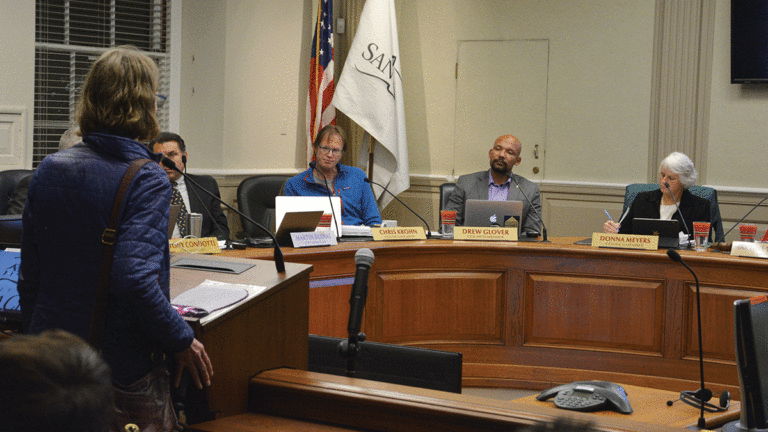
Transportation activist Dana Bagshaw is staring at a three-sided board plastered with a map of downtown Santa Cruz overlaid with bright purple rectangles. The shapes represent future potential housing projects and indicate the growing demand for parking downtown, according to the city of Santa Cruz.

“My problem is I always see both sides of the argument,” she says at this open house organized by the city to share information about a controversial six-story library and parking garage proposal. “The truth lies somewhere in between, but I don’t know what the balance is. I just think our public officials need to pay attention. I think they’re still living in the past, with cars.”

Santa Cruz officials organized the Aug. 6 event to give a tour of the downtown Santa Cruz Public Library’s decaying branch and also share information about the city’s parking needs.

Bagshaw argues that instead of building new garages, the city could double down on promoting park-and-rides, bus transit and other transportation alternatives. Bagshaw understands there are plans to build more housing downtown, and knows that some parking spots will be going away as developments pop up. But a 600-car garage strikes her as overkill.

“We don’t need that much parking,” she says. “We don’t want to encourage more cars. They’re projecting into the future on today’s model of car travel, which they need to get away from.”

The six-story project would be on what is now the farmers market parking lot on Cathcart and Cedar streets. The weekly Wednesday market would move to a yet-to-be-built pavilion in the lot behind the Del Mar Theatre.

GT is here to provide some answers on what has already been a complicated and sometimes confusing issue. But the biggest questions are ones of creativity and its limits. City officials and library supporters are selling a vision for a 21st-century library within a downtown Santa Cruz that has a little more housing—some of it affordable—and an increased vibrancy, without sacrificing any of our small-town charm. Activists are calling on city staffers to embrace possibilities for sustainable living and new trends in transportation.

Q: What’s wrong with the current library?

Friends of Santa Cruz Public Libraries’ Vivian Rogers gets an eerie feeling when she sets foot in the downtown branch’s heating ventilation and air conditioning (HVAC) compartments. “I always wonder if you’re gonna see mice hanging on for dear life up there,” she says.

The system has been known to fail, as has the building’s electrical wiring. The building isn’t American Disabilities Act-compliant, either. On top of that, library supporters say other problems include inadequate bathrooms and the lack of a teen space. Rogers says the most glaring issue may be the outdated plumbing system, which also fails periodically, as it did in May of last year, when the branch was forced to close right before a May the Fourth Star Wars event that librarygoers had been excitedly anticipating.

“We had all the library staff dressed like storm troopers or Darth Vader or Leia—and all these kids,” Rogers says. “We had this whole event shut down by this archaic plumbing. It breaks all the time.”

Rogers envisions Library Director Susan Nemitz being able to start planning a brand new space, one that has new modern technology, teen areas, community spaces, and study rooms.

Q: What if the city just renovates the current library?

Steve Blair, a member of the Downtown Library Advisory Committee (DLAC), said at a June 19 Santa Cruz City Council meeting that he had a vision when he joined the commission to study possible scenarios.

Going in, Blair imagined the best option would be to remodel the existing building. That was before he realized that a huge amount of cash would get spent “mitigating, not resolving or remediating infrastructure problems in the existing building.” The partial remodel would have the highest operating costs.

And when the 10-member DLAC voted, the members unanimously agreed to support a “mixed-use construction project” that would combine the library with a parking garage, as well as with a few offices or units of housing.

If the city took the remodel route, seismic regulations would limits improvements, and the DLAC report called a partial remodel “fiscally irresponsible,” as there are many features it doesn’t include—like a modern HVAC system, a teen room or an entrance that discourages loitering or otherwise improves the flow of visitors. The most common comments in a 2017 survey about the library were about feeling unsafe due to the homeless, many of whom hang out around the branch’s only entrance. Other popular survey themes included calls for better bathrooms and dedicated parking. But the fourth-most popular comment—from 8 percent of respondents—was not to combine the library with a parking garage.

In the four options studied, the DLAC considered a full remodel, too, which was estimated to be more than $10 million more expensive than either the partial remodel or the mixed-use project, according to estimates from the architecture firm Noll & Tam. Members also looked at a total rebuild, which would be more than $20 million more expensive than the mixed-use project. City officials say the mixed-use project is more efficient because a few costs are shared with the parking district, and the library wouldn’t have to pay to host temporary facilities elsewhere.

Q: Doesn’t Santa Cruz have enough parking?

It depends on who you ask. Rick Longinotti and other members of the Campaign for Sustainable Transportation have reminded city officials that planning consultants they hired two years ago suggested they exhaust all transportation alternatives before they begin planning for multi-story garages. They also pressed for other solutions, like phone applications and displays to let consumers know how full the various lots are.

The city’s current models, however, assume that there will be increased demand from a few hundred new housing units and a couple hundred less parking spaces as long-standing lots get developed.

City transportation planner Claire Fliesler has outlined that 234 existing spaces could be gone by 2025. That estimate is a moving targets, though.

More than a couple city officials have said in recent months that public parking in the lot owned by Calvary Episcopal Church is expected to soon disappear, adding that the “red church,” as it’s commonly known, is getting ready to sign a lease with a developer for affordable housing on that site. As a result, many staffers said, the church wouldn’t be renewing its lease. Parking manager Marlin Granlund sent permit holders a letter to that effect last month.

The reality is that nothing’s quite so imminent. A church official did speak about talks with a developer at the June 19 meeting, but he was speaking as a private citizen.

Scott Galloway, who serves on a church committee, says that nothing’s been decided, and the church hopes to renew its lease with the city. Even if Calvary does sign with an affordable housing developer, it could be a couple of years before the developer breaks ground and the parking goes away.

“There could be a better and higher use, clearly, than a parking lot,” Galloway says of the property, which is across the street from the farmers market lot, where the library project has been proposed. “One way of looking at our lot is that open spaces are better. The other way of looking at it is that this town has a housing shortage, and it would probably be better to develop housing downtown, where there are shops and transit. It will be developed at some point, but whether that’s soon or in the distant future, we don’t know.”

Q: How much will the new building cost the people of Santa Cruz?

The cost depends on how much you drive.

Santa Cruz Transportation Manager Jim Burr has laid out a plan to increase parking rates and fees to pay for the garage. While parking deficiency fees may get eliminated, hourly parking rates would more than double to $1.25 over two years, and parking passes would increase to $75 over five years. Transportation activists, like Bagshaw and Longinotti, want the city to raise those same fees and rates, but instead reinvest them in transportation alternatives to driving, like subsidized bus passes.

Q: Do we need more parking to address affordable housing in the downtown core?

Some DLAC members like the mixed-use project, in part, because it could include housing or support affordable housing off-site.

As surface lots get redeveloped, downtown Santa Cruz could end up with very few parking spots south of Lincoln Street—the same portion where most of the city’s new housing is expected to go. Planning Director Lee Butler says structured parking costs $45,000-$65,000 per space. Supporters hope that a new garage would leave wiggle room for more affordable housing to get proposed downtown, without forcing downtown leaders to sweat the parking impacts of approving such projects.

Q: How much can we reduce demand for parking altogether?

The campaign for Sustainable Transportation calls for a more robust package of transportation alternatives, like programs implemented in Boulder, Colorado and at Stanford University in Palo Alto.

Only half of Stanford commuters drive alone, a 22 percent drop from 2000 levels. However, although the city’s drive-alone rate is 56.5 percent, that’s still nearly 9 points lower than Palo Alto’s.

It’s also just over 5 points higher than Boulder’s. That difference can be attributed to a gap in the two cities’ work-from-home rates—Boulder’s is much higher. Be that as it may, Santa Cruz’s downtown commissioners aren’t interested in growing their work-from-home population, under the assumption that downtown employees are downtown customers.

There’s a common argument against building new parking—that the growth of ride-sharing apps pending a self-driving car revolution will lead to a dramatic decline in parking demand. It’s worth pointing out that this perspective may not be able to exist in harmony with sustainability goals. A July report from transportation expert Bruce Schaller found that mobile-based ride-sharing options, like UberPool and Lyft Line, have led to more driving, not less, largely because they appeal to people who weren’t going to drive anyway.

Schaller outlines a couple of tools that could be used to combat this trend, including the continued expansion of bus and bike lanes.

KSQD Launching Soon, But Will Miss Sept. 1 Target

When the group behind the planned Santa Cruz community radio station KSQD announced in March that it planned to start broadcasting by mid-June—meaning the all-volunteer, 100-percent grassroots, extremely DIY nonprofit Natural Bridges Media that had formed in December of last year to purchase, rebrand, raise funds for and clear bureaucratic hurdles on a new launch for the 90.7 FM frequency would be able to do so in a mere six months—it seemed impossible.

And it was.

In June, when NBM announced a new target date of Sept. 1, it still seemed outrageous, even though they had cleared some massive hurdles, like getting FCC approval for KSQD and finding office space in the Harvey West neighborhood through the Santa Cruz County Office of Education. And, again, it probably was.

“It’s not looking good,” admits Rachel Goodman, chair of NBM’s board. “We’re delayed again.”

This time, NBM was held up by a long wait for legal documents that took far longer than expected to process. The group is dealing with multiple governing bodies at once—not only the federal government and the county, but also the UC system, from whom they are leasing space on KZSC’s transmitter.

“There’s a lot of legal twists and turns, and huge bureaucracies involved,” says Goodman. “It’s like pushing a boulder up a hill, and then you run into a bigger boulder.”

But here’s the thing: if KSQD goes live any time this year, it would be a mightily impressive feat by any measure. So why do the people behind the new station keep giving themselves crazy deadlines?

One practical reason is fundraising. NBM has had to raise a lot of money to get KSQD up and running, most of which went to buying the station and other initial costs. (They still have to raise $40,000 of what they anticipate to be $83,000 in operating costs for the first year on the air.) And they are clearly driven to deliver on their promises to a community looking to fill the hole left when KUSP went bankrupt and disappeared from the FM band in 2016.

“The people who gave us $265,000, they’re expecting something,” says NBM’s Mathilde Rand, the board treasurer, who has been spending countless hours poring over insurance documents and other paperwork necessary to get KSQD on the air. “There’s work to be done.”

For the last eight years that KUSP was on the air, Rand hosted First Person Singular, that station’s long-running series of two-minute pieces that let local people tell their own stories. That’s one of several KUSP shows that will be resurrected on KSQD (with Rand once again hosting)—along with Dr. Dawn Motyka’s Ask Dr. Dawn, Charlie Lange’s blues showcase, the tech advice segment Geek Speak, Zombie Jamboree, and the former station’s daily news and current-events flagship Talk of the Bay. Bringing these shows back, Goodman says, was a no-brainer.

“Everyone asked for these shows by name,” she says.

But while much of the focus so far has been on the ways that KSQD will be like KUSP, it’s also important to note that NBM is actively trying not to be like KUSP in some ways. In particular, like the final years of KUSP, which saw the station move further and further from local programming, alienating much of the community that had once supported it.

“It’ll be totally different than the last 10 years of the station,” says Goodman, pointing to the almost fully local programming slate. KSQD will run a few syndicated programs—most notably Amy Goodman’s Democracy Now, which will air every weekday at 8 a.m.

KSQD programmers are also trying to broaden the scope of local programming and be more inclusive than KUSP.

“There will be more cultural diversity, more female voices, a lot more African-American voices, and also more youth voices,” says Goodman. “It’ll sound more like a kaleidoscope of Santa Cruz County.”

For Rand, the question of who gets a voice on the airwaves is key to KSQD’s reason for existing at all. “Building community has always been important, but now I think it’s even more important,” she says of the current political climate. “The end goal is letting voices from the community be heard.”

For more information or to contribute to KSQD’s Phase II funding through GoFundMe, go to centralcoastcommunityradio.org.

Preview: Locally Loved Gypsy Rock Band Diego’s Umbrella at Moe’s Alley

Jake Wood recently played percussion with a traveling production of Hamilton. The drummer for gypsy rock band Diego’s Umbrella, Wood says the experience was “drastically different” than what he’s used to.

“I was stuck in an orchestra pit for the last six months, playing the exact same notes every night,” he says. “To come back to this, where I get to rock out and play the stuff I came up with, and have fun, and express myself in a completely different setting and manner is such a cathartic release.”

A longtime drummer and percussionist, Wood holds down rhythm duties for one of the rowdiest, high-energy acts around. Comprising Vaughn Lindstrom on acoustic guitar and vocals, Jason Kleinberg on fiddle and vocals, Kevin Gautschi on electric guitar and vocals, Red Cup on bass, and Wood on drums, Diego’s Umbrella has a gift for playing rafter-rattling songs that capture the imagination and feet. After his time on the road, Wood is thrilled to be back with the band.

“I might even be feeling it more than the rest of the guys,” he says with a laugh.

Blending Eastern European gypsy (Roma) sounds, Spanish flamenco, polka, ska, pop, rock and more, Diego’s Umbrella digs deep into traditional styles and brings to them a 21st century flair and spirit. Wood describes the band’s live shows as infectious.

“If people are paying any attention,” he says, “they realize that we’re having a party and they should join us. It usually works out for both parties involved.”

The band members have a solid handle on a number of styles to hold the whole thing together. For Wood, this is the challenge and the joy of performing with Diego’s Umbrella.

“I get to play reggae, polkas, ska, punk rock, a little bit of metal, hip-hop—it’s a dream come true for a drummer,” he says. “I get to do a lot of cool stuff and flex different parts of my brain, in terms of what I’ve learned over the years. It’s not boring in the slightest.”

Formed in 2001, Diego’s Umbrella released its fifth full-length album, Edjka, last year and is gearing up to record a new batch of songs. The band treats its performances and setlists with the same care it treats its albums. As Wood explains, they run performances like a stage show, with few pauses between songs. The members, Wood explains, “cultivate a certain experience.”

“We’ll decide to start off on the harder side with one crowd, then go into some mellower stuff and have the crescendo later,” he says. “Or, if the crowd isn’t arriving early, we’ll start with B-list stuff, then once we have a full crowd, we unleash the A-list stuff.”

For a band that was born and raised in San Francisco, the members of Diego’s Umbrella have seen the music scene in the city change dramatically in the last 10 years. Most striking is the present lack of small venues where bands can get experience and start a fan base.

“Most of the smaller venues that I came up playing in don’t exist anymore,” says Wood. “You need those small venues to cultivate a following. Without that, you’re just not going to have as many acts coming out of San Francisco. Not to mention, a lot of musicians are moving out of the city, so you don’t have as many local bands to play with anymore.”

He stresses, however, that the Bay Area music scene is still alive and well.

“Some artists are pretty quick to hate on San Francisco—that it’s not what it used to be,” he says. “I tell them that I’m still here and it’s my job to keep it cool. We all have to do our part so it doesn’t suck too much.” He adds, “But, as I was traveling the last six months, it was quite obvious that it’s a lot easier to be a musician in other cities.”

When asked what we can expect from the upcoming Diego’s Umbrella performance at Moe’s Alley, Wood says, “a whole lot of sweat.”

“We expect to see a pretty big turnout of die-hard, dancing, party fans,” he says. “We’ve been playing Moe’s in Santa Cruz for years and we haven’t played a weekend in a long time. This show should be quite the dancing spectacle. That’s my prediction.”

Diego’s Umbrella will perform at 9 p.m. on Saturday, Sept. 1 at Moe’s Alley, 1535 Commercial Way, Santa Cruz. $12/adv, $15/door. 479-1854.

Be Our Guest: Dean Ween Group

Deen Ween
Win tickets to see the Dean Ween Group on Wednesday, Sept. 19 at the Catalyst.

Music Picks: August 29-September 4

Bad Bad Hats
Live music highlights for the week of August 29, 2018.

Love Your Local Band: Little Petie and the Mean Old Men

Little Petite
Little Petite and the Mean Old Men play the Crepe Place on Friday, Aug. 31.

5 Things to Do in Santa Cruz August 29-Sept 4

coastal cleanup
From holiday sidewalk sales to a conversation with California's Secretary of State.

Bottle Jack’s Viognier 2017 One of the Best Around

Bottle Jack's
Made from grapes in the Sierra Foothills, this wine is easy on the palate and dangerously refreshing

Catalyst Kitchen Opens in Former Rockers Pizza

Catalyst Kitchen
Rockers replacement promises fresher ingredients, pizza and a side of junk food

Meet Watsonville’s New Semi-Pro Soccer Team

Omar Garibay Ville FC
Could Ville FC change the game for South County talent?

Answers on Santa Cruz’s library and parking structure project

library
Getting to the bottom of the debate over downtown parking

KSQD Launching Soon, But Will Miss Sept. 1 Target

KSQD
New public radio station plans “kaleidoscope of Santa Cruz County”

Preview: Locally Loved Gypsy Rock Band Diego’s Umbrella at Moe’s Alley

Diego's Umbrella
Diego’s Umbrella promises sweat at upcoming Moe’s Alley show
17,623FansLike
8,845FollowersFollow