Kuumbwa Jazz Honor Band is Santa Cruz’s Musical Talent Factory

Most kids who want to play an instrument will probably cut their teeth on their local school band. But where do they go later if they have ambitions beyond their high school jazz band? In Santa Cruz County, the answer is the Kuumbwa Jazz Honor Band.

The Honor Band program is in some ways an extension of Kuumbwa’s Summer Jazz Camp, which takes place over the course of two weeks in June. It’s a crash course in all things jazz, and open to a range of experience levels.

Then in September comes the Jazz Honor Band, which requires an audition. For the kids that make it, there’s a weekly rehearsal, as well as several performances that happen over the course of the school year.

The Honor Band bucks music-education conventions—in most school jazz bands, kids learn how to play in an ensemble setting, but here the emphasis is on improvised soloing. Young musicians need to have the basics down when they start, and chances are that by the end of the school year, they’ll have a much stronger grasp on how to create spontaneous melodies.

“Jazz is a lot of things, but ultimately the essence of it is improvised soloing. It’s an enormous skill,” says Terrel Eaton, who led the Honor Band from 2002 to 2007, and again from 2016 until this year. “These are kind of the stars from the individual high school bands getting to play with other kids that are just as good as them, as opposed to ‘I’m the star.’”

The Honor Band was started in the early ’90s when retired North Monterey district band teacher and Kuumbwa board member Phil Snyder noticed that the jazz organization’s board was putting a lot of emphasis on educational programs. He saw it as a chance to use his many decades of experience leading school bands, and give Santa Cruz County kids who were truly interested in jazz a place to learn at a higher level than they could in their schools.

“I knew they were always claiming that they were pushing jazz education, but they didn’t really have much going,” Snyder says. “I’m glad to see that it’s grown. It’s doing what they said they wanted it to do in the first place. It’s gotten bigger and better.”

The results are remarkable. The Honor Band has become a true talent factory, and many of its alumni have gone on to successful, innovative and downright fascinating careers in the music world—and beyond. Over the last couple years of writing music features and Love Your Local Band columns for GT, I began to notice that some of the musicians I was most intrigued by had been involved with Kuumbwa’s program at some point. One in particular that jumped out at me was Dillon Baiocchi, whose experimental project Hermano blew my mind. So I tracked a few of them down to ask them about what they’re doing now, and how they feel their experience in the Honor Band contributed to it.

Name: Ben Flocks

Age: 29

Instrument: Saxophone

Years in Honor Band: 2005-2007

Right now, Ben Flocks is between tour dates with the group Sammy Miller and the Congregation, a wide-ranging revue production in which he plays tenor sax. He’s been in the band for a couple years, and has toured nationally and internationally with them. In this band, jazz is only one piece of the musical puzzle.

“It’s a broad range. We play a lot of old American songs. There’s a lot of old folk songs and old jazz songs: Jelly Roll Morton, Scott Joplin, Duke Ellington. A lot of new music, too, that we arrange and compose ourselves,” Flocks says. “We have a lot of theatrical elements to our performances. There’s acting, there’s costumes, dancing, and we interact with the audience. That’s been a really fun project to be involved with.”

Ben FlocksThis gig came well over a decade after his experience with the Kuumbwa Jazz Honor Band in high school. First, he attended the Brubeck Institute in Stockton for two years, then moved to New York, where he finished his education at the New School. While there, and for several years after, he gigged as much as he could.

In 2014, he released his first official album as bandleader, Battle Mountain. It’s steeped in jazz, with also some subtle, breezy Americana influences in the mix. The record got great reviews including 4.5 stars from All About Jazz and a positive write-up in the Los Angeles Times.

Even though he was living in New York by the time he made the album, he wanted to access his Santa Cruz roots for the record. So, he did the recording in California, and used musicians almost primarily from the area that he grew up with.

“It was inspired by Santa Cruz, and my experiences growing up in Bonny Doon up on a mountain,” Flocks says. “A lot of the songs are very open and introspective. They don’t necessarily reflect my experiences in New York, with the fast-paced lifestyle of living in the city. I’m more inspired by my time growing up in the country and by the beach. We play some folk songs, we play a bolero by the Buena Vista Social Club, all songs that you might hear in Santa Cruz when you’re walking on the beach or hanging at the Boardwalk.”

He considers his time with the Kuumbwa Jazz Honor Band a big inspiration. He says it was critical for him to have an opportunity to challenge himself, learn how to improvise better, and play with higher-caliber players. But just as important, says Flocks, was the opportunity he had to see unlimited shows at Kuumbwa for free, something you get to do when you make it into the Honor Band.

“I got to see the greatest musicians on the planet coming through Santa Cruz every week on Monday night and Thursday nights, and having the opportunity to learn from them by going to these shows, it was very cool,” Flocks says. “I feel really lucky to be able to play music and teach music, and do what I do for a living. It’s a blast. I get to travel and see the world and inspire young musicians to play music.”

Name: Nick Bianchini

Age: 28

Instrument: Trumpet

Years in Honor Band: 2005-2008

Nick Bianchini is one of the youngest high school band teachers in the county. Since 2015, he’s been teaching at Harbor High and Branciforte Middle School, and he couldn’t be more excited about the opportunity.

“Growing up, most people talk about teaching as being a back-up plan for their music careers if they fail,” Bianchini says. “It was a choice for me to go into this direction.”

Nick BianchiniIt hasn’t always been easy. The program—through no fault of the previous band director, Bianchini says—wasn’t doing too great when he got there. But in a few short years, he’s already grown the band in numbers, and made an impression in competition—including the Anaheim Heritage Festival last year at the Rose Center Theater, where they got a silver rating, meaning they were in the top 20 percent of high school bands in the country.

“I’ve been working hard at building the program up. It’s been a difficult process,” Bianchini says. “I think most of the kids that do jazz band at Harbor have never really experienced jazz.”

Before jumping into the world of teaching, Bianchini lived in L.A. for a while, where he played the trumpet for bands in a number of different genres, including jazz, funk and reggae. One band, Tribal Seeds, had some breakout success, and he gigged up and down California several times with them.  

“Things were going really well in Los Angeles. I had a lot of connections. I would say it was pretty successful,” Bianchini says. “I felt a need to come back to Santa Cruz and to change my direction as far as playing music goes. I fell in love with being able to teach and pass on all the knowledge that I learned in college, high school and the Kuumbwa Band, and give those opportunities to the kids now coming up. That gave me the same satisfaction and feelings that the performing did.”

When he first decided to move back to Santa Cruz, he didn’t have a teaching job lined up. Initially, he got a gig teaching “Hot Cross Buns” to second-graders—and loved it. Then the job at Harbor High opened up. He applied and got it.

Being has been trying to put some contemporary songs into the repertoire that the kids can relate to, including genres like Latin, salsa, funk and hip-hop. For instance, they play the popular electronic song “Say U Won’t” by Brasstracks.

“I’m trying to bridge the gap from what I grew up with in music and what I love about music, so that we’re not just playing classical music in band anymore,” Bianchini says. “We’re trying to move with the times and change with what’s really going on in music right now. That’s what’s made Harbor special, and made the program grow so much.”  

By engaging the students with popular music, he’s been able to teach them more classical and jazz numbers.

“Now that they’re at a level where they can play it successfully, they’re finding that playing classical music is fun, too,” Bianchini says. “We’ve done great things with that.”

Name: Remy & Pascal Le Boeuf

Age: 32

Instrument: Saxophone (Remy), piano (Pascal)

Years played in Honor Band: 2001-2004

Just recently, Pascal Le Boeuf was nominated for a Grammy for best instrumental composition for the song “Alkaline” from the record Imaginist, a collaboration between his jazz group the Le Boeuf Brothers and contemporary classical ensemble the JACK Quartet.  

“It felt wonderful to be recognized by the jazz community for a project I felt proud of. It brought together musicians from jazz and classical communities in a way that allowed them to speak their native languages and still have a conversation,” Pascal says.

Le Boeuf BrothersThe Le Boeuf Brothers now have four albums. The group is comprised of Pascal and his identical twin Remy Le Boeuf, who have been playing music together since they were kids, and who both went through the Kuumbwa Jazz Honor Band program.

Remy and Pascal have long been recognized as extraordinary talents in Santa Cruz, and since moving to New York they’ve been hailed as brilliant musicians by a number of publications, including the New York Times. And they give a lot of credit to their musical upbringing, which started with jamming together at an early age.

“I played a lot with Pascal on a regular basis. I had good teachers, and I was involved with good educational programs like the Kuumbwa Jazz Camp and the Kuumbwa Honor Band,” Remy says. “We were just in the right place to take advantage of all these excellent educational opportunities for young people in Santa Cruz.”  

The brothers play jazz mixed with a number of other genres, including electronic, hip-hop, pop, and in the case of their last album, classical.

“Jazz is certainly our native musical language. It’s how we became fluent in music,” Pascal says. “Anyone in the jazz community will be able to understand how to converse in that language. Even now when I write for classical musicians, I still think primarily in the language of jazz—although it gets pretty blurry.”

They recall playing at Santa Cruz farmers markets as kids, where they’d give out their business card for prospective gigs—which they got. They even score free food at the markets by arranging deals with specific vendors to set up near them to increase foot traffic, and thus sales.

“I think by the time I graduated high school, so much of my identity was wrapped up in music,” says Remy. “It’s so much a part of who I was. I was and still am interested in a lot of non-musical things, but at that time in my life, music was what I was going to do.”

“We were born musicians,” says Pascal, “just following the free food.”

Name: Lucas Hahn

Age: 18

Instrument: Piano

Years played in Honor Band: 2012-2013

Lucas Hahn currently attends Columbia University in New York. He hasn’t declared a major yet, but he’s considering pre-med. He’s been back home this summer, and found a gig combining his two major passions: science and jazz. He’s working with neuroscientist and otolaryngology surgeon Dr. Charles Limb at UCSF, where they are analyzing the effects of improvisation on the brain of jazz musicians.

“Since we’re in the business of trying to assign more objective scientific reasoning and logic to jazz—which is pretty famously not logical or scientific—I’m trying to use my experience in both fields to think of new solutions,” Hahn says. “I definitely have an edge in that aspect. It’s been really valuable in the lab.”

Lucas HahnIt was in another program Hahn did after Kuumbwa, the SFJAZZ High School All Stars, that he met Limb.

“He was doing research on creativity, and used our band as a model,” Hahn says. “He would talk about creative jazz musicians, and we might play a piece to illustrate that.”

In March, Hahn looked up Limb and asked him if there were any projects he could participate in while he was home this summer. Limb offered him a spot as a summer intern for his study of improvisation called the UCSF Sound and Music Perception Lab. It was a perfect fit for what Hahn wanted to study.

“If you ask jazz musicians—or really any performer—what makes them creative, nobody can really give a scientific answer to that,” Hahn says. “It’s so very hard to quantify it in objective terms. Our goal is to kind of decode what exactly is happening to somebody like Keith Jarrett or Herbie Hancock. We want to know what allows them to be so creative [in a way] that most of the population cannot replicate.”

A simple explanation of the methodology involves studying the brain activity of a jazz musician as they are improvising, and then comparing it to control data, where the same musician is playing a piece that they’ve already memorized.

“Areas associated with language are more active during improvisation,” Hahn says. “The part of our brain that is associated with self-inhibition is kind of less active during improvisation. I think there’s a lot of interesting insight we can glean from not only a musical sense, but also broader-reaching implications. It also has to do with the feeling of ‘being in the zone’ that musicians and athletes or any other people that perform under pressure talk about.”

Hahn will continue his education after he’s finished working with Limb, but right now, he’s all in on his work with the study.

“Maybe there’s a way to harness that for other people besides the Chick Coreas of the world,” Hahn says. “There’s a lot that can be done with that information. Right now, we’re just trying to figure out exactly what’s going on in their heads.”

Name: Emily Intersimone

Age: 30

Instrument: Piano

Years played in Honor Band: 2004-2006

Emily Intersimone is using the skills she gained from jazz improvisation and the Kuumbwa Jazz Honor Band for a completely different kind of job: software engineer.

“For me there’s a link,” she says. “Both things involve having a certain amount of creativity, but within a set of rules. Let’s say you’re writing an arrangement and you know you want to land on a certain chord in a section, and you have this melody that you have to harmonize for four bars before that. So, there’s a number of choices that you have to make, but you have this ultimate destination. I see the same thing in programming.”

Emily ZamaniShe has been living in New York City with this job for about a half a year. After graduating high school, she moved to Los Angeles to study jazz at UCLA, and then to New York to study jazz composition at New York University. There she recorded an album of her original pieces of songwriting as a class assignment.

She was fortunate to get started with songwriting while still at the Honor Band. She even wrote some of the music that the band would play at its shows.

“I found composition really absorbing,” Intersimone says. “I like to try to write music that I would like to listen to. I don’t think I would have had the facility if I hadn’t learned improvisation theory. When you play the standards, learn about setting up solos, all of that, it includes some form of improvisation. That’s always been in everything that I’ve ever written.”

Shortly after graduating college, she moved back to California, where she played jazz gigs, taught private piano lessons at her home, and eventually landed a gig as assistant musical director at the San Jose Repertory Theatre for a production of The Snow Queen.

Her compositional skills came in handy as she helped with arranging music and sometimes writing parts for individual musicians.

“I love that. I love being with talented performers. Some of them were truly exceptional,” Intersimone says.

Teaching was particularly special to her. Even now, with her full time coding job in New York, she still has one piano student that she teaches. Music has been a very important part of her life, and though it’s taken a backseat for now, she doesn’t think it will stay that way forever.

“I’d like to play with other people more, because that’s something I really miss,” Intersimone says. “I think I did it so much starting in high school, all the way up to a few years ago, that I didn’t really realize what I was missing until it had been gone for a little bit. I’ve just got to get out there and go to some jam sessions and re-insert myself into the scene.”  

KUUMBWA JAZZ HONOR BAND AUDITIONS

Kuumbwa Jazz Honor Band auditions will be held on Tuesday, Sept. 18 at 4 p.m. and Tuesday, Sept. 25 at 5 p.m. For more information and to apply for an audition spot, go to kuumbwajazz.org.

Rob Brezny’s Astrology Sept 5-11

Free will astrology for the week of Sept. 5, 2018

ARIES (March 21-April 19): Now is an excellent time to feel and explore and understand and even appreciate your sadness. To get you in the mood, here’s a list of sadnesses from novelist Jonathan Safran Foer: sadness of the could-have-been; sadness of being misunderstood; sadness of having too many options; sadness of being smart; sadness of awkward conversations; sadness of feeling the need to create beautiful things; sadness of going unnoticed; sadness of domesticated birds; sadness of arousal being an unordinary physical state; sadness of wanting sadness.

TAURUS (April 20-May 20): Do you have any feral qualities lurking deep down inside you? Have you ever felt a mad yearning to communicate using howls and yips instead of words? When you’re alone, do you sometimes dispense with your utensils and scoop the food off your plate with your fingers? Have you dreamed of running through a damp meadow under the full moon for the sheer ecstasy of it? Do you on occasion experience such strong erotic urges that you feel like you could weave your body and soul together with the color green or the sound of a rain-soaked river or the moon rising over the hills? I ask these questions, Taurus, because now is an excellent time to draw on the instinctual wisdom of your feral qualities.

GEMINI (May 21-June 20): “Close some doors today,” writes novelist Paulo Coelho. “Not because of pride, incapacity, or arrogance, but simply because they lead you nowhere.” I endorse his advice for your use, Gemini. In my astrological opinion, you’ll be wise to practice the rough but fine art of saying No. It’s time for you to make crisp decisions about where you belong and where you don’t; about where your future fulfillment is likely to thrive and where it won’t; about which relationships deserve your sage intimacy and which tend to push you in the direction of mediocrity.

CANCERIAN (June 21-July 22): To casual observers you may seem to be an amorphous hodgepodge, or a simmering mess of semi-interesting confusion, or an amiable dabbler headed in too many directions at once. But in my opinion, casual observers would be wrong in that assessment. What’s closer to the symbolic truth about you is an image described by poet Carolyn Forché: grapes that are ripening in the fog. Here’s another image that resonates with your current state: sea turtle eggs gestating beneath the sand on a misty ocean beach. One further metaphor for you: the bright yellow flowers of the evening primrose plant, which only bloom at night.

LEO (July 23-Aug. 22): I want to make sure that the groove you’re in doesn’t devolve into a rut. So I’ll ask you unexpected questions to spur your imagination in unpredictable directions. Ready? 1. How would you describe the untapped riches in the shadowy part of your personality? 2. Is there a rare object you’d like to own because it would foster your feeling that the world has magic and miracles? 3. Imagine the perfect party you’d love to attend and how it might change your life for the better. 4. What bird most reminds you of yourself? 5. What’s your most evocative and inspiring taboo daydream? 6. In your past, were there ever experiences that made you cry for joy in ways that felt almost orgasmic? How might you attract or induce a catharsis like that sometime soon?

VIRGO (Aug. 23-Sept. 22): By volume, the Amazon is the largest river in the world. But where does it originate? Scientists have squabbled about that issue for over 300 years. Everyone agrees the source is in southwestern Peru. But is it the Apurímac River? The Marañón? The Mantaro? There are good arguments in favor of each. Let’s use this question as a poetic subtext as we wonder and meditate about the origin of your life force, Virgo. As is the case for the Amazon, your source has long been mysterious. But I suspect that’s going to change during the next 14 months. And the clarification process begins soon.

LIBRA (Sept. 23-Oct. 22): When Warsan Shire was a child, she immigrated to the U.K. with her Somali parents. Now she’s a renowned poet who writes vividly about refugees, immigrants, and other marginalized people. To provide support and inspiration for the part of you that feels like an exile or fugitive or displaced person, and in accordance with current astrological omens, I offer you two quotes by Shire. 1. “I belong deeply to myself.” 2. “Document the moments you feel most in love with yourself—what you’re wearing, who you’re around, what you’re doing. Recreate and repeat.”

SCORPIO (Oct. 23-Nov. 21): “Once in a while came a moment when everything seemed to have something to say to you.” So says a character in Alice Munro’s short story “Jakarta.” Now I’m using that message as the key theme of your horoscope. Why? Because you’re at the peak of your ability to be reached, to be touched, to be communicated with. You’re willing to be keenly receptive. You’re strong enough to be deeply influenced. Is it because you’re so firmly anchored in your understanding and acceptance of who you are?

SAGITTARIUS (Nov. 22-Dec. 21): In 1928, novelist Virginia Woolf wrote a letter to her friend Saxon Sydney Turner. “I am reading six books at once, the only way of reading,” she confided, “since one book is only a single unaccompanied note, and to get the full sound, one needs 10 others at the same time.” My usual inclination is to counsel you Sagittarians to focus on one or two important matters rather than on a multitude of semi-important matters. But in accordance with current astrological omens, I’m departing from tradition to suggest you adopt Woolf’s approach to books as your approach to everything. Your life in the coming weeks should be less like an acoustic ballad and more like a symphony for 35 instruments.

CAPRICORN (Dec. 22-Jan. 19): Not many goats can climb trees, but there are daredevils in Morocco that do. They go in quest of the delicious olive-like berries that grow on argan trees. The branches on which they perch may be 30 feet off the ground. I’m naming them as your power creature for the coming weeks. I think you’re ready to ascend higher in search of goodies. You have the soulful agility necessary to transcend your previous level of accomplishment.

AQUARIUS (Jan. 20-Feb. 18): From 49-45 BC, civil war wracked the Roman Republic. Julius Caesar led forces representing the common people against armies fighting for the aristocracy’s interests. In 45 BC, Caesar brought a contingent of soldiers to Roman territory in North Africa, intent on launching a campaign against the enemy. As the general disembarked from his ship, he accidentally slipped and fell. Thinking fast, he exclaimed, “Africa, I have tight told of you!” and clasped the ground, thus implying he had lowered himself on purpose in a ritual gesture of conquest. In this way, he converted an apparent bad omen into a positive one. And indeed, he won the ensuing battle, which was the turning point that led to ultimate victory and the war’s end. That’s good role modeling for you right now.

PISCES (Feb. 19-March 20): Below are sweet words I’ve borrowed from poets I love. I invite you to use them to communicate with anyone who is primed to become more lyrically intimate with you. The time is right for you to reach out! 1. “You look like a sea of gems.” – Qahar Aasi. 2. “I love you with what in me is unfinished.” – Robert Bly. 3. “Yours is the light by which my spirit’s born.” – E. E. Cummings. 4. “Tell me the most exquisite truths you know.” – Barry Hannah. 5. “It’s very rare to know you, very strange and wonderful.” – F. Scott Fitzgerald. 6. “When you smile like that you are as beautiful as all my secrets.” – Anne Carson. 7. Everything you say is “like a secret voice speaking straight out of my own bones.” – Sylvia Plath.

Homework: What good old thing could you give up in order to attract a great new thing into your life? Testify at Freewillastrology.com.

Re-Thinking the Way We Live: Risa’s Star’s Sept. 5-11

Mercury, the messenger, is the planet of sharing information, communication, and developing new and interesting ideas. Mercury works with Virgo, sign of gardens and new realities (organizing and tending to them with motherly care). Virgo, sign of purity, cleanliness and health, seeks to create a new livingness and wholeness in the environment we find ourselves in (home, work, school, play, towns, cities, etc.).

I recently discovered the book Pocket Neighborhoods:

Creating Small Scale Community in a Large-Scale World by author and architect Ross Chapin. Chapin writes about creating small communities within neighborhoods. Why would we consider this?

Our present world is experiencing a great restlessness due to dramatic social, familial, educational, economic, monetary and other shifts. In times of restlessness, a divine discontent takes hold, helping us rethink our ways of living. Our training, education and language teach us to live separately from others (and thus isolated). In the times to come, the Aquarian era, this separation will not be a choice.

Aquarius is the sign of creative individuals building communities, being cooperative, collaborative, constructing a bridge (of Light) from “the wilderness to the commons.” In so many ways, due to how our towns, cities and homes are built, humanity lacks places to gather together.

A reset is beginning to form in the life of humanity. New and alternative ways of living are needed, creating a new resonance with nearby neighbors and nature itself.

ARIES: Everything concerning daily life is evaluated. Observe your life, environments and all that is around you, assessing the ways you want to change in response to them and their needs. You realize you must do things differently from now on, considering what and how and the results. Careful at work when communicating with coworkers. You may sound harsher than usual. Observe health, diet, fitness, exercise, and how you feel each day.

TAURUS: Interesting situations and communication may occur with lovers, children, and your own creative identification. Unresolved issues in relationships will reappear, seeking a more harmonious conclusion. Remember to listen to the core message in all communications. Don’t defend. Pay attention carefully, instead. The unresolved issues must be dealt with, or there will be a dissolution of important things sometime in the future. Love and listening are everything.

GEMINI: Everything about home, family, mother, real estate, and things domestic come into focus, needing careful perspective. Make no important decisions unless an emergency occurs. Everyone around you is experiencing the same present astrological transits, only everyone experiences them differently. Use your Gemini mind to observe and understand the differences. Ask for nurturing. Call upon patience. You heal quickly that way.

CANCER: Cancer, like a crab, circles a situation, moving to the center from every direction. Crabs, wary of their prey, never walk in a straight line. Cancer therefore has a very developed intuition. In the next month, that intuition may be even more illumined, filled with impressions and visions and information needing to be shared. Take care with communication. Something from the past is remembered. Or perhaps you’re planning on traveling to a place you called home. Forgetfulness is good sometimes.

LEO: How is your financial situation? Do not create any great waves in your financial picture. No loans (given or applied for), so there is no undue stress. Bring order and organization to finances, create new budgets, assess the flow of money (what’s coming in, what’s going out), and the hows and whys of these transactions, reviewing if everything you prepared for is proceeding as planned. Include a review of your values. And tithe.

VIRGO: Are you feeling somewhat veiled, quiet, behind the scenes, unable to convey feelings? At this time you are very internally involved, your mind assessing spirituality and religion, memories from the past, what you learned and what you sacrificed. Your choices are clearly perceived and then reviewed to see if they still reflect your values and needs. Prayer at this time is helpful. It opens the heart.

LIBRA: Be aware of thoughts and issues and things not tended to for a long time coming into your present life, seeking the needed attention. Know that as a harmonizer you are always heard and seen by others. Be very clear when communicating; speak slowly, informing people exactly what your intentions are. Be non-judgmental, call forth compassion and patience. A quiet mindful retreat sustains you. Form a group of like-minded others to read, bead, crochet, paint, garden and/or bake together.

SCORPIO: Be aware that friends and groups are helpful for you to further define yourself. Have plans recently been delayed, changed or didn’t happen at all? Have those close to you been distant, internal or confused? Have thoughts, ideas and friends from the past made contact and have you considered re-entering a group or friendships from long ago? Allow no heartache or anguish from the past to continue. Your foundation is being restructured. Your daily life may feel foggy or veiled. It’s a protection.

SAGITTARIUS: Notice if there is sensitivity (or changes) around these subjects: money, partnerships, joint resources/finances (something from the past?), thinking about career choices, communicating with co-workers, being misunderstood while in public, your life path, your future? It seems like every subject is fraught with sensitive feelings. “Don’t worry. Be happy.” Who sang that? He was right. This too will pass. Remind yourself that you are, everything is, just perfect.

CAPRICORN: The “big guys” (Mars, Saturn, Pluto, Neptune and Chiron) are coming around for a bit of a chat. Saturn makes one serious and rather tired. Pluto lays transformations at our doorstep. Neptune makes us think we can’t think anymore. And Chiron tells us what hurts. Enter the Seed Group called the Observers, and just observe your life for a while. Assess promises and large decisions. So much is deeply internalized. Sometimes outer realities won’t make sense. Just keep gardening.

AQUARIUS: You’re becoming more practical about money and resources. After the next two months it would be good for you to travel. However, at this point set new goals concerning your money and resources, reaffirm what is of value to you and eliminate all that is no longer useful, unused, untouched or not looked at in the past several months. Use this Virgo time to shed beliefs hindering you from reality, visions, hopes and dreams. Investing? Gold and silver are best.

PISCES: Maintain clean communication with partners, intimates and those close to you. Relationships seek to heal misunderstandings, disappointments, criticisms, overreactions, mixed messages and separations. Mediation may be needed for understanding to occur. Pisces is to assess the value of their own thoughts, minds, decisions and needs, and discriminate between the self and their beloved. Seeing the other as “luminous” is the disciple’s task. It heals all wounds.

Fight Over Rent Control, Evictions Comes to Santa Cruz

On a clear Wednesday evening in late August, around 170 landlords and homeowners—and even a few renters—gathered at the Westside tasting room of Stockwell Cellars. Set amid rustic wine barrels and industrial-chic chandeliers, the event marked the launch of a campaign against Santa Cruz rent control initiative Measure M, which will be decided by local voters this fall after a recent wave of similar efforts in other California cities.

As the anti-rent-control kickoff went on inside, a small protest just outside the winery’s outdoor patio went live on Facebook. Young speakers who had organized a “Vigil for the Displaced of Santa Cruz” passed a bullhorn a few feet away from their opposition, separated only by a thin strip of gravel lined with drought-resistant plants.  

“Oh, I’d love to give a story,” one rent-control opponent broke in, interrupting a protester mid-speech. “Can I give a story?”

“No!” the protestors replied. As the man walked away, one protestor yelled after him: “I hope you like the fart noise I left on your voicemail!”

While campaign mudslinging is par for the course, the battle over Measure M is getting particularly intense, as record housing prices collide with sharp generational divides and anxiety about widening economic inequality. The oddest part about the rent-control controversy: almost everyone agrees that rents do need some control as they climb precariously high.

“Most people don’t object to limiting rent increases,” said Lynn Renshaw, who owns multiple properties in Santa Cruz, and is a lead organizer of the anti-rent-control group Santa Cruz Together.

Renshaw says she would support a City Council draft ordinance that would limit rent increases to 10 percent a year, or 15 percent over two years. Measure M would limit annual rent increases to the rate of inflation of the Consumer Price Index, which rose about 2 percent each of the last two years.

The rent-control supporters who authored Measure M and collected more than 5,000 valid signatures to get it on the ballot argue that capping big, sudden rent hikes isn’t enough. “Unless there are protections against evictions without cause, a landlord can just evict somebody and jack the rents up to whatever they want,” says Zav Hershfield, a local renter and organizer with the Santa Cruz Tenant Organizing Committee.

Among the most controversial changes proposed in Measure M are new rules for “just-cause eviction,” which stipulate that a landlord can only kick tenants out for specific reasons like failure to pay rent, nuisance, or an owner move-in to the property. Though other recently approved rent control ordinances in Oakland, Mountain View and Richmond include similar rules, the Santa Cruz measure would require a larger-than-average relocation payment—the equivalent of six months of market-rate rent, well over $10,000 for larger units—from landlords who order tenants to leave for reasons unrelated to tenant conduct.

Hershfield draws from personal experience to explain the importance of such rules. He says he was evicted from an older house he shared with several roommates earlier this year with 120 days’ notice and no reason given.

“It was a scramble and a half to find something. We were looking for three months,” he says. “It’s stressful. I have to work.”

Rent control opponent Peter Cook, a real estate agent and property manager who oversees rentals to some 500 UCSC students, said red tape can already make it difficult and costly to evict tenants accused of illegal or dangerous behavior. Santa Cruz Together has seized on this idea to warn on its website that “Your neighborhood will deteriorate.”

Cook also questions who will benefit from rent control. In Santa Monica, he points out, a 2016 city report estimated that just 4 percent of rent-controlled units were occupied by working-class renters. The report adds that California’s Costa-Hawkins Act—which is up for repeal in November with the statewide Proposition 10—allows landlords to reset rents each time a tenant moves out, raising the prices of rent-controlled units over time.

“If I have a line of people, I’m not going to take a chance on a low-income person,” Cook says of the many choices landlords currently have in popular areas like Santa Cruz. “There’s a few lucky ones who will be, you know, dug in an apartment until their death.”

Clashing Activists

“I got really excited about Bernie Sanders’ campaign,” says Jeffrey Smedberg, a retired Santa Cruz County recycling coordinator and rent-control advocate, remembering what inspired him to become politically active.

Answering Sanders’ call to stay involved locally after the 2016 presidential election was a driving force behind Smedberg getting involved first in a challenge to the city’s camping ban impacting homeless residents and now rent control. Though Smedberg owns a home with a group of co-owners, he supports rent control because “homeowners really have the bulk of the power” in the city.

Renshaw, who works in software marketing, also cites 2016 as a turning point in her political activism. “I really got engaged as an activist after Trump’s election,” she says. “Working on local politics, you can tell you’re actually moving the needle.”

For Renshaw, the brand of further-left politics espoused by pro-rent control campaigners at events like the winery protest come off as “weak.” Cook, a Santa Cruz Together board member, frames rent control as one front in a broader local culture war.

“These folks are really trying to establish their vision of social justice on our city and California by forcing rent control,” Cook says. He’s critical of the role statewide tenant groups like San Francisco-based Tenants Together have had in shaping Measure M.

Hershfield says that while the campaign sought legal advice from Bay Area-based attorneys to craft the specifics of Measure M, it’s “hilarious” to characterize the pro-rent control campaign as a well-heeled political machine. Instead, he points to the $60,000 his opponents have raised so far, as well as to the outsized role realtor associations and the California Apartment Association have played in other rent-control races, pouring hundreds of thousands of dollars into 2016 elections in Mountain View, Burlingame and elsewhere.

While the campaigns for Measure M, a $140 million county affordable housing bond, and the statewide Proposition 10 play out this fall, one question is whether housing prices will increase, decrease or stay at their current level near historic highs in the meantime.

Santa Cruz, like many area cities, has failed to meet its state-ordered number of new housing units for much of the last few decades, creating a scenario where demand is high and supply is low. Realtor.com lists a total of 336 properties for sale in Santa Cruz at a median $995,000 as of early September. The cheapest non-mobile-home or non-senior housing listed is a $419,500, one-bedroom condo on River Street. Those who do buy a house are purchasing them for an average 130 percent of the list price.

While Cook says rent control would not “crater the housing market” due to strong demand from reliable groups like Silicon Valley retirees, he said some landlords are already considering selling off rental units. It might not make for the catchiest campaign slogan, but the San Francisco native points to his hometown—currently one of the most expensive markets in the world—to argue that rent control is a bridge too far.

“My chant is like, ‘It’s better to have an expensive rental than no rental,’” he says. “That’s the unfortunate reality right now.”

What’s in Measure M?

– Maximum annual rent increase: Equal to annual increase in inflation (Consumer Price Index), which rose about 2 percent each of the last two years.

– Rent rollback: Baseline rents would revert to Oct. 19, 2017.

Evictions: New “just cause” eviction rule would prohibit landlords from making tenants leave without a specific reason, including: failure to pay rent, nuisance, need for substantial repairs, owner move-ins, or to remove property from the rental market.

Relocation fees: In the event of an eviction unrelated to tenant’s conduct, landlord would pay a minimum of six months rent for relocation assistance.

Subleases and additional tenants: Landlords would not be allowed to evict tenants for subleasing rental units, so long as the primary tenant remains in the unit and the new tenant replaces an existing tenant. Landlords would also be barred from evicting tenants for moving in a spouse or partner, a child, a parent, a grandchild, a grandparent, a sibling, or those relatives’ spouses, so long as housing code limits on occupancy are not exceeded.

Types of properties exempted: Hospitals, transient occupancies and room rentals where tenant shares kitchen and bathroom. Single-family homes, condos and new units built after 1995 would also be exempt from rent limits (but not just-cause eviction rules), unless state Proposition 10 passes and repeals the longstanding Costa-Hawkins Rental Housing Act.

Oversight: New rent board, initially appointed by the city and then elected, would settle petitions or disputes. Measure would be an amendment to city charter, requiring voter approval for repeal or future amendments.

Full ballot measure: votescount.com.

The Price of Parking: 600-Space Downtown Project Faces New Scrutiny

[Editor’s note: This is the second part in a two-part series on the issues surrounding parking downtown. Read part 1 here.]

A former planning consultant has leveled a serious allegation against Santa Cruz city staff and future plans to build more downtown parking.

Economist and transportation planner Patrick Siegman spent more than a year working on the Economics of Parking study at the tail end of his 15 years with Nelson\Nygaard Consulting Associates. He claims that city staffers have predicated their plans for a 600-space mixed-use garage on faulty math.

“I don’t say that lightly. I was really disturbed by it,” adds Siegman, who was laid off this past spring. Siegman, who now runs his own firm, says that years of repetitive stress slowed his work habits, and he harbored no hard feelings over the layoff. Two of his projects, including his work on the parking study, ran over budget, he says. Nelson\Nygaard officials did not return GT’s calls about Siegman’s termination.

Earlier this year, Jim Burr, the city’s transportation manager, began working on the model started by Nelson\Nygaard, and Burr says that he and other staffers did so “in a professional manner.”

“It’s our job to let decision makers here in the city know about our best picture of what the future’s gonna be for downtown parking, and that’s what we did,” Burr says. “That’s a very serious allegation, and I’ve been doing this for a long time. I take it very seriously, and I’m quite offended by Patrick.”

Most of the spots in the garage would be replacement parking for redeveloped lots in other blocks, according to city projections. The garage would be combined with a new public library and some housing or office spaces.

GT spoke with two former colleagues, who vouched for Siegman’s work but asked to remain anonymous.

“He’s a very upstanding guy. I’ve never heard of him speaking out against a client or former client,” one former coworker said. “He’s certainly very passionate about sustainable transportation, but I’ve worked closely with him on some projects, and he’s always very fact-based.”

Siegman says that part of what initially perturbed him was that Burr said in a presentation to the Downtown Commission that parking demand necessitated a new garage, based on modeling from Nelson\Nygaard. But Siegman says he did not hear any mention of city staff modifying the firm’s model. (Burr says he is certain he mentioned it in either his talk or in the staff report.)

In his original version, Burr assumed that an off-street parking garage was effectively full when it reached 80 percent capacity. Siegman, however, had created his earlier model with the assumption that a parking garage is effectively full when it reaches 90 percent capacity.

Burr later changed the city’s downtown parking model to have a 90 percent full rate for later meetings, and he says the parking models still penciled out, as he had presented. He also clarified Nelson\Nygaard’s role in the process.

There is still disagreement on many of the key issues around parking demand, including the impact of raising parking rates and fees.

Siegman has observed that raising parking rates—which the city of Santa Cruz plans to do in order to pay for the garage—has created a decrease in demand in other cities. Siegman’s model assumed that Santa Cruz would be no different.

Siegman believes the garage may never make enough money to break even—a notion that Burr sees as ridiculous.

City officials see the increased parking rates having little to no impact on demand. Economic Development Director Bonnie Lipscomb says that even though the city would more than double its hourly rates to $1.25, prices would have to go much higher before they would have any impact on demand. Burr notes that less than a decade ago many lots were free, and demand didn’t change at all when they became pay lots.

Santa Cruz officials—including Lipscomb, City Manager Martín Bernal, and Public Works Director Mark Dettle—are standing by the city’s calculations.

“We’re still working with Nelson\Nygaard,” Bernal says, “and they’re completing the study, so it’s not like the project was completed, and we threw it out.”

WHEN YOU’RE DOWNTOWN

Even if the proposed increased parking rates sound relatively low, it’s hard to know exactly what effect they’ll have on workers. Many downtown businesses already have a difficult time recruiting employees and holding on to them—partly because of the town’s high housing costs. It isn’t hard to imagine increased rates putting an additional squeeze on many downtown workers. Such questions aren’t new.

In Santa Cruz City Council meetings over the years, Chip, the executive director of the Downtown Association, has pushed for creative solutions to parking problems and encouraged councilmembers to consider options carefully. Even the monthly parking passes, which are more affordable than hour rates, can be steep for some workers.

According to the city’s projections, parking passes would be going up also, to $75 a month.

The potential impact on workers has been on Lipscomb’s mind.

“It’s definitely a concern,” she says. “That’s part of the conversation that we’ve been having with some of the businesses—looking at the proposed parking rate structure and working with the businesses to come up with some programs. We’re going to be able to do some of that.”

There has been a push from the Campaign for Sustainable Transportation to provide free or substantially reduced-cost bus passes to workers, arguing that it would be a better way to spend revenue from increased parking rates. At a June 19 council meeting, Brett Garrett challenged notions that Santa Cruz cannot have a parking shortage, given that New York City and San Francisco both do. He noted that both cities also have great transit, which is what he would like to see Santa Cruz prioritize. “And then, if we have enough money left over, we’ll think about whether or not we have enough parking,” he says.

Lipscomb says the city is “totally supportive” of distributing such downtown bus passes. “We want to make sure we’re matching the bus passes to those who will use them,” she says.

A city survey of downtown commuters found that 24 percent of downtown workers would use such a pass if it were available to them.

Chip tells GT that increased public transit can only have so much of an impact. “A lot of the places where people live, there isn’t a bus,” he says. “We can’t just pretend that employees don’t park downtown.”

BOULDER PUSH

After last week’s story (“Levels in the Details,” GT, 8/29) ran, sustainable transportation activist Rick Longinotti wrote to remind us about downtown commuter surveys. He suggested the information could be a more effective method to measure how people get around than the census data which had been used prior.

Downtown commuter information isn’t readily available for as many communities for a wide-ranging side-by-side comparison. But the city of Boulder conducted one in 2014, as did the city of Santa Cruz in 2017. Unlike census data, the surveys show the workers who come downtown. It also shows a bigger gap between the two towns than indicated in the census data.

Santa Cruz’s commuter results were similar to the census numbers, and still impressive: the drive-alone rate was 58 percent, less than 2 percent higher than shown in the census data. Boulder’s was far lower, coming in at 43 percent, highlighting why activists see it as a dream scenario.

Even so, Downtown Commissioner Zachary Davis tells GT that when he went with the Santa Cruz Chamber of Commerce on a trip to Boulder in 2014, he was struck by how long community members have been working on creating multimodal transportation in and around Boulder—a history documented in two papers, one on the history of Boulder transportation from 1858-1984, and another on transportation from 1984-2017. While it’s the more recent paper that illustrates the focus of getting people out of single-occupant vehicles, Davis argues that both papers demonstrate the depth of engagement Boulder has had with regional transportation planning, as well as its willingness to document efforts made and lessons learned over the years.

“From my perspective, what Boulder has achieved has taken decades of far-reaching vision, consistency and political will,” Davis, who co-owns the Penny Ice Creamery, writes in an email. “Not something easily replicated.”

Preview: Aki Kumar Brings Bollywood Blues to Michael’s on Main

Aki Kumar has been a regular presence on the Santa Cruz blues scene in recent years, but you’ve never seen him quite like this.

The San Jose vocalist and harmonica ace can often be found playing in an acoustic duo with guitarist Jon Lawton at Aptos St. BBQ, a stripped-down setting for his disparate repertoire of folky country blues, sinewy Delta boogies, and searing Chicago anthems. But when Kumar takes the stage Friday at Michael’s on Main, he’s stepping into a role for which he was born. Literally.

In an inspired cultural mashup, Kumar blends the blues he came to love after moving to the South Bay with the Bollywood themes that filled his home growing up in Mumbai. The result is Aki Goes to Bollywood, a deliriously inspired act that marries propulsive blues and R&B grooves to soaring melodies from some of Indian cinema’s best-loved scenes.

“All the songs I cover are songs I grew up with, part of my musical upbringing,” says Kumar. “And while it might seem like these are totally different styles, there are a lot of parallels. There’s one Hindi song I do, ‘Sajan Re Jhoot Mat Bolo,’ about how we’re all going back to Mother Earth. What could be more blues than that? I had to include it, but it had to have a very big blues signature, so I set it to this Bo Diddley groove. The whole concept is progressing more and more, representing what’s in my head.”

Kumar introduced the project on 2016’s Aki Goes to Bollywood, one of the first albums released by the Little Village Foundation, a nonprofit label created by veteran blues keyboardist Jim Pugh—who spent three decades on the road with Etta James and Robert Cray—that has already become an invaluable outlet for roots music, with 22 releases by overlooked artists in gospel, blues, mariachi, country music, and beyond.

Kumar recently released his second album for the label, Hindi Man Blues, and he’s been delighted with the response from audiences. While the blues scene can be a provincial realm where people expend a lot of energy policing the borders, he’s found freedom in forging a sound that reflects his reality, rather than pursuing someone else’s notion of authenticity.

“I’m a guy from India who really loves the blues,” Kumar says. “I listen to the music all the time, and love learning new songs. But at the end of the day I’m not from Mississippi Delta. My formative experiences are from India, and I’m never going to be African-American. Sometimes we put this shell around ourselves trying to force-feed the tradition. There needs to be an acknowledgement that while we love blues, we need to infuse our own identity into our music.”

While Aki Goes to Bollywood is Kumar’s most vivid and visible project—he’s performing with the band at Hardly Strictly Bluegrass on Oct. 7—many of his gigs are straight-ahead blues. Dedicated to building the Bay Area scene, he runs a Tuesday night jam session at San Jose’s Poor House Bistro and a Thursday night session at Little Lou’s BBQ in Fremont.   

For Friday’s show, he’s joined by a killer band that reflects the far-flung reach of the blues. Drummer June Core is a well-traveled veteran who was hired by heavyweights such as Robert Lockwood Jr., Johnny Shines, James Cotton, and LaVern Baker before putting in a 14-year stint with Charlie Musselwhite. Bassist Vance Ellers has toured with blues harp greats Mark Hummel and Rick Estrin. The wild card is 23-year-old Mountain View guitarist Rome Yamilov.

“He’s one of the newest voices on the Bay Area scene, and he hasn’t been playing blues that long compared to some, but the kid has more talent than just about anybody I’ve met,” Kumar says. “He’s not only taken to straight traditional blues, he picked up my Bollywood material really quickly. He went from helping me set up gear a year ago to being my second guitar player to being the only guitar player, playing lead and rhythm.”

INFO: 8:30 p.m. Friday, Sept. 7, Michael’s On Main, 2591 S Main St., Soquel. $10. 479-9777.

Ocean Film Tour’s New Wave Cinema Rolls into Rio Theatre

Nobody in Santa Cruz County needs to be sold on the majesty and the beauty of the ocean. All of our lives are oriented to one degree or another toward the mighty Pacific.

That means the upcoming International Ocean Film Tour at the Rio Theatre is already working with some “you-had-me-at-hello” appeal. At the same time, the ocean itself is a pretty intimidating distraction. The only question remaining is whether sitting in a darkened theater with this collection of short films is a more awe-inspiring experience than a couple of hours sitting on the sand at Its Beach.

The Ocean Film Tour is a package of seven short films strung together in one two-hour-plus program. In terms of mood, the films range from the meditative to the methodical, from the inspiring to the informational. And, yes, there’s some big-wave surfing, too.

According to tour producer Henry Lystad, there are only two elements that all of the films have in common: the ocean and general excellence. “To tie the films together, you’d have to have quite a long cord,” says Lystad. “The thing that holds this whole program together is that we really feel that these are the seven best ocean films of the year. The key to this being a successful annual program is the fact that we go out and source films regardless of whether they are shorts or feature-length films.”

Putting together a single program of the best films on any given subject, regardless of length, means that you can end up with a program nine hours long—which is not all that practical.

“We create edits of lengthy films that otherwise wouldn’t fit into a program,” says Lystad. “We create edits that keep audiences on the edge of their seats and really cut through the fog of things that sometimes make feature films untenable.”

Of the seven films to be presented Sept. 8 at the Rio Theatre, four are edited-down versions of films that were originally 60 minutes or longer. Individually, the films range from five minutes to 35 minutes.

To take one example, Paradigm Lost is a portrait of waterman Kai Lenny and his talent at riding waves on just about every board imaginable (kiteboarding, windsurfing, paddle-boards, big-wave surfing). As a stand-alone, Paradigm weighs in at just over an hour. As part of this program, it’s a 14-minute distillation.

“It’s a totally different experience,” said Lystad of the new edit. “You never change the story in documentary film, but you can change the flow—as long as you’re not changing the original intent of the filmmaker.”

One man’s relationship with the ocean is also the theme of The Ocean Rider, a Swiss film about a sailor named Yvan Bourgnon and his insane effort to sail around the world alone on a catamaran with no cockpit—“not an ocean-going vessel in any way, shape or form,” says Lystad—facing storms, pirates and other horrors along the way.

The magnificence of coral reefs is the subject of Vamizi, a Swedish doc that explores one of the world’s oldest coral reefs (a “mother reef” as it’s called) off the coast of Mozambique in southeastern Africa. Another short film, Water II, is a lush, visually rich look at waves from under the surface using a high-contrast, slow-motion camera.

Of course, it’s extremely unwise—maybe even illegal—to screen a seafaring film festival without some surfing. The Ocean Film Tour doesn’t disappoint, with an edited-down distillation of The Big Wave Project—Band of Brothers, a documentary which follows three surfers as they attempt to navigate the waves at Nazaré, off the coast of Portugal. It’s a place, says Lystad, where “the world’s largest surfable—or maybe not surfable—waves are found.”

The festival will also include a surprise film or two.

“What you’re getting,” said Lystad, “is this chance to buckle in, and we’re going to take you around the world several times as we criss cross the oceans.”

INFO: The International Ocean Film Tour will be presented at 7 p.m. on Saturday, Sept. 8, at the Rio Theatre, 1205 Soquel Ave., Santa Cruz. $16. riotheatre.com.

Film Review: ‘Searching’

It’s neither the first nor the best movie about living (and dying) online, but San Jose-raised filmmaker Aneesh Chaganty’s thriller Searching is an absorbing picture constructed of Windows and iPhone shots, of Google searches and live-streaming of TV news websites.

We see the Santa Clara Valley girl Margot grow up via home movie footage—she’s played by several actresses, finally in adolescence by Michelle La. When she’s 15 going on 16, she vanishes one weekend, even as her clueless dad is hounding her with snapshots of the trash she forgot to take out before she left. Her widowed Korean-American father David Kim (a harsh, dogged John Cho) is a high-tech executive who may have been too distracted to notice her pain. Now he has to hunt for leads on the laptop she left behind.

It’s more than just the dropped references to the tech companies that make this seem based in the Bay Area; perhaps it was all inspired by the Sierra LaMar murder case. Chaganty scans “San Jose Fins” hockey jerseys and the “Silicon Valley Police Department” while hunting for Margot, and the finale is set at fictional Barbosa Lake up in the mountains west of Gilroy. An unscrubbed reference to Evergreen hides in the margins, but the gone girl is a student at “Evercreek High School,” home of the Evercreek Catfish football team. Catfish, a clue! True, most of the fish here are red herrings.

Chaganty masters the technical challenge of making every shot an electronic transmission without making what we see visually boring. When we think we’ve gone live, as when a news bulletin comes in, we pull back to reveal yet another computer screen. Searching’s not a cheat, either; among these glanced-at suspects, the person responsible for Margot’s disappearance is there for us to see.

Searching’s view of the internet includes the swine who come out when they smell disaster. Social media posters weigh in on the idea that David was responsible: hashtags #parentfail and #daddidit. While it’s mostly humorless, there are a few bleak laughs, Heathers-style. An Evercreek student who first claimed not to know Margot is later seen sobbing on Skype, wailing “She was my best friend,” and accepting all the condolences from people touched for a nanosecond or two on Facebook. Beyond the thoughts-and-prayers emotional bilge is the viciousness of kids hiding behind pseudonyms. Since actress La excels at emoting loneliness, the cutting remarks do sting—as when some anonymous person Margot is pouring her heart to online responds “BOOBIES PLZ.”

Chaganty won the NEXT award at Sundance; he’d previously directed Seeds on Google Glass, which went viral on YouTube; thus he was invited to become one of the “Google Five” making commercials in New York. Searching may be the next step beyond Google-goggles POV, perhaps indicating what post-cinema will look like, a hypertextual storm of popups and open windows.

You can’t expect a young filmmaker to be as pessimistic as Brian De Palma, who collaged footage from CCTV, smart phones and web pages into Redacted (2007). But Searching’s unrealistically positive ending matches some unfortunate acting choices by Debra Messing as Rosemary Vick, the detective on the case. While we later learn a reason for her emotions, the throbbing broken-hearted approach to playing a cop at a press conference sticks out like a sore thumb.

Worse, Searching’s beginning and end reflect Chaganty’s experience as a maker of commercials. It’s a genuine skill to conjure up instant emotions, as a commercial must, in the service of getting clients sniffling in 60 seconds flat. This rabbit punch straight in the feels contradicts the critical side of Searching. It touches on the sinister side of the internet and then retreats into warmth. You leave a little bewildered, marvelling at how we entered this electronic panopticon of our own free will, and how it’s easier to get in than to get out.

Searching

Directed by Aneesh Chaganty. Starring John Cho, Michelle La and Debra Messing. PG-13. 102 mins.

Festival fever: Mole & Mariachi, Greek Festival converge on Santa Cruz

Live like a Greek! Or at least dance, eat, drink, and party like one at the Santa Cruz Greek Festival, Sept. 7, 8 and 9th.

The aroma of oregano and the taste of ouzo always transport me back to Crete, where I spent some time a while back savoring the joyful Greek approach to life. Slightly closer to home is the annual Greek Festival here, on the grounds of the Prophet Elias Church in downtown Santa Cruz. And if you have never taken in the sights, sounds and fabulous aromas of this wildly (justly!) popular street festival, now’s your chance. Greek folk dancing by costumed young performers accompanied by live music from the Spartan Band, the kind that Zorba loved. Trust me, you’ll join in after that first glass of Metaxa. And you can comb through the Greek agora filled with gorgeous ethnic pottery, clothing and jewelry for sale.

But as far as I’m concerned the big draw during this three-day adventure in Grecophilia is the food! Greek pastries are fine, delicate, and intensely flavorful, baked by members of the Prophet Elias congregation. Moussaka that is to die for is only one of the savory specialties you’ll want to surrender to. Roasted lamb, calamari, gyro, souvlaki, spanakopita, and all of this tastes even better once you have stopped by the on-site Taverna and ordered a glass of authentic ouzo or that rich and bracing Greek brandy, Metaxa. The Greek Festival is your quick trip to Mediterranean party consciousness. Do not miss this event of lavish sensory proportions. Bring your friends. Stay all day. Put down your cell phone and dance! Friday, Sept. 7 from 5-10 p.m., Saturday, Sept. 8 from 11 a.m.-10 p.m., and Sunday, Sept. 9 from noon to 7 p.m. Admission is free. 223 Church St., Santa Cruz. Details at livelikeagreek.com.

Festival Fever

The sixth annual Mole & Mariachi Festival returns to the beautiful Santa Cruz Mission State Historic Park on Saturday, Sept. 8, from 11 a.m. to 5 p.m. And the name of the game is the glorious Mexican mole in all of its complex deliciousness. Music, margaritas, My Mom’s Mole, plus lots more. Admission is free and mole tasting kits are available for purchase. The Festival is a benefit for nonprofit Friends of Santa Cruz State Parks, and event proceeds fund educational programs, visitor services and restoration at the Mission.

New Food Updates

Chef David Kinch, who has famously embarked on a dining venture in the new Aptos Village complex, emailed me admitting that there’s “not much to say right now about the project,” but headed, “I am truly excited to be finally doing something on this side of the hill.” Kinch’s three-star Michelin restaurant Manresa experienced a recent fire, and Kinch says the renowned Los Gatos restaurant plans to reopen around Sept. 19. Chef/Owner Jeffrey Wall of the downtown Santa Cruz restaurant-in-progress Alderwood emailed me to confirm the debut is still scheduled for this fall, although there is “no firm opening date yet.” Ditto for the always almost Barceloneta tapas establishment. Erin Hempel tells me that her Aptos Companion Bakeshop should be ready to open Octoberish.

Wine of the Week

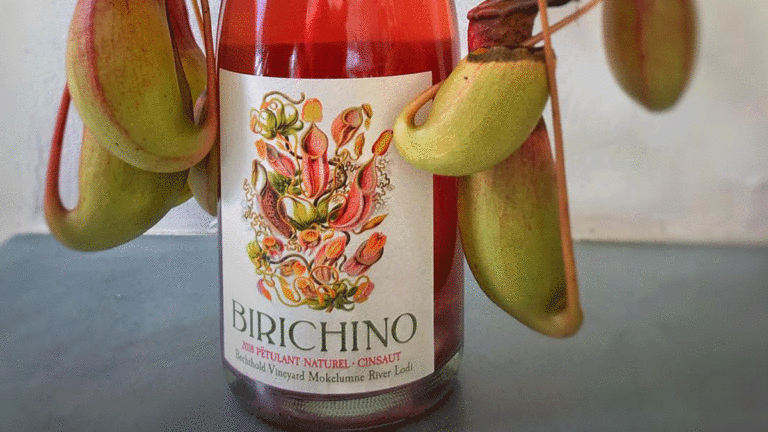
From the fabled bargain wine shelf at Shopper’s Corner, I recently scored a bottle of 2013 McHenry Vineyard Santa Cruz Mountains Pinot Noir, marked down from $34 to $19.99. Yes, this is a big deal. The 13.4 percent alcohol wine shows off the terroir of the Bonny Doon estate’s 2-acre, 1,800-foot-elevation vineyard. An elegantly-structured Pinot, the McHenry opens with mint, blueberries, and a generous nose of bay leaves. The finish offers a distinctive suggestion of orange and mystery spice. Firm tannins. We have enjoyed this wine for two nights, first with Thai curry carry-out from Sabieng, and then with local king salmon from Shopper’s.

Opinion: August 29, 2018

EDITOR’S NOTE

World Cup fever came and went again this year, without appearing to make much of a lasting shift in how soccer is viewed in this country. A decade ago, soccer fans believed Americans would be joining the rest of the world in truly embracing their sport any time now, but that’s never really happened. Every four years there’s a spike in interest here when the World Cup rolls around, but it doesn’t stick.

Cultural referees are constantly arguing about the reasons why, but I think this year it had a lot to do with the fact that the U.S. men’s national team didn’t qualify for the first time since 1990. People like to have a home team to root for; they want to feel an emotional connection to what’s happening. That’s why the closest soccer has come to a real pop-culture breakthrough in the U.S. was probably 2004, when the American women’s team improbably won their second Olympic gold medal with a performance in Athens that stunned the world.

It’s also why this semi-pro team that Lauren Hepler writes about in our cover story this week, Ville FC, has potential to affect how a lot of people in Santa Cruz County feel about soccer—and they haven’t even played a game yet! You’ll have to read the story to understand why; it’s full of interesting characters, raw talent, compelling stories and crazy dreams. And if that isn’t the best reason to follow soccer—or any sport—I don’t know what is.

STEVE PALOPOLI | EDITOR


LETTERS TO THE EDITOR

Read the latest letters to the editor here.

Re: “Trestle Mania” (GT, 8/22):

Bud Culligan, Miles Reiter and William Ow—Greenway backers—financially supported the Capitola initiative to undermine the current rail trail project. Why scrap the current plan and start from the beginning, wasting all the time and money already put into this project, costing millions of dollars more, and likely never getting a trail at all? This makes absolutely no sense.

Why would a rich organization, Greenway, suddenly appear in our community with one purpose: kill rail-with-trail that has been in the planning for almost 20 years with groundbreaking on the first segment within months? Especially when the current rail-trail plan essentially builds one half of the unapproved, unfunded Greenway “concept plan” with walk and bike use beginning for all of us soon! Then I read articles in the New York Times and L.A. Times in June, which outlined how the Koch brothers’ organization is winning and removing rails against communities’ desires to keep them. The big money backing removal of rails is called “Americans for Prosperity” and is a Koch-financed conservative group. This very rich and powerful organization has been successful in removing rails all over the country and they focus on areas like ours. Koch companies produce gasoline, asphalt, seat belts, tires and other automotive parts. I wonder if our local individuals are being used by the Kochs.

Mary Murray
Santa Cruz

Re: KSCO

Uh oh, it’s the Thought Police! I remember around a year ago when the same naive “journalist” proudly bragged about getting KSCO to no longer discuss such crazy things as white genocide. Now, it’s in the news daily. Speak your truth. Quit trying to make others be silent. Being a beta male doesn’t mean you can’t be a bully.

— Tommy

Re: KSCO

I am so disgusted over Zwerling’s coddling of racism and bigotry. I really enjoy Rosie & Rick in the morning, but supporting the likes of Georgia is not something I can do. Charlie is bad enough, but Georgia is an outright bigot. I am going to have to boycott the station until she is fired. It is disgusting that MZ allows it to happen. He’s as bad as his Mother was!

— Nanci

Re: KSCO

With all these double standards (when it comes to the hosts and what is allowed and not allowed), it appears as if there is an agenda at KKKSCO. How can all of Georgia’s anti-American rhetoric go ignored and unrecognized as such, but Billy gets fired for pointing out the obvious?

Georgia gets to say that America is a nation based on heritage and culture, which she defines as race specific. She even parts ways with the MAGA movement and claims that America IS NOT AN IDEA. So this un-American wannabe Nazi is allowed to continue to be on the air and further confuse some, encourage others, and disgust the rest. What do you do?

KSCO: Listen, and be herded … to the slaughter… by this Judas goat.

— William Milton

Re: KSCO

Thank you Jacob for this article. I have filed an “Out of Bounds” report on the KSCO website. My complaint is based upon today’s “Georgia Peach” show. I believe that the verbiage and statements that she shares on the airwaves are far more detrimental than the two hosts that were fired. I do not understand why she is still on the air at KSCO.

— Marilyn Theresa Rockey


PHOTO CONTEST WINNER

Submit to ph****@*******es.sc. Include information (location, etc.) and your name. Photos may be cropped. Preferably, photos should be 4 inches by 4 inches and minimum 250dpi.


GOOD IDEA

The Harm Reduction Coalition of Santa Cruz County is organizing a vigil on International Overdose Awareness Day, the evening of Friday, Aug. 31, to honor and remember community members who died of overdose. Coalition supporters will gather on the Santa Cruz County courthouse steps at 5:30 p.m. and walk to San Lorenzo Park. Signs and photographs are welcome. The group will host guest speakers, share training information and distribute Naloxone as well as Fentanyl test strips. For more information, email hr******@***il.com.


GOOD WORK

The Santa Cruz Chamber Board of Directors has selected the 2018 Gala Award Honorees. During its Oct. 25 gala at the Cocoanut Grove, the local economic partnership will honor Carrie Birkhofer, president and CEO of Bay Federal Credit Union; Duf Fischer, chamber ambassador chair; Santa Cruz County Bank and the Downtown Streets Team. Special Legacy Awards will go to Dan Haifley and Gary Griggs for their lifetime contributions toward promoting and protecting the Monterey Bay’s ocean waters and the environmental health of our region.


QUOTE OF THE WEEK

“Soccer isn’t the same as Bach or Buddhism. But it is often more deeply felt than religion, and just as much a part of the community’s fabric, a repository of traditions.”

-Franklin Foer

Kuumbwa Jazz Honor Band is Santa Cruz’s Musical Talent Factory

Kuumbwa Jazz Honor Band
Local program is spawning some of the most innovative musicians in the country

Rob Brezny’s Astrology Sept 5-11

Astrology, Horoscope, Stars, Zodiac Signs
Free will astrology for the week of Sept. 5, 2018

Re-Thinking the Way We Live: Risa’s Star’s Sept. 5-11

risa's stars
Esoteric astrology as news for week of Sept. 5, 2018

Fight Over Rent Control, Evictions Comes to Santa Cruz

Measure M
A battle brews over Measure M and a vision for Santa Cruz

The Price of Parking: 600-Space Downtown Project Faces New Scrutiny

downtown parking
A former planning consultant raises alarm as officials look to other communities for examples

Preview: Aki Kumar Brings Bollywood Blues to Michael’s on Main

Aki Kumar
Aki Goes to Bollywood performs Friday, Sept. 7 at Michael’s on Main.

Ocean Film Tour’s New Wave Cinema Rolls into Rio Theatre

Ocean Film Tour
The international ocean-themed film festival will happen Sept. 8 in Santa Cruz

Film Review: ‘Searching’

Searching film
Beneath the missing-person plot of ‘Searching’ is a subtext about humanity lost in a wash of tech

Festival fever: Mole & Mariachi, Greek Festival converge on Santa Cruz

Santa Cruz Greek Festival
Plus a screaming wine deal at Shopper’s Corner, and an update an upcoming openings

Opinion: August 29, 2018

Plus letters to the editor
17,623FansLike
8,845FollowersFollow