

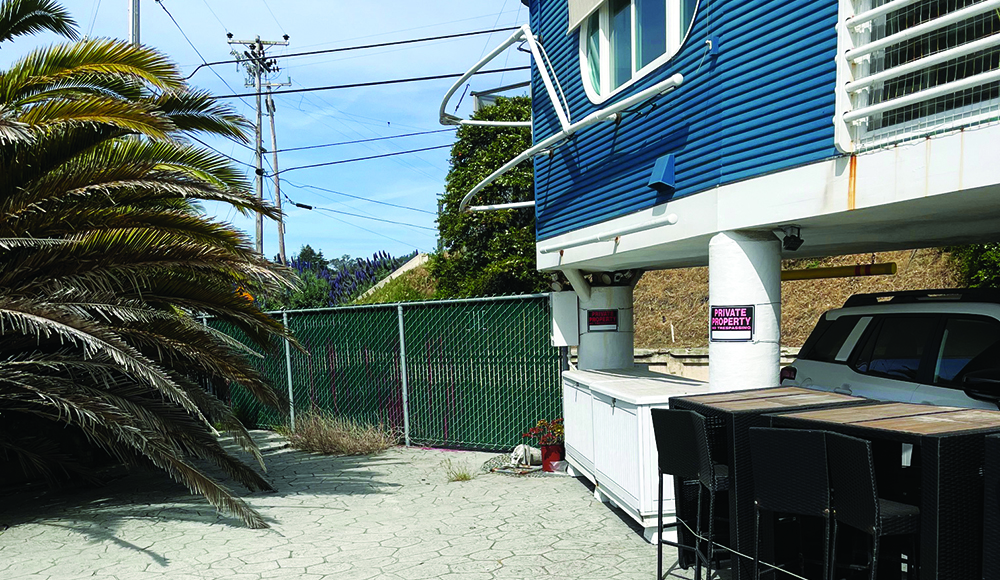
The long-running fight over access to the Rio Del Mar beachfront walkway took a turn in Santa Cruz County Superior Court on April 24, as a judge granted a temporary injunction in favor of the homeowners who brought the case led by Christopher Weseloh, who challenged the county’s position that the walkway is public.
In a post-disposition hearing held after appellate courts affirmed the public’s right to the path, Judge Syda Cogliati ruled that the plaintiffs, led by Weseloh, are entitled to preliminary relief while remaining issues are sorted out. The plaintiffs are requesting some restrictions or accommodations, such as possibly closing the walkway at night in the interests of safety. Judge Cogliati scheduled a settlement conference on June 30 to discuss this further.
The court denied the county’s attempt to end the case outright, signaling that key questions about how the ruling is implemented are still unresolved. The court has now ordered the parties into judicial mediation, suggesting the next phase of the dispute may be negotiated rather than decided in court.
Walk down the narrow strip of concrete that runs for 800 feet behind a row of oceanfront homes in Rio Del Mar, at both ends you’ll find a six-foot cyclone fences with green slats blocking the way. The courts had already affirmed that the public can walk there, now the question is when that law will be enforced.
After an appellate court affirmed the public’s right to use the beachfront path—and the California Supreme Court declined further review—the case has returned to the trial court to determine what happens next. The court is now positioned to monitor compliance, set deadlines, and, if necessary, order enforcement actions to ensure the long-disputed path is reopened. At this point, the question isn’t whether access exists—it’s when the law will enforce it. For now, enforcement is paused under a court-ordered stay.
On March 26, I encountered jovial, young, Air B&B vacationers, getting their sunburn on, who were happy to joke with me. One offered me a beer as I passed. My welcome by the revelers was far different than when I meta homeowner two years earlier (see Good Times 4/10/24, goodtimes.sc/take-a-hike).
The 10-foot-wide path runs parallel to the shoreline. In 1929, Santa Cruz County accepted the strip as a public dedication. In 1953, the county appeared poised to abandon the walkway but never completed the legal steps to do so. Two decades later, under the California Coastal Act, access to the shoreline became a state priority and when coastal protections were applied to this stretch in the 1980s, public access was written into the terms.
Over time, the path blurred into private space with barriers, at times with fencing and temporary obstructions. Then, in 2023, the California Coastal Commission ordered the barriers removed and proposed roughly $4.78 million in fines.
A trial court sided with the homeowners in early 2024, calling the walkway private. Months later, an appellate court reversed that decision, finding the public’s rights had never been extinguished. On December 10, 2025, the California Supreme Court declined to intervene, leaving that ruling in place. The pathway is legally public. The homeowners’ argument wasn’t frivolous; it was just weaker once the historical record came into focus. They believed the public right had disappeared. Legally, it had not.
John P. Erskine, attorney for the Rio del Mar Homeowners’ Association, declined to comment.









Would it be ok if I walk on the sand and got onto the walkway that way? I used to walk there so I know there are steps leading down to the beach that I could walk up and get on the walkway that way.
It is sad when any homeowner living on the beach then uses government benefits to protect themselves from sea level rise to building barriers or extending their staircases for personal use. Worst build yet another gated community.
It is time for these county leaders to take action and stop focusing their energy on national issues that don’t involve the community.
Whatever happened to ADA compliance or negotiations to protect our access to and along California shoreline
I wonder what would happen if the fences were simply moved to the side by concerned citizens. Surely they wouldn’t place them back while under orders to remove them? Surely right?
Hello again, a group of us took a walk down this very narrow sidewalk. Ling and behold, garbage and recycling cans blocked our ability to safely walk on the narrow sidewalk – HENCE PUBLIC RIGHT AWAY ALONG THE SHORELINE. Where are the fire departments enforcement officers? Secondly, the writer describes how a air-b-nb or O’Neil vacationers were recklessly drinking beer and throwing a beer to the writer. Where are the owners responsibility? Supervisor De Serpa cares nothing about this situation per her campaign run but now it’s time that she respond or resign from office. Enough that secondary homes are preventing the public from accessing safety walking bc they don’t want to maintain public access and safety. Where are the Coastal Commission and Health Inspectors?
As a septuagenarian, with some balance issues, who prefers walking where parking access to the beach in Aptos does not require negotiating a long stairway, I was very upset to see the fences erected. The walkway along the street is dangerous, as it is poorly lit, poorly maintained, and obstructed by storage of waste receptacles.
I proposed an alternative in the past that the sidewalks behind the buildings be widened, parking be prohibited there, people be prohibited from storing containers that impede access, and that the area where people are parking their cars be divided into extension of the sidewalk into the street, to widen it, and the other half be used for a dedicated bicycle lane. Trash and recycling receptacles being placed on the walkway, block the sidewalk, and create a hazard as someone needs to step off and on and simultaneously negotiate around parked cars.
The HOA is quite selfish, in that they desire the walkway with ocean frontage, block and poorly maintain the walkway behind the buildings, and block the street with their vehicles. I have lived in beach communities most of my life. Ocean facing buildings more often have sidewalks in front of them to allow public access. The court order should be enforced.
I walk along this location every day. I remember when the path in question was open after the county removed the barrier on the Southern end of the walkway. I didn’t relish walking along the disputed path while people were enjoying themselves with Sunday brunch or afternoon cocktails. It felt like I was intruding. I also don’t like playing dodgeball with people or other impediments while trying to navigate the sidewalk which is currently imposed on me. There are many impediments I must navigate just to enjoy my walk. Trash cans, cars which have extended side mirrors, so called landscaping extended on the sidewalk, steps protruding into the walkway. I frequently need to stop and allow people to pass because of these impediments. WHY? If the owners of these properties wish to enhance their revenue, and lets be honest here, that is reason they wish to close a public pathway for financial gain. They must make amends to the public and the community that it resides in. The solution. Improve the passageway on the sidewalk. Remove all obstacles. Trash cans, planters, cement steps. All which impedes walking traffic which includes walkers and wheelchair access.
This issue is about money! Plan and simple. The owners of these properties have zero interest for the community, we shoulder the burden.