
You feel it, most days in Santa Cruz, some more than others, a kind of vibe, a kind of magic in the air, like that feeling just as the fog is burning off and the chill salt air comes alive with an extra tingling energy in the fresh late-morning sunlight. If you take THAT feeling, that giddy energy suffused with possibility, and try to find the living human embodiment, the avatar if you will of Santa Cruz creative energy at its potent and playful best, that avatar has a name, and it’s Wallace Baine.
Talk about energy. The man spent 26 years at the Santa Cruz Sentinel, where his tireless reporting and smart, funny writing turned him over the years into the pulsing heart of the Santa Cruz County creative scene, a role he continued in his work here at the Good Times and later at Lookout, an online local news outlet. His love of creativity breathed life into his articles, and brought people out for everything from author events to music gigs.
Bookshop Santa Cruz owner Casey Coonerty Protti speaks for many when she calls Baine a “community treasure,” whose work has sone so much to give Santa Cruz a rich cultural life. “He was at the center of it all,” she added.
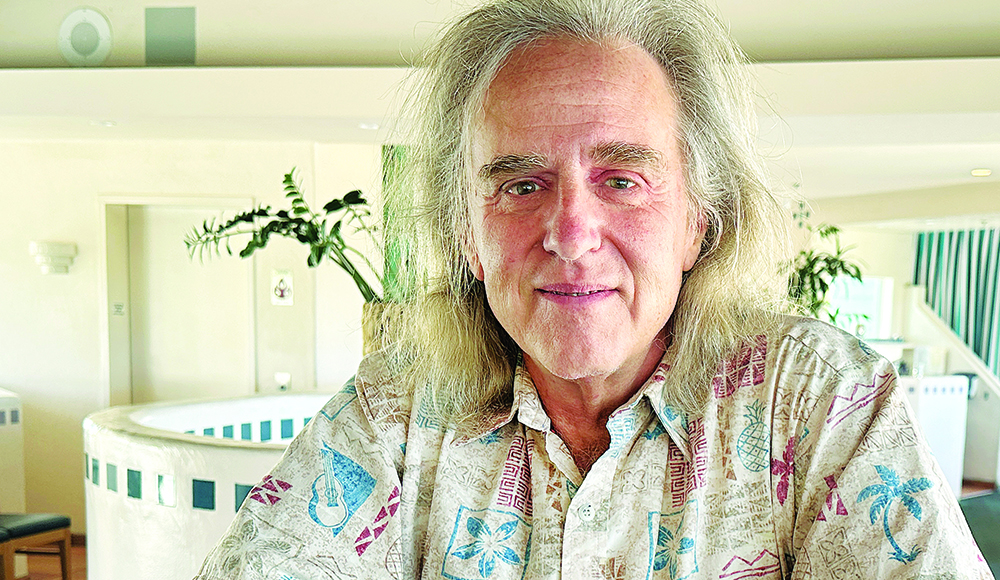
Baine, in his way, is still at the center of it all, showing in his sixties that if you live the life of creativity, it can push you to take daring and thrilling risks no matter your age. Baine is a published author many times over, including his highly regarded volume on the story of Bookshop Santa Cruz surviving the Loma Prieta earthquake and so much more, A Light in the Midst of Darkness: The Story of a Bookshop, a Community, and True Love.
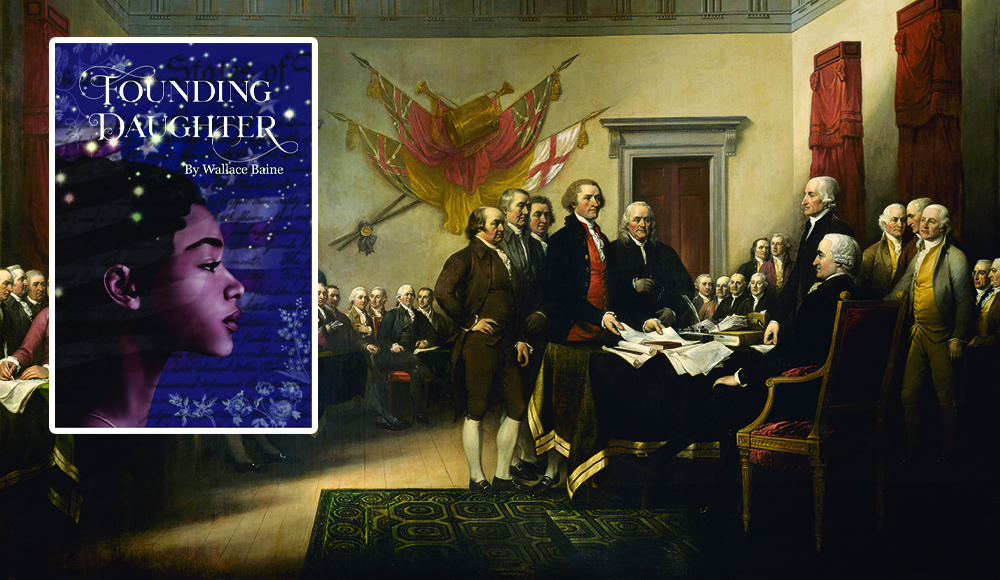
Now, at 64, he’s a first-time novelist, an accomplishment at any age, publishing his debut novel, Founding Daughter, a story guaranteed to make anyone who reads closely think all over again about the creative vision behind the founding of the United States. I look forward to questioning Baine about his novel at Bookshop Santa Cruz on Wednesday, June 24, starting at 7 p.m. I for one expect it to be a lively discussion! (See Fact Box below.)
Ready for the setup? Try this from the back jacket: “What if the noble words of the Declaration of Independence were not written by Thomas Jefferson, but by an author of much lower station still aspiring to be free? What if ‘life, liberty and the pursuit of happiness’ was the idea of an especially precocious, bookish, half-Black, teenage servant girl.”
To some, no question, talk of the noble promise of a document from the 18th Century might not inspire quite the excitement, say, of a fresh swell at Pleasure Point or a really cool new photography exhibit at the MAH, but I for one feel like, in the year 2026, watching U.S. democratic culture veering wildly off the road, it’s worth delving into the question: What was this whole experiment in self-governance about from the start?
One thing it was about, we know, was catering to the needs and wishes of propertied white men, a small percentage of the overall U.S. population. They were the only ones who worked on the Declaration of Independence and the U.S. Constitution, and for the most part, they were the only ones, back then, who could vote.
It kind of pained me recently to have to explain to my daughters—9 and 11—that up until 1920, less than a century before either of my daughters was born, women did not even have the right to vote in this country. They looked at me with puzzled eyes, then went back to watching Helena Bonham Carter try to blow things up in London as the suffragette mother of Sherlock Holmes in the Enola Holmes movies.
If the words and the ideas of the Declaration helped power this country’s early years as a democracy, they have over the years become like a TV remote control that needs new batteries. Somehow, the signal is not getting through anymore. Baine, daringly, steps into this conundrum by unspooling an alternate-reality history of the United States through the perspective of Temple Franklin, grandson of founding father Ben Franklin. You know, the guy who flew a kite, wore little glasses every coffeehouse poseur tried at some point ever since, author and publisher of Poor Richard’s Almanack, which made him rich, and The Autobiography of Benjamin Franklin, which bedeviled lit students for centuries to come. His grandson Temple is a bit of a misfit, given to anguished looking back at what he failed to do.
Baine’s idea was bold, but simple. What if you could remove some of the moral stain of a document purporting to support equality to all that happened to have been written and ratified by slave owners?
“To me, the preamble to the Declaration is beautiful in its elegance and simplicity as a political aspiration, and I recognized how revolutionary it was to utter in the age of worldwide monarchy,” Baine said in an interview. “But, of course, like millions of other Americans, I had to grok that it was written by a slaveholder, someone who denied hundreds of people their life, liberty and pursuit of happiness. That fact diminishes the words; how could it not? So, as a thought experiment, I mulled, what if the Declaration was written with a pure heart, by someone with a real stake in its outcome, and not an elite white male slaver?”
This led Baine to create his scene-stealing character, Charlotte “Lottie” Berbich, a fifteen-year-old of mixed race whose hobby, if you want to call it that, was deep-dive binge reading of her favorite French Enlightenment authors, Voltaire above all, but also Rousseau, Locke, Montesquieu, Hobbes, Diderot, and on and on. She dives into these books with joy and wit and a searching mind.
Baine’s novel unfolds in two sections, one in third person, setting up the story, and the rest in first person, told through the perspective of Temple Franklin, secretary to his famous grandfather, who is smitten by Lottie Berbich from the moment he sees her when he and his grandfather pay a visit to Mrs. Patience Berbich, Lottie’s adoptive mother.
I would guess that most any reader, wading into Baine’s story with a fresh and open heart, would probably feel a similar reaction to this fictional creation. “A door opened, and a girl appeared clutching a book,” Baine writes on page 35 in a section from the perspective of poor, besotted Temple Franklin. “She bowed her head and lowered her eyes in deference but I could see that she was laboring to suppress a grin. When she lost her battle and the smile prevailed over the embarrassment, I immediately felt as if I were witnessing a sunburst.”
Pulls you in, doesn’t it?
‘“My heavens,’ said Dr. Franklin, gesturing to the book the girl was holding. ‘I recognize that volume by its cover. Is that not the copy of Plutarch’s ‘Lives’ that I…”
That Franklin himself had left years earlier.
“Franklin reached out his hand and the girl gave him the book. He opened it and the morning light reflecting off its pages illuminated the delight dancing across his face. ‘I must have read these stories as a lad, oh, I don’t know how many times.’
“’It’s the third go-round for me,’ said the girl, comely, black-haired, her copper-colored eyes as seductive as a cat’s. ‘In truth, I prefer Tacitus. His prose is more invigorating. But I treasure that volume with my every breath. There are worn spots there on the leather that I’m just sure came from Voltaire’s own hand.’”
A little over the top? I don’t know. Baine started work on this novel more than a decade ago, and read from it at one of our Wellstone Center in the Redwoods’ Tuesday night Open Mic nights many years ago. I recall being taken by the character and wondering if others would be. Then in January 2021, I was one of many wowed by California-born poet Amanda Gorman, then 22, turning in an electrifying performance during Joe Biden’s presidential inauguration, reciting her poem, “The Hills We Climb.” To me, to anyone who had trouble imagining Lottie Berbich, I thought: Think Amanda Gorman, a few years earlier.
Baine delights in capturing the confused stupidity in white men forever underestimating the intellect and imagination of others who are neither white nor men.
“Franklin’s face froze in puzzlement,” Baine continues the scene “He looked at the girl in a mystified daze.
“’This is Charlotte,’ said Mrs. Berbich. ‘But we call her our Lottie. She’s our bookish one. She can name just about all the popes of Rome in order.’
“Franklin peered at Mrs. Berbich over his spectacles. “A rare feat indeed in Pennsylvania,’ he said slowly, with an edge of skepticism.
“’She’s also devoured every copy of Poor Richard’s Almanack that she’s been able to find,’ said Mrs. Berbich in reference to Franklin’s own contribution to the literature of his time.
“With that, Lottie began reciting many of the aphorisms by which Poor Richard and Franklin had become famous: ‘Plough deep while sluggards sleep and you shall have corn to sell and to keep,’ she said, swaying her hips in a sing-song rhythm. ‘Pride dines on vanity, sups with contempt… How many observe Christ’s birthday; how few his precepts.’
“After quoting perhaps two dozen of Franklin’s adages, Lottie elaborately bowed in front of the great man, like a dancer after the music has stopped.”
Given the painful relevance of that last adage in our diseased contemporary culture—how many observe Christ’s birthday, how few his precepts, indeed—the passage lands with an authority few could see coming.
The message it conveys is this: If you do the reading, if you let your mind run in the field of ideas, like Dylan singing about “using ideas as my map,” you just might plot a journey to somewhere miraculous, and that journey is wide open to anyone willing to take it.
This is the essential truth of Baine’s novel and of Baine the man: He believes in creativity, especially Santa Cruz-style creativity, and believes in a well deep inside each of us, which we can feed and let feed us. Anyone who has sat with him in a group of writers sharing their work can attest to the generosity and insight, yes, but also the love of creativity in the notes he shares. Now here he is, a Pulitzer Prize in journalism behind him, publishing his first novel.
“It’s almost like he’s been hiding his brilliance, who knows where, and he finally, in his 60s no less, has unearthed the rock and let his mind dance around us,” said local author and theatrical actor and producer Helene Simkin Jara. “Every time I hear bits of his novel, I want to jump up and say, ‘Are you kidding me? How’d you do that?’”
It takes not only a deep well of talent to produce a polished work of fiction as thoughtful as Founding Daughter, but it also takes other qualities. One must possess a certain disarming proclivity toward slamming into brick walls, dusting off, spot-drying a bloody patch or two, then getting back up to—BOOM!—slam into another brick wall. If anyone thinks I’m being glib, try writing a novel, and doing a rewrite or two or five, and then get back to me. Then move on to the part about being a white dude past sixty delving into a story whose novel is built around a female character, a character centuries—and universes— away from his own experience in so many ways. That, of course, is the point: If we can’t all stress-test the unfulfilled promises of the Declaration and also the Constitution, if we can’t take it seriously as a document for everyone, then we’ve already lost.
Baine’s writing is rich and pitch-perfect throughout, a master prose stylist focused on evoking the language of the era to show that language is just language, what changes is how we perceive it. There is, therefore, a kind of rebirth in this book, a rebirth of actual ideals, as opposed to slogans we mouthed as children.
When Baine’s fifteen-year-old Lottie is introduced to Thomas Paine, he scoffs that he has ‘food lodged in my teeth’ older than her. But then she speaks to him.
“If I may, sir,” she says, “What are your own writings in the Pennsylvania Magazine but the insistence that every man should be able to determine the shape of his own life outside the boundaries imposed by English monarchy? Forgive me for my boldness, sir, but who might be more intimately familiar with the pinch of those restraints than an orphaned mulatto female?”
It is a good question. ∎
Wallace Baine, author of “Founding Daughter,” in conversation with Steve Kettmann, Wednesday, June 24, 7 p.m., Bookshop Santa Cruz (1520 Pacific Ave.), free. bookshopsantacruz.com/wallace–baine