

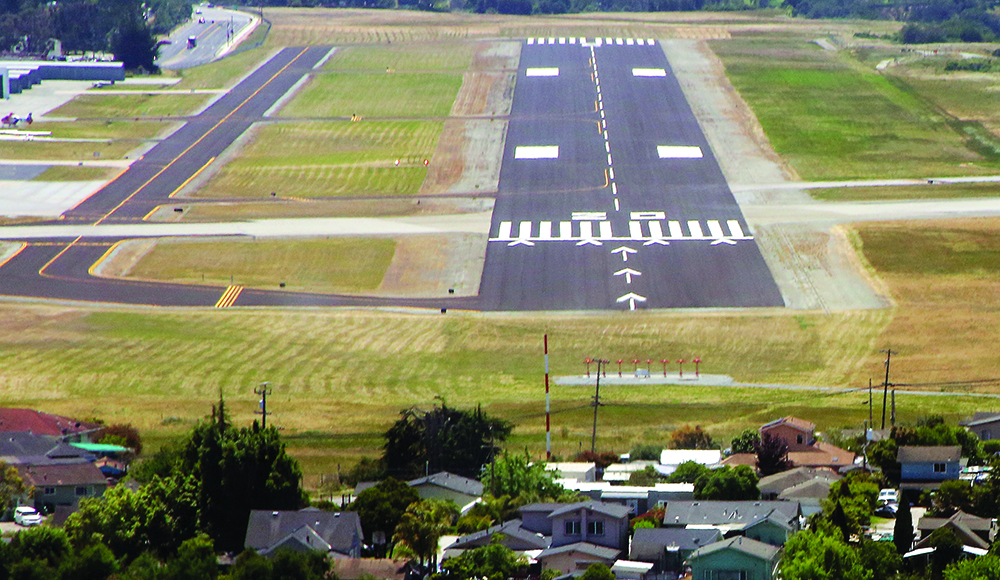
A Santa Cruz County Superior Court judge has ruled that the City of Watsonville violated state law when it approved housing development near the Watsonville Municipal Airport without first adopting required airport safety standards.
In a 24-page decision issued Feb. 3, Judge Timothy Schmal sided with the Watsonville Pilots Association in a long-running dispute over land use around the airport.
A judge sided with the group and ruled that the city broke state aviation and environmental laws. The court ordered the city to fix the problem and stop the illegal actions.
At issue was the city’s 2021 approval of a 21-unit residential project at 547 Airport Blvd., within designated airport safety zones. The court found the city approved the project without incorporating mandatory state airport safety standards — outlined in the California Airport Land Use Planning Handbook — into its General Plan, as required under state law and by earlier court rulings.
“This case is not about discretion,” Schmal wrote, noting that Santa Cruz County is considered a “no-procedure” county under state aeronautics law. In such counties, cities must adopt state airport compatibility standards into their general plans before approving development near an airport.
Watsonville city officials declined to comment.
The decision traces more than a decade of litigation between the pilots association and the city. Courts previously ruled in 2008, 2010 and 2014 that Watsonville must incorporate state aeronautical safety criteria as nondiscretionary standards in its planning documents.
Despite those rulings, the city continued approving projects near the airport based on its own safety analyses and its 2005 General Plan, which does not formally adopt the state standards.
The court rejected the city’s argument that it could rely on project-by-project findings. “Making findings in development applications that incorporate Handbook standards is not enough,” Schmal wrote, concluding the city “has no discretion” to substitute its own analysis for formal adoption of the standards into its General Plan.
The judge also found deficiencies in the city’s environmental review. Rather than preparing a full environmental impact report, the city relied on a mitigated negative declaration.
The ruling states that the environmental document did not adequately analyze aircraft noise or safety hazards for future residents. The city relied in part on a 2018 noise study that did not measure conditions at or near the project site and provided limited discussion of airport-related safety risks, the court found.
“The MND’s analysis was conclusory at best,” Schmal wrote, concluding that the city failed to provide sufficient information about potential risks as required under CEQA.
Although permits for the 21-unit project have expired, the court rejected arguments that the case is moot. The city’s zoning and land-use changes near the airport remain in place, leaving open the possibility of similar proposals.
The decision clarifies that Watsonville may not approve development within airport safety zones unless it first amends its General Plan to comply with state aeronautics law or an Airport Land Use Commission is established.
Representatives of the city did not immediately respond to a request for comment Monday.
In a statement, the Watsonville Pilots Association said it supports addressing the city’s housing needs but maintains that development near the airport must comply with state safety requirements.
The ruling leaves it to the city to decide whether to update its General Plan, pursue formation of an airport land use commission or appeal the decision.