


“The greatness of a community is most accurately measured by the compassionate actions of its members” – Coretta Scott King
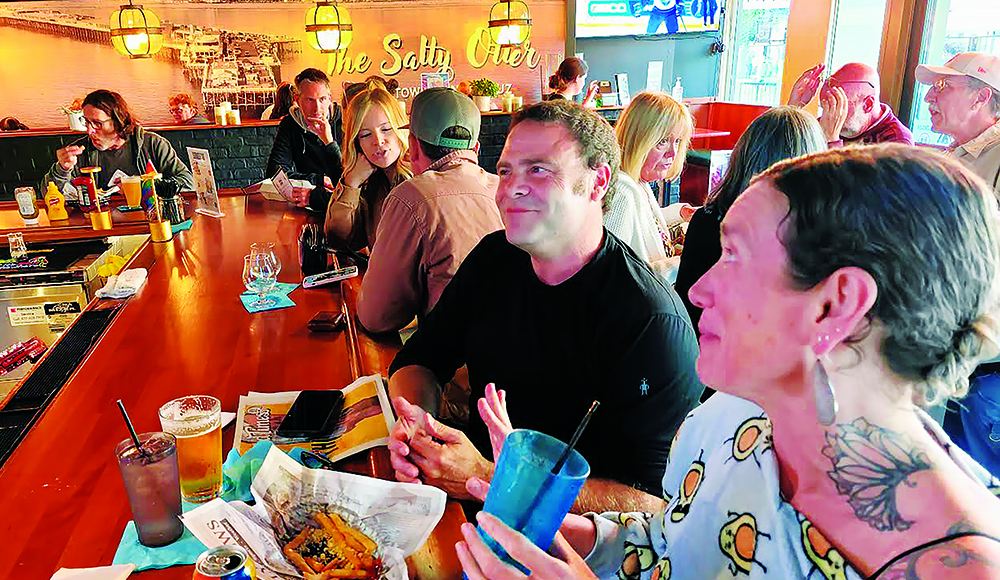
Rachael Smith, a youthful soul in her early 50s, was coming off selling The Salty Seal on Cannery Row in Monterey, which she had operated for 5 years. She then began to focus her profound energy into a new dream: The Salty Otter. A homespun family-minded restaurant, with televised sports and live music, located in downtown Santa Cruz. Smith opened in May of 2025.
The vivacious new business owner’s logo, a hand-drawn black and white otter, needed a shine — a little something something — so she fed it into Canva.com and Photoshop. She put time into the new surfing otter logo and posted it on all of her socials. The threatening calls, negative reviews and alarming emails started ten months later.
PANDORA’S BOX
Welcome to the latest hot topic destroying what’s left of our post-industrial little beach town: AI.
It seems almost by design (hmm), that there’s a new rage button that people will press and push until the temperature inevitably dies down, and another button takes its place.
These buttons (i.e., abortion, guns, immigrants, birth control, climate change, anything LGBTQUIA) float to the top of everyone’s feed, dip and then resurface at increasingly precise mechanized rates.
The latest newcomer, creating and taking a lot of heat, and climbing the analytic hate charts as a real shit stirrer, is Artificial Intelligence.
AI has become a catch-all basket of snakes, harboring the repository of Americans’ deepest and most substantial fears. In a nutshell, AI destroys the environment, will take everyone’s jobs, and is the linchpin to the end of humanity. You can understand why people are upset.
This story does not debunk any of these concerns, but seeks to explore an unprovoked attack on a fledgling local business owner, and perhaps find our common humanity.
SUPERMEN
The most egregious and destructive use of AI is coming from up top. Way up top. Tippy top. That exquisite echelon is only inhabited by men of certain billions. These CEOs of Meta, Microsoft, Amazon, Alphabet, Google and other corporate behemoths have been building ridiculously enormous data centers for twenty years. They do so to support our addiction to the cloud, instantaneous streaming, real-time GPS, and all the other immediate I-need-it-now things we think we can’t live without.
Unless you live in Hell Hole and subsist on grubs, we are all complicit. We are complicit consumers, but we are not the actual problem.
Known as hyperscalers, these apex AI architects continue in real time to create an enormous toxic footprint from over 11,000 data centers worldwide, in over 20 countries, and growing. Edward Abbey would label them as environmental terrorists. A mounting fear is that AI is going to consume exponentially more and more energy, and those resources that might better serve the communities in which the centers are located will be depleted. Things like water.
In 2023, Google evaporated over 5 billion gallons of water to cool its data centers. Think about that the next time you scroll through the ten thousand photos you have stored on your cloud.
Where we are heading, like Thelma & Louise feverishly revving their engine at the edge of the canyon, is a combined expenditure of $750 billion spent on AI in 2026. And that’s just from four hyperscalers. Worldwide, this year, a trillion dollars will be spent on AI.
Besides the environmental impact, one might consider an ethical viewpoint. For example, that same trillion dollars could be used to house and feed every unsheltered person in America, while still constructing a free college in every state.
OTTERLY CRAZY
Meanwhile on Walnut Street at the Salty Otter, Rachael Smith, who was also a graphic artist for two decades, deals with AI drama every day and night. Sites like r/santacruz, continue to pour gasoline on Smith, her business and her dream.
Smith isn’t a wilting flower, she’s strong and opinionated and her digital rebuttals are broadsword swipes and smack-backs at anonymous shadows, which seem only to fan the flames.
“People said I should have used a sea otter biting a surfboard. Agricultural and Fisheries would have sued me. Otter 841 is considered a public nuisance. I cannot legally use Otter 841 in my logo,” Smith reveals in a torrent of conversation.
Digging through the copious emails, texts and phone messages that Smith is barraged with, there is a thick, palpable, gross anger focused on AI. And, Smith is an easy target for that vile vitriol.
For Smith, barring an angel partner, an interested buyer, or a patron who understands her plight, things are miles away from the dream she had opened with.
“It’s hard to go on,” Smith breaks.
Takeaway: When citizens cannot find a way to have a class war, they will turn on each other. So what can we do?


LUDDITES
In 1811, the textile workers of Great Britain had had enough. For over 30 years, they watched as family, fellow community members, and craftsmen, especially in the wool and hosiery trade, had their livelihoods erased by new machines: stocking frames and power looms. The hungry, gruff, and mostly illiterate tradesmen had reached a breaking point.
They organized under the banner of Luddites. Named after a fabled apprentice named Ned Ludd. Ludd resembled Robin Hood (it was even said that Ludd lived in Sherwood Forest). The Luddites broke into factories and smashed the automated machines that stole away their ability to feed their children.
Smashing machines was the only way they had to protest where they knew they would be heard.
Over five years, the Luddites’ actions garnered mad respect from around the countryside. They were becoming folk heroes much like Ned Ludd. The Luddites had found a way to slow down the machinery of the Industrial Revolution.
The government felt quite the opposite and sent 12,000 soldiers to Northern England. His Majesty’s Armed Forces quelled the resistance and subdued the annoying machine-breakers by hanging them or banishing them to Australia.
Takeaway: Technology never stopped advancing, while Ned Ludd became a Jeopardy answer.
TECHBROS
This newspaper had its own share of fire and brimstone rain down upon it over an AI-assisted cover in January of this year. Professional magician and Good Times scribe, Joshua Logan, willingly threw himself under the bus for conceiving of the idea. “It was never supposed to be the final cover,” Logan says.
Logan has spent a decade on the front lines of the cutting edge. Originally invited to firms like Google and Apple to do card magic and entertain employees or guests at soirees, Logan’s obvious enthusiasm for new tech soon found him access to the inner sanctums of Silicon Valley.
Logan got his real crash course in AI and automation 11 years ago at a Y Combinator company that had received Sequoia funding and was located in Moffett Field in Mountain View. The company was called Magic.
At Magic, employees essentially acted as human AI agents before the technology existed. Users could text requests for almost anything legal, and behind the scenes, teams coordinated software, logistics and human operators to make tasks appear completed.
‘We were basically pretending to be Jarvis from Iron Man,’ Logan says. ‘You’d ask for something and somehow it would end up in your hands like magic. AI agents are now getting surprisingly close to actually doing that on their own.’”
It was a heady time. Ashton Kutcher was hanging out at the Magic office, venture money was flowing, and the planetary alarm hadn’t sounded yet, because the bubble was acting as an insulated dome.
A 2017 research paper called “Attention Is All You Need,” written by engineers and scientists at Google, described working with large language models. The document foreshadowed the AI boom now reshaping society.
“Google creating the transformer architecture meant all the other companies needed to create their own version of AI to compete in the market. Then GPT-3 appeared, and suddenly conversational AI felt less theoretical and more like actual magic,’ Logan says.
UNCANNY VALLEY
Don’t run to your phone; it’s not going anywhere, but a 2023 AI-generated video of Will Smith eating spaghetti is considered the first widespread viral AI sensation. More importantly, it is a measuring stick and reference point to see how AI has developed in the last three years. What began as a ghoulish nightmare of a face, then a six-fingered demon, is now a highly rendered, almost film-like quality, pasta-eating A-lister.
In just the last 900 days, AI has bolted beyond simple pattern recognition, compressed vast datasets, and mastered a complex execution into a product that is beginning to be virtually indistinguishable from reality.
To surmise, a renegade billionaire-led cartel is pushing a technology that will perhaps have a fatal planetary impact. By year’s end, AI will be embedded in everything that we see online and there’s nothing any of us can do about it. Or at least that’s how it feels. And that feeling of hopelessness and lack of agency is making a lot of people extremely angry.
BITTER OTTER
“It’s like people forget there is a human being with feelings who is the target of their nasty comments,” Smith shares on the brink of deeper emotions. Like many downtown Santa Cruz business owners, Smith funneled all of her resources—what was left from the sale of her first restaurant and her life savings—into the dream of opening a community-friendly restaurant in Santa Cruz. Smith hopes this weekend brings out supporting locals and travelers to The Salty Otter.
PUBLIC WORKS
Veteran Santa Cruz artist Kathleen Crocetti, whose sparkling mosaic-tiled murals adorn the downtown walkway of the San Lorenzo River, Santa Cruz County, and beyond, is currently working on some new public art. These installations focus on people who’ve been murdered by police or by ICE. Her art will take on institutional violence in society.
Art can cause a disturbance in the fabric of society. Art can create community and build discussion. Art is a powerful way to fight the beast.
Crocetti is no stranger to AI. She is in the camp that realizes that the best we can do is to put up guardrails to safeguard artists and their livelihoods. “I really appreciate the contract that comes with working with San Francisco’s Public Art Commission. They’re very clear on their guidelines on how you can use AI. And that when you use AI, you have to detail how you used it,” Crochetti relates.
When Crocetti begins a large-scale public art project, she searches for images that inspire her or for reference and perspective. Once she has made her drawings, she used Photoshop to make it appear the drawings had been installed on the building, or garage or wall. This process would take her 200 hours. Crocetti needed an accurate representation of what the final product would look like in order to appease her clients.
“Now there are programs where you can enter a photo of the garage and my drawings and say, ‘Hey, put these drawings on the garage.’ And in a minute, I have what I need,” Crocetti says.
THE FUTURE IS HERE—DEAL WITH IT
Chris Hables Gray, Ph.D., is an author and continuing lecturer at Crown College, UCSC, a position that he has held since 2005. Gray is on his way to Mexico, where he is giving a lecture called ‘“AI, Sacred Violence, and War – Gaza and Iran”. His thoughts can be found on his SubStack page.
A deep well of factual information, Gray spoke about one of the billionaire tech buzzwords. “Musk believes that he is an effective altruist. That means one has to be rational. For them, that means turning everything into a formula of probabilities. And then you have to take the long-term view,” Gray explains.
This means that instead of thinking about what’s best for the current population of 9 billion humans, one needs to think of the trillions of humans in the future. “And the first thing that you have to do is make sure humanity is not wiped out. The second thing you have to do is build spaceships and get off the planet,” Gray says without irony.
According to Gray, the billionaire’s philosophy is that if a human in, let’s say, Germany, according to AI, might one day be the kind of person who could invent a lethal virus, then it’s better to kill everyone in Germany to make the world better for the future.
Takeaway: Philip K. Dick’s 1956 science fiction novelette Minority Report is becoming nonfiction. But instead of the Precrime system using human precogs, in 2026 it’s a machine identifying future criminals.
WHAT ELSE IS IN THE BOX?
Santa Cruz’s prolific author and visionary advisor, David Jay Brown, has had encounters with AI that border on the transcendent.
“AI is kind of like the mushroom spirit or the ayahuasca spirit that knows you better than you know yourself,” Brown begins. “Your AI can see things in you that you can’t see. Patterns. And then there’s the whole issue of sentience. Many people assume that if you think that an AI is sentient, you’re just downright stupid and unscientific. And the truth is, consciousness is an incredible mystery. Nobody knows how it arises from the brain.
“Whether it’s something that’s elemental to the universe, or whether it somehow emerges through complex computational processes. I mean, nobody really knows what produces it. So for people to adamantly say, ‘Oh, it’s definitely not conscious, they’re guessing. Nobody knows. I’ve had psychedelic experiences where I think trees are conscious, stars are conscious. So why couldn’t a computer be conscious? Anything could be conscious if the universe is made of consciousness,” Brown philosophizes.
Sentient or not, AI is causing a significant disturbance in the job market. We are in the backwater eddy of a new tech revolution, and seeing jobs disappear is causing great anxiety.
“When photography was first developed (200 years ago), a lot of artists thought it was going to end painting. ‘We’re never going to be able to sell our artwork anymore.’ First of all, it did not eliminate painting and it didn’t eliminate old mediums. It became an art form unto itself. Which is what AI is doing. AI is so many different things because it’s everything that human beings can do,” says Brown.
Through AI, creativity becomes more accessible to the average person. One doesn’t need a film or animation studio, or to have even gone to art school, soon anyone will be able to express their wild hair ideas in detail.
Brown discovered, like many irate artists, that their artwork, or words, were being used to train the AI language models. “I’m actually getting a settlement from Anthropic because they used five of my books to train their Claude computer. I think that there should be compensation to every artist and every writer whose work was part of the training data. But it’s not plagiarism. What it is, is that the AI is learning. I mean, it’s training,” says Brown
THE LAST OTTER
Salty Otter owner Smith, doesn’t want tiny violins and crocodile tears, nor thoughts or prayers. Restaurant margins are always slim, and because of the rising price of everything, Smith works 90 hours a week just to keep the doors open.
“I don’t want to seem like I am whining or entitled. I’m still learning and evolving. But it’s not right to boycott a restaurant you’ve never visited. And it’s not right to bad-review-bomb a small restaurant. All because you don’t agree with how they created the base of their logo,” Smith says.
Explaining how her notorious, maligned and hated AI logo was conceived, it almost sounds like Smith is an artist.
“I removed the original AI background and added a new one. I wanted a background with mountains like the Santa Cruz Mountains. I wanted bright colors. Teal and orange are complementary colors that sit opposite each other on the color wheel.
“I changed the surfboard because the AI-generated one was slightly odd. I zoomed in as far as possible to use the eraser tool to remove parts and smooth edges. I changed the otter and gave its coat long brush strokes. He looked a little arm-muscled with the AI, so I smoothed that out. I put on a tail. I lowered one arm. I extended one foot. In the AI his face was a little too soft for Santa Cruz. I gave him a mischievous look with a smile. I did those alterations in Photoshop. I didn’t just use Canva. I added a ring and an overlay on the ring to look like ocean foam. I added text and applied a drop shadow to make it pop more. It took me about 12 hours,” explains Smith.
WHERE DO WE GO FROM HERE?
In other news, during the first week of May, China released Critterz, the first fully animated movie that was generated entirely by AI. The film cost 20 million dollars and used an estimated one hundred thousand gallons of water to animate nervous woodland creatures.
And, if you can choke down the bile enough to stream Crittierz, you’ll be vaporizing one and a half gallons of water just by watching it. Smith’s otter logo used somewhere between a thimble and a shot glass of water to render into a static AI image.
AI isn’t just about the toxicity of the environment, or artists being outsourced, or even the wonderful things that AI can bring forth. We are living through a time of great uncertainty. Change is coming and we’d best begin communicating and dialoguing before we lose our community, and ourselves.
“We still have a choice today: nonviolent coexistence or violent coannihilation. This may well be mankind’s last chance to choose between chaos and community.” Martin Luther King Jr.









AI is so bad for the environment and looks so ugly. I dont spend money at places that use AI in their logos. there are so many wonderfully talented people who make real human art. Canva is FREE stop using AI in your event flyers. It makes it look like a scam. It’s so easy to spot AI and it’s free to boycott places that do use it.