

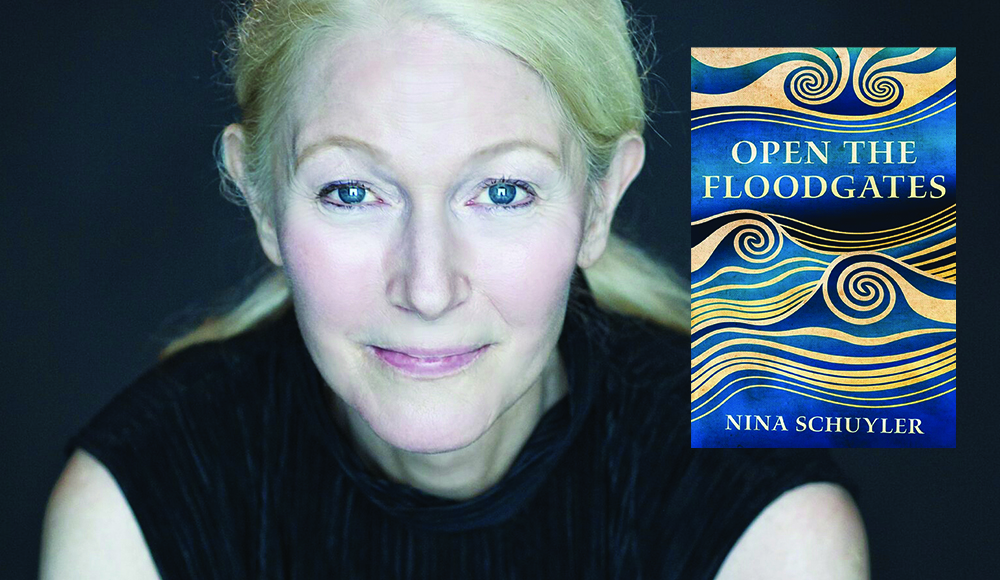
The River, in Nina Schuyler’s new novel Open The Floodgates, is on trial to determine if it actually qualifies for “personhood.”
Existing uncomfortably in the dark confines of the courtroom, surrounded by “man-stink,” The River listens as well-intentioned defenders tell stories of their memories of it, when it was clear and free-flowing.
When enormous amounts of trash and industrial waste hadn’t been dumped into it. When there were many fish, and they were healthy. When all the cottonwoods were still standing on its banks.
Open The Floodgates takes place in “an unidentified California town.” Imagine the river to be the San Lorenzo, as it looked when the Ohlone lived by it, when trout and Coho and Chinook salmon flourished. Before gunpowder was dumped into it by the California Powder Company, before 13,000 septic systems began dumping nitrates into it. Before it was “flood controlled” by the Army Corps of Engineers. Imagine if the San Lorenzo was a person.
But to begin at the beginning: Open The Floodgates is a stunningly written, captivating environmental fable, featuring characters such as Larry Skolnick, “The Judge,” or, as The River thinks of him, “Crow Man,” 9-year-old George, called as a witness for the River, Ed Jacobs, whose First People family has lived by the River for generations, Willard, who dreams he is a seahorse but hates the River, and perhaps most indelibly, along with the River, Hazel.
Hazel is 75, a retired schoolteacher who now owns a beauty salon, and is an ardent supporter of the River during the trial’s opening. She refuses to be curtailed in her testimony by The Judge. “Hazel is like an old-growth tree,” says the River…Ring after ring of life: wisdom with each ring sunny years rainy years a couple of tornadoes years of hardship and struggle and death she turns around the sun like the gloriousness she is.”
Yet even Hazel has second thoughts when, later in the story, the River floods her home and the whole town during days of torrential rain. (She has third thoughts even later.)
THE AUTHOR
Hazel, Schuyler revealed, is one of her favorite characters. A San Anselmo resident, she grew up next to the Deschutes River, which flows north from the Cascade Range through Central Oregon. “We hiked along it. I learned how to fly fish there. I loved the sound of the river, the birds,” she said.
Open The Floodgates is her fourth novel; she has also published a book of short stories, and two books on writing, which draw on her experience teaching multiple creative writing courses through Stanford’s Continuing Education department.
Asked about the possible influences of other writers, such as Donald Barthelme, especially his short story, “A Shower of Gold,” she agrees that his writing and hers share both humor and the sense of unexpected combinations of things. George Saunders’ Booker Prize-winning Lincoln in the Bardo comes up, as do Claire Oshetsky’s Poor Deer, The Friend by Sigrid Nunez, and especially Max Porter’s Grief is the Thing with Feathers, with its trickster Crow.
The reader for Open The Floodgates, Schuyler suggested, is “someone who wants to experience the world from the point of view of a river, of pigeons, [of many other beings], while being immersed in a courtroom drama.”
As she points out in the book’s introduction, in 2008, Ecuador “became the first country to enshrine the rights of nature into its constitution.” In 2017, New Zealand granted personhood to the Whanganui River, and since then, rivers in Colombia, Canada and Bangladesh have been given personhood.
“More and more people are accepting that “sentient beings” includes more than just humans,” she said. “Artificial intelligence is now being used to decode the languages of bees and plants,” she said, citing Karen Bakker’s The Sounds of Life. “I am in awe that we are on the cusp of [major] discovery.”
THE PUBLISHER
Open The Floodgates is being published by Santa Cruz-based Reverberations Books. Founder Gregory Graalfs graduated from UCSC in 1976 with a degree in “The Art of the Book.”
Reverberations’ stated mission is “Addressing Human Impact on the Environment,” and this is reflected in its three previous releases: Char Miller’s Natural Consequences: Intimate Essays for a Planet in Peril, Tiffany Yap’s graphic novel Tales of the Urban Wild: A Puma’s Story, and Merrill Sapp’s Knowing Wonder: An Elephant’s Story.
Open The Floodgates is a step further for Reverberations. “It presents its stories in a way that gives people some hope,” he said, “[encouraging them] to think about things in a constructive way.”
BACK TO THE RIVER
Graalfs’ assessment aligns with its author’s goal: “to balance hope with the truth.”
In the end, the River, having been on trial, in jail, in wild, destructive flood, is now back inside its banks. An egret alights.
“Swishing over to the /glowing white feathers / whirling and burbling / ripple gurgle whoosh / (hello) long black legs”
See Nina Schuyler Nov. 15, 1:30-3pm, at the Santa Cruz Public Library, 224 Church Street, Santa Cruz,; in conversation with Karen Joy Fowler, author of We Are All Completely Beside Ourselves.
Nina Schuyler is available for Zoom bookclub meetings. Contact her at ninaschuyler.com