

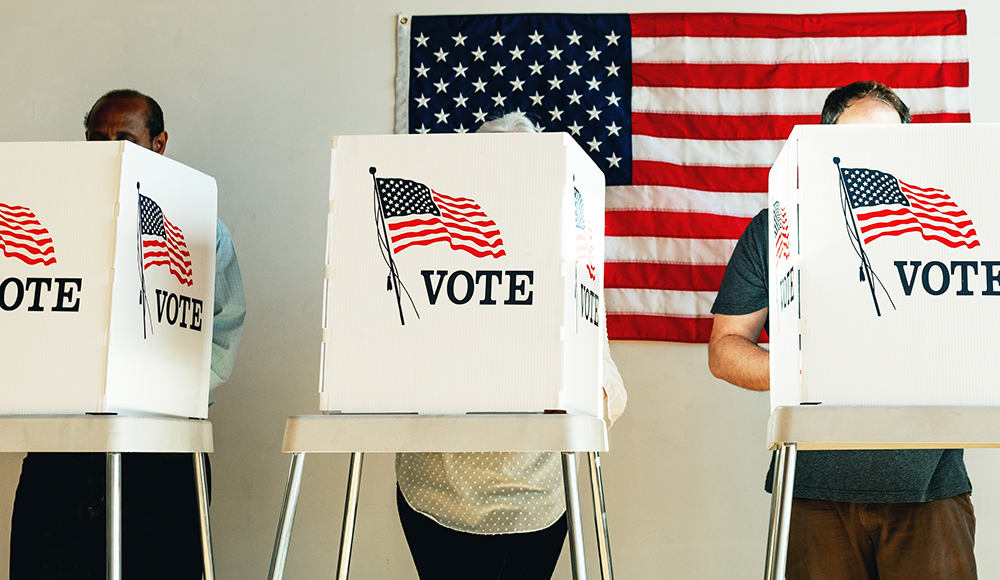
In an election where millions of Californians cast ballots for statewide offices and propositions, some local races could be decided by just a handful of votes.
Nowhere is that more apparent than in Watsonville’s City Council District 5 race, where incumbent Casey Clark trailed challenger Ángel Zúñiga by just 24 votes, with 1,391 votes cast as of Sunday at 4pm.
In Watsonville’s Council District 7, Ed Acosta had a slightly more comfortable 209-vote lead over Nancy Bilicich, but with 2,447 total votes cast, it’s a number that could conceivably shift.
In Pajaro Valley Unified School District, Trustee Area 7 incumbent Misty Navarro started on election night ahead of challenger Mads Realmuto, a number that slowly shifted as additional votes came in. As of Sunday, Realmuto had a 156-vote advantage, with 7,822 people casting ballots in District 7, which covers the Aptos area.
The numbers are clearer in other races.
Ryan Coonerty appears to have clinched the Mayor seat in the city of Santa Cruz, outpacing Ami Chen Mills by 1,671 votes, with 25,950 votes counted and 63.8% of the overall total
The razor-thin margins underscore the importance of individual votes in local district elections, where relatively small numbers of voters can determine who represents their neighborhoods.
It also means that the outcome could remain uncertain as Santa Cruz County election officials continue counting ballots.
California law does not require automatic recounts, regardless of how close an election is.
Santa Cruz County Clerk Tricia Webber said she expects to certify the election sometime between Nov. 25 and Dec. 1, after which voters will have five calendar days to request a recount.
Webber said her office has historically expanded the state-required 1% manual tally to a full 100% manual tally in particularly close races to verify results before certification.
That happened during the June election for the 4th District seat on the Santa Cruz County Board of Supervisors, when Tony Nuñez received just six votes more than the 50% threshold needed to avoid a runoff.
“Before certifying, I made sure that was true,” Webber said, adding that all three candidates were invited to observe the process. No recount was requested.
Webber said she would consider a similar full manual tally if the current vote margins remain close, but will wait until all outstanding ballots are counted before making that decision.
“We have had close contests in the past where no recount was requested,” she said.
Clark said that it’s too early to tell whether he will ask for a recount.
“Whatever will be will be,” Clark said. “I’m not going to fight it, but it’s prudent to have this discussion.”
Kim Alexander, president of the California Voter Foundation, said such close contests are not necessarily a problem, but they can present challenges for election officials, candidates and voters waiting for a final result.
“There’s an old saying in the world of election administration that you pray for a high turnout and wide margins,” Alexander said.
The reason, she explained, is that wide margins allow election officials and news organizations to determine the likely outcome relatively quickly. When candidates are separated by just a few votes, however, the remaining uncounted ballots can change the outcome.
“The challenge with close contests is that they do take longer for news organizations to call them, because if the margin is really narrow, and you still have a sizable number of ballots to count, you can’t predict who is going to be the winner,” Alexander said.
That uncertainty can leave candidates and voters waiting days or even weeks before the outcome becomes clear.
Alexander’s organization launched its Close Count Transparency Project in 2022 to help the public understand how election results evolve between election night and certification.
The project tracks closely contested congressional, legislative and statewide races, recording how many votes are added with each update and how the margins between candidates change.
One example was California’s 13th Congressional District race in 2024, in which Democrat Adam Gray defeated Republican incumbent John Duarte by just 187 votes, a margin of approximately 0.1%.
The Associated Press did not call that race until Dec. 4, one day before the deadline for counties to certify their results.
Another factor that can delay the outcome of close races is California’s process for allowing voters to correct problems with their vote-by-mail ballot signatures.
Known as “signature curing,” the process allows voters whose ballot envelopes have missing or mismatched signatures to correct those problems so their votes can be counted.
Counties are required to notify affected voters, who have until 22 days after Election Day to resolve the issues.
In particularly close races, Alexander said, campaigns sometimes contact supporters whose ballots have been challenged and encourage them to complete the process.
That can leave additional votes outstanding well after Election Day.
But Alexander cautioned against characterizing close elections as problematic simply because the results take longer to determine.
“They’re not a problem,” she said. “I would not characterize them as a problem. They’re a challenge for election officials.”
California’s election verification procedures, she said, are designed to ensure that results are accurate, regardless of how narrow the margin may be.
Those procedures include a manual tally of ballots from randomly selected precincts to verify the accuracy of the machine count.
“There are a lot of procedures involved in election ballot processing and election verification that help us give voters confidence in a close race that the results have been verified,” Alexander said.
The trade-off, she said, is that voters may have to wait longer for an official outcome.
For Watsonville voters in District 5, where fewer than 1,400 votes have been counted, that means a relatively small number of outstanding ballots could determine who represents the district on the City Council.
And with the winner of the District 5 race slated to serve as Watsonville’s mayor in 2027 under the city’s rotating mayoral system, the stakes extend beyond a single council seat.