There was a lot of trash talk Sunday in Santa Cruz. Not gossip. Literal trash.
In the ocean and deep into the food chain.
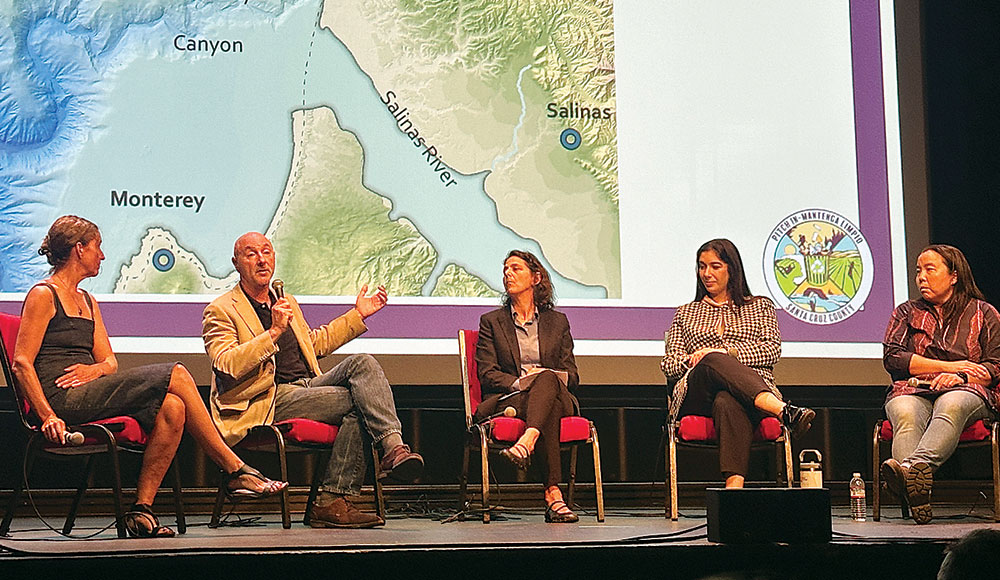
Close to 400 people gathered at the Rio Theatre to hear some of the latest research on the health of the ocean and what steps can be done to combat pollution on land and sea.
“Even in the face of industrial mining and fishing—if that stops—our oceans can recover,” said Sally-Christine Rodgers, who works for an anti-pollution organization called Trash Talkers. “And right here in our county, our litter, our cigarette butts, our plastics are going into our watershed, and we’ve got to stop it.”
This group of scientists lamented that plastic is everywhere, even the most remote oceans.
UCSC adjunct and environmental toxicologist Dr. Myra Finkelstein spoke of her research on Midway Atoll in the South Pacific, which revealed dangerous amounts of plastic in the eggs and digestive tracts of seabirds such as albatross.
“We saw this everywhere,” she said. “But we have little data on what the harm was and if you don’t have harm, it’s really hard to advocate for change. But there is also a lot of evidence that humans are also ingesting microplastics.
“I do think we, as a society, can do something about this; we can make this change and clean up this mess.” She advised joining the Pitch In initiative and using less plastic in daily behavior and “don’t microwave plastic,” adding, “And think that even that one plastic cap you pick up—and it doesn’t get in the storm drain—maybe that’s one less thing that’s going to end up in an albatross chick’s stomach.”
Hosted by Sally-Christine Rodgers, Trash Talkers organizer, the nearly four-hour event featured scientists Dr. Anela Choy, associate professor, Scripps Institution of Oceanography, UC San Diego; Dr. Myra Finkelstein, environmental toxicologist and adjunct professor, UC Santa Cruz; Dr. Alexa Fredston quantitative ecologist and assistant professor of Ocean Sciences, UC, Santa Cruz; and Dr. Ivano Aiello, marine geologist and sedimentologist, San José State University/Moss Landing Marine Laboratories.
Also on site were four information tables by Watsonville Wetlands Watch, Coast Watershed Council, Pitch In Santa Cruz County, O’Neill Sea Odyssey and Save Our Shores.
Dr. Aiello stressed one main point: “Whatever happens on land, it goes into the ocean,” while emphasizing “how delicate our coastal systems are.” He said that farmers typically use around 20 million pounds of plastic every year in the Monterey Bay area, some of which ends up in waterways and the sea. He stressed “fantastic restoration ecosystem work” being done by the Elkhorn Slough National Estuarine Reserve, including recovering previous wetlands that were dyked and sunk.
He said the use of certain mulches, biodegradable plastics, recycling plastics and long-term monitoring will make a big difference in healing the oceans and coastlands.
Fredston touched on the unhealthy picture of many of today’s coral reefs, coated in plastic pollution, while emphasizing widespread efforts to end the behavior that causes that.
“If we stop producing so many of these plastics, I think a lot of these ecosystems can recover,” she said. She explored how human behavior blended with natural currents, climate change, container ships, and fishing gear “jointly affect marine ecosystems.” She stressed reducing plastics and chemical production that reaches the sea, and endorsed creating more regulations on over-fishing, and protecting coastal regions.
Choy talked of the enormous range of sea life, from seabirds, whales, shrimp, and crustaceans, that live amidst a flurry of plastic waste.
“It is really important to think about the products that we use every day,” she said.
The event culminated with a new documentary film by David Attenborough, Ocean.
“We must open our eyes right now to what is happening…below the waves,” Attenborough said in the one hour and 50 minute film. “We have drained the life from our ocean but I would find it hard not to lose hope. “The ocean is our final frontier,” he said, and “a healthy ocean keeps the entire planet stable and flourishing.”