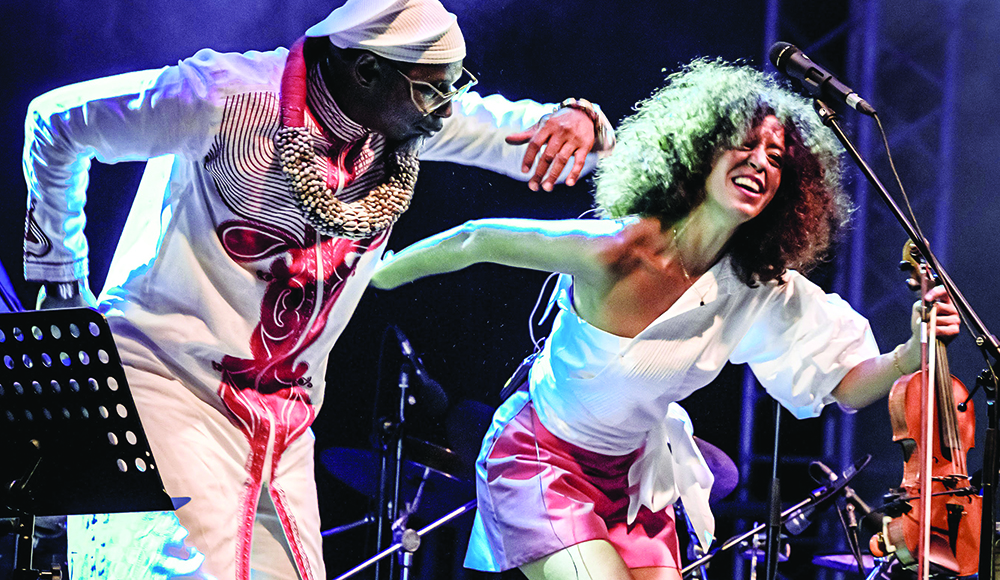
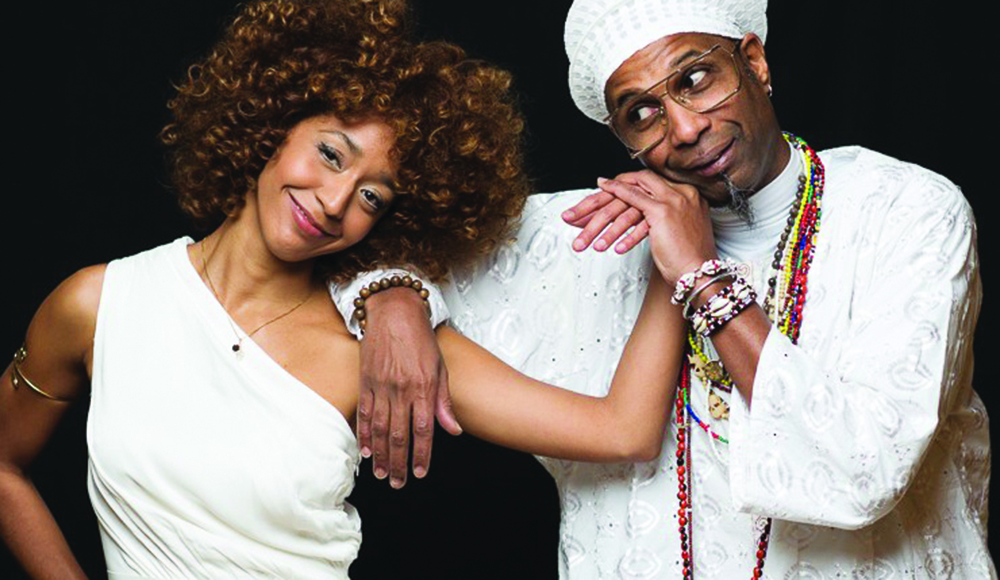
Omar Sosa and Yilian Cañizares will perform at Kuumbwa Jazz Center on Monday, March 2 with the Aguas Trio that includes Venezuelan percussionist Gustavo Ovalles. Their 2018 Otá Records album titled Aguas is grounded in the Lucumí spiritual tradition and combines Jazz, Afro-Cuban rhythms and classical and global influences.
Omar Sosa was born in Camagüey, Cuba and is now a resident of Mallorca, Spain. Yilian Cañizares was born in Havana and now lives in Switzerland. Pianist/percussionist Sosa is a seven-time Grammy nominee and is the Resident Artistic Director for the 2026 San Francisco Jazz Festival and has performances there March 5 – 8 with his Quarteto Americanos and Seckou Keita.
‘Aguas’
I’ve been listening to Aguas again, and it’s so sweet and peaceful. How is it performing this music now?
OMAR SOSA: It’s a beautiful opportunity to bring back a project that had a really good acceptance in the world. Yilian is going to play in Santa Cruz for the first time. For me, Santa Cruz is like my second home!
YILLIAN CAÑIZARES: Yes, it will be my first time there! After many years, Omar and I performed the music of Aguas in France last summer and for me it was like this; when you do a piece of art that is timeless, you can play it whatever year you like! We can play Aguas in 2050 and it will still have the spirit and soul!
Yilian, tell me how you came into playing violin and singing.
YC: I started my studies in my hometown, Havana. I was singing in a children’s band before getting into school, because I was very drawn to music. I started violin at the age of 7. Since then, I’ve been a musician. In Cuba, we have this education system that takes kids from a very early age and prepares them to become professional artists. I’ve been following Omar’s path, which has opened Cuban music to the world. For me, he was the first to mix Cuban music with sounds we never heard before, like Indian music and music from West Africa. I’ve learned so much from him and we just try to keep making this music with humility, from the soul.
OS: This is what we practice in our spiritual tradition – Lucumí – and it’s what we’re doing when we play music; we respect each other, listen to each other and we share our emotions. Most of the time through music, we are sharing our problems. When we play music we press against what we have inside, and most of the time they are not happy things. But through music, we transform this darkness and turn it into a light. Sometimes when we’re playing music we don’t even know what is going to happen! The idea is to channel our emotions and bring people to a simple perspective of peace, love and unity.
Cuba / Venezeula / Minneapolis
You’re both from Cuba. The US military recently abducted the president of Venezuela and bombed boats in the Caribbean. The US has an oil embargo against Cuba and is threatening to attack it again. Inside the US, immigrants are being arrested and protesters have been killed. How are you feeling about what’s happening?
OS: We are in a moment when equilibrium is not the main plate on the table. We live in an interesting moment of human history, because we are living during the change of one way to another.
New values, new ways of being. Of course, we see the reality in America, but it’s not all about America! Sometimes Americans think they are the belly of the world, and it’s not true!
There are more countries than America! Now people ask, “Why is this happening in America?” What happens now in America is because of what happened in the past. And it’s happening in many places. There is violence in Sudan, Ethiopia, the Middle East, Cuba, Venezuela–war is happening in a lot of countries. When we look in the mirror of life, most of the time we see only ourselves; we don’t see others in ourselves.
We need to see that these things happening in America happened before. We may complain about what’s happening now, but like James Baldwin said, “We are the result of what we’ve done. We carry our history with us. We are our history.”
The only way we can move forward is to figure out a way to be together, to be a community, and to be a human being who loves other human beings. Problems arise when we say, “I’m better than you. I’m from this place and you’re from that place.” We’re supposed to share everything with love and respect.
YC: I just came from Cuba last week, playing in a festival in Havana. The situation is so sad because I can see people there feeling hopeless for the first time. I can see some kind of anxiety, too. I’ve never seen Havana in the way I saw it in the last few weeks.
I would love my people to have a more easy and comfortable life, because we deserve it. What I saw in the streets of Havana is a reflection of a lack of hope. It breaks my heart because it’s my hometown and it’s my people. Nobody deserves to live in the circumstances that Cuban people are living now, thinking from the first moment when they open their eyes, “What will I eat and when will I have electricity?”
Without a unity between the Cubans in Cuba and the Cubans in the diaspora outside, we cannot build a better future for all of us.
Fidel Castro’s Birthday
I heard you went to Fidel Castro’s 70th birthday celebration in 1996. Tell me about that.
OS: The father of my second wife was a personal friend of Fidel Castro. We went to the Palais Congress for the celebration of his 70th birthday. Fidel never was safe when he traveled so only his personal security would know when he’s going to arrive.
But there he was, walking around, and his personal team was not with him. Everybody tried to shake Fidel’s hand and he came to me and leaned close and said quietly in my ear, “How is the music going?” I said, “Good, Comandante!” Really, I almost peed in my pants! I’m a tall guy, but he was really tall! But now for me it’s not about the leaders, but how all the people can live with balance, love and equilibrium.
Recently some musicians have been speaking and singing about ICE and how the US is treating immigrants and Venezuela and Cuba. Bruce Springsteen released a song and Bad Bunny did a performance during the Super Bowl. What’s your feeling about musicians doing this?
OS: I’m going to ask one question; Why now and not before, when the whole world was suffering? Because this country has always been the same. Why didn’t they see the problem before?
Here in Oakland, they kill people every day. In Chicago, they kill people every day. But this question brings me to another point; how much it cost to be at the Super Bowl! Tickets in the top row were $1000. Down lower was $15,000. I love this country in a lot of ways, but in another way this country uses everything in its favor. Who is gonna pay $15,000? The people from Oakland? No! There is no equilibrium, brother, no balance.
People like me and Yilian–born in a different country–are judged as less than the people who are born in this country. Why?
YC: Everything gets amplified by social media and the new technologies. There’s a lot of mental health issues because of that. Like Omar, I think we need to put the human being at the center of the conversation once again. We need to think about what we really want for our future as human beings, and stop being distracted by so many anecdotal things that are not fundamental for making a change. We are overwhelmed. When we read something now we don’t even know if it’s true or fake!
This is not normal for anyone! There are so many fundamental problems that we have on the planet concerning global warming, nutrition for kids, fighting pedophilia, protecting women and protecting minorities.
OS: I say it again; James Baldwin said, “We carry our history with us.” We need to fight in a positive way and give ourselves time to enjoy the opportunity to be alive. Life is temporary and you will eventually die no matter if you’re rich or poor. Knowing this, we must live fully every second of each day.
YC: Omar is a master musician and he always says to me, “Go with the flow.” The other phrase he uses is, “estas o no estas.” “Either you are in, or you are not.”
This is exactly what we’re trying to express in music. The practice is to be present. Music is a tool we’re using to deliver a message that is way bigger than us. As human beings, we’re trying to evolve and improve our lives. It’s about the process we go through as human beings and to deliver this message of peace.
Listen to this interview with Omar Sosa and Yilian Cañizares on Thursday at noon on Transformation Highway with John Malkin on KZSC 88.1 FM / kzsc.org.