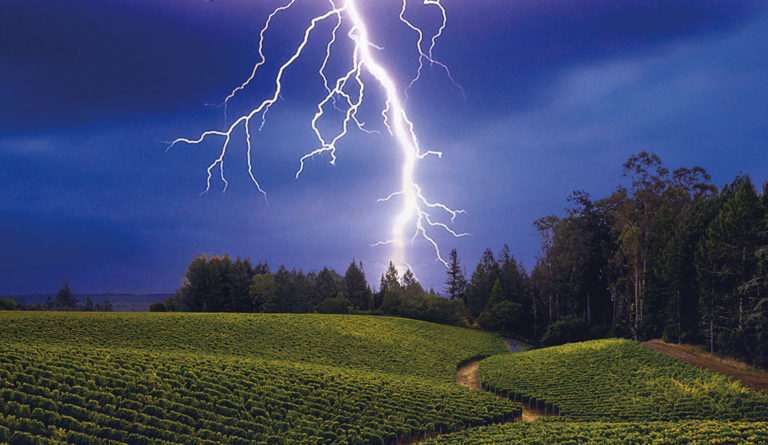
Back in early August, winemakers John Locke and Alex Krause of Birichino were gearing up to start picking grapes, feeling very optimistic about the upcoming harvest. With fairly mild temperatures and plenty of spring rain, it was shaping up to be an easy crush with great quality fruit and a leisurely picking schedule. Then the heat waves started rolling in.
“The start of harvest was brutal, three night picks in a row, back to back, just because it absolutely had to happen,” Krause recalls.
“Everything just got smashed together,” Locke confirms. “That’s not the type of vintage we like, both the style of the wine it makes, and just [picking] one vineyard after another, just finding a place in the winery to put some friggin’ grapes. … It’s not ideal—for people, for wine, for plants, for anything.”
Now, as the rains return and the last of the vintage is barreled down to rest for the winter, local winemakers and vineyard managers reflect on another typical atypical harvest in California, and speculate on the impacts of climate change on the industry, the people who work in it, and the wines themselves.
Weather and Wine
Wine quality is determined in large part by the weather, and climatic conditions affect every aspect of how grapes are grown, harvested and fermented. The wine philosophy of terroir flows from the idea that it is the interaction of the weather, the vines, the soil and the myriad organisms living in the vineyard that combine to produce the character of each vintage, the “taste of place.”
Changing climate and more frequent extreme weather events will undoubtedly affect the taste of the wines we produce and necessitate adaptations in every facet of the industry. But these growing pains might also be an opportunity for consumers to gain a better understanding of how our food is grown and how interconnected we are with our environment.
California encompasses a wide range of meso- and microclimates, but on average in the last two rainy seasons the state finally saw ample precipitation after a prolonged drought as the result of the El Niño climate pattern, which brought massive storms that caused major flooding and landslides. Despite the damage, grape growers were encouraged by the free water and the long, cool spring.
The alarm bells started ringing as temperatures increased through June, leading to the hottest summer in California in 130 years, according to NOAA. More than the increase in average temperatures, it’s the increasing frequency of extreme heat events that threaten vineyards. Inland wine regions like Napa experienced startling heat waves in July that had winemakers biting their nails, but August cooled down enough to allow for the gradual maturation of the crop.
Meanwhile, Santa Cruz saw mild temperatures for most of the summer. “It’s because of the beautiful, giant bathtub that is the Monterey Bay,” says Prudy Foxx, local vine expert and founder of Foxx Viticulture. “It really helps moderate our experience of those extreme heat events.”
But the marine influence only extends so far, and even Santa Cruz is not immune to temperature extremes. The heat finally broke through in September, peaking in the first week of October, and winemakers were forced to compress their picking schedule and left scrambling to find space to ferment it all.
“It basically accelerated our whole season,” Foxx says. “Suddenly everything that was ripening gradually, really nicely, easy to plan for, became an emergency.”
Megan Bell of Margins Wine has thought a lot about how to adapt her business to the chaos and unpredictability of climate change.
“There were always outlier harvests, of course, but I think in general there was a flow of harvest that was predictable-ish every year, where I generally know how this is going to go, and I have enough equipment on hand to handle it, and now it’s not like that.”
Besides potential impacts on the quality of the fruit, heat waves can affect planning and scheduling, hiring and training of seasonal workers, and the logistics of wine production, so one of Bell’s strategies is to pick as early as possible.
Winemakers are very particular about the timing of the pick, sampling and tasting frequently as the grapes ripen to assess the development of sugars, acids, tannins, and other flavor and aromatic compounds, trying to divine the perfect moment to harvest and begin the fermentation process. But heat spikes tend to ripen the fruit very quickly, which can cause imbalances in berry chemistry, high sugar content, desiccation, sunburn and a host of other issues.
“This year is a prime example where you’ve got perfect fruit development all summer long without any real heat extremes, so that the skins have developed this really supple elasticity, but they were unprepared,” Foxx says. “If the fruit is exposed to those brutal rays, it’s like a Midwesterner in Hawaii for the first time.”
Harvest Time
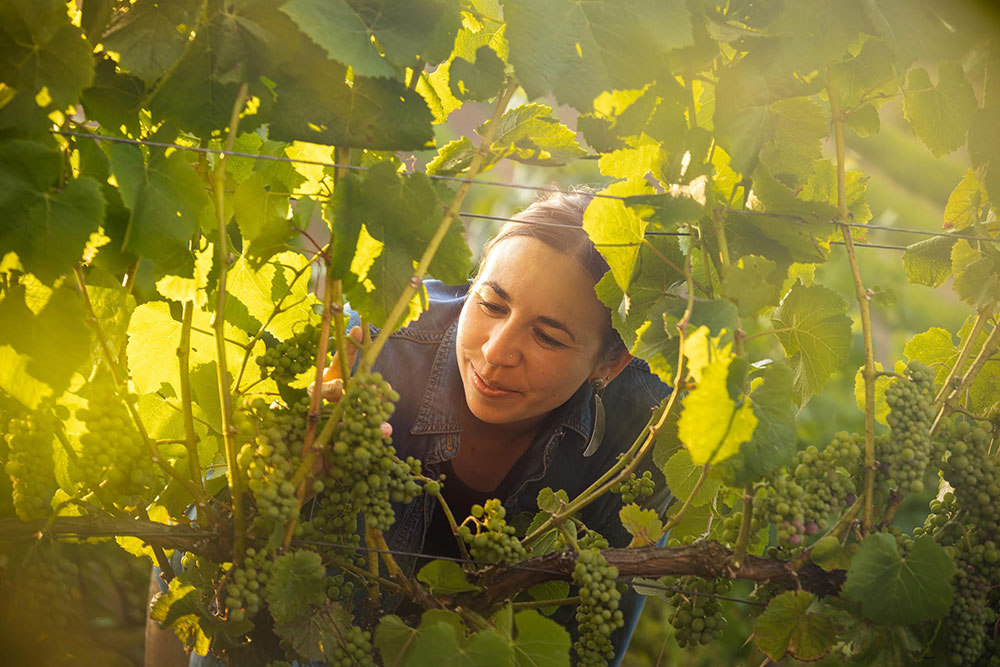
In September, as the fruit began to pour in, winemakers let out a collective sigh—it was good. “The yields were crushingly low for some, the lowest we’ve ever seen,” Krause says, “but the quality is great.”
“It’s a really good year for red grapes,” Locke says. “I think the whites are a little heavy. … A lot of the things we get are in places that are hot, and they’re all adapted [to that climate]. Contra Costa—the old-vine cinsault looked great at harvest … the carignane out in Lodi looked like it was friggin’ just born out of a Botticelli clamshell opening up.”
Bell managed to pick all but one of the vineyards she works with before the last heat wave hit: Santa Cruz Mountains cabernet franc and merlot, two heavier red varietals that were taking their time to ripen. Letting it hang through a nine-day heat wave was risky, but the sugar content was still way lower than she wanted, and she waited until the last day of the heat wave to pick it.
“That was a really hard decision,” she says. “The risk isn’t letting it get too ripe; the risk is the part of the berry that’s connected to the stem becoming disconnected due to intense and quick dehydration, and once that connection’s gone, it’s gone. So it might basically desiccate from heat without gaining any sugar.”
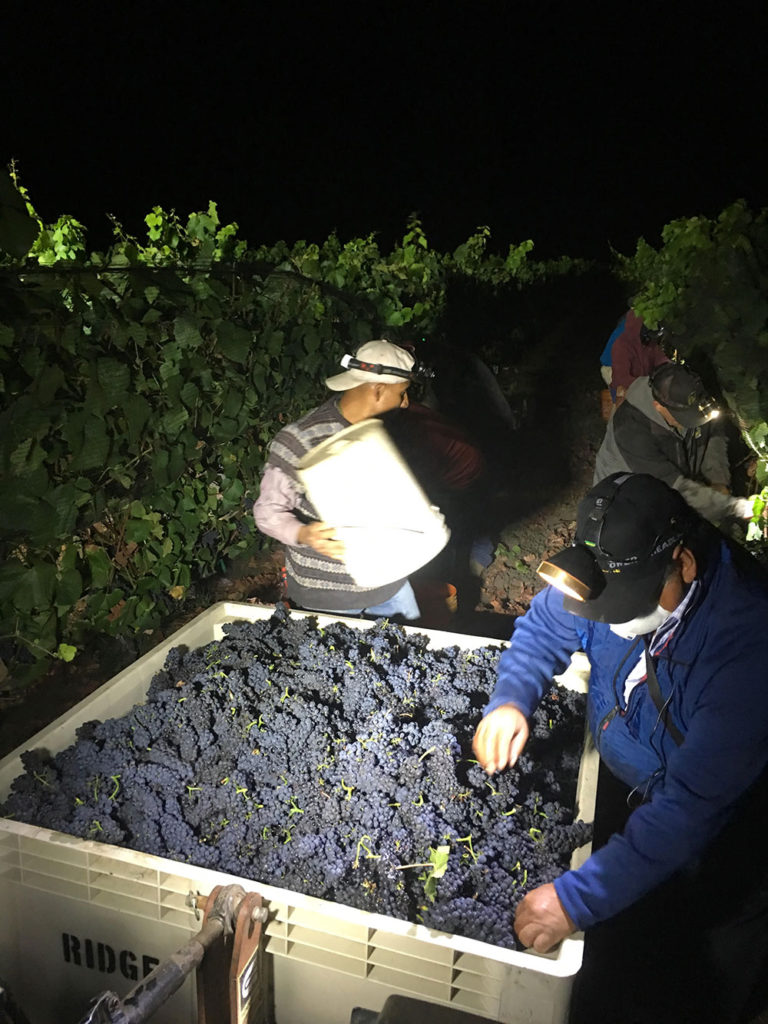
When heat threatens the crop, it is the harvest workers who suffer. Picking crews routinely start work between 3 to 5am to beat the heat and preserve the chemistry of the fruit, hustling under mobile LEDs to reap each succulent cluster. Cellar workers often pull marathon shifts day in and day out to manage the delicate alchemy of fermentation. And when the pressure is on, the work only gets more intense.
As in all agriculture in California, these skilled laborers are largely undocumented immigrants from Latin America who often perform dangerous and backbreaking seasonal work in brutal conditions with little protection or support, all for wages that many citizens would find insulting. This is one of the ways in which climate change disproportionately affects marginalized communities. We would do well to remember them every time we raise a glass.
Art of Winemaking
Wines are so diverse that it’s impossible to make generalizations about how they express their characters in different climates. That said, in cooler climates, grapes ripen more slowly, producing less sugar and preserving their acids better. These wines tend to be more tart, aromatic and lower in alcohol, while grapes from warmer climates tend to have more sugar and less acids, and are often characterized by bolder ripe fruit flavors, leaning into the tropical fruits as the temperature increases.
As the climate grows warmer, winemakers anticipate the character of their wines to shift in that direction, for better or worse. So what happens when the fruit comes in overripe, or low in acids or nutrients, or half shriveled up like raisins? Then it’s up to the winemaker to adapt, adjust—or go with the flow.
High sugar content means more food for the yeast, which means high alcohol content, and although winemakers are loath to admit it, sometimes all they can do is water it back to the desired levels and add tartaric acid and coloring to balance it out—a common practice in many fine wines, they hasten to add.
Fermentation management techniques also include the use of sulfur to control unwanted bacteria and yeast, inoculating with specialized lab-grown yeasts, controlling temperature and exposure to oxygen, and adding nutrients, tannins and a range of other compounds for fining, clarification and stabilization.
Other winemakers, like Bell, Krause and Locke, believe that minimal intervention in the winery lets the essence of the fruit come forward. “We really just have what nature made,” Bell says. “So it needs to be watched closer.”
“Our personal stylistic preference is to find vineyards and sites that express their character … at more modest degrees of ripeness,” Krause says, “but sometimes you get a year like this where it’s just not going to happen at 12% alcohol, or even 13, and there’s no sense in fighting that.”
“It just seems like those types of vintages are going to be more common, and I don’t know that we’ve quite gotten our hands around how we’re going to react to that,” Locke adds.
Challenges
Beyond warming average temperatures and more frequent heat waves, climatologists predict that California will experience more frequent and severe wildfires, storms, droughts and other climatic events, all of which will impact viticulture and enology.
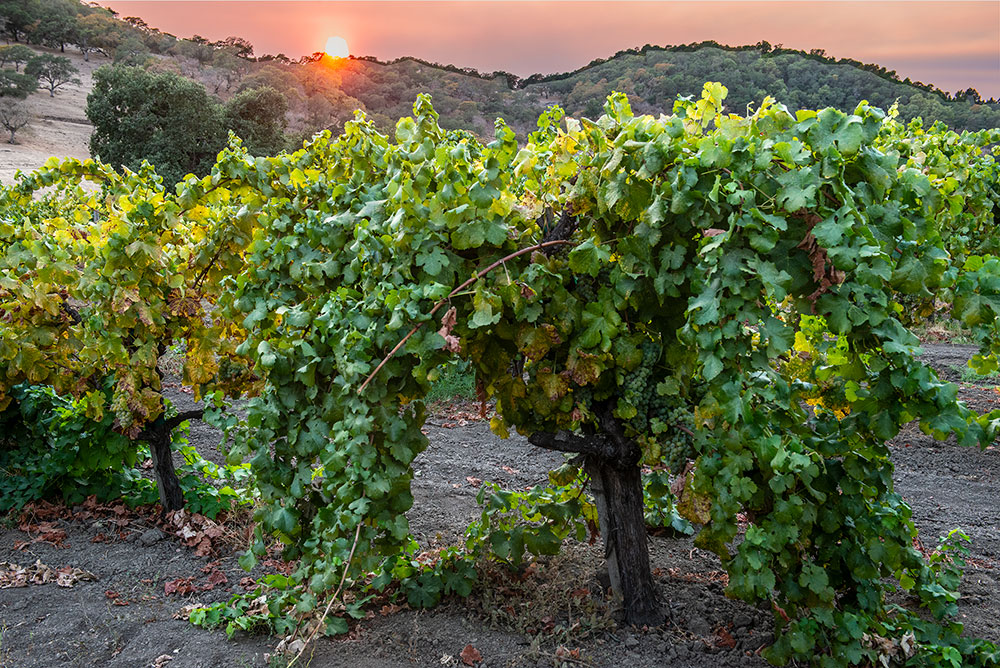
Wildfires like the CZU Lightning Complex fires of 2020 are one of the biggest concerns, directly threatening vineyards and farm workers as well as spoiling the fruit. “Smoke taint” is a winemaker’s nightmare, a nasty residue left on grape skins that can mask the natural fruit flavors and even, in the worst-case scenario, come out tasting like an ashtray, a fate they’ll do anything to avoid.
“We didn’t pick things, we blended things, we made a lot of rosé,” Krause says of the 2020 vintage. “We didn’t have anything that tasted like mesquite barbecue, but we did have a mild cork taint, is how I would describe it—it just seemed like there was nothing like the aromatic expressiveness of the variety, it was just like anonymous red wine.”
Drought is another ongoing challenge. Ken Swegles, founder of Rhizos Viticulture and manager of about 50 vineyards in the area, says he irrigated everything he could this year, even dry-farmed and well-established old vineyards that have never needed water before, just to get them through the heat waves, but doing so is costly and creates problems of its own.
Swegles says he’s seeing increased pressure from animals like gophers, moles and nematodes in the vineyards he is irrigating. To combat them he’s started grafting vines onto a particular native rootstock that is deeper rooted, more drought-tolerant and less susceptible to these pests. He also incorporates raptor perches and bird boxes for western bluebirds to attract these obligate predators to help with pest management.
Increasing organic matter in the soil is great for the vines, but it also helps retain water, sequester carbon and increase beneficial soil microbes. To this end, Swegles tills as little as possible, builds compost on-site, and uses extensive cover-cropping, incorporating animals like ducks, geese and chickens wherever he can for free weeding.
“We’re trying to plant cover crops that are more native and drought tolerant,” he says. “Things that can last longer in the vineyard and provide organic matter, beneficial insect attraction, and microbial, mycorrhizal and arbuscular communication for longer.”
The vineyard is part of a complex ecological web, and as the balance shifts, farmers will have to challenge many preconceived notions in order to adapt.
Varietals
Thousands of wine grape varietals have been cultivated throughout Europe, Asia and the Middle East over thousands of years, each adapted to the specific microclimate and soils in which it evolved. As Europeans colonized the world, they brought grapes with them, learning purely by trial and error which ones thrived and where.
Conquistador Hernán Cortés decreed that mission grapes be planted at every Spanish settlement in the New World to make the sacrament. Padre Junípero Serra planted the first cuttings in Alta California in 1769. After the Mexican-American war, wine varietals proliferated throughout the new US state, until the Phylloxera aphid blight decimated vineyards and Prohibition halted the fledgling industry.
After Prohibition, interest in and demand for wine skyrocketed again, and two UC Davis professors saw the promise of California as a world-class wine-growing region. Albert Winkler and Maynard Amerine created the Winkler Index, a system for categorizing wine-growing areas into five climatic regions based on a measure of heat accumulation throughout the growing season. They also analyzed thousands of grape samples from all over the state to recommend which varietals were best suited to each region.
Winkler and Amerine’s work has become gospel for the last 70 years. But most viticulture experts today agree that the Winkler Index has never been particularly accurate. Their methodology was too crude to explore the nuanced relationship between wine and climate, and with the climate becoming less predictable, the Index is looking less and less useful.
Thankfully, Beth Forrestel, assistant professor of Viticulture and Enology at UC Davis, is in the process of developing a new Index to help growers decide what to plant in the era of climate change. She envisions it as more of an algorithm than a fixed chart, using more sophisticated technology and robust data sets to measure environmental parameters and quantify wine quality.
Demand
However, climate is not the only factor that winegrowers must take into account when deciding what to plant; they must also consider what sells. According to Swegles, consumer demand is just as much a driving force behind the choice of varietals.
America is a largely uninformed and unadventurous wine market dominated by a few well-known varietals. According to the California Department of Food and Agriculture’s 2023 Grape Report, the state has an estimated 610,000 acres planted to wine grapes; cabernet sauvignon and chardonnay each account for about 15% by acre, and the top eight varietals combined account for about half of the total area.
Consumer tastes can be fickle, which Locke says can contribute to the “manic, cyclical, boom-and-bust nature of the industry.” For example, when the movie Sideways (2004) highlighted pinot noir as a delicate, temperamental, yet elegant varietal, it launched a craze that caused pinot acreage to increase by 50% over the next five years and double by the present. “Now there’s a glut, it’s overplanted,” Swegles says.
As a winemaker, one of Bell’s missions is to highlight lesser-known varietals that are “on the margins,” and she says that only planting well-known varietals is a limitation and a mistake.
“It makes us so much less resilient, because we don’t know all the challenges that are coming as a result of chaos in our climate,” Bell says. “We have pinot noir and chardonnay instead of the dozens, hundreds, of other cold-climate varietals that are delicious and definitely should have and could have been planted here.”
Locke and Krause say they’ve been seeing their grenache, mourvèdre, carignane and cinsault thriving in these conditions, all warm-climate reds from the south of France, Spain and Italy.
There is at least a small segment of consumers who are branching out beyond the “Big Six” varietals and trying new things. “I think it is changing a bit,” Swegles says, “I think the next generation is expanding and broadening their horizons—they’re trying natural wines, getting turned onto new varietals that they’ve never heard of—which is cool, but unfortunately, it’s a very small percentage of the population.”
Industry in Turmoil
Global demand for wine has been declining for years, sending the California wine industry into turmoil.
Grapes are the second biggest agricultural commodity in California, behind only milk and dairy products. The wine industry generated $73 billion in economic activity in the state alone and $170.5 billion in the US economy as a whole in 2022 (Wine Institute). But despite all this activity, growers and winemakers are increasingly panicking that the bubble is about to burst, driven by lower spending on luxury goods and moderation in alcohol consumption.
Lower demand means a decline in production, and many growers this year struggled to find winemakers to buy their grapes and were forced to slash their prices. Swegles says this was the first year that he couldn’t quite sell all his clients’ fruit. “I know people who left over ten tons hanging in their vineyard. Couldn’t even give it away.”
Add these pressures to the rising cost of labor and falling yields, and it’s getting harder and harder to make ends meet, especially for small organic farms. “It’s led some of our friends to just retire or abandon their vineyards,” Swegles says.
On the bright side, Swegles sees an opportunity in the growing market for natural wine. “Luckily for us, we are selling out most of our inventory, but it’s just because we’re doing all organic farming, low-alcohol wines, interesting varietals, and trying to fill that niche in the market that has less supply and therefore more demand.”
And as the wine industry adapts to the changing climate, Foxx sees an even bigger opportunity: for the concept of terroir to act as a gateway to environmental consciousness.
As wine lovers discover the real story of how the vineyard’s response to its climate, soils and living community contributes to the unique expression of the place and vintage, Foxx hopes they may gain a better understanding of our interdependence with nature.
“The really cool thing about it is, it also translates into other food,” Foxx says. “I mean when you really start to respect the contribution of the vineyard to the wine, you start to realize that all food that is produced has that contribution to what you’re eating … I think it helps us all have more respect on a deeper level for how all things grow.”