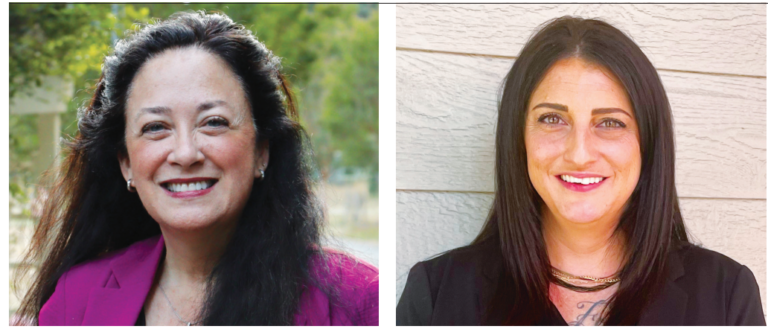
Two of the four people who have signaled their intentions to replace outgoing Santa Cruz County Supervisor Zach Friend for the District 2 seat are veteran policymakers with years of experience in the public sector.
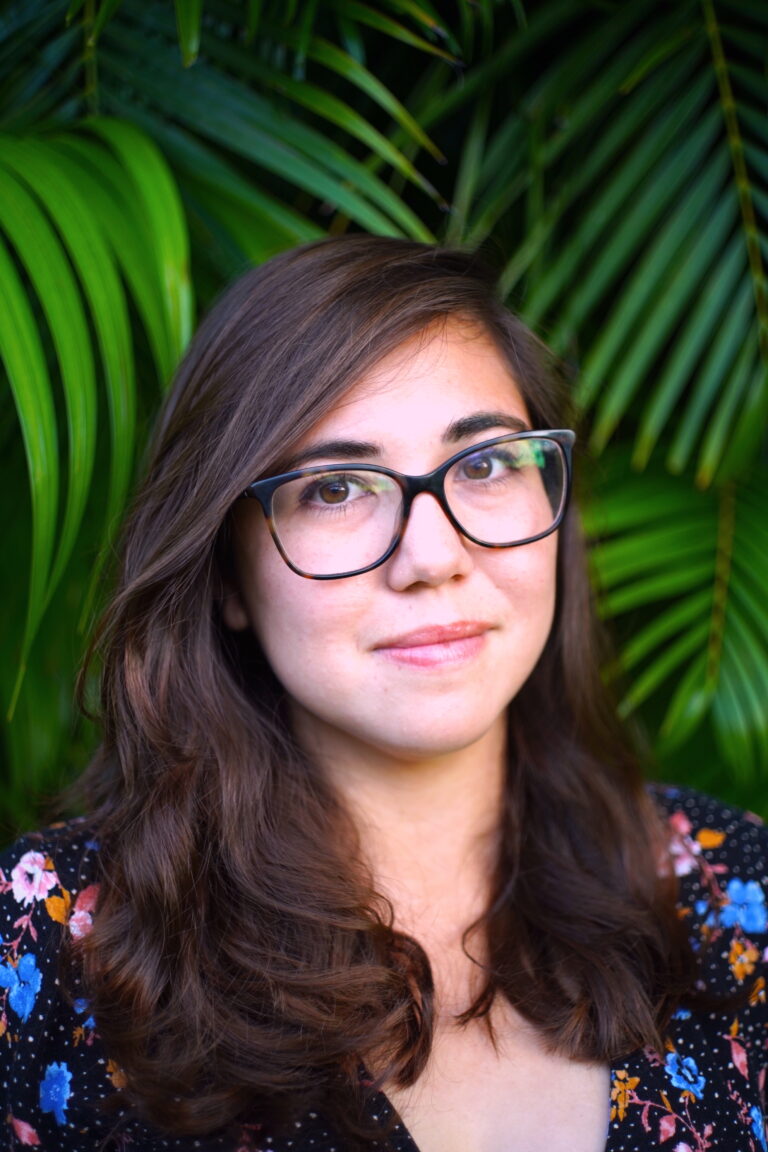
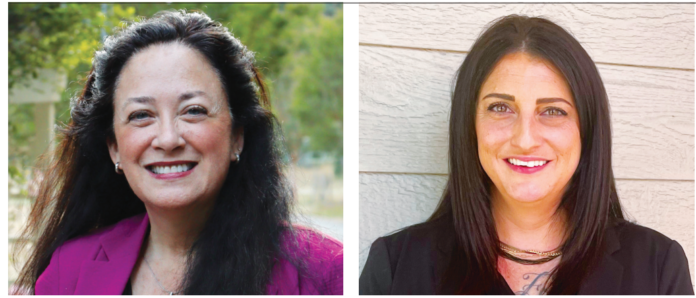
Kim De Serpa, who has served on the Pajaro Valley Unified School District Board of Trustees since 2010, will face off in the March 5 election against Kristen Brown, who was elected to the Capitola City Council in 2016.
Good Times will feature the other two candidates—Doug Dietch and Tony Crane—in next week’s edition.
The top two vote-getters from the March primary will go on to face-off in the November election.
Kim De Serpa
De Serpa is social services manager for the Salinas Valley Health Medical Center.
She was inspired to work in government from an early age by her mother, who worked for Barbara Shipnuck, Monterey County’s first woman supervisor.
“In my family we have a legacy of public service,” she says.
De Serpa has a bachelor’s degree in social work from Humboldt State University, and a masters in social work from Washington University in St. Louis.
She interned for the Clinton Administration in the Health and Human Services Department under Secretary Donna Shalala. She also served with Fernando Torres-Gil, the Clinton Administration’s chief advocate on aging.
“I think my experience in governing one of the biggest school districts in California—with a $330M budget—has informed my view of governance and how to get things done,” she says. “It would be a great honor to serve the people of the Second District, a place that I’ve called home for 26 years.”
De Serpa says that when people come to their elected leaders, they are seeking help with problems that seem insurmountable. Solving those, she says, takes someone who can address them on both a macro and micro level.
“A lot of people say ‘this can’t be done,’ but I’m an expert at removing barriers and working with other people to open up opportunities,” she says.
As a school board member, De Serpa championed Measure L, a $150 bond measure passed by voters in 2012. Money from that bond has paid for upgrades, repairs and construction projects at every school in the district.
De Serpa says she fought to bring equity to the schools in the northern half of the district at a time when a lion’s share of resources were going to the lower-income ones to the south.
She wants to rethink the way departments such as Planning and Mental Health deliver their services.
“What a lot of people talk to me about is improving county services,” De Serpa says.
Another aspect of that is recruiting and retaining skilled employees, she says. Boosting the county’s economic vitality is an essential step to recruit and retain businesses.
“This is very important because of the sales tax revenue they generate,” she says.
De Serpa also wants to expand the county’s mental health services to include everyone that needs it, regardless of insurance status.
She also wants to increase the county’s stock of affordable housing and preserve agricultural land.
Kristen Brown
Brown is a lifelong member of the Capitola community, with ties dating back four generations. Her great-grandparents owned a coffee shop in the village in the 1960s, her grandfather worked for Capitola Police Department for 30 years and her uncle worked for the Santa Cruz County Sheriff’s Department.
“Public service runs in my family,” she says.
With that as her inspiration, Brown began her political career at an early age when she discovered an innate skill as a rabble-rouser.
In high school, she organized a school walkout to protest her school’s policy of having weight taken in PE class. She also led efforts to demand comprehensive sex education for students.
“No one told me I was an activist, they just said I was causing trouble,” she says. “I didn’t know when I was younger that this was even something I could do. But that was activism; that was leadership skills, but we often tell our young women that they are causing trouble or being bossy.”
After testing out of high school at 16, Brown earned two associates degrees by the time she was 18. It was during this time that she again got involved in activism, this time fighting the potential defunding of Planned Parenthood.
Around this time she also attended CSU Monterey Bay to study global political communications, and interned for Congressmen Sam Farr and Rep. Jimmy Panetta.
“That’s what really got me into government and politics,” she says.
One year after graduating, Brown joined the Capitola City Council in 2016. She served as Mayor in 2020, and will do so again in 2024, when she terms out.
She is Vice Chair of both Santa Cruz Metro Transit District and the Santa Cruz County Regional Transportation Commission.
“I’ve had the opportunity to work on causes around housing, transportation and climate change, and it’s been an incredible experience for me to see how things can happen and make a positive difference in the community,” she says. “Now that I’m coming to the end of my time on Capitola City Council, I want to continue to do that on a more regional, larger level than just within the city boundaries.”
Brown’s career reflects her political aspirations. She is Vice-President of Government Relations for the Silicon Valley Leadership Group, where she works with jurisdictions on issues such as housing development and transportation.
“So my life kind of revolves around those things,” she says.
Brown says that elected leaders must take heed of the impending economic recession, even as they address the county’s staffing shortage.
Governments must also look to lessen their affordable housing crises even as they put the finishing touches on the RHNA allocation plans.
Transportation planning is also important—as is climate change—both of which are intertwined with housing, she says.
When addressing the homeless population, Brown says she is a proponent of the “housing first” model.
“That’s a housing affordability issue,” she says. “A lot of people are just one paycheck away from becoming homeless and that’s not ok.”
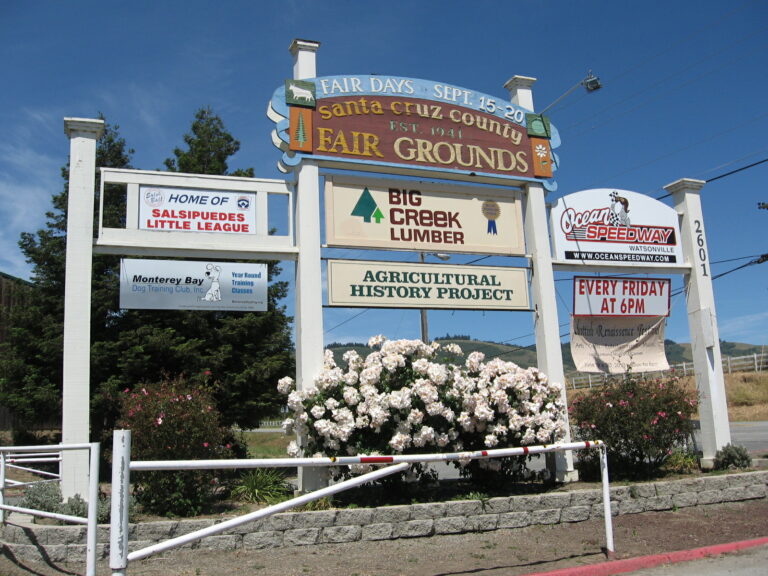
The Santa Cruz Metropolitan Transit District (METRO) announced last week that it is providing free rides to the upcoming Santa Cruz County Fair.
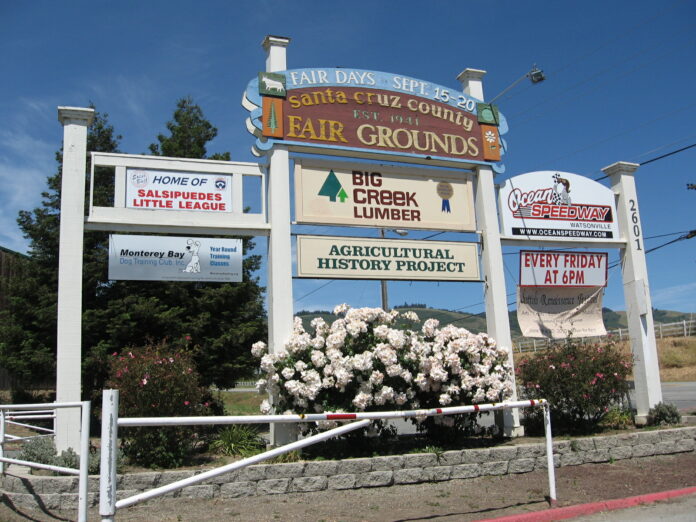
METRO’S new Route 79F was created specifically to transport fair-goers and will provide free daily service to the Santa Cruz County Fairgrounds in Watsonville from September 13-17. Free service on Route 79 weekend trips and daily ParaCruz service to the fairgrounds will also be provided during this time.
METRO has been expanding service to the fairgrounds for the Santa Cruz County Fair for several years in order to increase access and reduce emissions caused by personal vehicles, says Danielle Glagola, METRO’s marketing, communications and customer service director.
In recent years, METRO has seen an increase in ridership to the fair and in response added Route 79F in 2022. Glagola said that the additional route will hit the road every year from now on as they work to remove transit barriers for fair attendees.
Buses will depart from the Watsonville Transit Center at the top of the the hour from noon – 10pm on weekdays and 10am – 10pm on weekends, with return trips from the fair at 25 past the hour from 12:25pm – 10:25pm on weekdays and 10:25am – 10:25pm on weekends.
Expanded service to the fair is part of recent efforts by METRO to increase ridership. Youth Cruz is another program that gives free rides to K-12 students year-round, while Real-Time provides up to the minute bus arrival times to riders’ phones via text message. This winter, METRO will start the initial phase of theri Reimagine METRO initiative, which seeks to adapt local public transit to post-Covid travel patterns and to meet the community’s needs.
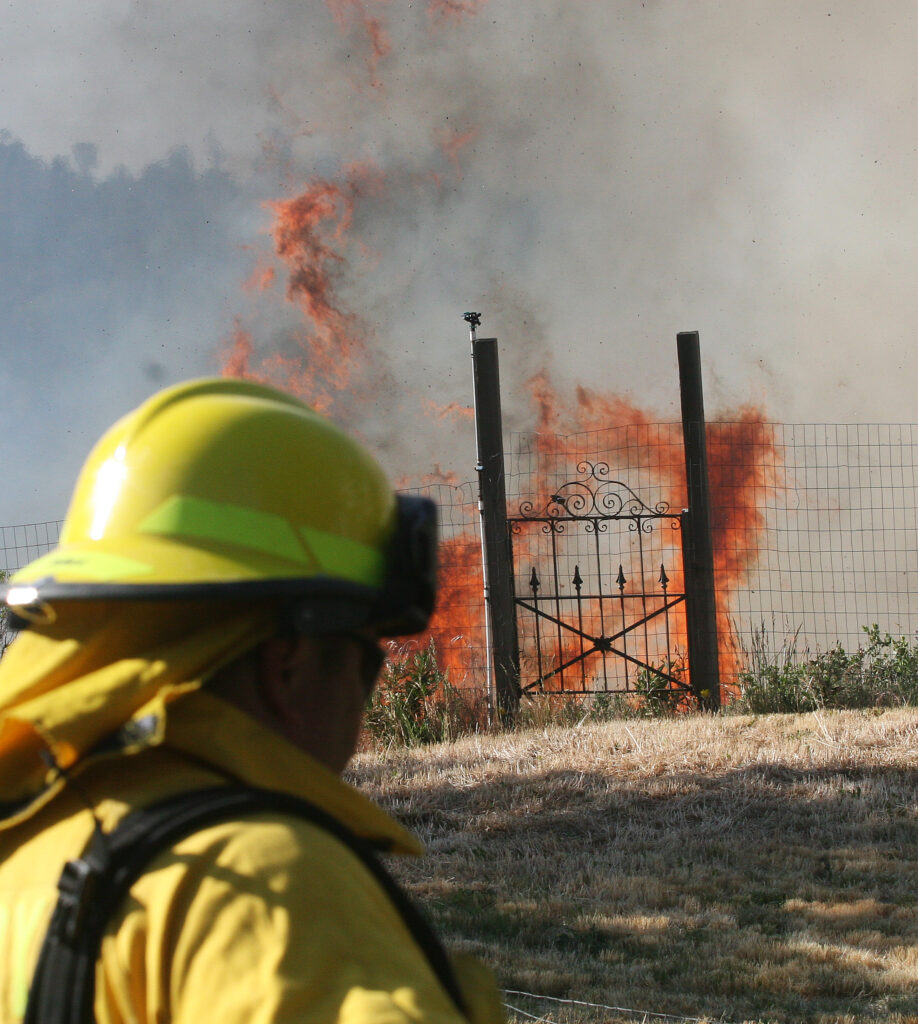
Cal Fire Battalion Chief Jon Heggie wasn’t expecting much to worry about when a late summer fire erupted north of Santa Cruz, home to California’s moist and cool “asbestos forests.” This place doesn’t burn, he thought, with just three notable fires there in 70 years.
Heggie’s job was to predict for the crews where the wildfire might go and when, working through calculations based on topography, weather and fuels—the “immutable” basics. For fire behavior analysts like Heggie, predictable and familiar are manageable, while weird and unexpected are synonyms for danger.
But that 2020 fire was anything but predictable.
Around 3am on Aug. 16, ominous thunder cells formed over the region. Tens of thousands of lightning strikes rained down, creating a convulsion of fire that became the CZU Lightning Complex.
By noon there were nearly two dozen fires burning, and not nearly enough people to handle them. Flames were roaring throughout the Coast Range in deep-shaded forests and waist-high ferns in sight of the Pacific Ocean. No one had ever seen anything like it. The blaze defied predictions and ran unchecked for a month. The fire spread to San Mateo County, burned through 86,000 acres, destroyed almost 1,500 structures and killed a fleeing resident.
“It was astonishing to see that behavior and consumption of heavy fuels,” Heggie said. “Seeing the devastation was mind-boggling. Things were burning outside the norm. I hadn’t seen anything burn that intensely in my 30 years.”
Almost as troubling was what this fire didn’t do—it didn’t back off at night.
“We would have burning periods increase in the afternoon, and we saw continuous high-intensity burns in the night,” Heggie said. “That’s when we are supposed to make up ground. That didn’t happen.”
That 2020 summer of fires, the worst in California history, recalibrated what veteran firefighters understand about fire behavior: Nothing is as it was. The August Complex Fire, which spanned an area the size of Rhode Island across the Mendocino National Forest in August 2020, was the largest in California history.
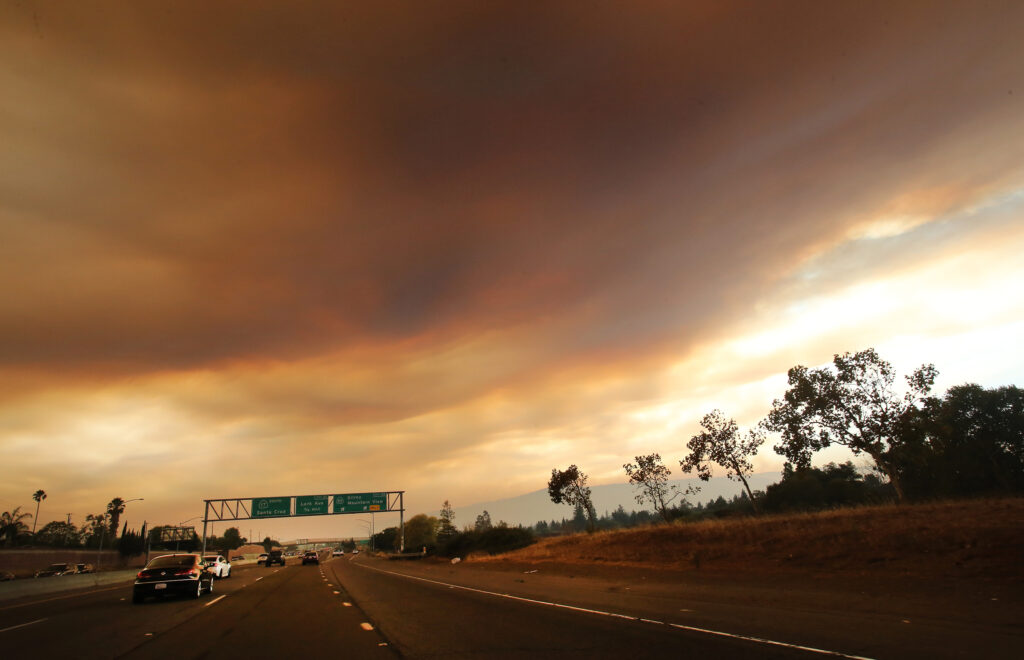
AIRBORNE Smokey conditions create murky dystopian skies. Photo: Tarmo Hanula
As California now heads into its peak time for wildfires, even with last year’s quiet season and the end of its three-year drought, the specter of megafires hasn’t receded. Last winter’s record winter rains, rather than tamping down fire threats, have promoted lush growth, which provides more fuel for summer fires.
Cal Fire officials warn that this year’s conditions are similar to the summer and fall of 2017 — when a rainy winter was followed by one of the state’s most destructive fire seasons, killing 47 people and destroying almost 11,000 structures.
It’s not just the size and power of modern wildfires, but their capricious behavior that has confounded fire veterans—the feints and shifts that bedevil efforts to predict what a fire might do and then devise strategies to stop it. It’s a dangerous calculation: In the literal heat of a fire, choices are consequential. People’s lives and livelihoods are at stake.
Cal Fire crews now often find themselves outflanked. Responding to larger and more erratic and intense fires requires more personnel and equipment. And staging crews and engines where flames are expected to go has been thrown off-kilter.
“We live in this new reality,” Gov. Gavin Newsom said at a recent Cal Fire event, “where we can’t necessarily attach ourselves to some of the more predictive models of the past because of a world that is getting a lot hotter, a lot drier and a lot more uncertain because of climate change.”
CalFire has responded by tapping into all the new technology—such as drones, military satellites, infrared images and AI-assisted maps—that can be brought to bear during a fire. Commanders now must consider a broader range of possibilities so they can pivot when the firefront shifts in an unexpected way. The agency also has beefed up its ability to fight nighttime fires with a new fleet of Fire Hawk helicopters equipped to fly in darkness.
The state has thrown every possible data point at the problem with its year-old Wildfire Threat and Intelligence Integration Center, which pulls information from dozens of federal, state and private sources to create a minute-by-minute picture of conditions conducive to sparking or spreading fires.
“We’re enlisting cutting-edge technology in our efforts to fight wildfires,” Newsom said, “exploring how innovations like artificial intelligence can help us identify threats quicker and deploy resources smarter.”
Wildfire-originated lightning storms are becoming more frequent. Just last week, a Red Flag Warning from the National Weather Service reported “a higher threat of lightning ignited wildfires” for the Happy Camp and surrounding areas. This warning came on the heels of an earlier lightning storm that prompted northwestern wildfires around Mendocino County. Other affected areas included Humboldt and Trinity counties.
All fires resulted in residential evacuations.
“Wildfires are a fact in California,” Joe Tyler, the chief of the California Department of Forestry and Fire Protection told the press in a July conference. “It’s not a question of if, but it’s a matter of when that fire is going to strike.”
MAJOR FLAMES Cal Fire pulls out the big guns to extinguish more intense fire conditions in the state. Photo: Tarmo Hanula
An unforeseen assault on two coastal towns
The 2017 Thomas Fire stands as an example of what happens when a massive fire, ignited after a rainy winter, veers and shifts in unexpected ways.
The blaze in coastal Ventura and Santa Barbara counties struck in December, when fire season normally has quieted down. Fire veterans knew fall and winter fires were tamed by a blanket of moist air and fog.
But that didn’t happen.
“We were on day five or six, and the incident commander comes to me and asks, ‘Are we going to have to evacuate Carpinteria tonight?’,” said Cal Fire Assistant Chief Tim Chavez, who was the fire behavior analyst for the Thomas Fire. “I looked at the maps and we both came to the conclusion that Carpinteria would be fine, don’t worry. Sure enough, that night it burned into Carpinteria and they had to evacuate the town.”
Based on fire and weather data and informed hunches, no one expected the fire to continue advancing overnight. And, as the winds calmed, no one predicted the blaze would move toward the small seaside community of 13,000 south of Santa Barbara. But high temperatures, low humidity and a steep, dry landscape that hadn’t felt flames in more than 30 years drew the Thomas Fire to the coast.
The sudden shift put the town in peril. Some 300 residents were evacuated in the middle of the night as the blaze moved into the eastern edge of Carpinteria.
In all, the fire, which was sparked by power lines downed by high winds, burned for nearly 40 days, spread across 281,000 acres, destroyed more than 1,000 homes and other buildings and killed two people, including a firefighter. At the time, it was the largest wildfire in California’s modern history; now, just six years later, it ranks at number eight.
The unforeseen assault on Carpenteria was an I-told-you-so from nature, the sort of humbling slap-down that fire behavior analysts in California are experiencing more and more.
“I’ve learned more from being wrong than from being right,” Chavez said. “You cannot do this job and not be surprised by something you see. Even the small fires will surprise you sometimes.”
And although it’s not California, the Aug. 8 fire that tore through the coastal town of Lāhainā on Maui, ravishing 2,200 structures and killing at least 115 people, should be noted. Another example of extreme and unusual weather leading to an unstoppable fire with an estimated $5.5 billion, at least, in repair damages, according to Maui Times.
Although the root cause of the Lāhainā fire is currently under investigation, there is speculation that the four power and electric companies running Lāhainā ignored a Red Flag Warning from the National Weather Service. “Warm temperatures, very low humidities and stronger winds are expected to combine to produce an increased risk of fire danger,” wrote the announcement.
There is a pending lawsuit against Maui Electric Company, Limited, Hawaiian Electric Company, Inc., Hawaiʻi Electric Light Company, Inc. and Hawaiian Electric Industries, Inc.
Warmer nights, drought, lack of fog alter fire behavior
Scientists say the past 20 years have brought a profound—and perhaps irreversible—shift in the norms of wildfire behavior and intensity. Fires burn along the coast even when there’s no desert winds to drive them, fires refuse to lay down at night and fires pierced the so-called Redwood Curtain, burning 97% of California’s oldest state park, Big Basin Redwoods.
The changes in wildfires are driven by an array of factors: a megadrought from the driest period recorded in the Western U.S. in the past 1,200 years, the loss of fog along the California coast, and stubborn nighttime temperatures that propel flames well into the night.
Higher temperatures and longer dry periods are linked to worsening fires in Western forests, with an eightfold increase from 1985 to 2017 in severely burned acreage, according to a 2020 study.
“Warmer and drier fire seasons corresponded with higher severity fire,” the researchers wrote, suggesting that “climate change will contribute to increased fire severity in future decades.”
“What we are seeing is a dramatic increase in extreme fire behavior,” Heggie said. “When you have a drought lasting 10 years, devastating the landscape, you have dead fuel loading and available fuel for when these fires start. That’s the catalyst for megafire. That’s been the driving force for change in fire behavior.”
About 33% of coastal summer fog has vanished since the turn of the century, according to researchers at UC Berkeley. That blanket of cool, moist air that kept major fires out of coastal areas can no longer be relied upon to safeguard California’s redwood forests.
Firefighters are losing another ally, too, with the significant increase in overnight temperatures. Nighttime fires were about 28% more intense in 2020 than in 2003. And there are more of them—11 more “flammable nights” every year than 40 years ago, an increase of more than 40%.
The upshot is that fires are increasingly less likely to “lie down” at night, when fire crews could work to get ahead of the flames. The loss of those hours to perform critical suppression work—and the additional nighttime spread—gives California crews less time to catch up with fast-moving blazes.
Also, fire whirls and so-called firenados are more common as a feature of erratic fire behavior. The twisting vortex of flames, heat and wind can rise in columns hundreds of feet high and are spun by high winds.
Firenados are more than frightening to behold: They spread embers and strew debris for miles and make already dangerous fires all the more risky. One was spotted north of Los Angeles last summer.
Fires are “really changing, and it’s a combination of all kinds of different changes,” said Jennifer Balch, director of the Environmental Data Science Innovation & Inclusion Lab at the University of Colorado Boulder and a longtime fire researcher who tracks trends that drive wildfires.
“We’re losing fog. We’re seeing drier conditions longer and later into the season. And so what that means for California right now is, under these record heat waves, we’re also now butting up against the Santa Ana wind conditions,” she said. “I think we’re loading the dice in a certain direction.”
FORESIGHT Firefighting will depend on technological developments as temperatures rise. Photo: Tarmo Hanula
A fire behaviorist’s day
Among the many specialists at work are fire behavior analysts, who are responsible for predicting a fire’s daily movements for the incident commander. As a fire rages, Cal Fire analysts get their information in an avalanche of highly technical data, including wind force and direction, temperature and humidity, the shape and height of slopes, the area’s burn history, which fuels are on the ground and, in some cases, how likely they are to burn.
Gleaned from satellites, drones, planes, remote sensors and computer mapping, the information is spat out in real time and triaged by the fire behavior analyst, who often uses a computer program to prepare models to predict what the fire is likely to do.
That information is synthesized and relayed—quickly—to fire bosses. Laptops and hand-held computers are ubiquitous on modern firelines, replacing the time-honored practice of spreading a dog-eared map on the hood of a truck.
“On a typical day I would get up at 4:30 or 5,” said Chavez, who has served as a fire behavior analyst for much of his career. “We get an infrared fire map from overnight aircraft, and that tells us where the fire is active. Other planes fly in a grid pattern and we look at those still images. I might look at computer models, fire spread models and the weather forecast. There’s other data that tells you what fuels are in the area. You plug all that in to see where the fire will be 24 hours from now.”
At the fire camp’s 8am briefing, “you get two minutes to tell people what to watch out for,” he said. Throughout the day, Chavez says he monitors available data and hitches a helicopter ride to view the fire from the air. At another meeting at 5pm, he and other officers prepare the next day’s incident action plan. Then he’s back to collating more weather and fire data. The aim is to get to bed before midnight.
The importance of the fire behavior analyst’s job is reflected by the sophistication of the tools available: real-time NOAA satellite data, weather information from military flights, radar, computer-generated maps showing a 100-year history of previous burns in the area as well as the current fuel load and its combustibility, airplane and drone surveillance and AI-enabled models of future fire movements. Aircraft flying over fires provide more detail, faster, about what’s inside fire plumes, critical information to fire bosses.
In California, the National Guard is entering the fourth year of an agreement to share non-classified information pulled from military satellites that scan for heat signatures from the boost phase of ballistic missiles. When those heat images are associated with wildfires, the agency’s FireGuard system can transmit detailed information to Cal Fire every 15 minutes.
Meteorologist Craig Clements, director of the Fire Weather Research Laboratory at San Jose State University, has chased fires for a decade.
“We can pull up on a fire, and the radar starts spinning and you’re peering into a plume within four minutes,” Clements said. “It gives us information about the particles inside, the structure of it.”
Fire behavior decisions are not totally reliant on outside data inputs. Seasoned fire commanders remain firmly committed to a reliable indicator: the hair on the back of their necks.
Fireline experience and hard-earned knowledge still counts when formulating tactics. But it’s a measure of how norms have shifted that even that institutional knowledge can fail.
Future of firefighting: AI crunches billions of data points
Perhaps the biggest leap is applying artificial intelligence to understand fire behavior. Neil Sahota, an AI advisor to the United Nations and a lecturer at UC Irvine, is developing systems to train a computer to review reams of data and come to a predictive conclusion.
The idea is not to replace fire behavior analysts and jettison their decades of fireline experience, Sahota said, but to augment their work—and, mostly, to move much faster.
“We can crunch billions of different data points in near real time, in seconds,” he said. “The challenge is, what’s the right data? We may think there are seven variables that go into a wildfire, for example. AI may come back saying there are thousands.”
In order for their information to be useful, computers have to be taught: What’s the difference between a Boy Scout campfire and a wildfire? How to distinguish between an arsonist starting a fire and a firefighter setting a backfire with a drip torch?
Despite the dizzying speed at which devices have been employed on the modern fireline, most fire behavior computer models are still based on algorithms devised by Mark Finney, a revered figure in the field of fire science.
Working from the Missoula Fire Sciences Laboratory in Montana, Finney has studied fire behavior through observation and, especially, by starting all manner of fires in combustion chambers and in the field. In another lab in Missoula, scientists bake all types of wood in special ovens to determine how fuels burn at different moisture levels.
Still, Finney is unimpressed by much of the sophisticated technology brought to bear on wildfires as they burn. He said it provides only an illusion of control.
“Once you are in a position to have to fight these extreme fires, you’ve already lost,” he said. “Don’t let anybody kid you, we do not suppress these fires, we don’t control them. We wait for the weather.”
The Missoula research group developed the National Fire Danger Rating System in 1972, which is still in place today. Among the fire behavior tools Finney designed is the FARSITE system, a simulation of fire growth invaluable to frontline fire bosses.
Finney and colleagues are working on a next-generation version of the behavior prediction system, which is now undergoing real-world tests.
“This equation has an awful lot of assumptions in it,” he said. “We’re getting there. Nature is a lot more complicated. There are still a number of mysteries on fire behavior. We don’t have a road map to follow that tells us that this is good enough.”
By far the best use of the predictive tools that he and others have developed is to learn how to avoid firestarts, he said, by thinning and clearing forests to reduce threat.
“I would love to tell you that the key to solving these problems is more research. But if we just stopped doing research and just use what we know, we’d be a lot better off.”
Still, research about fire behavior races on, driven by the belief that you can’t fight an enemy you don’t understand.
According to an Aug. 25 article by the L.A. Times, a two-month-old AI pilot program out of UC San Diego called ALERTCalifornia is currently working with Cal Fire on ways to further prevent massive wildfires in the state. The program involves 1,039 high-definition cameras placed throughout the state and has been used by six Cal Fire emergency command centers so far.
“The proof of concept has already been so successful—correctly identifying 77 fires before any 911 calls were logged—that it will soon roll out to all 21 centers,” wrote Hayley Smith from the L.A. Times article. To date, the program has flagged 128 incidents to agencies prior to 911 calls, sometimes alerting crews 20 minutes in advance. “Of those, 77 were confirmed to be fires.”
Mike Koontz is on the frontlines of that battle, tucked into a semicircle of supercomputers. Koontz leads a team of researchers in Boulder, Colo., studying a new, volatile and compelling topic: California megafires.
“We began to see a clear uptick in extreme fire behavior in California since the 2000s,” said Koontz, a postdoctoral researcher with the Earth Lab at University of Colorado Boulder. “We keyed in on fires that moved quickly and blew up over a short period of time.” California is a trove of extreme fires, he said.
Koontz is using supercomputers to scrape databases, maps and satellite images and apply the data to an analytical framework of his devising. The team tracks significant fires that grow unexpectedly, and layers in weather conditions, topography, fire spread rates and other factors.
What comes out is a rough sketch of the elements driving California’s fires to grow so large. The next hurdle is to get the information quickly into the hands of fire commanders, Koontz said.
The goal: if not a new bible for fighting fires, at least an updated playbook.
CalMatters wrote this article.Jeanette Prather contributed.
I’m writing to express both disgust and concern that, yet again, the Utility Monopolies put profit before people. This is one of the hottest summers I can remember. If I want to keep my air conditioner on to stay cool and safe, I have no choice but to have a large electricity bill.
And to think that the legislature gave utilities a rubber stamp. It’s disgusting. Their latest hustle to force high bills on us is the so-called fixed-rate Utility tax. This would be the largest monthly utility tax in the nation–by a long shot. And monthly electricity bills will go up for millions of Californians like myself, significantly increasing my cost of living that is already more expensive because of inflation.
Last year, the monopoly utilities reported more than $30 billion in profit. They seem to be doing fine. It’s obvious that these fixed rates are nothing more than a utility tax. That’s a deceptive ploy by PG&E, SDG&E and SCE to protect those profits for their Wall Street investors–all at the expense of California’s working families and our environment.
Ira Kessler
HORSE SENSE
Kudos to GT for publishing the fascinating article by Richard Stockton, “Horse Therapy Rules”, which was published in the Aug. 15 issue. It was an enlightening article which addressed serious subjects such as depression, anxiety, PTSD and how building trust and bonding during close encounters with horses has helped people heal.
Some of the information was a real eye-opener, such as the horse “mirroring” human emotions even if what the person shows on the outside is not in sync with what’s happening on the inside. Horses are so sensitive, they will respond to the fear, anxiety, turmoil or inner peace of the person approaching them. Thanks to Richard Stockton for writing this informative article with humor and heart.
Nadine Kelley l Portland, Oregon
DOWNTOWN BLUES
Having lived in Santa Cruz county for 55 years, I saw the charm, ruralness, green, tranquility and tempo metamorphose into a less-than-appealing demographic. Paved over begonia gardens, biotically-rich farmlands subdivided, Monterey Bay views blocked by condos, homes and businesses. Asphalt, traffic, noise, fumes and impatience spread. Quirkiness, funkiness, mom and pop-ness disappeared. I could brag, saying, “It takes me 20 minutes to bike from Aptos to Santa Cruz, along Soquel Drive.”
Traffic signals were much fewer then. It was pleasant.
Now, increasing traffic stress, carbon emissions, noise and urban temperatures are all increasing. Santa Cruz city policy-makers are considering 12-story high rises and a parking building replacing the farmer’s market. Bordering Beach Hill, Laurel Street and the San Lorenzo River streets would become congested and carbon intensive.
When I saw the movie “An Inconvenient Truth” in 2006, about global warming, climate change or the worst horror in the world, depending on your choice of words, I thought, “It can’t happen here. We’ll figure a way out of it.”
Now, I’m reading a cover story about devastating fires, while looking out windows everywhere I go or where my friends and family live, and seeing a devastating truth. It’s happening. Now. All over. Just as predicted.
For about a decade deniers from Rush Limbaugh to Franklin Graham told their followers it wasn’t happening, or don’t worry, God’s in control. Some told us that alternative fuel sources were worse for the environment, while others claimed the economy was more important than our delusions of climate change.
Well, here it is. Not to ruin your day, but where do we go from here?
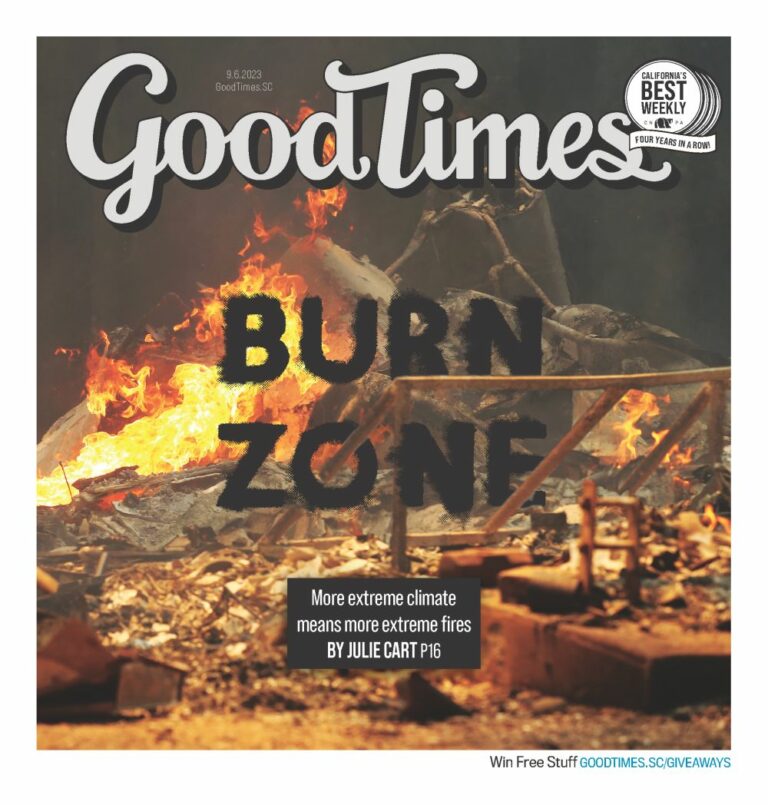
The most depressing line in our cover story was from our Governor: “We live in this new reality,” Gov. Gavin Newsom said at a recent Cal Fire event, “where we can’t necessarily attach ourselves to some of the more predictive models of the past because of a world that is getting a lot hotter, a lot drier and a lot more uncertain because of climate change.”
I’m serious here: I have no good answers. We are Good Times and as such, often try to be positive. We are also a community voice. Why don’t you let us know how you are handling this more than inconvenient truth, this devastating world change. Drop us a line and we’ll save a page for your answers.
What do you tell your kids? What are you doing to make positive change? Do you have hope and if so, why? How do you not give up? And is there any hope for the world to come together and fight this beast, like they do in science fiction movies with happy endings?
Send your thoughts. Let’s share them with the whole Santa Cruz community. Extra credit for anyone who sees something good in all this.
Good Idea
Beginning September 1, 2023, the Santa Cruz Metropolitan Transit District (SCMTD) will accept applications to fill two vacancies on its METRO Advisory Committee (MAC). Applications must be submitted by September 30, 2023 to be considered. The MAC operates in an advisory role to the SCMTD Board of Directors on policy issues related to customer service, bus operations, strategic planning and community needs, among other topics. The Committee meets quarterly and appointees serve a four year term. Please visit scmtd.com/mac to learn more or submit an application. For questions, contact METRO at (831) 426-6080 or email at ma*@***td.com.
Good Work
In light of the recent devastating wildfires that blazed across Maui, Hula’s Island Grill and Pono Hawaiian Grill locations are raising funds to support Maui victims. At Hula’s, all proceeds on Mondays through October will go to Hawai’i Community Foundation. Meanwhile, Pono is selling Mauia merch, with 100% of funds going to that same foundation. Stop by either establishments to learn more.
Santa Cruz METRO will drive you free to the Watsonville Fairgrounds for the County Fair from Sept. 13-17.
METRO has created a special route, Route 79F, that will provide free daily service to the Watsonville Fairgrounds.
Service will depart from the Watsonville Transit Center on the hour from noon – 10pm on weekdays and 10am – 10pm on weekends and will offer a return trip from the County Fair at :25 past the hour from 12:25pm – 10:25pm on weekdays and 10:25am – 10:25pm on weekends.
For more information on taking METRO to the County Fair visit https://scmtd.com/en/routes/county-fair or for details.
Photo Contest
LIGHT ON Iconic Harbor Lighthouse taken on June 27. Photograph by Ross Levoy.
Quote of the Week
“Under capitalism, man exploits man. Under communism, it’s just the opposite.” –John Kenneth Galbraith
Megan Kamalei Kakimoto’s short story collection, “Every Drop is a Man’s Nightmare,” is immersive. Each story is set in Kakimoto’s homeland Hawaii, where the sticky ocean breeze and the smell of smoke from pork cooking in the kālua linger thick in the air.
Kakimoto doesn’t shy away from anything: instead, she plunges into the uncomfortable.
Her storytelling exposes the subtle and overt consequences of colonialism on Native Hawaiians, examines the intersectionality of womanhood for women of color and reminds us how actions of the past haunt the present.
Kakimoto weaves in elements of her Native Hawaiian and Japanese roots throughout the collection. She uses Pidgin and Hawaiian language and incorporates the traditions and rituals of daily island life. She stretches the boundaries of reality by blending Hawaiian superstitions and mythology into each story, lore that plays a natural yet significant role in each characters’ life.
Her characters are diverse in experience, situation and age. But there is consistency in their complexity and the ways each must navigate womanhood and their indigenous identity on an island shrouded in colonization.
Ahead of her interview at Bookshop Santa Cruz, we sat down with Kakimoto to talk about her book.
Good Times: Hawaiian mythology and superstitions played such a huge role in your book. I loved how you used them to explore ideas of womanhood. Were there certain myths that you grew up being told that informed you of womanhood in some ways?
Megan Kakimoto: We call it mo’olelo, which is the stories and tales of our people in our culture. A lot of the female goddesses in our theology are incredibly powerful. They’re always feared and revered. And they have a lot of power. I think of Pelehonuamea in particular, who is constantly talked about and who is way more powerful than her male counterpart, and I always found that really fascinating. Especially when presented against or beside contemporary women and contemporary women’s stories. A lot of women in these stories and in my own personal life have had to wrestle with finding our identity, claiming our power and our place, living in our bodies that often have violence visited upon them by men, whether it be physical violence or emotional violence. And just that juxtaposition with these incredibly powerful and awe-inspiring goddesses in our history and culture really struck me.
GT: In one of your stories, your main character is a writer. She is having a conversation with her grandmother, who says, “don’t try too hard to make writing accessible to white people.” Throughout this book you chose to use a lot of Hawaiian words and landmarks, myths. What is it like, balancing that line between making your writing accessible to people without losing the natural flow and staying true to your culture, identity and what you want to write?
MK: It’s a very hard balance to strike. I think it helped that I tried really hard not to think about my audience, I kept it very private and very personal. I think my dream for the collection was always to have Hawaiian people and Hawaiian women especially, have their stories at the forefront, have them feel seen. And sometimes that means, you know, compromising on a little bit of accessibility for a different audience.
GT: I loved how you wrote about and incorporated food throughout your stories. It’s clearly such an important part of Hawaiian culture: the ritual of preparing the dishes, the way it brings people together, the types of cuisines.
In one of your stories, the main character feels a lot of tension around food: desiring it, being judged for wanting it. You used food to explore such a huge part of womanhood: having our bodies perceived and our own hyper-awareness of our bodies as a result, which starts at such a young age. What role did you want food to take on in your stories?
MK: Yeah, food and communal eating plays a huge role in history. It’s still a huge kind of touch point of how we come together now, a lot of local families and Hawaiian families. I was also just interested in food as its own form of desire. I feel like there’s a lot of different avenues of desire that I was interested in exploring in this piece. I also think that food often gets wrapped up in the perception of a woman’s body, and how a woman feels and belongs in her body. It can be really complicated to sort of navigate your own body under the best of circumstances when you don’t have any outside voices intruding, but I think a lot of the stories are interested in sort of how a woman has to be in her body, with that sort of noise and the intrusion of thoughts, opinions and feelings from outside people. It was a very natural tie-in to some of these other ideas of desire and consumption that I was interested in exploring.
GT: What does it mean to you to be an indigenous Hawaiian writing stories of Hawaiian life?
MK: Reclaiming space is something that I am really passionate about. There’s a lineage and a history here, I feel like it is important to hear from those people, from our own people. And the stories that are passed down to us, I think there’s all this richness in Hawaiian culture that people just don’t know about and aren’t really familiar with. I’m trying very much to focus on writing that is invested in Native Hawaiian representation and Native Hawaiian lives. My own single experience that sort of informs these stories will hopefully carve out space for more indigenous Hawaiian stories to be championed and platformed and published.
Megan Kakimoto will be at Bookshop Santa Cruz to discuss her new short story collection, “Every Drop Is A Man’s Nightmare,” on Monday, Sept. 11 at 7:00PM.
To learn more, visit: bookshopsantacruz.com/megan-kamalei-kakimoto
SURPRISE CHEF For my money, the 1970’s were one of the best times for music because every genre was exploding with new sounds, especially soul. Jazzy rhythms, funky bass lines and interstellar exploratory melodies defined ‘70s soul music with artists like Curtis Mayfield, Isaac Hayes and Earth Wind & Fire. Australian five-piece R&B group, Surprise Chef conjures these artists, along with a little Stevie Wonder “Superstition” vibes and some Latin flavors, for their mood-invoking blend of motherfunkin’ soul. This Melbourne act has been grooving since 2017 and have hit their golden stride with the last few releases over the past two or three years. MAT WEIR
KING DREAM Oakland native’s Jeremy Lyon is the man behind the psych-rock band King Dream. He celebrates the release of their latest album, Glory Daze, Vol. IV, this Thursday. King Dream delivers dive bar anthems with heart— think Bruce Springsteen-tinged lyrics with an experimental edge. Songs like “U + Me (Vs. the Human Race)” evoke the exuberance of youthful love, while also inviting the joyful chaos of an audience sing-along. JESSICA IRISH
KABAKA PYRAMID With a name that combines the Ugandan word for “King” with reference to some of the most enduring man-made structures of all time, Kabaka Pyramid aspires to nothing short of longevity, revolution and love. The Jamaican artist blends the sunny tones of reggae with the socially conscious lyricism of hip-hop to create an innovative sound. In February of this year, he won his first Grammy for Best Reggae Album for his sophomore record, The Kalling. His well-deserved, Rastafarian victory lap comes to Santa Cruz this weekend, with shows on both Friday and Saturday night. ADDIE MAHMASSANI
JULIE BYRNE Julie Byrne’s phenomenal otherworldly folk record, The Greater Wings, comes six years after her previous LP. She began work on The Greater Wings, her third record, almost immediately after Not Even Happiness, but partway through the recording, her longtime producer/collaborator/close friend Eric Littmann unexpectedly passed away. Though much of the record was written prior to Littmann’s passing, The Greater Wings feels like a meditation on his passing. And the musical arrangements are some of the best and most nuanced of Byrne’s career. The gentlest of folk songs with just the right touches of strings, harps and piano flourishings. AARON CARNES
TONY CAMIN Since its launch in 2019, DNA’s Comedy Lab has become a formidable hub for live entertainment in town, hosting hundreds of hilarious events and stoking at least a million laughs. Their Saturday series Laughternoon is going strong this fall as Tony Camin steps into the spotlight—make that sunlight—in London Nelson Park. With roots in the ‘90s Bay Area comedy scene, Camin brought some California to New York City in 2004 with his co-created off-Broadway performance The Marijuana-Logues and went on to co-host the live late-night show “Broin’ Out” via the famous Upright Citizens Brigade Theatre. AM
INFO: 4:30pm, London Nelson Park, 301 Center St., Santa Cruz. $20. 420-6177.
FILM
OCEAN FILM FESTIVAL Now in its 10th year, the Rio Theatre welcomes back the Ocean Film Festival World Tour. For the past decade this festival has been one of the leaders in independent oceanography filmmaking. This year, the two and a half hour fest will feature hand-picked films that dive into topics from the bond humans and animals can form (“Casey the Octopus”) and understanding the connection animals have with each other (“Sounds of a Generation”) to the importance of conserving the planet’s ice shelves (“In Search of a Frozen Ocean”). Sponsored by local nonprofits and companies such as Event Santa Cruz, O’Neill Wetsuits and the Good Times, a portion of this year’s ticket and beer sales will be donated to Save Our Shores. MW
INFO: 7pm, Rio Theatre, 1205 Soquel Ave., Santa Cruz. $21. 423-8209.
SUNDAY
STONER ROCK
BRANT BJORK There aren’t many more deserving of the title, “California Desert Rock Ambassador,” than Brant Bjork. As the drummer and founding member of the seminal stoner rock group, Kyuss, Brant helped put the Palm Desert scene on the map. Even after he left the band, Bjork continued to push the California, fuzzed-out stoner jam sound with Josh Homme on the latter’s Desert Sessions recordings, Mondo Generator and Stӧner with Nick Oliveri, Fu Manchu, Fatso Jetson and even had a stint in Santa Cruz playing in LAB with former B’LAST! members. Earlier this year he announced a tour with his new band, the Brant Bjork Trio featuring Fatso Jetson bassist, Mario Lalli, and Stӧner drummer, Ryan Güt. Dust off the jean vest, cause this one’s for the heshers. MW
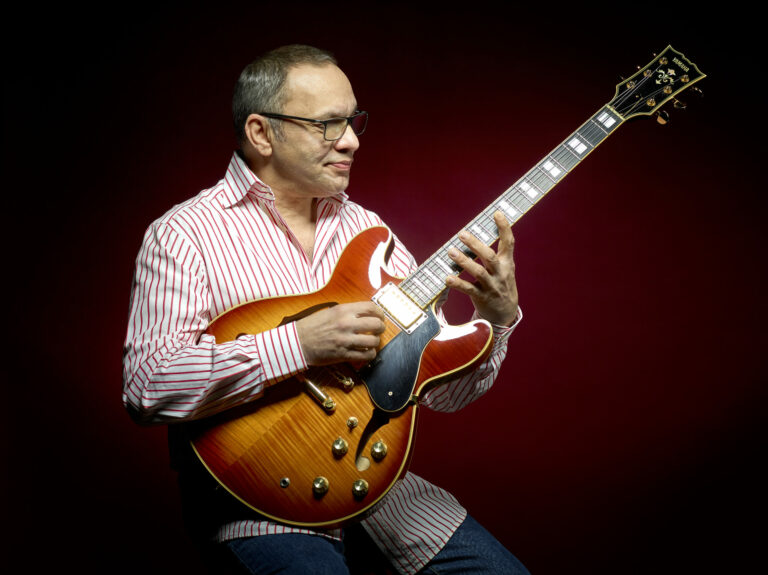
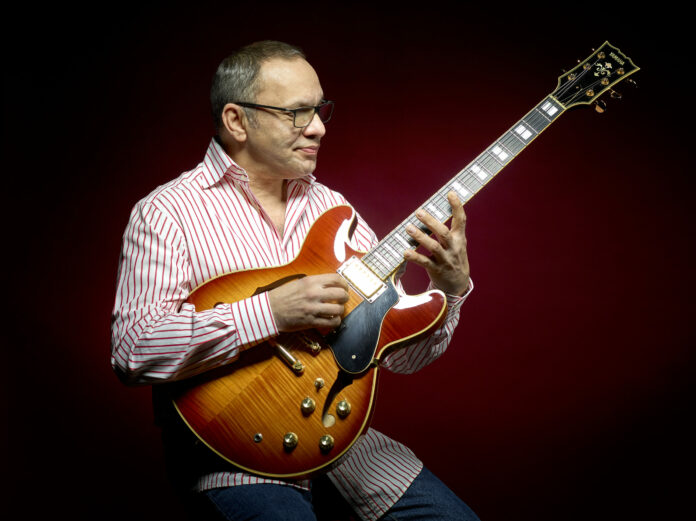
BIRÉLI LAGRÈNE & MARTIN TAYLOR At the age of seven, most people were learning their times tables. The precocious Biréli Lagrène, however, was already on his way to becoming a jazz icon, spending his days learning the improvisational guitar stylings of the mythic Romani-Belgian composer Django Reinhardt. That was approximately five decades, 26 albums and seven live concert films ago. Put shortly, the French child prodigy quickly became the globe-trotting, reigning king of Gypsy jazz guitar. This Monday, he brings his beloved fusions of swing and post-bop into musical conversation with Grammy-nominated Martin Taylor—a virtuoso jazz guitarist in his own right—for a concert for the ages. AM
INFO: 7pm, Kuumbwa Jazz, 320 Cedar St., Santa Cruz. $52.50/adv, $57.75/door. 427-2227.
TUESDAY
POETRY
THE HIVE LIVE Poetry will always have a place in Santa Cruz, which is due to all the hard work of the many people in town that care deeply about the artform. One group that should be regularly celebrated is The Hive Poetry Collective. They have a weekly show on KSQD 90.7 FM, but they also throw live events. This Tuesday, they are bringing some excellent poets to Bookshop Santa Cruz: Danusha Laméris and Laure-Anne Bosselaar. They’ve both published notable books and received much deserved acclaim for their work. AC
INFO: 7pm, Bookshop Santa Cruz, 1520 Pacific Ave, Santa Cruz. Free. 423-0900.
Question of the Week: “What does it mean to be an American today?”
A current candidate for President has claimed that if you ask a citizen “What does it mean to be an American today” you will get only a blank stare in response. Good Times decided to find out. It proved to be a thought-provoking question, but as always, Santa Cruzans had thoughts and feelings to share.
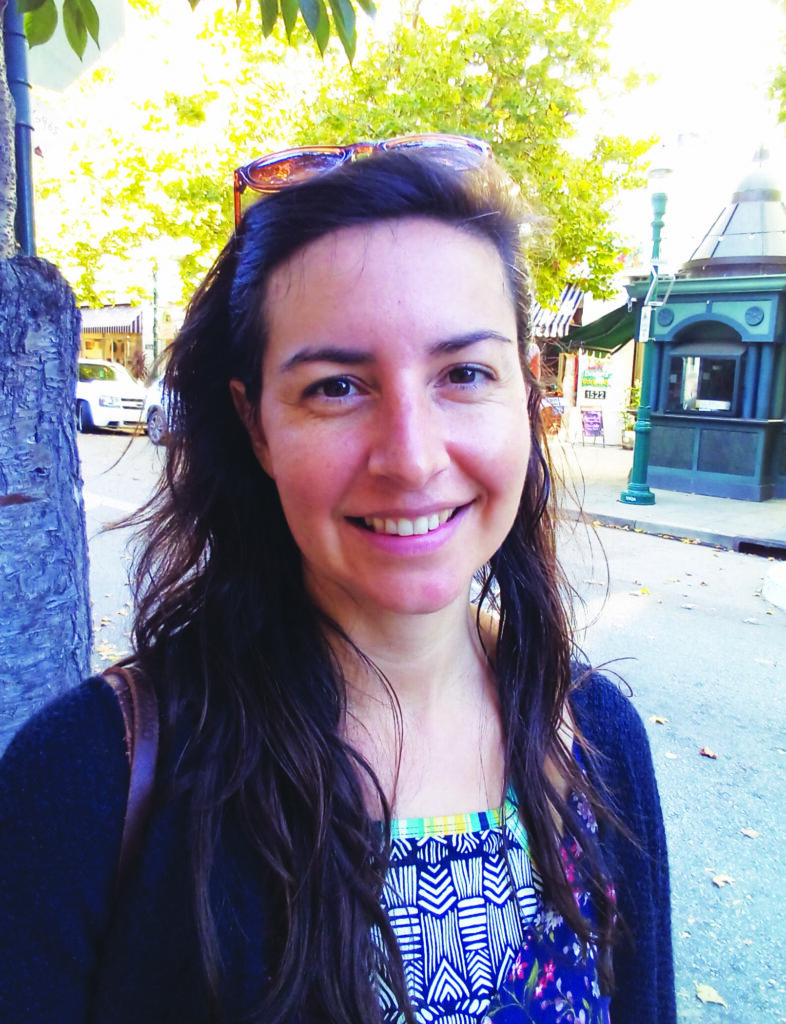
Margarita Acosta, 36, healer
“There’s a duality. Americans do amazing things to be proud of, and then there’s this legacy of the government that is really shameful. This country bombed my father’s country, El Salvador — and there hasn’t been a collective responsibility, at least not in the government.”
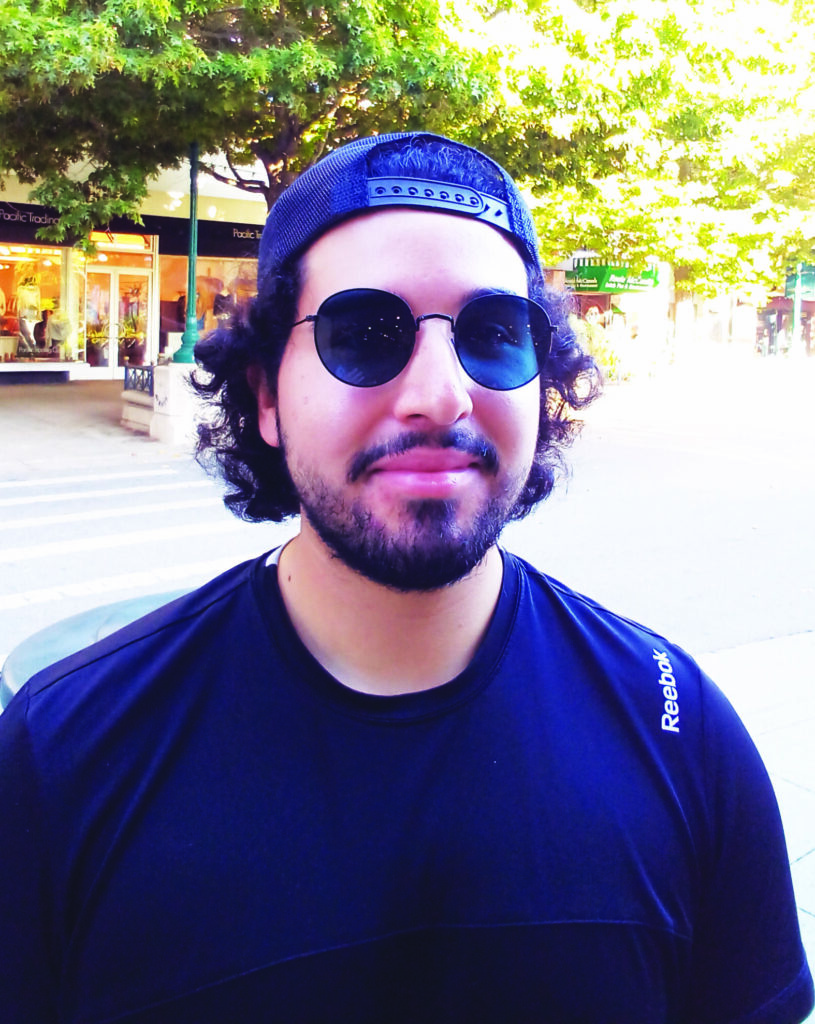
Art Mejia, 23, sales
“I’m proud to be from here, but at the same time it’s very disappointing. There’s so much conflict going on and people are focusing on the wrong things. But at the end of the day, I’m proud because it’s still my home and I want to see my people succeed. I’m really praying for things to get a lot better.”
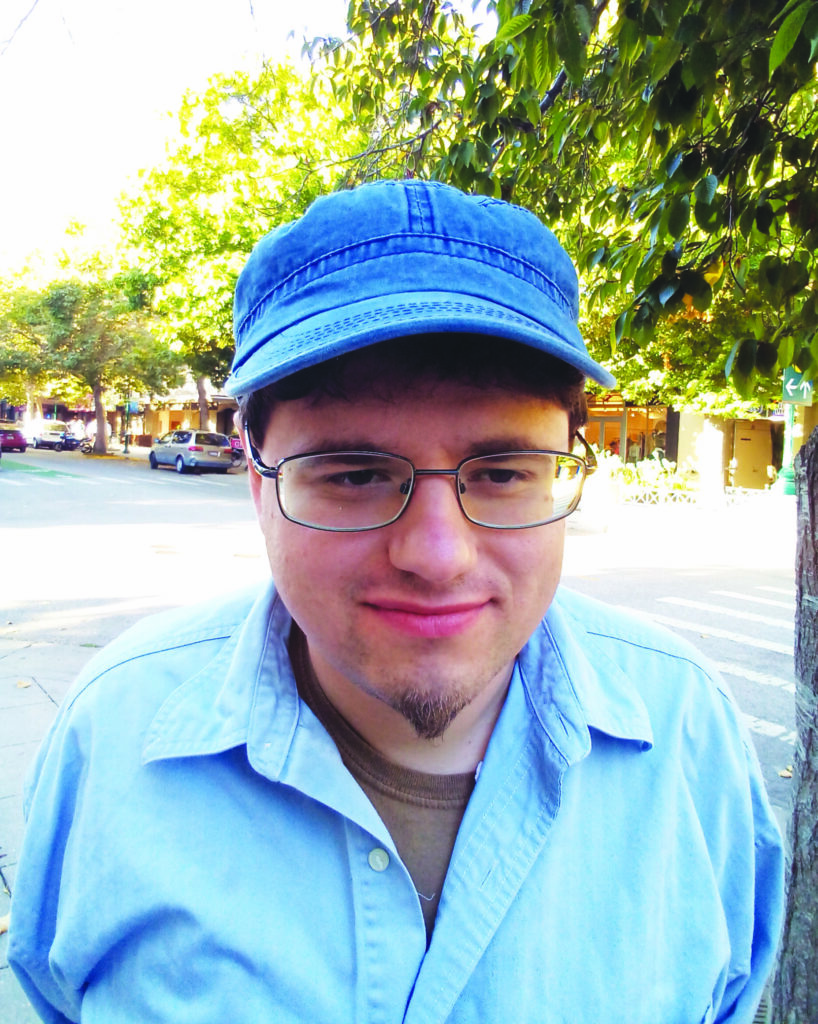
Andrew Kahn, 28, social worker
“It means having a sense of hopeful weariness. Hoping for the best but preparing for the worst.”
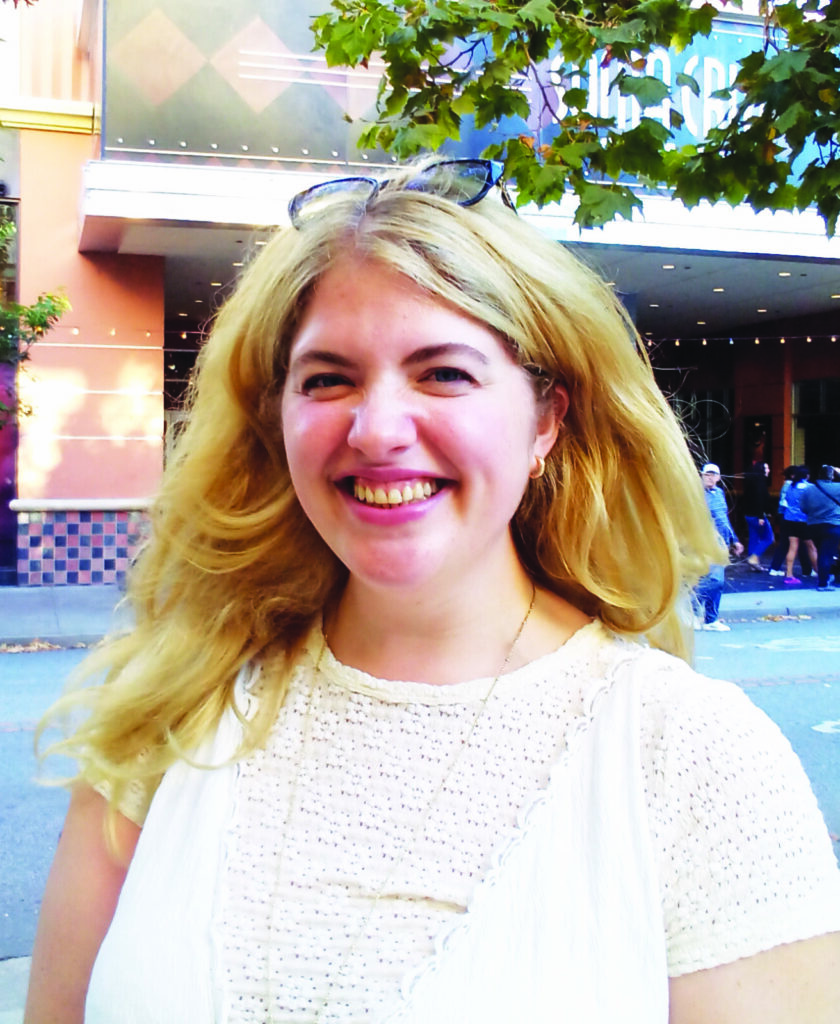
Riley Rhynes, 25, student
“Being American means we support each other. Freedom for all as long as you’re not hurting anybody. Just the foundation, the actual meaning of what being an American is. That is how I live, and how I hope.”
Phil Alfredo, 53, painter
“Being American means you have the opportunity to make a better life and do many things. You go step by step and find opportunities to make your life better.”
Franklin Kuit, 29, chef
“I’m not proud to be an American when it means supporting imperialism in the Congo where people die mining cobalt and lithium for Teslas and iPhones. What the founding fathers intended, limited government, power to the people, doesn’t exist now. We get comforts but lose freedoms, and don’t realize we’re lambs in the chute. Lambs fear the wolf, and don’t realize it’s the shepherd that will eat them.”
Psilocybin legalization may be right around the corner with new ballot measure
It’s becoming more likely that California voters next year will get to decide whether to legalize psilocybin—“magic mushrooms”—the same way they voted on cannabis legalization in 2016 when they approved Prop. 64.
The state attorney general’s office has approved the language for a measure to appear on the ballot in November 2024 that would legalize the possession and sale of psilocybin for adults 21 and over. It would also create a framework for the regulated use of the substance in therapeutic settings. Now, advocates must gather enough signatures to actually get the measure before voters.
This would be at least the third such attempt to do so, but it will be a bit easier this time thanks in part to voter apathy: the number of signatures needed is based on voter turnout in the previous general election. This time, advocates must collect 546,651 signatures, or 76,561 fewer than last time, when about 2 million fewer voters showed up to cast ballots in the most recent general election in 2022. That was when Gavin Newsom retained the governorship, beating out Republican Brian Dahle. The turnout wasn’t surprising, given that few people had even heard of Dahle and everybody was fatigued by the previous year’s insane recall vote.
The main advocate for the ballot measure is Decriminalize California, which has attempted, and failed, twice before to collect enough signatures to get such a measure before voters. The group is much more optimistic this time around, according to campaign director Ryan Munevar. In a newsletter statement announcing the attorney general’s approval of the ballot measure, Munevar cited the Covid pandemic as the main reason for the effort falling short in 2021 and 2022.
“Now that the plague is over we can take advantage of all the summer festivals and fully activate our college teams for tabling days when they are back in session in late August and September,” Munevar wrote. Advocates have until Jan. 10 to collect the needed signatures.
The measure would also seal the criminal records of people with past psilocybin-related convictions. It would create an “independent professional certifying body,” according to the attorney general’s language, to oversee therapeutic use of psilocybin in healthcare settings.
Unlike with cannabis, there would be no possession limit. Sales would be allowed in retail settings, at public events and at farmers’ markets, “whether or not for profit.” Also, unlike with cannabis, there would be no state taxes imposed and local governments could restrict sales only if such restrictions were approved by local voters. Psilocybin used for regulated therapeutic purposes would not be taxed.
The California Assembly, meanwhile, is considering a bill, which passed the Senate last spring, to legalize a range of psychedelics including psilocybin, DMT, ibogaine and mescaline. In a move that surprised even the bill’s sponsor, Scott Wiener, a Democrat from San Francisco, the Assembly’s Health Committee passed the measure last week in a 9-2 vote.
The momentum behind legalizing psychedelics is building, especially in California. The Berkeley City Council last week voted to deprioritize enforcing laws against psychedelics, mirroring similar moves by Oakland, San Francisco and Santa Cruz.
“Research shows that these substances can have significant benefits particularly for people experiencing mental health and addiction challenges,” Wiener told the Assembly Health Committee just before it voted to pass the measure along. “This research started in the 1960s and unfortunately, it was completely shut down by the war on drugs. Over the last decade, the research has started again and it is extremely promising.”
In the lead-up to the legalization of weed, the liquor business generally sided with the prohibitionists. In 2011, the California Beer and Beverage Distributors donated to the effort to oppose the first—failed—voter initiative to legalize weed in California. In 2016, similar groups opposed legalization efforts in states like Arizona and Massachusetts, as well as California.
Right around that same time, big liquor and beer companies warned investors that the burgeoning legal-pot industry might pose a threat. This approach might appear to make sense: pot and booze seem like they’re natural competitors. But, of course, that’s not really true—lots of people use both at the same time.
As the years passed and it became more obvious that legal pot wasn’t hurting liquor sales, the booze industry began tempering its messages. It began going beyond simply accepting the situation by asking, “how can we get in on this?”
Some beer and liquor companies are introducing cannabis-infused beverages, or are acquiring makers of them. Just last month, cannabis giant Tilray expanded its beer portfolio by purchasing eight “craft” beer brands from Anheuser-Busch, including well-known names like Redhook and Widmer Brothers.
NORML, the leading advocate for legal weed, issued a warning in 2021. Liquor, tobacco and other industries now lobbying on cannabis issues “have pushed for statewide limits on the number of licensed cannabis producers and retailers, in an effort to keep prices and supply artificially limited,” NORML pointed out. The organization believes in “the right to personal cultivation and mandates low barriers of entry to the cannabis market so that every American who wishes to benefit from legalization can do so.”
Last month, the law firm Feuerstein Kutrick warned that the highly concentrated liquor business might want to pattern the cannabis industry after itself. “At a minimum,” it noted, “a shift towards a regulatory structure that more closely resembles the alcohol industry would change the paradigm for a cannabis industry that has developed in a decentralized manner (out of necessity) over the past several decades.”
The question now is: is the cannabis industry willing to play along with Big Booze?
Cal Fire Battalion Chief Jon Heggie wasn’t expecting much to worry about when a late summer fire erupted north of Santa Cruz, home to California’s moist and cool “asbestos forests.” This place doesn’t burn, he thought, with just three notable fires there in 70 years...But that 2020 fire was anything but predictable.
Kudos to GT for publishing the fascinating article by Richard Stockton, “Horse Therapy Rules”, which was published in the Aug. 15 issue. It was an enlightening article which addressed serious subjects such as depression, anxiety, PTSD and how building trust and bonding during close encounters with horses has helped people heal.
When I saw the movie “An Inconvenient Truth” in 2006, about global warming, climate change or the worst horror in the world, depending on your choice of words, I thought, “It can’t happen here. We’ll figure a way out of it.” Now, I’m reading a cover story about devastating fires, while looking out windows everywhere I go or where my friends and family live, and seeing a devastating truth. It’s happening.
At the age of seven, most people were learning their times tables. The precocious Biréli Lagrène, however, was already on his way to becoming a jazz icon, spending his days learning the improvisational guitar stylings of the mythic Romani-Belgian composer Django Reinhardt. That was approximately five decades, 26 albums and seven live concert films ago.
A current candidate for President has claimed that if you ask a citizen “What does it mean to be an American today” you will get only a blank stare in response. Good Times decided to find out. It proved to be a thought-provoking question, but as always, Santa Cruzans had thoughts and feelings to share.
It’s becoming more likely that California voters next year will get to decide whether to legalize psilocybin—“magic mushrooms”—the same way they voted on cannabis legalization in 2016 when they approved Prop. 64.
In the lead-up to the legalization of weed, the liquor business generally sided with the prohibitionists. In 2011, the California Beer and Beverage Distributors donated to the effort to oppose the first—failed—voter initiative to legalize weed in California.